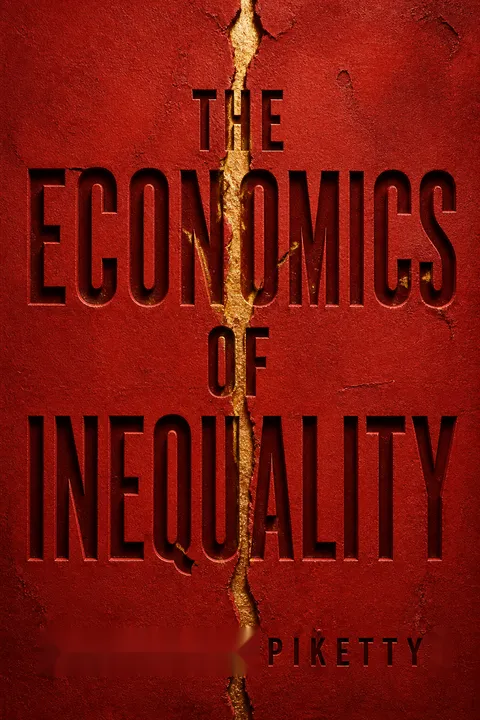

Key Takeaways
1. Inequality is Multifaceted, Dynamic, and Not Always Declining.
The Kuznets curve is thus not the “end of history” but the product of a specific—and reversible—historical process.
Beyond simple divides. Inequality is not a static concept, nor is it solely about the rich versus the poor. It encompasses disparities in wages, capital income, and employment opportunities, varying significantly across countries and over time. For instance, the P90/P10 ratio (the income of the top 10% compared to the bottom 10%) can range from 2.0 in Norway to 5.9 in the United States, highlighting vast differences even among developed nations.
Historical shifts. The 20th century saw a significant decrease in inequality in Western countries, leading economist Simon Kuznets to propose an "inverted U" curve, suggesting inequality would naturally rise during industrialization and then fall. However, this trend reversed in the 1980s, with inequality increasing in many advanced economies, particularly in the US and UK. This reversal demonstrated that historical reductions in inequality were not "natural" economic processes but rather consequences of specific historical shocks (like wars and depressions) and institutional changes (like progressive taxation).
Employment as a key factor. Beyond income and wealth, inequality in employment has become a critical dimension. While some countries show high unemployment rates, others, like the US, exhibit significant underemployment, where less-skilled individuals withdraw from the labor market or are incarcerated. This suggests that official unemployment statistics often mask a deeper problem of labor market exclusion, making cross-country comparisons complex and highlighting the need to consider various forms of labor market disadvantage.
2. Fiscal Redistribution Generally Outperforms Direct Intervention.
Regardless of the amount of redistribution desired, fiscal redistribution is preferable to direct redistribution in a market economy where capital-labor substitution is possible.
Efficiency in redistribution. A core economic argument posits that fiscal redistribution, achieved through taxes and transfers, is generally more efficient than direct redistribution, which involves manipulating market prices (e.g., setting strict wage schedules or nationalizing industries). Fiscal methods allow for income reallocation without distorting the price signals that guide firms' decisions on how much capital and labor to employ. This preserves the allocative role of the price system, ensuring resources are used optimally.
Avoiding unintended consequences. When direct redistribution attempts to increase wages or reduce capital's share by force, it can lead to unintended negative consequences. For example, if wages are artificially raised, firms might substitute capital for labor, leading to job losses. Conversely, fiscal redistribution, by taxing profits or high incomes to fund transfers or tax breaks for low incomes, can achieve the same redistributive goal without directly altering the cost of labor or capital for firms, thus avoiding such distortions.
The "fiscal incidence" matters. The effectiveness of fiscal redistribution depends on how taxes are structured and who ultimately bears their burden. It's not enough to look at who officially pays a tax; the "fiscal incidence" – where the tax ultimately lands – is crucial. For instance, increasing social charges on employers often translates into lower wages for workers in the long run, rather than coming out of capital's profits, demonstrating that the design of the tax, not just its label, determines its true redistributive impact.
3. Capital's Share of Income is Stable Long-Term, Yet Volatile Short-Term.
Indeed, Table 2.1 shows that the respective shares of profits and wages in the national income of three countries with very different histories, particularly in regard to social matters, remained more or less constant: the wage share never fell below 60 percent and never rose higher than 71 percent, generally hovering around 66–68 percent, and it is impossible to detect any systematic upward or downward trend.
A historical regularity. For over a century, across diverse Western economies, the division of national income between capital (profits) and labor (wages) has shown remarkable long-term stability, with capital typically receiving about one-third and labor two-thirds. This constancy, observed from the late 19th century through the late 20th century, suggests that the massive increases in workers' purchasing power over this period were primarily due to overall economic growth and increased productivity, rather than a fundamental shift in the capital-labor split.
Short-term political dynamics. Despite this long-term stability, the capital-labor split can exhibit significant variations over shorter periods, often reflecting political and social struggles. In France, for example, the wage share increased by over 5% of national income between 1970 and 1982 due to strong social movements and minimum wage hikes, only to fall by 10% between 1983 and 1995 as wage growth stagnated. These short-term fluctuations, though not altering the century-long average, profoundly impact the living standards of generations and shape political perceptions of redistribution.
The Cobb-Douglas approximation. Economists often explain this long-term constancy using the Cobb-Douglas production function, which implies an elasticity of substitution between capital and labor close to one. This means that as the relative price of labor or capital changes, firms adjust their usage of these factors in a way that keeps their respective shares of total income constant. Microeconomic studies generally support this, indicating that firms do adjust their hiring and investment decisions based on relative costs.
4. Labor, Not Capital, Bears the Burden of Social Charges.
It is therefore clear that social charges are not paid out of capital income.
The illusion of shared burden. Modern social protection systems, particularly in Europe, are often financed through social charges (payroll taxes) paid by both employers and employees, with the implicit intention of sharing the cost between capital and labor. However, empirical evidence consistently shows that employer-paid social charges do not reduce capital's share of income. Instead, they are ultimately absorbed by labor, either through lower wages or reduced employment opportunities.
Fiscal incidence in action. This phenomenon, known as fiscal incidence, demonstrates that the economic burden of a tax does not necessarily fall on the party legally responsible for paying it. For example, countries like Denmark finance generous social protection entirely through income tax, with no payroll tax, yet their labor share of value added is comparable to France, which has high employer-paid social charges. This indicates that the total cost of labor to firms remains similar, regardless of how it's broken down into wages and social contributions.
Implications for redistribution. The fact that labor bears the full cost of social charges means that these systems, while crucial for redistributing income among workers (e.g., from active workers to retirees, or from healthy to sick), do not achieve redistribution from capital to labor. To genuinely shift income from capital to labor, direct taxation of capital (e.g., through profit taxes or wealth taxes) is required. This understanding is vital for designing effective redistributive policies that achieve their intended goals.
5. Human Capital Differences Drive Significant Wage Inequality.
The fact that the average wage in the developed countries in 1990 was ten times what it was in 1870, as noted in Chapter 1, cannot be explained solely by the fact that workers in 1990 were so much more skilled than in 1870 that they could produce ten times more in the same period.
Productivity and skills. The most straightforward explanation for wage inequality is the human capital theory: individuals possess different skills, education, and experience, leading to varying productivity and thus different wages. This theory helps explain large historical increases in average wages (e.g., a tenfold increase in developed countries since 1870) and significant international wage gaps (e.g., between developed and less-developed nations, partly due to literacy rates).
Supply and demand dynamics. Changes in the relative supply and demand for different types of human capital can also explain shifts in wage inequality over time. For instance, the wage gap between skilled and unskilled workers in the UK fluctuated significantly in the 19th century due to industrial mechanization increasing demand for skilled labor and rural exodus increasing the supply of unskilled labor. Similarly, in the US, the "return" to education (the wage premium for higher degrees) decreased in the 1970s when the supply of educated workers surged, then rose in the 1980s as demand outpaced supply.
Beyond observable skills. While human capital theory is powerful, it doesn't fully explain all wage inequality. A significant portion of wage disparities occurs within groups of workers with similar observable characteristics (education, experience). This suggests that unobservable individual qualities, the uneven quality of education, or "skill-biased technological change" (where new technologies favor specific, often unequally distributed, talents) play a role. However, relying too heavily on unobservable factors risks making the theory tautological.
6. Credit Market Imperfections Perpetuate Wealth Inequality.
As the French saying has it, “on ne prête qu’aux riches” (one lends only to the rich).
The myth of perfect credit. Standard economic growth models assume perfect credit markets, where capital flows efficiently to the most profitable investment opportunities, regardless of the borrower's initial wealth. This implies that initial wealth inequalities should diminish over time as the poor borrow to invest and catch up. However, real-world evidence, such as the lack of massive capital flows from rich to poor countries and the persistence of wealth disparities, contradicts this ideal.
Information asymmetry and collateral. The core problem lies in credit market imperfections, driven by information asymmetries (adverse selection and moral hazard). Lenders struggle to accurately assess project profitability or ensure borrowers will repay, especially for long-term investments. To mitigate this risk, lenders often demand collateral, effectively limiting borrowing capacity to those who already possess wealth. This creates a vicious cycle where the poor cannot access capital for profitable investments, perpetuating inequality.
Inefficient outcomes. This "lending only to the rich" phenomenon is not just unjust but also economically inefficient. It prevents potentially profitable investments by capital-poor individuals or countries, leading to a suboptimal allocation of resources and slower overall growth. Public interventions, such as development banks or agrarian reforms, have shown success in specific contexts (e.g., micro-loans to peasants), demonstrating that targeted capital redistribution can unlock productivity gains that private markets fail to achieve.
7. Social Dynamics and Institutions Shape Labor Income Distribution.
In short, inequalities based on rank discrimination, such as between people of color and whites or men and women, are much more susceptible to remedy by affirmative action and changes in mentality than by any kind of fiscal redistribution.
Beyond pure market forces. Wage inequality is not solely determined by individual human capital and market supply/demand. Social dynamics and institutional factors play a crucial role, often leading to inefficient outcomes. Discrimination, for instance, can create self-fulfilling prophecies where employers' prejudices lead to lower human capital investment by discriminated groups, perpetuating inequality.
The role of unions. Labor unions, despite being criticized for creating market distortions, can significantly influence wage structures. They often fight for wage compression, reducing the gap between high and low earners, and can act as substitutes for fiscal redistribution when the state fails to address perceived injustices. In some cases, unions can even promote efficiency by establishing binding wage schedules that encourage firm-specific human capital investments, as seen in German apprenticeship systems.
Employer power and national traditions. Employers can also exert "monopsony power" in local labor markets, forcing wages below competitive levels, particularly for less mobile, low-skilled workers. This justifies minimum wage legislation as an efficient redistributive tool. Furthermore, national traditions and societal perceptions of meritocracy, like France's "republican elitism" which overestimates the productivity differences of elite graduates, can entrench wage inequalities that are not solely based on objective human capital.
8. High Marginal Tax Rates at the Bottom Create "Poverty Traps."
In other words, the prospect of earning a decent living seems to be more of an incentive for low-income people than the prospect of a still-higher income for those who are already well off: “poverty traps” are likely to be more important than “middle-income traps.”
The U-shaped curve of disincentives. While much political debate focuses on the disincentive effects of high marginal tax rates on top earners, empirical evidence suggests that the highest effective marginal rates often fall on low-income individuals transitioning from unemployment to work. This creates a "U-shaped curve" where marginal rates are high at both the very bottom and very top of the income distribution, but often lower in the middle.
The "poverty trap" mechanism. For an unemployed individual receiving social benefits, taking a low-wage job can result in a minimal increase in disposable income, as new earnings are offset by taxes and the loss of benefits. This can lead to effective marginal tax rates of 80-90% or even more, significantly discouraging labor market entry. This "poverty trap" is a major barrier to employment for the least well-off, making the prospect of earning a decent living less attractive than remaining on benefits.
Lessons from the EITC. The Earned Income Tax Credit (EITC) in the United States offers a compelling example of how reducing marginal rates at the bottom can stimulate employment. By providing a refundable tax credit that supplements low wages, the EITC effectively creates a negative marginal tax rate for very low earners, increasing their disposable income and making work more attractive. Studies have shown significant positive effects on labor supply among the target population, suggesting that flattening the initial portion of the U-curve is a crucial strategy for efficient redistribution and job creation.
9. Social Insurance Corrects Market Failures, But Can Be Anti-Redistributive.
In other words, pension payments redistribute upward: a substantial portion of the payroll tax paid by workers goes to finance the pensions of top managers.
Addressing market imperfections. Social insurance programs (unemployment, health, pensions) are often justified as efficient redistribution mechanisms because they address inherent market failures. Private markets struggle to provide adequate insurance due to adverse selection (individuals having private information about their risk) and moral hazard (individuals altering behavior after being insured). Compulsory public systems can overcome these issues, providing essential services that private markets cannot efficiently deliver.
Redistribution through in-kind benefits. Public expenditures on health and education represent significant forms of redistribution, often providing lump-sum benefits (e.g., free schooling, universal healthcare) financed by proportional or slightly progressive taxes. These "in-kind" transfers can substantially improve the living standards of low-income individuals, even if direct monetary transfers between active workers are minimal. For example, a minimum-wage worker in France benefits significantly more from public health and education than their US counterpart, who faces substantial private costs.
The paradox of pensions. While social insurance aims to protect vulnerable populations, not all programs are inherently redistributive. Public pay-as-you-go pension systems, for instance, often redistribute upward. Because high-income workers typically have longer life expectancies, they receive pension payments for a longer period, effectively benefiting more from their contributions than lower-income workers. This highlights the complexity of social insurance, where a system designed to correct market failures can inadvertently exacerbate certain inequalities.
10. The Pursuit of Pure Redistribution Remains Essential.
Although it is essential to identify efficient redistribution wherever it exists, it is pointless to denounce every inequality as a sign of gross inefficiency that the right policy can eliminate.
Beyond efficiency arguments. While identifying and implementing efficient redistribution (correcting market failures like discrimination or credit rationing) is crucial, not all inequality can be attributed to inefficiency. Some disparities may arise from market forces that are, in an economic sense, "efficient" (e.g., high wages for highly productive individuals in a competitive market). In such cases, the justification for redistribution shifts from economic efficiency to pure social justice, guided by principles like the maximin principle (maximizing the well-being of the least well-off).
The limits of "solving everything." It is a mistake to assume that every inequality is a "gross inefficiency" that can be eliminated by the "right policy" without any cost. Overstating the efficiency gains of redistribution can be counterproductive, as it risks delegitimizing the necessary taxes and transfers required for pure redistribution. For example, while Keynesian demand management can stimulate the economy, its long-term redistributive effects are often complex and can have unintended consequences, such as increasing public debt.
The enduring need for transfers. Ultimately, even if all market imperfections were addressed, some level of income and wealth inequality would persist due to factors like inherited endowments, luck, or differing individual preferences. Fiscal transfers, funded by progressive taxation, remain indispensable tools for attenuating these very real inequalities in living standards. The challenge lies in designing these systems to be as effective as possible, minimizing disincentive effects, and ensuring they genuinely benefit those most in need.
Review Summary
The Economics of Inequality receives mixed reviews, averaging 3.65/5 stars. Readers appreciate Piketty's accessible exploration of income inequality and redistribution mechanisms, noting it as a precursor to his famous Capital in the Twenty-First Century. Many find it technically dense and challenging for non-economists, with dry prose possibly due to translation from French. Positive reviews praise the data-driven approach and balanced analysis of fiscal versus direct redistribution. Critics cite excessive brevity, lack of real-world examples, and dated content. Several readers recommend it for understanding inequality's economic foundations, though some found it too academic or technical for general audiences.
People Also Read








About the Author




Download PDF
Download EPUB
.epub digital book format is ideal for reading ebooks on phones, tablets, and e-readers.








































