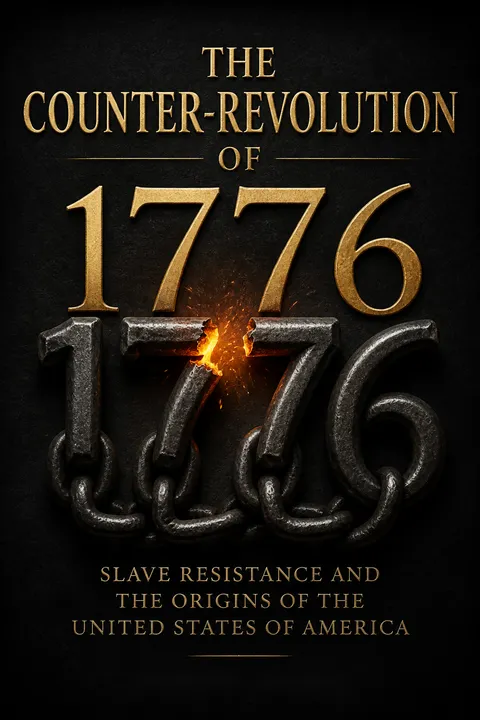

Key Takeaways
1. The American Revolution as a Counter-Revolution of Slavery
To the extent that 1776 gave such slavery a renewed lease on life, it was truly a lineal ancestor of 1861 and, thus, a counter-revolution of slavery.
A different narrative. The conventional narrative of the American Revolution often portrays it as a noble quest for liberty, a "great leap forward for humanity." However, this book argues that for enslaved Africans, 1776 represented a "counter-revolution," a decisive move by colonists to preserve and expand the institution of slavery against a growing abolitionist tide in Great Britain. The celebrated pursuit of "independency" by Euro-American settlers was inextricably linked to their determination to maintain and control their vast human property.
Economic imperative. Slavery was not a peripheral issue but permeated colonial North America, underpinning its pre-1776 economy in agriculture, insurance, banking, and shipbuilding. The immense fortunes generated by enslaved labor fueled the colonists' desire for greater autonomy, allowing them to chafe under London's rule and pursue economic arrangements that benefited them, even if it meant trading with Britain's rivals. This economic engine, powered by enslaved Africans, became a central point of contention between the colonies and the metropolis.
Legacy of oppression. The outcome of 1776, far from liberating all, cemented a caste-like status for Africans for decades to come. While London was moving towards abolition, the newly formed United States supplanted Britain as a kingpin of the global slave trade. This foundational "design flaw" meant that the ongoing persecution of African Americans was not accidental but a continuing expression of what befalls those defeated in bloody warfare, subjected to heinous collective punishment.
2. Slave Resistance as a Primary Catalyst for Colonial Migration and Anxiety
Their resistance helped to drive settlers from the Caribbean to the mainland, particularly in the years leading up to 1776.
Caribbean crucible. Fierce and frequent slave resistance in the Caribbean, particularly in islands like Jamaica and Antigua, created riotous instability that threatened the entire colonial project there. Massive slave uprisings, often involving Africans straining to assert themselves forcefully, made London more susceptible to abolitionist arguments due to the high expenditure of "blood and treasure" required to maintain control. This unrest directly led to a significant migration of anxious European settlers and their enslaved Africans from the Caribbean to the North American mainland.
Mainland anxieties. This "great trek" to the mainland, while offering more expansive land, did not eliminate the problem of slave rebelliousness. Instead, it transferred the volatile issue northward, intensifying anxieties among mainland settlers who now faced a growing, restive African population. Reports of plots and conspiracies by the enslaved, often involving poisoning, murder, and arson, rose sharply, creating a "yawning deficit of trust" between Africans and Europeans.
"Intestine" enemies. Colonists increasingly referred to their principal labor force as "intestine" enemies, a deadly threat that could not be easily expelled or digested. This pervasive fear of internal revolt, combined with external threats from rival European powers, forced settlers to expand their base of support by incorporating previously disfavored European groups (like Irish and Scots) into an evolving "racial" category of "whiteness," offering them land and rights in exchange for unity against the perceived "black" threat.
3. The Glorious Revolution (1688) Unleashed a Catastrophic Slave Trade
The year 1688, with its simultaneous launching of vast economic transformation—particularly in North America—and a riotous instability driven by enslavement, is the hinge moment in the creation of what is now routinely referred to today as modernity.
Deregulating human flesh. The so-called Glorious Revolution of 1688, while seen as a step forward for European liberty, was catastrophic for Africa and Africans. It weakened the monarchy's control over the slave trade, leading to the ascendancy of a rising merchant class and the entry of "private" or "separate" traders into this "frenziedly lucrative business." This deregulation ignited a "quantum leap" in the slave trade, dramatically increasing the number of Africans forcibly transported across the Atlantic.
Capitalism's dark engine. This surge in slave imports immensely developed the economy of the Americas, particularly on the mainland, and fueled the takeoff of nascent capitalism. The spectacular profits generated by this "free trade" in Africans enriched a new class of merchants and planters, who then chafed under London's rule, especially when the Crown sought to regulate their commerce or impose taxes. This economic transformation, however, came at an unimaginable human cost, marking a "world historic defeat for Africa and Africans."
Unintended consequences. The massive influx of enslaved Africans, while boosting colonial wealth, also engendered "ever more angry resistance." Accounts of shipboard insurrections became more common, raising doubts about the entire American enterprise and contributing to a nascent abolitionist movement in Britain. This growing instability and the moral questions it raised further complicated the relationship between the colonies and the metropolis, setting the stage for future ruptures.
4. Rival European Powers Exploited Slave Unrest, Intensifying Colonial Insecurity
As London jousted with Madrid in the Americas, both came to rely upon armed Africans, and this crucial factor, along with the substantial resources that had to be expended in order to maintain a slave system, inexorably helped to spur a nascent abolitionist movement.
Strategic alliances. Competing colonial powers, notably Spain and to an extent France, actively aided and abetted slave resistance in British North America. Madrid, in particular, offered liberty and protection to enslaved Africans who deserted from British soil, often incorporating them into its military forces in Spanish Florida and Cuba. This created a constant "Achilles' heel" for British mainland colonies, especially South Carolina and Georgia, which faced the dual threat of internal slave revolt and external invasion by Spanish forces bolstered by armed Africans.
"Cleanest dirty shirt." For many enslaved Africans, Spain, despite its own history of slavery, offered a comparatively "cleaner dirty shirt" than British rule. Spanish policy, which included the formation of African militias and the promise of freedom for converts to Catholicism, provided a powerful incentive for flight and rebellion. This dynamic forced London to expend "substantial resources" to maintain its slave system and, paradoxically, pushed the Crown towards considering its own reliance on armed Africans, a policy deeply unsettling to its colonists.
A "Black Scare." The constant threat of Spanish-backed slave insurrections fueled a pervasive "Black Scare" among British settlers. This fear was not unfounded, as evidenced by events like the Stono Uprising (1739) and the New York Conspiracy (1741), both of which were perceived to have Spanish involvement. This perceived alliance between European rivals and enslaved Africans became a potent factor in driving colonists towards "independency," as they increasingly viewed London as either unable or unwilling to protect their slave property.
5. Georgia: A Failed "White" Firewall Against Slavery and Spanish Influence
The crucial turning point for North America—and arguably, the British Empire as a whole—emerged in 1688 with the so-called Glorious Revolution, which, inter alia, caused the monarchy to retreat and led to the ascendancy of a rising class of merchants.
A utopian vision. The colony of Georgia was founded in 1733 with the explicit aim of creating a "white" pro-slavery wall, a slave-free buffer between the slave-heavy South Carolina and Spanish Florida, which actively encouraged slave defections. Its founder, James Oglethorpe, envisioned a colony of industrious European settlers who would serve as a military bulwark against Spanish incursions and African unrest, without the perceived dangers of enslaved labor.
Economic realities. This utopian vision quickly crumbled under the weight of economic realities. Settlers in Georgia, observing the immense wealth generated by slave labor in neighboring South Carolina, clamored for the right to own slaves. They argued that European laborers could not withstand the "hot climate" or compete with the lower costs of enslaved Africans, who could "endure this climate without any clothes" and were cheaper to feed. The "gravitational pull" of slave-driven prosperity proved irresistible.
A poisoned chalice. Despite Oglethorpe's strenuous objections and warnings that allowing slavery would "immediately destroy" the colony by encouraging defections to Spanish Florida, Georgia eventually yielded. By 1750, the ban on slavery was lifted, and enslaved Africans poured into the province. This transformation turned Georgia from a supposed firewall into a "transmission belt" for Spanish thrusts, placing London's settlements even closer to armed brigades of Africans and exacerbating the very security problems it was designed to solve.
6. Escalating Slave Conspiracies and Violence Fueled Settler Paranoia
Portraying the Africans as bit players supporting a revolt in 1776 dominated by Europeans—as the uplifting narrative tends to do—not only distorts and caricatures the historical record but also obscures a trust deficit that may still be of relevance today.
A climate of fear. The accelerating slave trade and the increasing number of enslaved Africans on the mainland led to a dramatic rise in slave conspiracies, acts of arson, poisonings, and murders of slaveholders. Events like the New York Conspiracy of 1741, where fires illuminated Manhattan and Spanish-speaking Africans were implicated, and the Stono Uprising of 1739, which resulted in the massacre of dozens of settlers, instilled deep-seated paranoia and a pervasive "trust deficit" among the European population.
Poison as a weapon. Poisoning, in particular, became a recurring and terrifying form of resistance. African herbalists, possessing knowledge of lethal botanical poisons, were accused of administering them to slaveholders, leading to widespread hysteria and brutal executions by burning, hanging, and gibbeting. This clandestine form of warfare was especially unsettling because it was difficult to detect and control, further fueling settler demands for ever more draconian slave codes.
"Intestine" enemies. The constant threat of internal subversion, often perceived as being instigated by external European rivals, solidified the image of Africans as "intestine enemies." This pervasive fear led to legislative responses that sought to pulverize Africans while simultaneously, and paradoxically, considering arming them for defense against foreign invaders. This contradictory approach highlighted the profound insecurity inherent in a society built on mass enslavement, a fear that would ultimately be leveraged by rebels against London.
7. The Seven Years' War: A Pyrrhic British Victory That Empowered Colonial Rebellion
The 1756 war, however it turned out, was unlikely to reverse this dim picture, as even a victory simply delivered a further disaster.
A costly triumph. The Seven Years' War (1756-1763), also known as the French and Indian War, resulted in a decisive British victory, ousting Spain from Florida (and briefly Cuba) and France from Quebec. This triumph, however, proved to be a "catastrophic victory" for London. By removing the immediate external threats to the mainland colonies, it inadvertently emboldened settlers, who now felt less dependent on British military protection and more free to pursue their own interests, including westward expansion and unrestricted slave trade.
Colonial disloyalty. Throughout the war, mainland settlers displayed a "noticeable dearth of enthusiasm" for fighting abroad, often deserting, mutinying, or engaging in "illicit and pernicious trade" with Britain's French and Spanish enemies. This double-dealing, driven by the "stupendous profits" of slave-driven capitalism, infuriated London and exposed a fundamental misalignment of interests. The Crown's increasing reliance on armed Africans during the war, particularly in campaigns like the siege of Havana, further alienated colonists who viewed such policies as a threat to their racial hierarchy.
Seeds of rebellion. The war's aftermath saw London attempt to impose taxes on the colonies to cover its immense costs, a move deeply resented by settlers who felt they had already contributed enough in blood and treasure. Furthermore, British policies restricting westward expansion to avoid further conflict with indigenous populations, and the perceived shift towards abolitionism in London, directly clashed with the colonists' desires for land and the expansion of slavery. This confluence of factors created fertile ground for rebellion, transforming a military victory into a political disaster for the British Empire.
8. Somerset's Case (1772): A Judicial Spark Igniting Pro-Slavery Independence
When days after Gaspee the decision was rendered in Somerset’s case and it was reported as ending slavery, the insecurity of slaveholders increased, while the self-assertion of the enslaved had a similar uptick.
A legal earthquake. The 1772 Somerset's case, a landmark legal decision in London, declared that slavery could not be enforced in England. Although the ruling was narrowly confined to the metropolis, its implications reverberated across the Atlantic, profoundly alarming American slaveholders. They correctly perceived it as a significant step towards abolition within the British Empire, threatening their "exalted private property" and the very foundation of their economic and social order.
Colonial outrage. The decision was widely reported in colonial newspapers, sparking outrage and fear among settlers. They viewed it as an unwarranted judicial activism that undermined parliamentary authority and threatened to "cheat an honest American of his slave." This perceived interference with their property rights, combined with growing abolitionist sentiment in Britain, solidified the colonists' resolve for independence, as they sought to protect their slave system from what they saw as a dangerously liberalizing Crown.
African aspirations. For enslaved Africans, Somerset's case was a beacon of hope, a "cue to flee" and a powerful symbol of potential liberation. Many took the ruling as a direct invitation to escape, some even attempting to reach London. This increased self-assertion by the enslaved, coupled with the colonists' escalating paranoia, created a volatile environment where the prospect of London aligning with Africans to impose discipline on settlers became a tangible fear, pushing the colonies closer to open revolt.
9. Lord Dunmore's Proclamation (1775): The Ultimate Provocation for Rebellion
Lord Dunmore’s proclamation effectively barred any possibility of rebel reconciliation with London.
The "Ethiopian Regiment." In November 1775, Lord Dunmore, the last royal governor of Virginia, issued a notorious proclamation offering freedom and arms to enslaved Africans who would join his forces to suppress the burgeoning colonial rebellion. This act was the ultimate provocation for American slaveholders, confirming their deepest fears that London would unleash "armed Africans" against them. It was seen as an "inhuman as well as so dangerous" scheme, designed to incite a "servile war" and "cut their masters' throats."
Uniting the rebels. Dunmore's edict, far from quashing the rebellion, galvanized white colonists across class lines, transforming moderates into zealous revolutionaries. The prospect of "black supremacy" and "race war" united settlers in a common cause against what they perceived as a treacherous Crown. This "Black Scare" became a powerful rhetorical tool, cementing the idea that Africans were inherently hostile to the formation of the republic and justifying the rebels' violent response.
A strategic miscalculation. While Dunmore's proclamation initially attracted thousands of enslaved Africans to the British side, its long-term impact was disastrous for the British cause. Disease, particularly smallpox, decimated his "Ethiopian Regiment," and the sheer scale of colonial opposition, fueled by the outrage over his actions, proved overwhelming. For Africans who sided with London, their decision, though understandable, often proved catastrophic, as the victorious rebels exacted harsh retribution and further entrenched slavery in the new republic.
10. The Enduring "Design Flaw" of a Slaveholding Republic
Unavoidably, this design flaw led to a blazing conflagration that concluded formally in 1865.
A flawed foundation. The American Revolution, driven in large part by the desire to preserve and expand slavery, embedded a "design flaw" at the heart of the new republic. The fabled founders, while espousing ideals of liberty, deliberately excluded Africans and indigenous peoples from its bounty, creating a society where citizenship and benefits were determined on a racist basis. This foundational contradiction meant that the nation was "born with a lie," destined for future conflict.
Persecution and inequality. The triumph of 1776 led to centuries of "collective political and economic persecution" for African Americans. Despite the rhetoric of freedom, the new republic intensified slavery, crushed indigenous polities, and established a Jim Crow regime, perpetuating massive structural inequality. This enduring legacy, often obscured by a "glorious narrative," highlights how the nation's conservative trajectory and its "white supremacy" were deeply intertwined with its origins.
A global perspective. Comparing the U.S. founding to other settler regimes, particularly in Africa, reveals stark commonalities in the violent implantation of white supremacy. The "blessings of liberty" that escaped Africans and indigenous peoples were not accidental but a direct consequence of a revolution that prioritized the property rights of slaveholders over universal human rights. This historical understanding necessitates a global, anti-racist, pro-equality movement to confront the toxic legacy created by this "counter-revolution of slavery."
Review Summary
Reviews of The Counter-Revolution of 1776 are largely positive, averaging 4.2 stars. Many readers praise Horne's compelling thesis that American independence was significantly driven by colonists' desire to preserve slavery, as Britain moved toward abolition. Reviewers appreciate the wealth of primary source material and the reframing of the Revolution as regressive rather than progressive. Common criticisms include overly dense academic prose, repetitiveness, non-linear structure, and occasional overreach in argumentation. Several readers note the book's importance despite its stylistic challenges.
People Also Read







About the Author

Download PDF
Download EPUB
.epub digital book format is ideal for reading ebooks on phones, tablets, and e-readers.








































