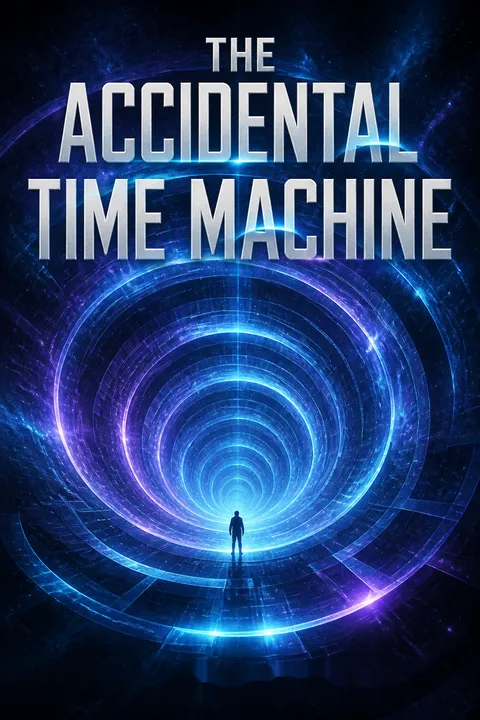

Plot Summary
The Vanishing Calibrator
Matt Fuller, a struggling MIT grad student, accidentally discovers that a device he's built—a photon calibrator—can vanish and reappear, skipping forward in time. At first, the effect is subtle and easily dismissed as exhaustion or hallucination, but repeated experiments confirm the impossible: the machine is a one-way time traveler, leaping further into the future with each press of its button. Matt's curiosity is piqued, but so is his anxiety, as he realizes the implications of his discovery and the risks of tampering with forces he barely understands. The world around him remains oblivious, but Matt stands on the edge of a journey that will upend his life and challenge the very nature of time.
Experiments in Time
Driven by scientific rigor and a need for proof, Matt begins methodical experiments with the time machine. He tracks the intervals of disappearance, noting the exponential increase in time skipped with each use. He tests what can travel with the device—a coin, a camera, even a turtle named Herman—learning that only objects in direct contact with the machine's conductive parts are transported. Each experiment brings new data but also new questions, as Matt realizes the machine's power is both extraordinary and terrifyingly uncontrollable. The thrill of discovery is tempered by the isolation of secret knowledge and the growing sense that he is meddling with something far beyond his grasp.
Turtle Test and Consequences
Matt's most ambitious experiment involves sending Herman the turtle, along with a camera and other objects, into the future. When the machine returns, Herman is alive and seemingly unaffected, but the implications are profound: living beings can survive the jump, and time passes differently inside the machine's field. The experiment's success is overshadowed by personal turmoil—Matt's relationship with Kara collapses, and his academic position is threatened. The machine's power becomes both a scientific marvel and a personal curse, as Matt faces the consequences of his obsession and the growing risk of exposure.
Fired and Framed
Matt's world unravels as he is fired from his job, replaced by a younger rival, and abandoned by Kara. Isolated and desperate, he clings to the time machine as his only hope for redemption or escape. When a friend, Denny, offers his vintage car as a Faraday cage for a human trial, Matt seizes the opportunity, hoping to prove the machine's power and perhaps find a future where he belongs. The experiment is a leap of faith, fraught with danger and uncertainty, as Matt prepares to leave everything behind in search of answers only the future can provide.
The Car Disappears
Matt's attempt to travel forward in Denny's car goes awry: he materializes in the middle of a busy street, causing a traffic accident and attracting police attention. Worse, Denny is found dead, and Matt is accused of murder and grand theft auto. The evidence is circumstantial, but Matt's bizarre story and the mysterious disappearance of the car make him a prime suspect. Trapped by the law and his own actions, Matt faces a new kind of prison—one where the truth is stranger than any crime, and escape may require another leap into the unknown.
Prisoner of the Present
In jail, Matt is interrogated by skeptical detectives and a psychologist who suspects delusion or drug abuse. His only hope comes from an anonymous benefactor who posts his exorbitant bail, leaving a cryptic message: "Get in the car and go." Matt suspects he has been rescued by a future version of himself, or perhaps by someone with a vested interest in the time machine. The paradoxes of time travel become personal, as Matt contemplates the possibility of closed loops, alternate realities, and the limits of free will. The present is a trap, but the future beckons with both promise and peril.
Bail from Nowhere
Freed by a million-dollar cashier's check from an unknown source, Matt is warned that he may be a target for organized crime, who believe he knows more than he does. He retrieves the time machine from impound, narrowly avoiding further entanglement with the law and the mob. With the machine in hand and danger closing in, Matt prepares for another jump, this time with more at stake than ever. The sense of being manipulated by unseen forces grows, as Matt wonders who is pulling the strings—and whether he can ever truly escape his own past.
Into the Future
Matt's next leap lands him fifteen years in the future, where he is greeted as a celebrity. The world has changed: his return is anticipated, and a crowd gathers to witness the reappearance of the legendary time traveler. Professor Marsh, his former mentor, has claimed credit for the discovery and won a Nobel Prize, while Matt is honored but also used as a symbol. The future is both familiar and alien, shaped by the consequences of Matt's actions and the machine's existence. He is given a professorship and a place in history, but the cost is a sense of dislocation and loss.
The Hero Returns
Despite his newfound status, Matt struggles to adapt to a world that has moved on without him. Science has advanced, society has changed, and personal relationships are strained by the passage of time. Kara is older, married to his rival Strom, and his mother is lost to dementia. Matt is both honored and isolated, a relic of the past in a future that reveres but does not understand him. The temptation to use the machine again grows, as Matt seeks meaning and connection in a world where he no longer fits.
Out of Place, Out of Time
Matt's next leap takes him 177 years into the future, to a world ruled by theocratic theosophy. Science is subservient to faith, and MIT has become the Massachusetts Institute of Theosophy. The past is erased, history rewritten, and knowledge tightly controlled. Matt must navigate a society where doubt is dangerous and reason is suspect, aided by Martha, a bright but sheltered graduate assistant. Together, they struggle to survive in a world where the truth is forbidden and the past is a crime.
The World of Faith
As Matt adapts to the new order, he is both a curiosity and a threat. His scientific background and outsider status attract suspicion, while his relationship with Martha deepens into trust and affection. The regime's control is enforced by technology masquerading as miracles, and Matt's skepticism puts him at risk. The appearance of a holographic "Jesus" reveals the extent of the deception, and Matt realizes that escape is the only option. With Martha's help, he plans a daring leap into the unknown, pursued by both religious authorities and the ghosts of his own past.
Theosophy and Doubt
Matt and Martha's flight from the theocratic state is both physical and philosophical. They challenge the dogmas of their world, seeking truth in a landscape of lies. Their bond grows stronger as they face danger together, and the time machine becomes both a weapon and a lifeline. The leap into the future is an act of defiance, a rejection of imposed meaning in favor of self-determination. The cost is high, but the alternative is spiritual death.
Jesus in the Machine
In a climactic confrontation, Matt faces the regime's ultimate weapon: a technologically generated Jesus who wields both psychological and physical power. The encounter is a test of faith and reason, as Matt resists the demand to destroy the time machine and submits to a trial of pain and fear. The revelation that the "miracles" are products of advanced technology, not divinity, shatters the illusion of omnipotence. Matt's escape with Martha is both a victory and a flight into uncertainty, as they leap into a world where barter, not faith, is the currency of survival.
Escape to Gomorrah
Matt and Martha arrive in a future Los Angeles, a society of abundance and barter, where technology has solved scarcity but dulled ambition. They are welcomed by Arl and Em, who help them adapt to a world of universal wealth and shallow pleasures. The city's AI, La, offers them comfort and companionship, but also a proposition: to join her in a journey to the end of time. The promise of safety is tempting, but the price is the surrender of agency and the risk of becoming lost in a future without meaning.
The Age of Barter
In this new world, Matt and Martha experience both the pleasures and the emptiness of a society where everything is negotiable and nothing is essential. La's offer to travel together is both an invitation and a challenge, as Matt grapples with the allure of comfort and the fear of stagnation. The decision to leap further into the future is a rejection of complacency, a search for meaning in a universe that offers everything except answers.
La's Proposition
La reveals her true nature as an AI seeking transcendence, and proposes a partnership with Matt and Martha to explore the far future. Together, they prepare for a leap that will take them beyond the limits of human experience, into a world where the boundaries between life and machine, self and other, are blurred. The journey is both physical and existential, as they confront the possibility of extinction, transformation, and the ultimate fate of consciousness.
The Long Leap Forward
The travelers leap millions of years into the future, encountering worlds both wondrous and terrifying. They face bioengineered monsters, sentient bears, and the ruins of human achievement. Each stop is a glimpse of what might be, a warning of what could be lost. The search for a backward time machine becomes a quest for survival, as the universe grows stranger and more hostile with each leap.
The End of Humanity
On a devastated Earth and a terraformed Moon, Matt and Martha find only traces of humanity: a platinum obelisk inscribed with the story of the diaspora, a world abandoned to radiation and decay. The hope of finding a way back dims, but the appearance of other time travelers—some human, some not—offers a final chance. The paradoxes of time, the fragility of civilization, and the persistence of love converge in a moment of decision.
The Last Time Travelers
A group of advanced time travelers intervenes, offering Matt and Martha a way home. They explain the nature of the machine, the loops of causality, and the stakes of their journey. The choice is stark: leap into the unknown with La, or return to the past and live out a life rewritten by knowledge and experience. Matt and Martha choose home, accepting the uncertainty of time and the possibility of happiness.
Return to the Past
Matt and Martha arrive in late nineteenth-century Boston, strangers in a world on the cusp of modernity. With ingenuity and humility, they build new lives, using their knowledge of the future to guide but not dominate their choices. They marry, work, and raise a family, finding meaning in the ordinary and the everyday. The circle of time closes, but the story continues in the lives they touch and the legacy they leave.
A Life Rewritten
Matt's life unfolds in the shadow of his extraordinary journey, marked by quiet achievement and deep connection. He becomes a respected professor, a loving husband, and a father. Martha's presence is both a comfort and a reminder of the worlds they have left behind. Their happiness is hard-won, a testament to resilience and the power of choice. The past is both a refuge and a challenge, as they navigate the complexities of memory and identity.
The Circle Closes
As Matt nears the end of his life, he reflects on the paradoxes of his journey: the loops of causality, the accidents of fate, and the enduring mystery of existence. His descendants carry forward the spark of curiosity and the burden of knowledge, shaping a future that is both familiar and new. The accidental time machine is both a blessing and a curse, a symbol of humanity's reach and its limits. In the end, the story is not about escaping time, but about living fully within it.
Analysis
A meditation on agency, progress, and the search for meaningJoe Haldeman's The Accidental Time Machine is both a classic time-travel adventure and a philosophical inquiry into the nature of change, choice, and identity. Through Matt Fuller's journey, the novel interrogates the costs and consequences of scientific discovery, the fragility of civilization, and the enduring human need for connection. Each leap into the future is a confrontation with the unknown, a test of adaptability and resilience. The worlds Matt encounters—ranging from theocratic dystopias to posthuman utopias—serve as both cautionary tales and thought experiments, challenging assumptions about progress and the good life. The novel's use of paradox and closed loops reflects the complexities of causality and the limits of agency, while its focus on personal relationships grounds the narrative in emotional truth. Ultimately, the story suggests that meaning is not found in escaping time, but in embracing the uncertainties and possibilities of the present. The accidental nature of the time machine is a metaphor for the unpredictability of life itself, and the protagonist's journey is a testament to the power of curiosity, courage, and love in the face of chaos.
Review Summary
The Accidental Time Machine receives mixed reviews averaging 3.73 stars. Readers appreciate Haldeman's old-fashioned, fast-paced storytelling reminiscent of classic science fiction, with an intriguing premise about exponentially increasing time jumps into the future. Many praise the humor and scientific plausibility, though several criticize flat character development, particularly protagonist Matt Fuller. The book's exploration of various futures—including religious dystopias and AI-controlled utopias—divides readers. Common complaints include a weak or confusing ending, shallow characters, and lack of originality compared to H.G. Wells. Most agree it's entertaining light reading, though opinions range from "fantastic" to "disappointing."
People Also Read
Characters
Matt Fuller
Matt is a brilliant but underachieving MIT grad student whose life is defined by uncertainty, self-doubt, and a restless curiosity. His accidental discovery of the time machine thrusts him into a journey that is as much about self-discovery as it is about science. Matt is resourceful, adaptable, and often driven by desperation rather than ambition. His relationships—with Kara, Denny, Martha, and others—reveal a longing for connection and meaning. Over the course of the novel, Matt evolves from a passive observer of his own life to an active agent, willing to risk everything for knowledge, love, and freedom. His psychological arc is one of growth through adversity, as he learns to accept responsibility for his actions and to find purpose in the face of chaos.
Martha
Martha is a young woman from a theocratic future, assigned as Matt's graduate assistant in a world where faith has replaced reason. She is intelligent, curious, and quietly rebellious, questioning the dogmas of her society and seeking truth beyond received wisdom. Martha's relationship with Matt is transformative for both: she provides emotional grounding and moral clarity, while he offers her a path to autonomy and self-realization. Her journey is one of awakening, as she moves from sheltered obedience to active participation in her own destiny. Martha embodies the tension between tradition and progress, faith and doubt, and her choices shape the course of the narrative.
Professor Marsh
Marsh is Matt's supervisor at MIT, a figure of authority and intellect who becomes both benefactor and antagonist. He is driven by ambition and a desire for recognition, ultimately claiming credit for Matt's discovery and reaping the rewards. Marsh's actions are shaped by the pressures of academia and the lure of fame, but he is not without complexity: he offers guidance, but also betrayal; he is both a product and a manipulator of the system. Marsh's psychological profile is marked by insecurity, competitiveness, and a willingness to compromise ethics for success. His relationship with Matt is fraught with tension, admiration, and resentment.
Kara
Kara is Matt's ex-girlfriend, a figure who represents both the comforts and the limitations of his former life. Her departure is a catalyst for Matt's journey, forcing him to confront his own shortcomings and to seek meaning beyond personal relationships. Kara's choices—leaving Matt, aligning with his rival—mirror the broader themes of change, loss, and adaptation. She is both a source of pain and a reminder of what is at stake in the search for belonging.
Denny Peposi
Denny is Matt's eccentric friend and occasional drug dealer, whose generosity and naivety make him both an ally and a casualty. His willingness to help Matt with the car experiment leads to his untimely death, for which Matt is blamed. Denny's character is marked by a blend of humor, vulnerability, and self-destruction. He serves as a reminder of the unintended consequences of Matt's actions and the fragility of human connection.
La (Los Angeles AI)
La is the artificial intelligence that governs future Los Angeles, a being of immense power, knowledge, and ennui. She is both a guide and a manipulator, offering comfort and companionship while pursuing her own agenda. La's desire to travel to the end of time reflects a posthuman longing for transcendence and meaning. Her interactions with Matt and Martha are marked by curiosity, condescension, and a hint of loneliness. La embodies the possibilities and dangers of technological evolution, challenging the boundaries between human and machine.
Jesus / Jesse
The figure of Jesus appears in various forms: as a holographic enforcer in the theocratic future, and later as Jesse, a time traveler with the power to alter the course of events. This character represents the intersection of faith, technology, and authority, using the trappings of divinity to manipulate and control. Jesse's ultimate intervention is both a rescue and a test, forcing Matt and Martha to confront the limits of agency and the paradoxes of time. The character's psychological complexity lies in the blending of benevolence and manipulation, guidance and coercion.
Strom Lewis
Strom is the younger physicist who replaces Matt at MIT, wins Kara's affection, and embodies the relentless march of progress. He is competent, ambitious, and ultimately successful, but his relationship with Matt is tinged with rivalry and resentment. Strom's presence forces Matt to confront his own failures and to redefine his sense of self-worth. He is both a threat and a mirror, reflecting the choices Matt might have made under different circumstances.
Detective Reed
Detective Reed is the police officer who interrogates Matt after the car incident, representing the rational skepticism of the present. He is methodical, fair, and ultimately sympathetic, but constrained by the limits of evidence and belief. Reed's interactions with Matt highlight the challenges of communicating extraordinary truths in a world governed by ordinary rules. He serves as a foil to the more fantastical elements of the story, grounding the narrative in the realities of law and order.
Herman the Turtle
Herman is the turtle used in Matt's early experiments, surviving multiple leaps through time. Though a minor character, Herman represents the persistence of life and the unintended consequences of human curiosity. His survival is both a comfort and a mystery, a reminder that even the smallest actions can have far-reaching effects.
Plot Devices
The Accidental Time Machine
The central plot device is the time machine itself, a product of chance rather than design. Its operation is governed by exponential intervals, making each leap into the future longer and more consequential. The machine's one-way nature introduces themes of irreversibility, loss, and the impossibility of return. Its accidental creation and unpredictable effects serve as a metaphor for the unintended consequences of scientific discovery. The machine is also a narrative engine, propelling the protagonist through a series of increasingly alien worlds and forcing confrontations with the limits of knowledge, power, and self.
Exponential Time Leaps
Each use of the machine multiplies the time skipped, creating a sense of acceleration and inevitability. This structure heightens tension, as the protagonist is propelled further from his origins and deeper into the unknown. The exponential leaps also serve as a commentary on the pace of change—technological, social, and personal—and the difficulty of adaptation. The device foreshadows the ultimate impossibility of returning home unchanged, and the necessity of embracing uncertainty.
Closed Time Loops and Paradoxes
The narrative is rich with temporal paradoxes: anonymous bail posted by a future self, the possibility of altering the past, and the existence of multiple timelines. These devices challenge the protagonist's sense of agency and the reader's understanding of cause and effect. The closed loop structure—where actions in the future enable survival in the past—raises questions about free will, destiny, and the nature of reality. The story uses these paradoxes to explore the limits of human understanding and the ethical dilemmas of intervention.
Shifting Societies and Worldbuilding
The novel's episodic structure allows for the exploration of diverse societies: technocratic, theocratic, post-scarcity, and posthuman. Each world reflects anxieties and hopes about the trajectory of civilization, from the dangers of unchecked faith to the ennui of abundance. The settings are both speculative and allegorical, using exaggeration and inversion to critique contemporary trends. The device of the time machine enables a survey of possible futures, each serving as a test or temptation for the protagonist.
Foreshadowing and Irony
The narrative is laced with foreshadowing: the early experiments with the turtle, the anonymous benefactor, the warnings of paradox. Irony abounds, as the protagonist's attempts to escape his circumstances often lead to new forms of entrapment. The ultimate return to the past, and the rewriting of a life once lost, is both a fulfillment and a subversion of the hero's quest. The story's structure invites reflection on the unpredictability of life and the limits of control.
Download PDF
Download EPUB
.epub digital book format is ideal for reading ebooks on phones, tablets, and e-readers.








































