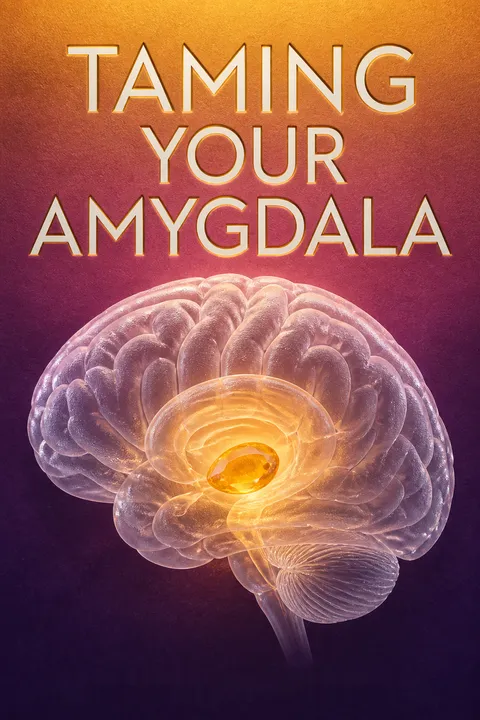

Key Takeaways
1. Anxiety's Core: The Amygdala, Your Brain's Alarm System
If you want to manage your anxiety, the amygdala is the most important part of the brain to understand.
Meet your amygdala. This small, almond-shaped part of your brain, located deep within, is the primary control center for your anxiety and fear response. You have two amygdalae, one on each side, constantly scanning for danger and initiating a preprogrammed defensive reaction. This reaction, often called fear or anxiety, involves dozens of bodily changes within milliseconds, largely outside your conscious control.
The amygdala's purpose. Its fundamental role is to detect, avoid, defend against, and survive dangers, acting as an alarm system. While this was crucial for our ancestors facing predators, in the modern world, it often misinterprets everyday stressors—like financial worries or work arguments—as life-threatening. This leads to unhelpful responses such as:
- Increased heart rate and muscle tension
- Adrenaline release
- Slowed digestion
These responses prime your body to fight or flee, which is rarely appropriate for 21st-century challenges.
Anxiety is normal. Everyone experiences anxiety to some degree, and it's not a sign of weakness or a character flaw. Understanding that your amygdala is simply doing its job, albeit sometimes overzealously, can be a huge relief. The goal isn't to eliminate anxiety entirely, but to learn to tame your amygdala so it doesn't prevent you from achieving your life goals.
2. Two Pathways Drive Anxiety: Fast Amygdala, Slower Cortex
Your amygdala “sees” things before you do.
The rapid amygdala pathway. Sensory information from your eyes, ears, and other senses first travels to the thalamus, a central relay station in your brain. From there, a swift, direct pathway sends this raw, unprocessed information straight to the amygdala. This allows your amygdala to react and initiate a defense response—like swerving to avoid a sudden obstacle—before your conscious mind (cortex) even fully registers what happened. This pathway prioritizes speed over detail.
The detailed cortex pathway. Simultaneously, the thalamus also sends sensory information to your cerebral cortex, the larger, "thinking" part of your brain. Here, the information is processed in much greater detail, allowing you to consciously perceive, interpret, and understand the situation. The cortex can:
- Recognize intricate details (e.g., a toy rat vs. a real one)
- Interpret complex concepts
- Retrieve memories and knowledge
Once the cortex has processed this information, it also sends signals to the amygdala.
Both pathways in action. Often, both pathways work together. The amygdala might trigger an initial, rapid fear response, and then the slower cortex pathway provides more accurate information, either confirming the danger or calming the amygdala down. Understanding these two pathways helps explain why you might feel anxious even when your logical mind tells you there's no real threat—your amygdala might have reacted to incomplete information.
3. The Amygdala's Primitive Language: Fight, Flight, or Freeze
The amygdala does not communicate through words or thoughts but, rather, through a variety of bodily reactions.
Decoding the defense response. The amygdala communicates through a preprogrammed defensive motivational state, commonly known as the fight-flight-freeze response. This ancient survival mechanism prepares your body for immediate action. Recognizing these physical and emotional signals as the amygdala's "language" is crucial for managing anxiety.
Symptoms of activation:
- Fight: Increased heart rate, muscle tension, irritability, snapping at others, wanting to hit.
- Flight: Avoidance, procrastination, desire to leave situations, canceling plans.
- Freeze: Feeling paralyzed, difficulty speaking, stiff muscles, shutting down.
These responses are often disproportionate to modern stressors, leading to unnecessary distress.
Misinterpreting signals. Many people misinterpret these bodily reactions as signs of true danger or illness. For example, a pounding heart might be mistaken for a heart attack, or nausea for sickness. Understanding that these are normal, albeit uncomfortable, operations of your amygdala can normalize the experience and reduce secondary anxiety about the symptoms themselves. It's like a car alarm going off in error—distressing, but not necessarily indicative of a real threat.
4. Calm Your Amygdala: Master Breathing, Imagery, and Relaxation
When I share these findings with my clients, they become very interested in learning breathing methods that directly affect the amygdala.
Direct amygdala impact. Unlike medications that take time, techniques like deep breathing can directly and quickly impact amygdala activation, sometimes in as little as 10 minutes. Slow, deep breathing activates the parasympathetic nervous system, which counteracts the sympathetic nervous system's defense response. Diaphragmatic breathing, in particular, stimulates the vagus nerve, signaling safety to your brain.
Effective calming techniques:
- Diaphragmatic Breathing: Place one hand on your chest, one on your stomach. Inhale deeply, expanding your stomach, and exhale slowly. Aim for 5-6 breaths per minute (6 seconds in, 6 seconds out).
- "Give Me Five" Breathing: Focus on long, slow inhalations and exhalations, completely filling and emptying your lungs. Visualize breathing out stress (colored smoke) and breathing in calm (clear air).
- Relaxation through Imagery: Visualize a peaceful, relaxing scene, engaging all your senses (sight, sound, smell, feel). This mental escape can quickly calm your mind and amygdala.
- Progressive Muscle Relaxation (PMR): Systematically tense and then relax major muscle groups throughout your body. This teaches your body to release tension, counteracting the amygdala's muscle-tensing response.
Strategic application. Use these techniques proactively before anticipated stressful events, during moments of anxiety, or regularly throughout the day as a "reset" mechanism. They are most effective when practiced consistently, becoming second nature. Remember, courage isn't the absence of fear, but acting in spite of it, and these tools empower you to do just that.
5. Lifestyle Pillars: Sleep, Exercise, and Diet for a Quieter Amygdala
When you get enough sleep, your amygdala is much less likely to have strong reactions to what you sense and experience.
Sleep's critical role. Healthy sleep is paramount for a calm amygdala. Even one night of sleep deprivation can make the amygdala react more strongly, and insufficient REM sleep is linked to increased amygdala activation. Aim for 7-9 hours of uninterrupted sleep, as longer REM periods occur in the later hours of sleep, which helps reduce amygdala reactivity the next day.
Exercise as an antidote. Physical activity, especially aerobic exercise, directly calms the amygdala. When the amygdala activates the defense response, it prepares your body for exertion. Engaging in exercise fulfills this physiological preparation, signaling to the amygdala that the "threat" has been addressed. Regular exercise also:
- Reduces general anxiety and depression
- Affects the sympathetic nervous system and HPA axis, making defense responses less likely
- Strengthens connections between the amygdala and calming brain regions
Diet for stability. What you eat and drink significantly impacts your amygdala. Caffeine activates the sympathetic nervous system, increasing anxiety, especially in sensitive individuals. Sugar fluctuations also trigger the amygdala; low blood sugar (hypoglycemia) is interpreted as a danger, releasing adrenaline. Maintain stable blood sugar by:
- Eating regularly (every 3 hours)
- Choosing complex carbohydrates, proteins, and fiber
- Avoiding excessive processed sugars and alcohol
6. Triggers: How Your Amygdala Learns What to Fear
The amygdala can learn to fear objects and situations as a means of protecting us from threats that didn’t exist for previous generations or earlier in our lives.
Associative learning. Your amygdala learns through association. When an object, location, or situation (the "trigger") is paired with a negative event—like pain, discomfort, or embarrassment—the amygdala forms an emotional memory. This creates new neural connections, causing the amygdala to react with fear or anxiety whenever that trigger is encountered again, even if the trigger itself isn't inherently dangerous.
Beyond conscious memory. What makes amygdala-driven triggers particularly challenging is that these emotional memories are distinct from conscious, "story" memories formed by the cortex. You might not remember the specific negative event that created a trigger, but your amygdala still "remembers" and reacts. This explains why some fears seem illogical to your conscious mind.
Multiple triggers, indirect learning. A single negative event can create multiple triggers (e.g., a car accident leading to fear of passenger seats, squealing brakes, or honking horns). Furthermore, the amygdala can learn fears indirectly, by observing others' fearful reactions. This powerful learning mechanism, while protective, can also lead to an ever-expanding list of triggers that limit your life.
7. Exposure: Re-teach Your Amygdala That Triggers Are Safe
Gradual exposure like this—where we ensure that nothing negative happens—is the best way to teach the amygdala that a trigger is safe.
The power of exposure. Exposure is the most effective way to re-teach your amygdala that a trigger is no longer dangerous. It involves deliberately and repeatedly confronting your trigger in a safe environment, ensuring no negative event occurs. This process activates the neural circuits associated with the fear, allowing the amygdala to form new, non-fearful emotional memories.
No pain, no gain. Exposure will initially cause distress, fear, and anxiety—this is normal and necessary. You must stay in the situation until your anxiety significantly decreases (e.g., to half of its peak level). Leaving prematurely reinforces the amygdala's belief that escape was necessary, strengthening the fear response. The amygdala is designed to learn, and it will eventually recognize the absence of danger.
Key exposure guidelines:
- Hierarchy: Create a step-by-step list of increasingly anxiety-provoking situations related to your trigger. Start with a moderately anxiety-provoking step (SUDs around 40).
- Repetition: Multiple, repeated exposures are crucial for lasting change.
- Direct experience: Fully engage with the trigger (look, listen, feel) without distraction.
- Relaxation skills: Use deep breathing and muscle relaxation to manage distress, but don't aim for complete relaxation, as some activation is needed for learning.
- Imaginal exposure: If real-life exposure is too difficult or impractical, visualize the situation in detail.
- Avoid safety behaviors: Don't use crutches (e.g., bringing tranquilizers, having a friend present) that prevent the amygdala from learning true safety.
- Monitor thoughts: Challenge self-defeating or amygdala-activating thoughts.
- Independence: Work towards handling exposures on your own to build lasting confidence.
8. The Cortex's Influence: Your Thoughts Can Activate Anxiety
The amygdala is watching cortex television.
Cortex as an activator. While the amygdala can react directly to sensory input, your cortex—your thinking brain—can also activate the amygdala through its interpretations, thoughts, and images. The amygdala constantly monitors the cortex, and if it perceives a threat in your thoughts, it will trigger the defense response, leading to anxiety.
Two ways the cortex activates:
- Interpreting sensory information: The cortex provides detailed context and meaning to raw sensory data. For example, hearing a phone buzz might not be threatening, but your cortex interpreting it as "my partner is breaking up with me" can activate the amygdala.
- Generating thoughts/images without sensory input: Humans uniquely conjure up worries and imagined scenarios. Thinking about a past traumatic event or visualizing a future disaster can activate the amygdala as if the danger were real, even if you're physically safe.
The "Anxiety Channel." Many people frequently tune into the "Anxiety Channel" in their cortex, playing a marathon of negative thoughts, worst-case scenarios, and self-criticism. This constant stream of distressing content keeps the amygdala in a state of heightened activation, leading to unnecessary and prolonged anxiety. Recognizing this pattern is the first step to changing the channel.
9. Cognitive Restructuring: Combat Amygdala-Activating Thoughts
You can change the structures in your brain that create anxiety, but achieving that change requires taking a new approach to how you respond to your anxiety and worry.
Changing your "channel." Your cortex, unlike the amygdala, can learn from logic and planning. The key to managing cortex-driven anxiety is cognitive restructuring: identifying and replacing amygdala-activating thought patterns with more affirming, calming, and adaptive ones. Remember, "you can't erase; you must replace" – trying to suppress a thought only makes it stronger.
Common amygdala-activating thought patterns:
- Pessimism: Expecting the worst ("Things will never work out"). Replace with "I don't know what will happen; I can handle whatever comes."
- Anticipation: Overthinking future events, focusing on problems. Replace with "I've thought enough; I'll figure it out when I'm there."
- Mind Reading: Assuming others' negative thoughts about you. Replace with "I can't know what they're thinking without asking," or "Their opinion doesn't define me."
- Catastrophizing: Treating minor setbacks as disasters. Replace with "This is a setback, not a catastrophe; I can cope."
- Perfectionistic Thinking: Holding impossible standards, fearing imperfection. Replace with "No one is perfect; mistakes are part of being human."
- Cognitive Fusion: Believing thoughts are reality ("My worry means it will happen"). Replace with "This is just a thought; it doesn't mean it's true."
- "Shoulds": Imposing rigid rules on yourself, leading to guilt/shame. Replace with "I want to..." or "I prefer to..."
Practice makes perfect. The cortex operates on "survival of the busiest"—thoughts you use frequently become easier to access. By consistently practicing new coping thoughts and actively changing your mental channel, you weaken the old, distressing neural circuits and strengthen new, calmer ones. This deliberate effort allows your cortex to become a source of calm, not anxiety.
10. Worry Wisely: Harness Its Power for Planning, Not Pointless Distress
Worry is supposed to be only a trigger for problem solving. It is not supposed to last a long time.
The evolutionary purpose of worry. Worry, originating in the orbitofrontal cortex, is a uniquely human ability to anticipate potential negative outcomes. This capacity for foresight has adaptive benefits, allowing us to plan and prepare for future challenges. However, worry is only beneficial if it leads to a plan and action; otherwise, it becomes a source of pointless distress and amygdala activation.
Assessing your worry. Many people believe worry is protective, thinking that if they stop worrying, bad things are more likely to happen. This cognitive fusion is a common misconception. Frequent, unproductive worry leads to chronic amygdala activation, causing physical and emotional exhaustion, and even health problems like high blood pressure.
Using worry correctly:
- Become aware: Recognize when you are worrying.
- Identify the concern: Clearly define the specific problem.
- Form a plan: Shift focus from worrying to developing a concrete plan to prevent, correct, or cope with the situation.
- Move on: Once a plan is in place (even if it's a contingency plan for uncertainty), consciously shift your attention away from the worry. Do not return to pointless rumination.
- Scheduled worry time: If you struggle to stop worrying, designate a specific "worry time" each day (e.g., 30 minutes, not before bed). If worries arise outside this time, briefly note them and defer them until your scheduled session.
Coping with uncontrollable worries. For worries about things beyond your control (e.g., "I won't be perfect," "I can't prevent my partner from leaving"), the plan shifts from "how to prevent" to "how to cope." Focus on developing strategies for responding if the situation occurs, rather than trying to control the uncontrollable.
11. Reclaim Your Life: Set Goals to Guide Your Amygdala-Taming Journey
You do not have to give up on your goals and allow the amygdala to run your life.
Anxiety's limiting power. Anxiety often interferes with daily life, relationships, and career aspirations, blocking you from pursuing meaningful goals. The amygdala's defensive responses can cause avoidance, making you stop thinking about activities or situations that trigger distress. This can lead to a restricted and unfulfilling life.
Identify your aspirations. The first step to taking back control is to clearly define your life goals. Reflect on:
- What you would do if anxiety weren't a barrier.
- Activities you used to enjoy but now avoid.
- How anxiety impacts your relationships and career.
Use these reflections to create a list of specific, meaningful goals.
Prioritize and strategize. Rate your goals by importance and anticipated anxiety level. Start with goals that are highly important but cause moderate anxiety, as these offer the most rewarding initial successes. Remember, the aim isn't an anxiety-free life, but one where anxiety doesn't dictate your choices. Your goals provide the motivation to push through discomfort and engage in amygdala-taming strategies.
Empowerment through action. By consciously choosing your goals and actively working to overcome anxiety's limitations, you are putting yourself back in the driver's seat. This journey involves courage, determination, and utilizing the tools learned—calming techniques, lifestyle adjustments, exposure, and cognitive restructuring—to teach your amygdala to back off and allow you to live the life you truly desire.
People Also Read







Download PDF
Download EPUB
.epub digital book format is ideal for reading ebooks on phones, tablets, and e-readers.








































