
Plot Summary
Fourth of July Fireworks
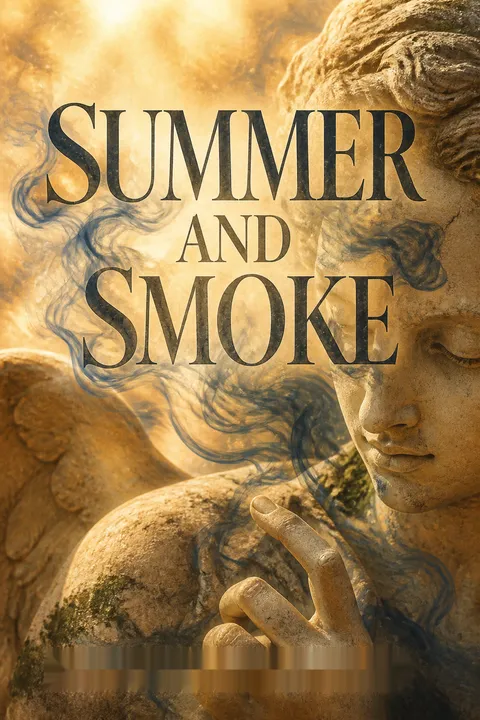
In Glorious Hill, Mississippi, the Fourth of July brings the town together for music, fireworks, and social rituals. Alma Winemiller, the minister's daughter, sings for the crowd, her nerves barely contained. The night is alive with expectation and the subtle tensions of Southern society. John Buchanan, the doctor's son, is home from school, watched closely by his possessive mother. Alma's longing for connection is palpable, but she is mocked for her eccentricities. The fireworks illuminate the distance between Alma and John, hinting at the emotional explosions to come. The stone angel at the fountain, named Eternity, presides over the scene, a silent witness to the hopes and disappointments of the night.
The Nightingale's Song
Alma, known as the "Nightingale of the Delta," is both celebrated and ridiculed for her emotional singing. Her performances are fraught with anxiety, and her gestures and voice are imitated at parties. She is painfully aware of her difference, her sensitivity, and her inability to fit in with the other young people. Her father, the Reverend Winemiller, is both supportive and critical, urging her to control her mannerisms and avoid the appearance of eccentricity. Alma's mother, lost in her own madness, is a constant reminder of the family's fragility. Alma's longing for love and acceptance is expressed through her music, but her vulnerability leaves her exposed to cruelty.
Eccentricities and Expectations
Alma's life is shaped by the expectations of her father and the burden of her mother's illness. She is expected to be the perfect minister's daughter, managing the household and serving the church, while suppressing her own desires. Her father warns her against her "eccentricities," fearing that she will become an unhappy outcast. Alma's attempts to form a club of like-minded young people are met with skepticism and derision. She is caught between the need to conform and the urge to express her true self. The town's gossip and her own self-doubt reinforce her sense of isolation.
The Shadow of the Rectory
Living next door to John Buchanan, Alma is haunted by memories of their childhood and her unspoken love for him. She spies on him from her window, her feelings a mixture of hope and shame. John, meanwhile, is restless and drawn to the pleasures of the world, including the seductive Rosa Gonzales. Alma's attempts to reach out to John are awkward and often rebuffed. The physical proximity of their houses only emphasizes the emotional distance between them. Alma's yearning is both spiritual and sensual, but she is unable to bridge the gap.
John's Return and Temptations
John returns to Glorious Hill after medical school, torn between his father's expectations and his own impulses. He is drawn to the excitement of the casino and the allure of Rosa, whose world is one of sensuality and danger. John's mother dreams of a perfect, respectable wife for him, while John himself is fascinated by Alma's difference but unsure how to respond. His encounters with Alma are marked by a mixture of attraction, amusement, and frustration. The town's moral codes and his own desires pull him in opposite directions.
The Club of Misfits
Alma gathers a small group of "misfits" for a literary club, hoping to create a space for intellectual and artistic exchange. The meetings are awkward, filled with petty rivalries and misunderstandings. John attends once, but his presence only highlights Alma's nervousness and the group's lack of cohesion. The club becomes a symbol of Alma's longing for connection and her inability to find it. The other members are as lost and isolated as she is, and the meetings end in disappointment and embarrassment.
Mother's Madness, Daughter's Burden
Alma's mother, once a lively woman, has retreated into childishness and delusion, obsessed with memories of her sister Albertine and the Musee Mecanique. Alma is forced to care for her, sacrificing her own youth and freedom. The family's history is marked by scandal and tragedy, and Alma fears that she is destined to repeat it. Her father's bitterness and her mother's madness create an atmosphere of repression and guilt. Alma's struggle to maintain her dignity and sanity is a daily battle.
The Meeting That Fails
Alma's club meeting, attended by John, ends in disaster. The group's insecurities and resentments boil over, and John leaves abruptly, called away by his mother. Alma is left humiliated and heartbroken, her hopes for connection dashed. The episode reinforces her sense of being an outsider, unable to find a place in the world. The failure of the meeting mirrors the larger failure of Alma's attempts to reach John and to find meaning in her life.
Panic in the Night
One night, Alma suffers a panic attack and rushes to John's office for help. John, half-amused and half-concerned, soothes her with brandy and gentle words. Their conversation turns intimate, and Alma confesses her loneliness and longing. John diagnoses her with a "doppelganger," a divided self at war with her circumstances. The encounter is charged with emotion, but ends with Alma's shame and John's gentle refusal to take advantage of her vulnerability. The barriers between them remain.
The Tenderness of a Mother
John's mother, Mrs. Buchanan, is determined to protect her son from unsuitable matches. She sees Alma as an eccentric, unfit for marriage to a promising young doctor. Her vision for John's future is one of social advancement and respectability, and she manipulates him to avoid Alma and seek a more conventional partner. Alma, meanwhile, is painfully aware of her exclusion and the impossibility of competing with Mrs. Buchanan's expectations. The maternal bond is both tender and suffocating.
The Unattainable Connection
After a night at the movies, Alma and John walk together and finally speak honestly about their feelings. Alma confesses her long-standing love, and John admits he is not in love with her. In a moment of desperation, Alma suggests they go to a hotel room together, seeking physical intimacy as a substitute for the emotional connection they cannot achieve. The experiment fails; the fire in the room will not burn, and both realize that what they seek cannot be forced. They part with a sense of gentle resignation.
The Hotel Room Experiment
In the small hotel room, Alma and John confront their desires and limitations. The setting is cold and impersonal, and their attempt at intimacy falters. Alma's honesty and vulnerability are met with John's kindness but not passion. The fire in the fireplace refuses to catch, symbolizing the impossibility of their union. Alma's eccentricities, once a source of shame, become a badge of honor. She leaves the room with her dignity intact, but her hopes dashed.
The Fire That Wouldn't Burn
The failed fire in the hotel room becomes a metaphor for Alma and John's relationship. Despite their efforts, the warmth and passion they seek elude them. Alma's willingness to risk everything for a moment of connection is met with gentle refusal. The scene ends with a sense of acceptance and the recognition that some things cannot be willed into existence. Alma's honesty is her "plume," a mark of her uniqueness and strength.
The Turning of the Tables
Time passes, and the roles between Alma and John reverse. John finds stability and respectability, while Alma becomes more restless and unconventional. When Alma finally offers herself to John, he is no longer available—he is engaged to Nellie, a younger, more conventional woman. The timing is wrong, and the opportunity for love has passed. Alma is left to grapple with the consequences of her choices and the pain of missed chances.
Alma's Awakening
Alma's experiences lead her to a new understanding of herself and the world. She recognizes the strength that comes from embracing her own desires and eccentricities. No longer content to live in the shadow of her family or the expectations of society, she seeks her own path. Her encounter with John has changed her, but she must move forward alone. The parade in town and John's new life are reminders of the world's indifference to individual suffering.
The Parade and the Prescription
John is celebrated for his medical achievements, while Alma is left behind, her health and spirit diminished. The town honors John, but Alma's contributions and struggles go unnoticed. She visits John's office, seeking closure, and learns of his engagement to Nellie. The encounter is painful but honest, and Alma leaves with a sense of finality. The prescription John gives her is both a literal and symbolic gesture—a recognition of her need for comfort and healing.
The Last Meeting at the Fountain
Alma returns to the fountain, the site of so many memories, and meets a young traveling salesman. Their conversation is tentative but charged with possibility. Alma is no longer the innocent, yearning girl she once was; she has been changed by experience and loss. The stone angel, Eternity, remains unchanged, a silent witness to the passage of time and the transformations of the human heart. Alma's willingness to embrace the unknown marks the beginning of a new chapter.
Into the Night, Alone
As the fireworks fade and the town settles into darkness, Alma steps into the night, alone but not defeated. She has lost much—her innocence, her illusions, her chance at love with John—but she has gained a deeper understanding of herself and the world. The play ends with Alma moving forward, her eccentricities now a source of strength rather than shame. The future is uncertain, but she faces it with courage and a sense of hard-won dignity.
Analysis
Tennessee Williams' Summer and Smoke is a profound meditation on longing, repression, and the search for meaning in a world governed by social convention and personal limitation. Through the character of Alma Winemiller, Williams explores the pain of being different in a society that values conformity above all else. Alma's journey from innocence to experience, from repression to self-acceptance, is both tragic and redemptive. The play's central symbols—the stone angel, the failed fire, the doppelganger—underscore the themes of unattainable desire and the impossibility of perfect union. Williams critiques the suffocating expectations of Southern society, the destructive power of family history, and the ways in which individuals are shaped and constrained by forces beyond their control. Yet, the play also offers a vision of resilience and transformation. Alma's willingness to embrace her own eccentricities and to seek meaning on her own terms is a testament to the human capacity for growth and change. In a modern context, Summer and Smoke speaks to anyone who has ever felt out of place, who has struggled to reconcile inner desires with external demands, and who has found strength in vulnerability. The play's enduring power lies in its honesty, its compassion, and its recognition of the beauty and pain of the human soul.
Review Summary
Summer and Smoke explores the conflict between spirituality and physicality through Alma, a repressed minister's daughter, and John, a sensual doctor. Set in early 20th century Mississippi, the play follows their failed relationship as they represent opposite extremes—soul versus body. In a dramatic reversal, they eventually switch perspectives, but too late to connect. Reviewers praise Williams' lyrical dialogue and the poignant anatomy chart scene, though some find it overly melodramatic. Most appreciate the tragic exploration of timing and compatibility in love.
People Also Read
Characters
Alma Winemiller
Alma is the minister's daughter, known for her emotional singing and her inability to fit into the narrow confines of Southern society. She is intelligent, sensitive, and deeply spiritual, but also plagued by anxiety and self-doubt. Her mother's madness and her father's expectations weigh heavily on her, forcing her into a role she cannot fully inhabit. Alma's love for John is the central force in her life, but her longing is never fully reciprocated. Over the course of the play, Alma moves from innocence to experience, from repression to self-acceptance. Her eccentricities, once a source of shame, become a mark of her individuality and strength. She is a tragic figure, but also a survivor, capable of transformation through suffering.
John Buchanan, Jr.
John is the son of the town doctor, expected to follow in his father's footsteps. He is intelligent and charismatic, but also restless and drawn to the pleasures of the world. His relationship with Alma is marked by attraction, amusement, and frustration. John is pulled between the expectations of his family and the temptations of sensuality, represented by Rosa Gonzales and the casino. His mother's possessiveness and his own uncertainty prevent him from committing to Alma. Ultimately, John chooses respectability and stability over passion, marrying Nellie and leaving Alma behind. He is both a victim and an agent of the social forces that shape his life.
Reverend Winemiller
Alma's father is the Episcopal minister, a man of principle and duty. He is both supportive and critical of Alma, urging her to control her emotions and avoid eccentricity. The burden of his wife's madness and his daughter's struggles weighs heavily on him, leading to bitterness and frustration. He represents the moral and social expectations of the town, but is also trapped by them. His inability to understand or help Alma contributes to her isolation.
Mrs. Winemiller
Once lively and charming, Mrs. Winemiller has retreated into a state of childishness and delusion. She is obsessed with memories of her sister and the Musee Mecanique, and is unable to fulfill her role as wife and mother. Her madness is both a burden and a warning to Alma, who fears she will share her mother's fate. Mrs. Winemiller's presence is a constant reminder of the fragility of the human mind and the destructive power of repression.
Mrs. Buchanan
John's mother is determined to protect her son from unsuitable matches and to secure his future through a socially advantageous marriage. She sees Alma as an eccentric and a threat to her plans. Her love for John is both tender and suffocating, and her influence shapes his choices. Mrs. Buchanan embodies the social codes and expectations of the Southern upper class, and her manipulations contribute to the tragedy of Alma and John's relationship.
Rosa Gonzales
Rosa is the daughter of a casino owner, representing the world of sensuality and danger that tempts John. She is passionate and uninhibited, a stark contrast to Alma's restraint. Rosa's relationship with John is marked by intensity and violence, and ultimately leads to tragedy. She is both a victim and an agent of the social forces that exclude her from respectability.
Nellie Ewell
Nellie is a young woman of the town, fresh and unspoiled. She is everything Alma is not—conventional, pretty, and socially acceptable. John's marriage to Nellie represents his choice of stability over passion, and the triumph of social norms over individual desire. Nellie's innocence and optimism are both appealing and a reminder of what Alma has lost.
Roger Doremus
Roger is a friend of Alma's, a member of her club, and a potential suitor. He represents the possibility of safe, companionate love, but Alma cannot bring herself to settle for less than passion. Roger's presence highlights Alma's isolation and her refusal to compromise her desires.
Dr. Buchanan (John's father)
John's father is a respected doctor, a figure of authority and tradition. He expects John to follow in his footsteps and is deeply disappointed by his son's restlessness and indulgence. His death is a turning point in the play, forcing John to confront his responsibilities and make choices about his future.
Mrs. Bassett
Mrs. Bassett is a widow and a member of Alma's club. She is quick to judge and spread gossip, embodying the small-mindedness of the town. Her interactions with Alma are a source of pain and frustration, reinforcing the social pressures that shape the characters' lives.
Plot Devices
Symbolism of the Stone Angel
The stone angel at the fountain, named Eternity, is a central symbol in the play. It represents the unchanging, impassive nature of time and fate, in contrast to the fleeting passions and disappointments of the characters. The angel is present at key moments, witnessing Alma's hopes, failures, and transformations. Its inscrutable presence underscores the play's themes of longing, loss, and the search for meaning. The angel's name, worn away and only readable by touch, suggests the difficulty of grasping the eternal truths that elude the characters.
Fire and Water Imagery
Fire and water are recurring motifs, representing the tension between desire and repression. The failed fire in the hotel room symbolizes the impossibility of Alma and John's union, while the cool water of the fountain offers temporary relief but no lasting comfort. The imagery of burning, drowning, and thirst recurs throughout the play, reflecting the characters' struggles to satisfy their needs and the consequences of their failures.
Doppelganger and Divided Self
Alma's "doppelganger," diagnosed by John, is a metaphor for her divided self—the conflict between her spiritual aspirations and her sensual desires. This theme is echoed in the play's structure, with characters repeatedly confronting their own limitations and the impossibility of reconciling their inner and outer lives. The motif of the divided self is central to the play's exploration of identity, repression, and transformation.
Social Expectations and Reversal
The play's narrative structure is marked by foreshadowing and irony. Early scenes hint at the eventual reversal of roles between Alma and John, as well as the missed opportunities that define their relationship. The expectations of family and society are both a source of comfort and a trap, shaping the characters' choices and sealing their fates. The play's ending, with Alma stepping into the unknown, is both a resolution and an open question.
About the Author
Other books by Tennessee Williams


Download PDF
Download EPUB
.epub digital book format is ideal for reading ebooks on phones, tablets, and e-readers.








































