

Key Takeaways
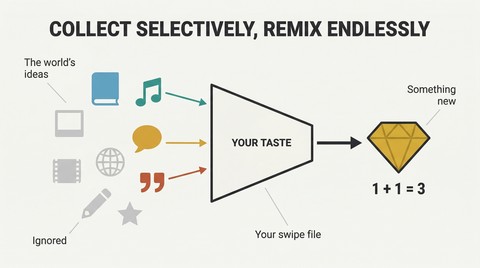
All creativity is remix — collect influences like a selective thief
Nothing is truly original. When people call something "original," they usually just don't know the sources. Every new idea is a mashup — like the art school trick where two parallel lines create a third line of negative space between them: 1 + 1 = 3. You have a genealogy of ideas just as you have a family tree, except you choose it through the books you read, the music you hear, and the people you follow.
Keep a swipe file to track everything worth stealing — a scrapbook, camera roll, or digital folder of images, quotes, and fragments. Newspaper reporters call theirs a "morgue file": dead things you'll reanimate later. There's an economic theory that averaging your five closest friends' incomes approximates your own. Kleon argues your "idea income" works the same way.
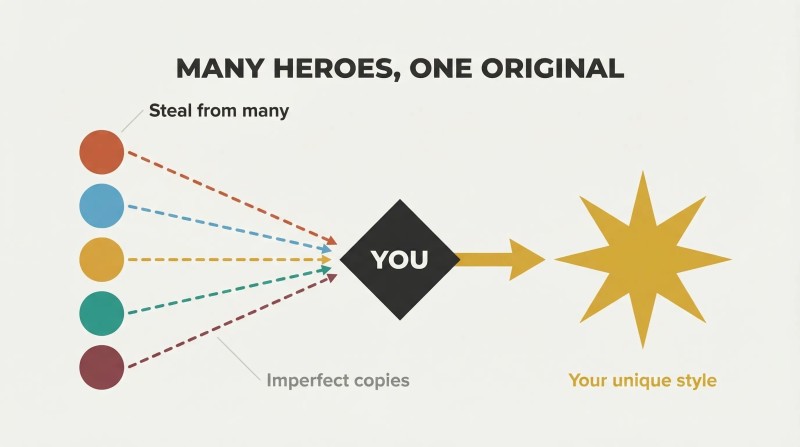
Copy a hundred heroes — where you fail to replicate, your style emerges
Start with one thinker you love. Study everything about them, find three people they loved, study those, repeat — climbing the creative family tree. But steal from many: cartoonist Gary Panter noted that copying one person makes you a knockoff, but copying a hundred makes you original. Even The Beatles started as a cover band, emulating Buddy Holly, Little Richard, and Elvis.
Your imperfections are your fingerprint. Kobe Bryant stole all his moves from tape of his heroes, but his different body type forced adaptation — creating something uniquely his. Conan O'Brien tried to become David Letterman, who tried to become Johnny Carson, who tried to become Jack Benny. Each failed, and that failure became their signature. Copy the thinking, not just the surface.
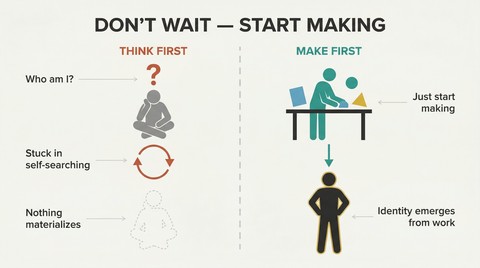
Start making stuff before you figure out who you are
Identity follows action, not the reverse. If Kleon had waited to know who he was before creating, he'd still be sitting around. Impostor syndrome — the feeling of being a phony who can't internalize accomplishments — is universal among creative people. Nobody truly knows where the good stuff comes from. They just show up every day.
All creative work is theater. In Patti Smith's memoir Just Kids, she and photographer Robert Mapplethorpe dressed in bohemian gear and wandered New York pretending to be artists. An old couple gawked: "I think they're artists." "Oh, go on — they're just kids." The stage is your desk, the costume is your painting pants, the props are your tools. Start the performance, and the role becomes real.
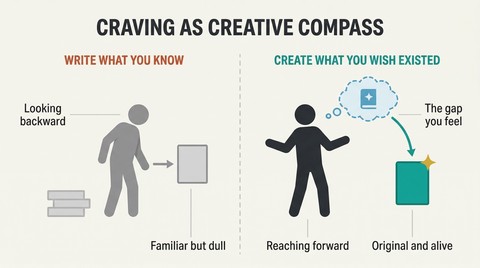
Create what you wish existed, not what you already know
"Write what you know" produces boring work. Kleon argues you should create what you love — what you'd want to consume if it already existed. At ten years old, he wrote his own Jurassic Park sequel because he couldn't wait for the real one. Years later the official sequel disappointed him. The version in your head is always better.
Channel cravings into creation. Bradford Cox of the band Deerhunter would record fake versions of his favorite band's unreleased albums before release day. Many of those imagined tracks became actual Deerhunter songs. The manifesto: draw the art you want to see, start the business you want to run, write the books you want to read, build the products you want to use — do the work you want to see done.
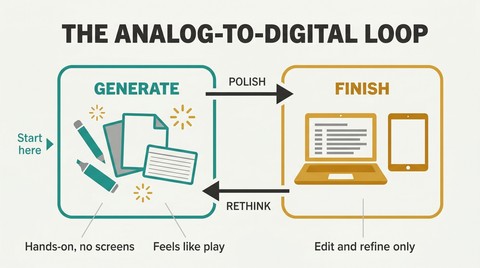
Keep two desks: analog for generating ideas, digital for polishing
Screens put glass between you and your ideas. Kleon keeps two workstations: an analog desk with nothing but markers, pens, paper, and index cards — no electronics allowed — and a digital desk with laptop, scanner, and tablet. His book Newspaper Blackout was made entirely with newspaper articles and permanent markers. The tactile process — newsprint texture, squeaking markers, vanishing words — felt like play, not work.
Ideas flow through an analog-to-digital loop. Hands first, computer second, then back again. Cartoonist Tom Gauld avoids the computer until thinking is done, because once digital tools are involved, work lands on "an inevitable path to being finished." In the sketchbook, possibilities stay endless. Kleon's advice: grab $10 of school supplies and treat your analog station like craft time.
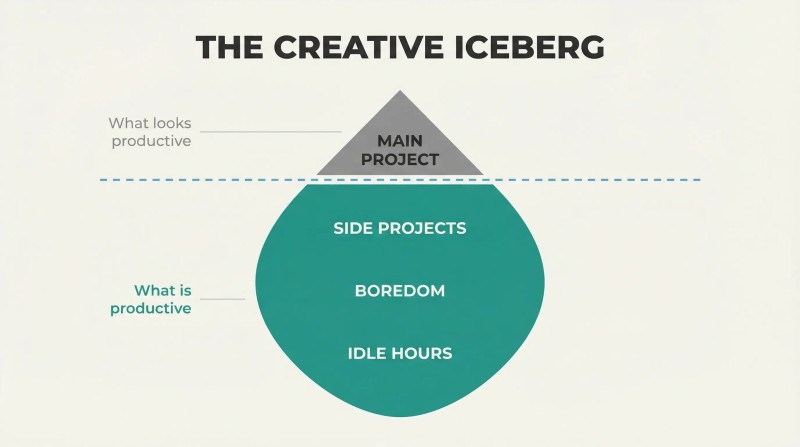
Treat boredom and side projects as your real creative engines
Side projects outperform main projects. Kleon's career lesson: the stuff that looked like "just messing around" is what actually took off. He recommends keeping multiple projects alive so you can bounce between them — a technique he calls productive procrastination. When one project stalls, the other catches fire.
Unstructured time is an idea generator. A coworker once told Kleon, "When I get busy, I get stupid." Creative people need idle hours — staring at walls, washing dishes, ironing shirts, taking long walks. Artist Maira Kalman confessed that avoiding work is how she focuses her mind. The key is wandering without an agenda and letting your brain make unexpected connections in the background.
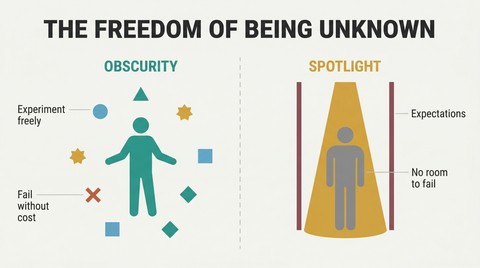
Enjoy your obscurity — it's your last chance to experiment freely
Obscurity is a gift, not a sentence. When you're unknown, there's no public image to manage, no stockholders, no agent emails. You can experiment, fail, and try bizarre things without consequences. Kleon warns that freedom evaporates once attention arrives — and especially once money follows.
The only formula Kleon knows: do good work and share it with people. Step one is brutally hard — make stuff daily, accept that you'll suck, get better. Step two is now simple: put it on the Internet. But share strategically — glimpses of your process, handy tips, interesting links. Think Bob Ross giving away painting secrets on PBS. People love when you open up your process, and sometimes they'll reward you by buying what you're selling.
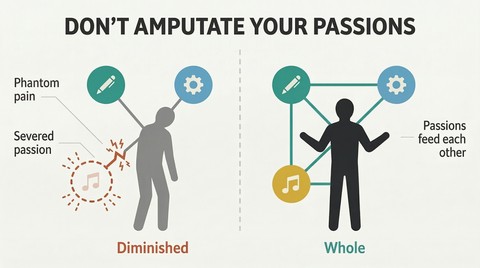
Keep all your passions alive — amputating one causes phantom pain
Multiple passions feed each other. Playwright Steven Tomlinson advises that if you love different things, keep spending time with all of them and let them talk to each other. Kleon spent years abandoning music to focus solely on writing. The result wasn't clarity — it was worsening creative phantom limb pain.
Reconnecting transformed his work. When he joined a band again, he felt whole, and his writing actually improved — new synapses fired, new connections formed. Many of his Austin colleagues are musicians with day jobs in tech and business, and they all report the same: music feeds their other work. A hobby with no pressure to monetize is regenerative. Kleon calls his Sunday jam sessions "like church."
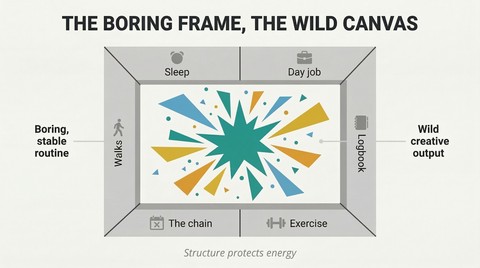
Build a boring life so your creative work can be wild
The tortured-genius myth is a trap. Kleon is a self-described boring guy with a nine-to-five, a wife, and a dog. The romantic image of artists burning out on drugs is "for the superhuman and the people who want to die young." Practical creativity requires sleep, breakfast, push-ups, and long walks.
Routine protects creative energy. Keep a day job for money, structure, and human connection. Learn about money early. Use Jerry Seinfeld's calendar method: mark an X each day you do creative work, then don't break the chain. Keep a logbook — not a diary, just a daily list of what you did. And keep a praise file of kind emails for dark days when you want to quit. Carve out time and defend it.
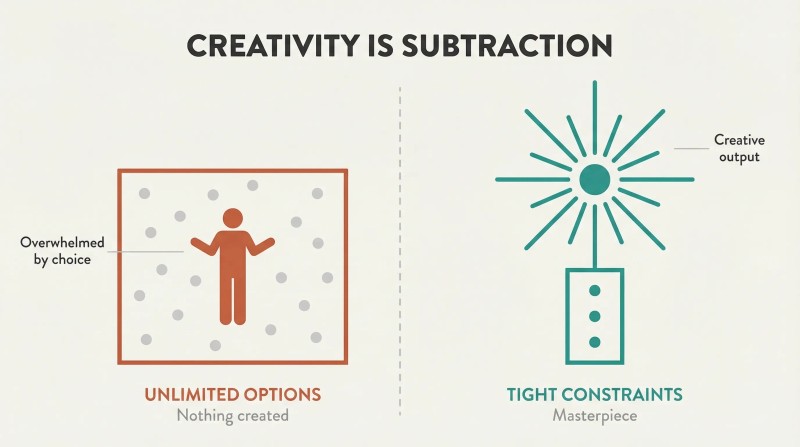
Set tighter constraints — creativity is subtraction, not addition
Unlimited possibilities paralyze. Nothing is more terrifying than being told you can do anything. Kleon's solution: place deliberate constraints on your work. Write a song on your lunch break. Paint with one color. Shoot a movie on your iPhone. Don't make excuses — make things with the time, space, and materials you have right now.
Constraints produce masterpieces. Dr. Seuss wrote The Cat in the Hat using only 236 different words. His editor bet he couldn't write a book with just 50. Seuss won with Green Eggs and Ham — one of the bestselling children's books ever. Artist Saul Steinberg observed that what audiences respond to in any work of art is the artist's struggle against limitations. What you leave out defines the art.
Analysis
Kleon's Steal Like an Artist operates as a democratizing intervention in creativity discourse. Published in 2012, it systematically dismantles the Romantic myth of the solitary genius — a mythology that has paralyzed would-be creators since the 19th century — and replaces it with a combinatorial model where originality emerges from the accumulation and transformation of influences. His philosophical lineage runs from T.S. Eliot's 'tradition and the individual talent' through DJ culture's remix ethic, synthesized into accessible, actionable praxis.
What distinguishes Kleon from typical creativity literature is his dual emphasis on embodied cognition and material constraints. The two-desk system anticipates findings in embodied creativity research — the idea that physical manipulation of objects activates different cognitive pathways than screen-based work. His advocacy for constraints echoes experimental research demonstrating that moderate limitations actually enhance creative output, exemplified perfectly by the Dr. Seuss anecdote.
The book's most philosophically interesting move is reframing creative identity as emergent rather than foundational. You don't discover your voice through introspection; you forge it through the accumulated failures of imitation. This resonates with identity theory in developmental psychology, which holds that identity is constructed through active experimentation rather than passive reflection — a genuinely useful inversion of the 'find your passion first' advice dominating self-help.
Its weakest point is the treatment of digital sharing, which reads as early-2010s optimism about the open web — before algorithmic feeds, platform decay, and creator burnout became defining features of online creative life. The advice to 'put your stuff on the Internet' was more revolutionary in 2012 than it is now, when the challenge has shifted from access to attention. Nevertheless, the core principles — steal widely, start before you're ready, constrain deliberately, stay boring — remain durable precisely because they address the psychology of making rather than the mechanics of distribution.
Review Summary
Steal Like an Artist receives mixed reviews. Many praise its inspirational, concise advice on creativity, finding it refreshing and motivating. Readers appreciate the simple yet profound insights, practical tips, and engaging visual style. Some criticize the book for being too basic or rehashing common knowledge. Critics argue it lacks depth and originality. However, most agree it's a quick, enjoyable read that can spark creativity and provide valuable reminders for artists, writers, and creative professionals. The book's central message about embracing influence and making things resonates with many readers.
People Also Read

Glossary
Swipe file
Personal archive of stolen inspirationA curated collection where you save anything worth stealing—images, quotes, clippings, screenshots, doodles, or fragments that inspire you. Also called a "morgue file" (a newspaper term for archived reference material). Can be analog (scrapbook, notebook) or digital. The purpose is maintaining a reservoir of raw material to draw from when you need inspiration or want to reanimate old ideas in new work.
Productive procrastination
Bouncing between multiple active projectsA creative strategy where instead of forcing yourself to push through a stalled project, you deliberately switch to another active project. When that one stalls, you return to the first. The procrastination is "productive" because you're always making something—just not the one thing you feel you "should" be making at any given moment. Kleon recommends keeping several projects going simultaneously to enable this.
Praise file
Folder of encouraging feedback savedA dedicated folder—digital or physical—where you save every genuinely kind email, positive review, or encouraging message about your work. Kleon's antidote to creative despair: instead of keeping a rejection file, archive the praise. Open it sparingly during dark periods when you're questioning why you bother. Nasty emails get deleted immediately; the praise file is reserved for the moments you need a lift to keep going.
Analog-to-digital loop
Alternating handmade and computer workKleon's creative workflow rhythm: generate ideas by hand at an electronics-free analog workstation (using paper, markers, sticky notes), then move to a digital workstation (laptop, scanner) to edit and publish. When digital work stalls, return to analog play. The loop leverages the tactile freedom of handwork for ideation and the precision of computers for execution, preventing premature editing that kills nascent ideas.
FAQ
What's "Steal Like an Artist" about?
- Creativity and Influence: The book explores how creativity is influenced by the work of others and encourages embracing this influence rather than fearing it.
- Practical Advice: It offers practical advice on how to be more creative in your work and life, regardless of your profession.
- Ten Key Principles: The book is structured around ten principles that guide readers on how to harness creativity effectively.
- Universal Application: Although it targets artists, the principles apply to anyone looking to inject creativity into their life.
Why should I read "Steal Like an Artist"?
- Inspiration for Creativity: It provides inspiration and motivation for anyone looking to enhance their creative process.
- Actionable Tips: The book is filled with actionable tips that can be easily implemented in daily life.
- Broad Audience Appeal: Its advice is applicable to a wide range of professions and hobbies, not just traditional art forms.
- Engaging and Accessible: The writing style is engaging and accessible, making complex ideas easy to understand.
What are the key takeaways of "Steal Like an Artist"?
- Embrace Influence: Creativity is about building on the work of others, not creating in isolation.
- Start Before You're Ready: Don't wait to know who you are to begin creating; the process will help you discover yourself.
- Share Your Work: Doing good work and sharing it with others is crucial for growth and recognition.
- Use Constraints: Limitations can foster creativity by forcing you to think outside the box.
How does Austin Kleon define creativity in "Steal Like an Artist"?
- Mashup of Ideas: Creativity is seen as a remix or mashup of existing ideas, not something entirely original.
- Influence Over Originality: The book emphasizes that all creative work builds on what came before.
- Collecting and Curating: Artists are collectors who selectively gather ideas and influences that resonate with them.
- Subtraction as Creativity: Creativity involves choosing what to leave out as much as what to include.
What is the "Fake it 'til you make it" concept in "Steal Like an Artist"?
- Two Interpretations: It can mean pretending to be something until you become it or pretending to create until you actually create.
- Role of Imitation: Imitation is a form of practice that eventually leads to finding your own voice.
- Emulation Over Imitation: The goal is to move from imitation to emulation, where you adapt influences into something uniquely yours.
- Creative Theater: Creative work is likened to theater, where you play roles and use props to bring ideas to life.
What does "Steal Like an Artist" say about the role of geography in creativity?
- Geography's Diminished Role: The book argues that geography is no longer a barrier to creativity due to the internet.
- Build Your Own World: If you're not in a creative environment, create one around you with books, objects, and online communities.
- Travel for Inspiration: While geography isn't a barrier, travel can still provide new perspectives and inspiration.
- Community Online: The internet allows you to connect with like-minded individuals regardless of physical location.
How does "Steal Like an Artist" suggest using your hands in the creative process?
- Hands-on Creation: The book emphasizes the importance of using your hands to engage more senses in the creative process.
- Analog Tools: It suggests incorporating analog tools like pens and paper to generate ideas before moving to digital tools.
- Physical Engagement: Engaging physically with your work can lead to more authentic and satisfying creative experiences.
- Analog-Digital Loop: A balance between analog and digital methods can enhance creativity and productivity.
What is the importance of side projects and hobbies according to "Steal Like an Artist"?
- Source of Innovation: Side projects often lead to unexpected breakthroughs and innovations.
- Productive Procrastination: Having multiple projects allows you to switch focus and maintain creativity.
- Hobbies for Happiness: Hobbies provide a creative outlet without the pressure of monetization or fame.
- Interdisciplinary Benefits: Engaging in diverse activities can enhance your primary work by creating new connections.
What are the best quotes from "Steal Like an Artist" and what do they mean?
- "Art is theft." - Pablo Picasso: This quote underscores the idea that all art is influenced by what came before.
- "Immature poets imitate; mature poets steal." - T. S. Eliot: It suggests that mature artists transform their influences into something new.
- "What is originality? Undetected plagiarism." - William Ralph Inge: This highlights the notion that originality is often about how well you disguise your influences.
- "Start copying what you love." - Yohji Yamamoto: Encourages learning through imitation as a path to finding your own style.
How does "Steal Like an Artist" address the concept of sharing your work?
- Two-Step Process: The book emphasizes doing good work and then sharing it as a way to gain recognition.
- Internet as a Tool: The internet is a powerful platform for sharing your work and connecting with others.
- Transparency Benefits: Sharing your process can lead to learning and inspiration from others.
- Building Community: Sharing helps build a community around your work, providing support and feedback.
What does "Steal Like an Artist" say about the importance of being boring?
- Routine for Creativity: A stable, boring routine can provide the structure needed for creative work.
- Energy Conservation: Avoiding distractions and chaos helps conserve energy for creative pursuits.
- Long-Term Perspective: Emphasizes the importance of a sustainable lifestyle for long-term creativity.
- Balance and Health: Encourages maintaining health and balance to support creative endeavors.
How does "Steal Like an Artist" suggest overcoming creative blocks?
- Embrace Constraints: Use limitations to spark creativity and overcome blocks.
- Start Small: Begin with small, manageable tasks to build momentum.
- Change Your Environment: Sometimes a change of scenery can help refresh your perspective.
- Stay Curious: Keep learning and exploring new ideas to fuel your creativity.
About the Author
Download PDF
Download EPUB
.epub digital book format is ideal for reading ebooks on phones, tablets, and e-readers.








































