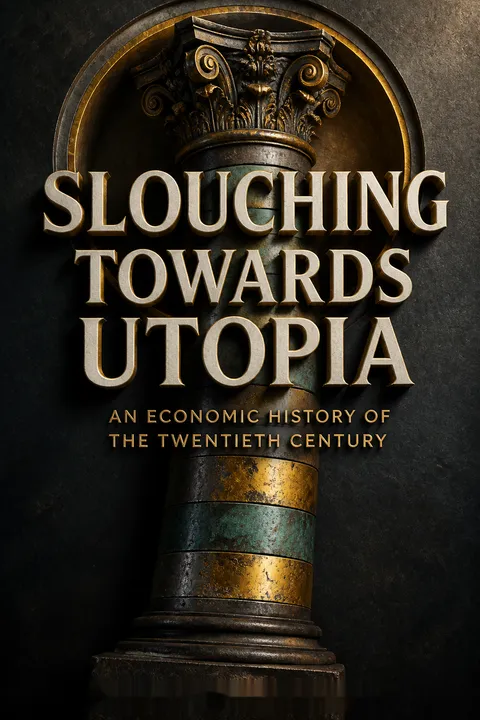

Key Takeaways
1. The Long 20th Century: Humanity's Great Escape from Poverty (1870-2010)
The 140 years from 1870 to 2010 of the long twentieth century were, I strongly believe, the most consequential years of all humanity’s centuries.
A watershed moment. The year 1870 marked a profound shift, as the triple emergence of globalization, the industrial research lab, and the modern corporation began to pull the world out of the dire poverty that had plagued humanity for millennia. This period, which I call the "long twentieth century," saw the average worldwide pace of useful ideas about manipulating nature and organizing humans jump from about 0.45 percent per year before 1870 to 2.1 percent per year afterward.
Breaking Malthus's spell. For most of human history, technological advances were consumed by population growth, trapping humanity in a cycle of subsistence-level poverty, a phenomenon Thomas Robert Malthus gloomily described. After 1870, however, technology began to outpace human fecundity, leading to unprecedented wealth creation. By 2010, average world income per capita was roughly 8.8 times what it was in 1870, and extreme poverty had plummeted from 70% to less than 9% of humanity.
Utopia unreached. Despite this astonishing material progress, the world of 2010 was far from a utopia. The immense wealth was vastly unequally distributed, and new technologies were often used for exploitation and tyranny. The core challenge remained: how to translate humanity's newfound power to create abundance into a society where everyone could "live wisely and agreeably and well," a question that the market economy alone could not answer.
2. The Invention of Invention: Technology's Unprecedented Acceleration
What changed after 1870 was that the most advanced North Atlantic economies had invented invention.
Systematizing innovation. Before 1870, inventions were largely singular discoveries, requiring inventors to also be engineers, managers, and financiers. The post-1870 era saw the rise of the industrial research lab and the large modern corporation, which rationalized and routinized the process of scientific discovery, technological development, and mass-scale deployment. This "invention of invention" allowed for continuous, rapid innovation.
A "second industrial revolution." This period brought forth a cascade of new commodities and technologies that transformed daily life, from steel and electricity to telephones, automobiles, and household appliances. Robert Gordon aptly described this as "one big wave" of technological advance, fundamentally altering:
- Urban infrastructure (electricity, gas, clean water)
- Transportation (decline of horses, rise of automobiles)
- Household conveniences (refrigerators, washing machines)
- Communication (telephones, radio)
Creative destruction. This relentless technological revolution, as Joseph Schumpeter observed, constantly "revolutionizes the economic structure from within, incessantly destroying the old one." While creating immense wealth, it also imposed poverty and anxiety on those whose livelihoods were tied to obsolete technologies, necessitating new forms of societal management.
3. Hayek vs. Polanyi: The Enduring Tension Between Market Logic and Human Rights
The market economy solved the problems that it set itself, but then society did not want those solutions—it wanted solutions to other problems, problems that the market economy did not set itself, and for which the crowdsourced solutions it offered were inadequate.
Market's power and limits. Friedrich August von Hayek championed the market economy as the only system capable of efficiently coordinating human activity and generating wealth, arguing that attempts to impose "social justice" would inevitably lead to serfdom. He believed the market's decentralized "spontaneous order" embodied more information than any central planner could grasp, making it the sole path to progress.
Society's counter-demands. Karl Polanyi, however, argued that the market economy, by recognizing only property rights, ignored fundamental human rights to:
- A stable community and environment.
- A suitable income commensurate with effort.
- Economic stability and job security.
Society, he predicted, would inevitably react against the market's dehumanizing tendencies, leading to a "double movement" of market expansion followed by societal self-protection.
The political struggle. This tension played out in the political arena, as seen in the labor conflicts of late 19th-century Chicago or the debates over suffrage. While some sought to protect property and order, others demanded that the market be "made for man, not man for the market." The inability to reconcile these competing demands often led to political instability and, as World War I approached, a dangerous turn towards nationalism.
4. Globalization's Double-Edged Sword: Prosperity for Some, Underdevelopment for Others
The proportion of global economic activity that was traded across today’s national borders rose from perhaps 9 percent in 1870 to perhaps 15 percent in 1914, as the revolutionary decreases in the cost of transport massively outstripped what were also that era’s revolutionary decreases and differentials in costs of production.
Unprecedented integration. The period from 1870 to 1914 saw an explosion of globalization, driven by:
- Revolutionary transport: Iron-hulled steamships and railroads drastically cut shipping costs.
- Instant communication: The global telegraph network connected continents in minutes.
- Mass migration: 100 million people changed continents, seeking better lives.
- Open borders: Reduced barriers to trade and investment.
This integration created a single world economy, where opportunities and constraints in one region depended on events elsewhere.
Divergence, not convergence. While globalization brought immense benefits, particularly to the Global North (e.g., rising wages in Europe, higher living standards for migrants), it also led to a stark divergence. The Global North industrialized rapidly, while the Global South often experienced deindustrialization and became a low-wage periphery specializing in primary products. This was exacerbated by:
- Imperialism: European powers imposed their will, often hindering local industrialization.
- Lack of "Big Push": Colonial masters did little to foster industrial development in their subjects.
- Competition: Low-wage labor from India and China suppressed wages elsewhere in the Global South.
Japan's unique path. Japan stood out as the sole non-European nation to successfully industrialize and join the ranks of imperial powers during this era. Through the Meiji Restoration, it rapidly adopted Western technology and organization, focusing on "a rich country with a strong army" (Fukoku kyōhei) and providing a model for later East Asian development.
5. The Catastrophe of Ideology: How Utopian Dreams Led to Dystopian Horrors
Thanks to ideology, the twentieth century was fated to experience evildoing on a scale calculated in the millions.
War's irrationality. Norman Angell's pre-WWI argument that war was economically irrational proved tragically wrong. The "Great Illusion" was that humanity had outgrown war; instead, nationalism, aristocratic ambition, and miscalculation plunged Europe into World War I, a conflict that killed over 10 million and shattered empires.
The rise of totalitarianism. The devastation of WWI and the subsequent Great Depression created fertile ground for totalizing ideologies promising radical societal transformation:
- Really-Existing Socialism (Lenin/Stalin): Claimed to build Marx's utopia, but in agrarian Russia, it led to brutal civil war, "war communism," forced collectivization, purges, and famines that killed tens of millions. It was a "command economy" that required a "command polity."
- Fascism (Mussolini/Hitler): Rejected liberalism and socialism, promising national unity and purpose under a strong leader. It leveraged economic discontent, contempt for limits, and violent assertion, often rooted in ethno-nationalism and antisemitism.
Ideology's deadly grip. Both really-existing socialism and Nazism, despite their theoretical differences, shared a contempt for individual rights, a reliance on terror, and a willingness to sacrifice millions for their utopian (or dystopian) visions. Hitler's Malthusian-inspired quest for "living space" (Lebensraum) in the East, fueled by antisemitism and a belief in racial superiority, led to World War II and the Holocaust, killing over 60 million people.
6. Social Democracy's Golden Age: A Brief Era of Shared Prosperity and Stability
In the Thirty Glorious Years, wise business leaders recognized that Keynes and his full-employment policies were not their enemies but their best friends.
Post-WWII resurgence. Following the devastation of World War II, the Global North experienced an unprecedented economic boom from 1945 to 1973, dubbed the "Thirty Glorious Years." This era saw G-7 economies grow at an average of 3% per year, doubling material wealth every 23 years, and bringing widespread prosperity, particularly to white men.
The Keynesian consensus. This success was underpinned by a "shotgun marriage" of Hayek's market efficiency, Polanyi's social rights, and Keynes's demand management. Governments, having learned from the Great Depression, prioritized full employment and economic stability, using fiscal and monetary policies to smooth business cycles. This created a virtuous cycle where:
- High employment meant high capacity utilization and profitability.
- Rapid growth allowed for social safety nets without crippling the economy.
- Unions secured higher wages and benefits, expanding the middle class.
The social democratic state. This period saw the rise of the welfare state, with expanded social insurance programs, public investment (e.g., US Interstate Highway System), and a "great compression" of income inequality. While not fully egalitarian, it provided a sense of shared progress and opportunity, especially for the burgeoning middle class in suburban homes.
7. The Neoliberal Turn: A Flawed Response to Stagnation and Discontent
But after expectations had been set so high by the prosperity of 1945–1973, 1.6 percent didn’t look so impressive.
End of the Golden Age. The rapid growth of the Thirty Glorious Years slowed sharply after 1973, due to factors like:
- Environmental cleanup efforts diverting resources.
- Oil price shocks (1973, 1979) disrupting the global economy.
- Exhaustion of post-WWII "catch-up" opportunities.
This slowdown, coupled with rising inflation (stagflation), eroded public confidence in social democracy's ability to deliver continuous prosperity.
The right's resurgence. Discontent created an opening for neoliberal ideas, which blamed government overreach and social democratic policies for economic woes. Figures like Ronald Reagan and Margaret Thatcher promised to restore growth by:
- Cutting taxes, especially for the rich.
- Deregulating markets.
- Curbing union power.
- Reducing government spending.
This shift was also fueled by a cultural backlash against perceived "permissiveness" and the erosion of traditional hierarchies, including racial and gender equality.
Failed promises, enduring influence. Despite failing to restore rapid, equitable growth (median incomes stagnated, inequality soared), neoliberalism became the dominant political-economic paradigm. It gained legitimacy by:
- Taking credit for the end of the Cold War.
- Appealing to a sense of "deserved" wealth for the rich and punishment for "undeserving" poor.
- Being aggressively promoted by plutocrat-funded networks.
This ideological doubling down, even in the face of empirical failure, set the stage for the "Second Gilded Age" and a growing distrust in the system among the working and middle classes.
8. Information Technology and Hyperglobalization: Reshaping Work and Wealth
Thus, after 1990, manufacturing, which had been increasingly concentrating itself in the global north since 1800, began to spread out away from the global north at tremendous speed.
The microelectronics revolution. Starting in the 1950s and reaching critical mass in the 1990s, microelectronics emerged as a new General Purpose Technology. Moore's Law, predicting the doubling of transistors on a chip every two years, drove exponential growth in computing power, transforming:
- Calculation and communication.
- Manufacturing processes (microcontrollers).
- The nature of work (complementing, then substituting for, human labor).
Hyperglobalization's "second unbundling." This IT revolution, combined with containerization, enabled a "second unbundling" of global production. It became possible to geographically separate a firm's sophisticated industrial division of labor, leading to:
- Global value chains: Manufacturing shifted from the Global North to low-wage regions in the Global South (e.g., China, Korea, Taiwan).
- "Smile curve" economics: Value concentrated in design/raw materials (beginning) and marketing/branding (end), with less value in manufacturing (middle).
- Uneven development: While some Global South regions (e.g., East Asian "growth poles") benefited immensely, others remained disconnected.
Disruption in the Global North. While hyperglobalization brought cheap goods and new capabilities to consumers, it also led to:
- Decline in manufacturing jobs: Especially for less-skilled workers.
- Wage stagnation: Productivity gains concentrated at the top, not trickling down.
- Polanyian backlash: Workers felt their rights to stable employment and community were violated, blaming globalization for their plight.
9. The Great Recession: A Self-Inflicted Wound and a Failure of Governance
It is only when the tide goes out that you discover who has been swimming naked.
Hubris and nemesis. By 2007, a neoliberal consensus of light financial regulation and confidence in central bank crisis management had taken hold. This hubris, coupled with a "global savings glut" and a housing bubble fueled by reckless mortgage lending and opaque financial derivatives, set the stage for nemesis.
A Minskyite depression. The collapse of the housing market in 2007 triggered a crisis of confidence, leading to a "Minskyite depression"—a severe shortage of safe assets. The financial system, made opaque by derivatives, became paralyzed as institutions distrusted each other's solvency. The uncontrolled bankruptcy of Lehman Brothers in September 2008 magnified initial losses by a factor of 40, pushing the world economy to the brink of meltdown.
Policy failures. Despite the existence of a "Bagehot-Minsky playbook" for managing such crises (lend freely at a penalty rate on good collateral), governments and central banks:
- Were slow to act, fearing moral hazard and political backlash.
- Failed to distinguish between insolvent and illiquid institutions.
- Ignored the "penalty rate" component, allowing bankers to profit from bailouts.
This led to an anemic recovery, with high unemployment persisting for years in the Global North, while China, by contrast, implemented massive fiscal stimulus and avoided recession.
10. The End of an Era: Why the Slouch Towards Utopia Stalled
Thus the long twentieth century’s story was over.
A broken promise. The Great Recession exposed the fragility of the neoliberal order and the failure of its promises. Productivity growth stalled, income inequality intensified, and governments proved unwilling or unable to implement effective recovery policies. The "slouch towards utopia" had not only slowed but seemed to have lost its direction.
Erosion of confidence. By 2010, several factors signaled the end of the long twentieth century's defining characteristics:
- US exceptionalism undermined: Challenged by rising powers and its own foreign policy misadventures.
- Globalization in reverse: Few advocates, many enemies, as its costs became more visible.
- Loss of confidence in the future: Global warming emerged as a Malthusian threat, unchecked by decisive action.
- Political breakdown: The rise of populist and neofascist politicians, fueled by economic discontent and a search for scapegoats.
A new narrative needed. The election of Donald Trump in 2016 cemented the sense of rupture, highlighting a world where pessimism, fear, and division animated events. The old frameworks of progress and American leadership no longer applied. Humanity, possessing godlike technological powers, found itself unable to build a truly human world, leaving the question of how to "live wisely and agreeably and well" more pressing than ever, and demanding a new grand narrative to make sense of its predicament.
Review Summary
Slouching Towards Utopia examines economic history from 1870-2010, receiving mixed reviews averaging 3.92/5 stars. Supporters praise DeLong's engaging narrative style, accessible prose, and synthesis of economic and political history through the lens of Hayek, Polanyi, and Keynes. Critics fault the book's meandering structure, superficial treatment of non-US history, oversimplified catchphrases, and glaring omission of climate change. Many note it offers little new insight for knowledgeable readers. The writing style—mixing academic economics with internet memes—divides readers. Most agree it provides a solid introduction for newcomers but disappoints those seeking deeper analysis or broader geographic scope.
People Also Read









Download PDF
Download EPUB
.epub digital book format is ideal for reading ebooks on phones, tablets, and e-readers.








































