
Key Takeaways
1. The Constitution was a "Covenant with Death," deeply protecting slavery.
A careful reading of the Constitution reveals that the Garrisonians were correct: the national compact did favor slavery.
Foundational flaw. The American Constitution, often hailed as a beacon of liberty, was fundamentally compromised by its protections for slavery. Abolitionists like William Lloyd Garrison rightly called it "a covenant with death" and "an agreement with Hell," arguing that it strengthened slavery's hold on the nation. This perspective, though controversial, is supported by a detailed examination of the 1787 Constitutional Convention and the document's text.
Explicit and implicit protections. Five clauses directly sanctioned slavery, referring to enslaved people as "other persons" or "persons held to Service or Labour" to avoid the term "slave." Numerous other provisions indirectly guarded the institution, ensuring its survival and growth within the new federal structure. These protections were not accidental but the result of deliberate political bargaining.
Southern dominance. Slave owners, particularly from the Deep South, tenaciously fought for and largely secured their interests. They understood that the Constitution, by creating a government of limited powers, lacked the authority to interfere with slavery within the states, a crucial guarantee for the institution's long-term viability. This framework ensured that the national government would, for decades, pursue policies that protected slavery.
2. The Three-Fifths Clause granted disproportionate power to slave states.
The three-fifths clause also gave the South extra political muscle—in the House of Representatives and in the electoral college—to support that claim.
Political leverage. The Three-Fifths Clause, counting three-fifths of enslaved persons for representation in Congress and the Electoral College, was a critical victory for slave states. This provision, initially proposed as a compromise for taxation, was adapted for representation, giving Southern whites disproportionate influence in national elections and legislative decisions.
Southern advantage. Virginia, the most populous state, stood to gain significantly from this clause, as its large enslaved population would boost its congressional delegation. This electoral advantage was a key factor in Southern delegates' consistent support for population-based representation, assuming the three-fifths rule would be applied. The clause effectively amplified the political voice of slaveholders.
Northern acquiescence. Despite objections from some Northern delegates, who questioned the morality and fairness of counting property for representation, the clause was ultimately adopted. This early concession to Southern demands highlighted the willingness of Northern states to compromise on slavery for the sake of forming a stronger Union, setting a precedent for future proslavery policies.
3. The "Dirty Compromise" secured the slave trade for the Deep South.
An understanding on the two subjects of navigation and slavery, had taken place between those parts of the Union, which explains the vote on the Motion depending, as well as the language of General Pinckney and others.
Economic alliance. The "dirty compromise" at the Constitutional Convention involved a direct trade-off: New England delegates agreed to protect the African slave trade for twenty years and ban export taxes, in exchange for Southern support for Congress's power to regulate commerce by a simple majority. This alliance between commercial North and agrarian South was crucial for the Constitution's adoption.
Deep South's demands. Delegates from South Carolina and Georgia vehemently insisted on explicit constitutional protection for the African slave trade, threatening to reject the Constitution otherwise. They argued that their economies "cannot do without slaves" and that a ban would be "an exclusion of S. Carolina from the Union." This blustering proved effective in securing their demands.
Moral sacrifice. Despite moral objections from some, particularly Gouverneur Morris, the compromise was struck. Northern delegates, eager for a stronger Union and unified commercial system, justified their concessions by arguing that the slave trade provision was temporary and that the trade would eventually end. This pragmatic decision prioritized national unity and economic interests over the immediate moral imperative against slavery.
4. The Northwest Ordinance's antislavery promise was ambiguous and often evaded.
There shall be neither slavery nor involuntary servitude in the said territory, otherwise than in the punishment of crimes, whereof the party shall have been duly convicted: provided always, that any person escaping into the same, from whom labour or service is lawfully claimed in any one of the original states, such fugitive may be lawfully reclaimed, and conveyed to the person claiming his or her labour or service as aforesaid.
Ideal vs. reality. The Northwest Ordinance of 1787, with its famous Article VI prohibiting slavery, is often seen as a landmark antislavery achievement. However, its implementation was fraught with ambiguity and evasion, allowing slavery to persist in the region for decades, particularly in what became Indiana and Illinois. The article's lack of an enforcement mechanism and internal inconsistencies undermined its stated goal.
Southern motivations. Southern congressmen, who voted for the Ordinance, may have done so for various reasons, including:
- Preventing economic competition from the Northwest in crops like tobacco and indigo.
- Implicitly sanctioning slavery in territories south of the Ohio River.
- Securing the fugitive slave clause within the Ordinance, a protection not yet in the Constitution.
- The need to pass legislation to facilitate land sales to the Ohio Land Company.
Persistent bondage. Despite the Ordinance, territorial governors like Arthur St. Clair and William Henry Harrison, often slave owners themselves, interpreted Article VI narrowly, asserting it only applied to new slave importations, not existing slaves. They actively promoted laws that created de facto slavery through long-term indentures, ensuring that many enslaved people and their descendants remained in bondage until well into the 19th century.
5. The Fugitive Slave Law of 1793 solidified federal power for slave owners.
This law was a major boon to the South with no reciprocal gain for the North.
Federal enforcement. The Fugitive Slave Law of 1793, enacted in response to a dispute between Pennsylvania and Virginia over the kidnapping of a free black man, John Davis, established a federal mechanism for the rendition of runaway slaves. This law, passed by a Congress dominated by the founding generation, significantly strengthened the constitutional fugitive slave clause, which had previously lacked clear enforcement provisions.
Summary process. The law allowed slave owners or their agents to seize alleged fugitives without a warrant and bring them before a federal or state magistrate. Proof of ownership could be established through oral testimony or affidavit, with no provision for a jury trial or defense for the alleged fugitive. This summary process made it easy to reclaim runaways but also created significant risks for free blacks, who could be kidnapped and enslaved.
Northern acquiescence. Despite the law's proslavery implications and the potential for abuse, many Northern congressmen, including some who opposed slavery, voted for it. This reflected a "federal consensus" that national unity required concessions to slaveholding interests. The law's passage underscored the early national government's willingness to use its power to protect slavery, even at the expense of individual liberty and state autonomy.
6. The 1808 ban on the African Slave Trade was a limited, yet significant, antislavery achievement.
This was the first time in history that a slaveholding society voluntarily ceased to import new slaves.
Historic ban. In 1807, Congress passed legislation, effective January 1, 1808, to ban all importations of slaves into the United States. This was a momentous step, marking the first time a slaveholding nation voluntarily ended the transatlantic slave trade. President Thomas Jefferson, despite his personal contradictions, advocated for the ban, aligning with widespread opposition to the trade.
Economic and moral motivations. Opposition to the African slave trade stemmed from various factors:
- Economic: Virginia and Maryland slaveholders had a surplus of enslaved labor and stood to benefit from increased slave prices if new imports ceased.
- Humanitarian: Many found the transatlantic trade particularly brutal and immoral, even if they tolerated domestic slavery.
- Prudential: Fears of a growing, potentially rebellious, African-born slave population.
Limited impact on slavery. While the ban prevented hundreds of thousands of Africans from being forcibly brought to America, it did not challenge the institution of slavery itself within the United States. Illegally imported Africans were often sold into slavery in Southern states, and the domestic slave trade flourished, relocating enslaved people from the Upper South to the burgeoning cotton kingdom of the Deep South and Southwest.
7. Federalists generally opposed slavery more consistently than Jeffersonian Republicans.
In the realm of race, the Federalists clung to the ideological inheritance of the Revolution far more than the Jeffersonians.
Party divide. During the Age of Federalism, a discernible pattern emerged: Federalists, particularly in the North, tended to be more critical of slavery and supportive of black rights than their Jeffersonian Republican counterparts. This ideological split became evident in various political and social issues, from constitutional debates to foreign policy.
Key differences:
- Constitutional interpretation: Federalists often highlighted the proslavery compromises of the Constitution, while Republicans, despite their "Empire for Liberty" rhetoric, defended the spread of slavery into new territories.
- Black suffrage: Federalists generally supported black voting rights in states where it existed, whereas Republicans often sought to restrict or eliminate it, appealing to white working-class anxieties.
- Haitian Revolution: The Federalist Adams administration fostered trade and diplomatic relations with the black republic of Haiti, seeing Toussaint L'Ouverture as a revolutionary leader. In stark contrast, the Jeffersonian administration actively sought to undermine Haiti, imposing embargoes and even offering aid to France to re-impose slavery.
Moral and economic underpinnings. Federalist opposition to slavery was often rooted in a combination of moral convictions (influenced by Puritanism and Quakerism), economic interests (favoring free labor and maritime trade over plantation agriculture), and an elitist perspective that allowed them to grant rights to blacks without feeling threatened by social equality. This contrasted with the Jeffersonians' reliance on Southern slaveholding elites and their appeal to white racial solidarity.
8. Thomas Jefferson's ideals of liberty starkly contrasted with his actions as a slave owner.
His words are those of a liberty-loving man of the Enlightenment. His deeds are those of a self-indulgent and negrophobic Virginia planter.
Profound contradiction. Thomas Jefferson, the eloquent author of the Declaration of Independence's assertion that "all men are created equal," lived his entire adult life as a slave owner. This fundamental contradiction between his professed ideals of liberty and his personal reliance on human bondage is a central, uncomfortable truth of his legacy.
Inaction on emancipation. Despite opportunities to act, Jefferson did little to end slavery or even diminish his personal connection to it. He never publicly advocated for emancipation while in office, and even in retirement, he discouraged others from doing so. His proposed emancipation schemes were often impractical, delayed, or conditioned on the forced expatriation of freed blacks, reflecting his deep-seated fears of a multiracial society.
Financial dependence. Jefferson's extravagant lifestyle and chronic indebtedness made him deeply dependent on his enslaved labor force. He frequently sold enslaved individuals, often separating families, to manage his finances, a practice he claimed to have "scruples" about but consistently engaged in. This economic reality often overshadowed any theoretical opposition he held towards the institution.
9. Jefferson's deep-seated racism underpinned his inability to embrace emancipation.
Because Jefferson could not imagine living in a society in which blacks could claim equal rights, he could never comfortably consider emancipation or manumission.
Racial prejudice. Jefferson's inability to reconcile his ideals of liberty with the reality of slavery was deeply rooted in his profound racism. He believed blacks were intellectually inferior, swayed by emotion, and incapable of participating in a free republican society alongside whites. These views, articulated in his Notes on the State of Virginia, were extreme even for his era.
Fear of free blacks. Jefferson harbored an almost paranoid fear of free blacks, viewing them as "pests in society by their idleness, and the depredations to which this leads them." He also feared miscegenation and the potential for violent retribution from formerly enslaved people. These anxieties made him insist on "expatriation" or colonization as a prerequisite for any emancipation, a solution he knew was impractical on a large scale.
Scientific racism. Jefferson's pseudoscientific speculations about black inferiority, such as their supposed lack of imagination or "disagreeable odour," contributed to the intellectual justification for racism in America. Despite evidence of black accomplishment, like Benjamin Banneker's almanac or Phillis Wheatley's poetry, Jefferson dismissed or downplayed such achievements, reinforcing his preconceived notions of racial hierarchy.
10. Jefferson's relationship with Sally Hemings highlights the moral complexities of his life.
From a moral perspective, does it matter much whether Jefferson held his own children in bondage, or merely his blood relatives and his wife’s blood relatives?
Family in bondage. The DNA evidence confirming Thomas Jefferson fathered at least one child with his enslaved woman, Sally Hemings, brought to light a profound moral dilemma. Sally Hemings was also the half-sister of Jefferson's deceased wife, Martha, making her children doubly related to him. This relationship underscores the deeply intertwined nature of slavery, family, and power at Monticello.
Enslaving his own. Even before the DNA confirmation, it was widely accepted that Jefferson enslaved his wife's half-siblings (the Hemings family) and their children, who were his nieces and nephews by marriage and, in the case of Sally's children, his grandnieces and grandnephews by blood. The question of whether he enslaved his own children or merely his close relatives highlights the inherent moral compromises of his position as a slave owner.
Selective manumission. Jefferson's manumission record is telling: he freed only eight enslaved individuals during his lifetime and in his will, all of whom were members of the Hemings family. These were not acts of broad benevolence but often involved complex circumstances, such as Robert Hemings buying his freedom or James Hemings asserting his freedom after living in France. The fact that he freed some of his enslaved relatives while condemning others, including Sally Hemings herself, to continued bondage, reveals the selective and self-serving nature of his "antislavery" actions.
11. Historians have often distorted the record to preserve Jefferson's idealized image.
The historian who questions Jefferson, it would seem, implicitly questions America.
Protecting the icon. For generations, many historians and biographers have actively sought to protect Thomas Jefferson's image as a flawless champion of liberty, often downplaying, excusing, or outright denying his problematic relationship with slavery and race. This tendency stems from a belief that Jefferson is a foundational symbol of America, and any criticism of him is seen as an attack on the nation itself.
"Presentism" as a shield. Critics of this historical approach often face accusations of "presentism"—unfairly judging an 18th-century figure by modern standards. However, this argument is often selectively applied; while Jefferson's defenders readily praise his "modern" liberal achievements, they resist applying contemporary moral scrutiny to his actions regarding slavery, even when compared to his own contemporaries who took stronger antislavery stances.
Selective narratives. This protective impulse has led to:
- Ignoring or misrepresenting Jefferson's racist views, such as his pseudoscientific theories on black inferiority.
- Downplaying his financial dependence on slavery and his frequent sales of enslaved people.
- Exaggerating his public and private efforts against slavery, often conflating opposition to the slave trade with opposition to slavery itself.
- Omitting inconvenient details from his correspondence, such as his advice to Edward Coles against emancipating his slaves.
This selective portrayal creates a distorted historical record, hindering a full and honest understanding of Jefferson's complex legacy and the deep contradictions at the heart of the American founding.
Review Summary
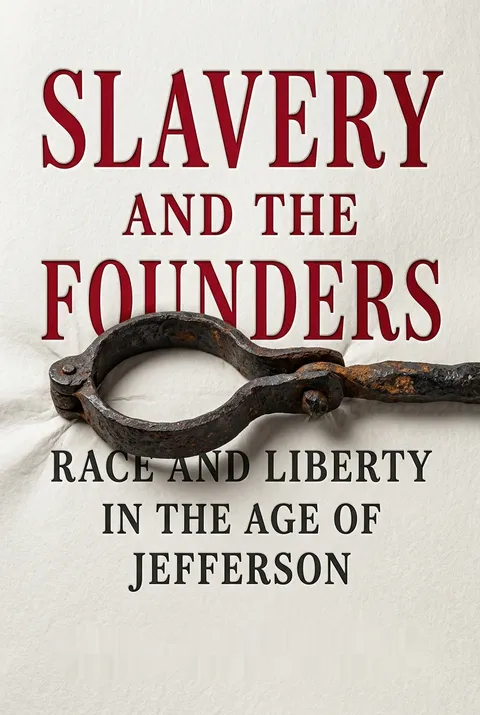
Slavery and the Founders by Paul Finkelman examines how slavery shaped America's founding, particularly focusing on the Constitutional Convention and Thomas Jefferson. Reviewers praise Finkelman's detailed analysis of political compromises that embedded slavery in the Constitution, especially the 3/5 clause. Multiple reviews highlight his critical examination of Jefferson's contradictions—publicly advocating liberty while privately maintaining white supremacist views and owning slaves. Some note repetitive organization and occasional unsupported assumptions. Overall, readers appreciate Finkelman's willingness to challenge sanitized portrayals of founding fathers and demonstrate slavery's central role in early American politics.
Download PDF
Download EPUB
.epub digital book format is ideal for reading ebooks on phones, tablets, and e-readers.








































