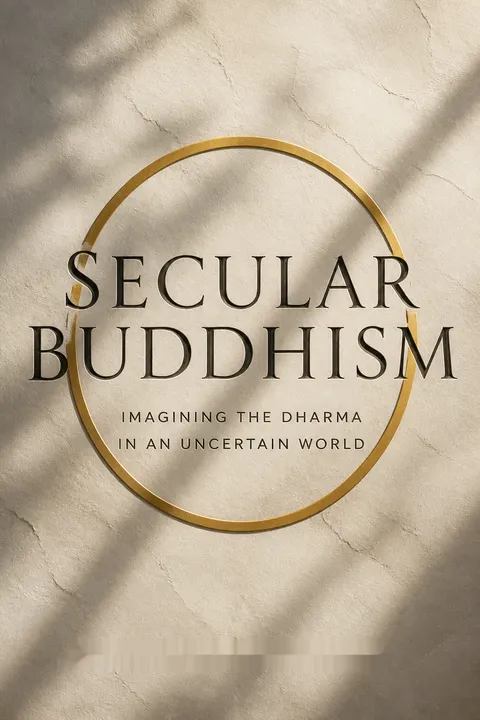

Key Takeaways
1. Secular Buddhism: A This-Worldly, Non-Religious Path
What, in other words, would a nonreligious, this-worldly, secularized Buddhism look like?
A new operating system. Secular Buddhism represents a fundamental re-imagining of the dharma, moving beyond its traditional religious and metaphysical frameworks. It seeks to articulate a vision of human flourishing rooted in this world, this age (saeculum), and our present experience, rather than in ancient Indian soteriology concerning karma, rebirth, and liberation from a cycle of lives. This shift is akin to upgrading from "Buddhism 1.0" to "Buddhism 2.0," rewriting the underlying operating system rather than just updating the software.
Three senses of secular. The term "secular" is understood in three overlapping ways:
- Non-religious: In contrast to traditional religious institutions and beliefs.
- This-worldly: Focused on the quality of our personal, social, and environmental experience on this planet.
- Historical-political: Reflecting the transfer of authority from religious institutions to temporal state power, as seen in the mainstreaming of practices like mindfulness.
Addressing modernity. This secular approach aims to make the dharma relevant to contemporary individuals informed by natural sciences and living in pluralistic societies. It questions whether traditional Buddhist tenets, often at variance with modern understanding, are essential for authentic practice, suggesting that the dharma's potential contributions to pressing global issues may be minimized if it remains confined to an ancient worldview.
2. Reimagining the Four Noble Truths as Four Tasks (ELSA)
The aim of one’s practice is not to confirm or refute such time-honored dogmas but to respond in a radically different way to what presents itself at any given moment.
From truths to tasks. The traditional presentation of the Four Noble Truths as propositions to be believed ("Existence is suffering," "Craving is the origin of suffering," etc.) is reinterpreted as four dynamic tasks to be performed. This shift moves the dharma from a belief-based metaphysical system to a praxis-based ethical framework, where the focus is on doing rather than believing.
The ELSA framework. This pragmatic approach is summarized by the acronym ELSA:
- Embrace: Fully know and accept dukkha (suffering/anguish) in all its forms, rather than denying or resenting it.
- Let go: Release the self-interested craving (taṇhā) that habitually arises in reaction to suffering, which hinders engagement with the path.
- Stop: Experience the cessation of reactivity, creating a clear, non-reactive space (nirvana) from which new possibilities emerge.
- Act: Cultivate the eightfold path, making ethical choices unconditioned by habitual patterns of greed, hatred, and self-centeredness.
A new causality. This reinterpretation inverts the traditional causal understanding: instead of craving causing suffering, suffering gives rise to craving. And the cessation of craving (nirvana) gives rise to the eightfold path, rather than being its ultimate goal. This makes the path an ongoing, positive feedback loop, a continuous engagement with life's conditions.
3. Agnosticism: Embracing Not-Knowing as a Catalyst for Action
To not know, to be agnostic, is nothing more than an honest acceptance of the limited human condition.
Beyond belief and disbelief. Agnosticism, in the context of secular Buddhism, is not a superficial disinterest but a profound acknowledgment of the limits of human knowledge, particularly regarding metaphysical claims like karma and rebirth. It offers a middle way, allowing these concepts to remain open questions rather than dogmas to be asserted or denied. This "deep agnosticism" is a passionate recognition of fundamental unknowing.
Challenging consolatory illusions. Traditional religions often provide comforting explanations for life's mysteries, such as an afterlife or divine purpose. Agnosticism strips away these consolatory illusions, forcing a direct confrontation with the "Great Matter of Birth and Death" and the sheer bafflement of existence. This confrontation, rather than leading to despair, can be a powerful catalyst for spiritual awareness and ethical action.
A pragmatic stance. For an agnostic Buddhist, the value of dharma practice—generosity, compassion, mindfulness, inquiry—is self-validating and worthwhile in itself, irrespective of arcane theories of multiple lives. This shifts concern from a hypothetical future life to the urgent dilemmas of the present, demanding a compassion-centered ethic. It fosters a sense of awe and wonder at the contingent nature of life, unclouded by dogma.
4. The Human Buddha: A Pragmatic Guide, Not a Metaphysical Authority
The Buddha’s life is in itself a teaching of the dharma.
Beyond myth and hagiography. Secular Buddhism seeks to recover the historical Gotama, a flesh-and-blood human being who lived and taught in fifth-century BCE India, rather than the quasi-divine figure of later myth. This involves a critical reading of early canonical texts, differentiating between what Gotama likely taught and later interpolations influenced by prevailing Indian cosmologies.
A situational physician. Gotama is presented not as a metaphysician offering universal truths about reality, but as a pragmatic physician who prescribed different "medicines" (teachings) to specific people in specific situations. His primary concern was alleviating suffering in this life, not providing answers to abstract metaphysical questions about the universe or the afterlife.
Life as teaching. The Buddha's life, with its struggles, crises, and compromises, serves as a model for applying the dharma in a complex sociopolitical world. By humanizing the Buddha, the dharma itself becomes more grounded and accessible, challenging practitioners to engage with their own contemporary contexts rather than retreating into abstract spiritual ideals or idealized figures.
5. Creating Sangha: Beyond Monasticism to Inclusive Communities
A Buddhist community—a sangha—is not something one is merely born into or chooses to join but something one is challenged to create.
Re-evaluating monasticism. While acknowledging the historical importance of monastic communities in preserving the dharma, secular Buddhism questions their exclusive identification with the "sangha." Traditional monasticism, shaped by medieval socioeconomic conditions, often created a sharp divide between monastics and laity, limiting lay engagement with deeper practice.
Vulnerability of monastic structures. Historically, Buddhism's reliance on isolated monastic institutions made it vulnerable to external threats, as seen in its rapid decline during invasions in India and political upheavals in Asia. This suggests that a more integrated, socially embedded form of sangha is crucial for long-term survival in a secular world.
A new communal matrix. The modern world, with its widespread education and increased leisure, allows for a new conception of sangha where lay practitioners can pursue rigorous dharma study and practice. The challenge is to create imaginative, democratic communities that:
- Maintain the rigor and depth of tradition.
- Function caringly and critically in modern society.
- Avoid sectarianism, dogmatism, authoritarianism, and sexism.
- Are rooted in secular culture, fostering a "culture of awakening" for all.
6. Buddhism's "Other Enlightenment Project": Engaging Postmodernity
If a defining trait of our times is indeed widespread loss of credibility in such narratives and their inability any longer to compel consensus, then such ambitions may be doomed to frustration.
Postmodern resonance. Buddhism, with its emphasis on the fragmented self, contingent reality, and the ambiguity of perception, resonates strongly with postmodern thought. However, it's crucial to avoid simply labeling Buddhism as "postmodern," as it has its own distinct "Enlightenment Project" and has not undergone a Western-style modernity.
Critique of grand narratives. Secular Buddhism aligns with postmodern incredulity towards grand, totalizing narratives, including those that promise universal emancipation or a "New Society" based on Buddhist principles. Instead, it encourages the unfolding of individual and communal "petits récits" (small narratives) within imaginative, democratic communities.
Emptiness as a critical tool. The doctrine of emptiness, often misunderstood as nihilistic, serves as a powerful tool for deconstruction, sharing postmodernism's suspicion of a single, non-fragmentary self or a "transcendental signified." However, unlike purely intellectual postmodernism, meditation on emptiness is a contemplative discipline rooted in ethical commitment and offers a therapeutic approach to human anguish, fostering empathy and interconnectedness.
7. The Dharma as Art: Cultivating Imagination and Creativity
The artist’s dilemma and the meditator’s are, in a deep sense, equivalent.
Creative act of self-creation. Dharma practice is akin to creating a work of art, where one molds the "clay" of one's existence (body, feelings, perceptions, inclinations, consciousness) into a bodhisattva. This process of self-creation involves confronting the unknown, risking unpredictable responses, and expressing one's vision in an original way, much like an artist facing a blank canvas.
Imagination as a bridge. The Buddha's awakening is reinterpreted not just as a private insight, but as an explosion of imagination that finds expression in the dharma. Imagination acts as the bridge between contemplative experience and the anguish of the world, enabling the creative articulation of wisdom and compassion in response to specific situations.
Democracy of imagination. Traditional Buddhist institutions often control imagination, dictating what can and cannot be envisioned. Secular Buddhism advocates for a "democracy of the imagination," where every practitioner becomes an active creator of spiritual truths, envisioning and telling the story of their own unfolding. This frees individuals and communities to adapt the dharma to their unique needs, transforming "rubbish" into objects of contemplation and beauty.
8. Mindfulness: A Secular Gateway to Deeper Dharma
For certain people, an unintended consequence of such mindfulness practice is the experience of a still, vivid, and detached awareness that does more than just deal with a specific pain; it opens a new perspective on how to come to terms with the totality of one’s existence.
A Trojan horse for dharma. The widespread adoption of mindfulness in secular contexts—healthcare, education, workplace, criminal justice—is a significant development. While presented as a non-religious, value-neutral technique for stress reduction and improved performance, it often serves as an unintended gateway to deeper engagement with Buddhist principles for many individuals.
Beyond therapeutic technique. Jon Kabat-Zinn's definition of mindfulness, emphasizing "wise," "non-judgmental," and "ethical understanding," reveals its inherent values, which align with a secular ethics envisioned by the Dalai Lama. This suggests that mindfulness, as the seventh element of the eightfold path, is not merely a short-term therapeutic intervention but a practice that can lead to the non-reactive freedom of nirvana.
Recovering a secular soul. The secularization of mindfulness, while sometimes criticized as a "dumbing down," can also be seen as Buddhism recovering its secular soul, long obscured by religious beliefs. It demonstrates that the dharma's core practices can alleviate suffering and improve life quality independently of traditional cosmology, paving the way for a broader secularization of Buddhist ethics and philosophy.
9. Beyond Beliefs: A Praxis-Based Approach to Awakening
Above all, secular Buddhism is something to do, not something to believe in.
Pragmatism over dogma. Secular Buddhism fundamentally shifts the emphasis from believing in metaphysical propositions (like "existence is suffering" or "craving is the origin of suffering") to engaging in practices that make a tangible difference in one's life and the world. The efficacy of the dharma is judged by whether it "floats" – whether it works in practice – rather than by its adherence to ancient dogmas.
Awakening as a process. "Awakening" is reinterpreted not as a mystical insight into ultimate reality, but as an ongoing process of being-in-this-world, free from the conditioning of greed, hatred, fear, and selfishness. It is an ethical way of life and commitment that enables human flourishing, accessible to all, not just enlightened teachers.
Nirvana as source, not goal. Nirvana, understood as the stopping of craving, is seen as the source of the path, not its distant goal. It represents the clear, empty space that emerges when neurotic self-centeredness dissolves, freeing one to act with wisdom and compassion. This perspective empowers individuals to engage with the dharma as a living, transformative practice in the present moment.
10. The Everyday Sublime: Finding Awe in Contingent Existence
The view of reality disclosed through the natural sciences evokes for me feelings of awe incomparably greater than anything religious or mystical writings of any tradition can inspire.
Beyond the sacred. Rejecting traditional theological terms like "sacred" or "God," secular Buddhism embraces the concept of "the sublime" to describe profound experiences of awe and wonder. This is a "nontheological" sublime, found not in transcendent realms or magnificent landscapes alone, but in the "everyday" details of contingent existence.
Awe in the ordinary. The practice of mindful attention, whether in meditation or artistic creation, reveals the perplexing uniqueness and radiant contingency of each moment. This deepens one's awareness of life's infinitely poignant beauty, transforming the mundane into the awe-inspiring. The "everyday sublime" is about seeing the infinite in the ordinary, as William Blake suggested, by cleansing the "doors of perception."
Solar ethics. This perspective leads to a "solar ethics," concerned with shedding light (wisdom) and heat (compassion) into this world, which, as far as we know, might be the only one that ever has been or ever will be. It is a call to embrace life's transient, tragic, and impersonal nature, finding profound beauty and meaning in our shared, fragile existence on this planet.
Review Summary
Secular Buddhism receives mixed reviews, averaging 3.90 out of 5 stars. Many readers appreciate Batchelor's approach to modernizing Buddhism, praising his efforts to make it more accessible and relevant to Western audiences. Some find his ideas thought-provoking and helpful in their spiritual journey. However, critics argue that Batchelor's interpretation may oversimplify or misinterpret traditional Buddhist teachings. The book's structure as a collection of essays and interviews is noted, with some readers finding it uneven but still valuable for those familiar with Batchelor's work.
People Also Read






About the Author
Other books by Stephen Batchelor
Download PDF
Download EPUB
.epub digital book format is ideal for reading ebooks on phones, tablets, and e-readers.








































