

Key Takeaways
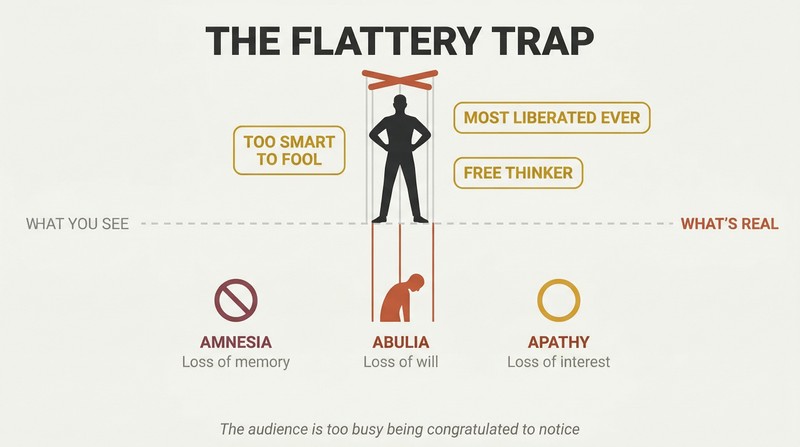
Flattery is mind control's master key — tell people they can't be fooled
The arrogant cannot be cured. Hoffman argues that the first and most fundamental technique of mass mind control is not force or technology — it's flattery. Tell people they're the smartest, most liberated beings in history and they'll never suspect manipulation. This principle, he claims, underlies "virtually every false religion, party, cult, philosophy, system and training."
Three symptoms diagnose the controlled. Like a patient who refuses treatment because he doesn't believe he's sick, the modern public displays what Hoffman identifies as three nearly universal symptoms:
1. Amnesia — loss of memory
2. Abulia — loss of will
3. Apathy — loss of interest in one's own survival
The trick works because the audience is too busy being congratulated to notice the real sales pitch has already begun.
The powerful reveal their crimes because a paralyzed public can't respond
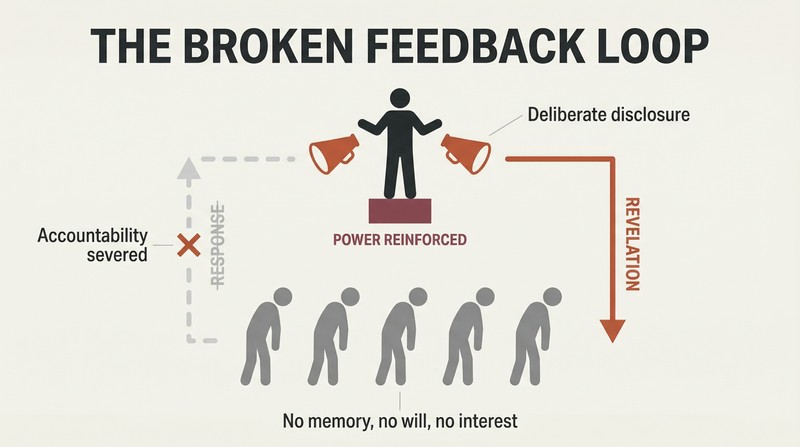
The hoodwink has been lifted. Hoffman's central thesis is that the hidden ruling hierarchy — which he terms the "cryptocracy" — no longer relies primarily on secrecy. In the early stages of operations spanning millennia, concealment was essential. But the modern public has been so thoroughly processed that the cryptocracy now deliberately reveals its methods, symbols, and crimes in what Hoffman calls the "Revelation of the Method."
Calculated disclosures, not leaks. In the 1970s, formerly classified occult knowledge was published in books by OTO initiate Kenneth Grant and astronomer Robert Temple — with the hierarchy's apparent approval. Even advertising agencies have pointed to subliminal imagery in their own liquor ads. These disclosures signal that secrets are revealed precisely because a degraded public cannot muster a meaningful response — rendering the confession a demonstration of power.
Silence after seeing the crime is the most potent form of consent
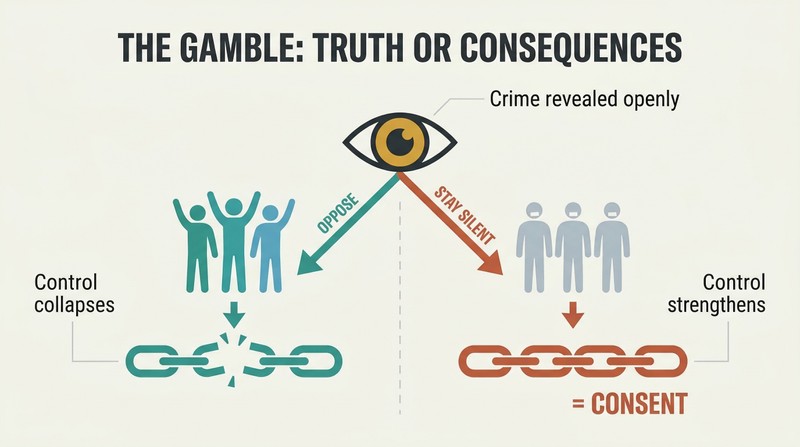
Silence is the signature. An ancient rule of moral and common law holds that silence connotes consent. When crimes are committed in secrecy, the perpetrators alone bear responsibility. But when those crimes are openly displayed and the public fails to respond with meaningful opposition, the dynamic shifts — the audience becomes complicit through inaction.
The "Truth or Consequences" gamble. Hoffman frames this through the New Mexico town of Truth or Consequences, a name linked to masonic toponomy — the deliberate naming and siting of locations for symbolic power. The cryptocracy gambles that revealing operations won't trigger revolt. If the public perceives truth and acts, consequences destroy the conspirators. If the public shrugs, their tacit consent strengthens control. So far, the response to revelations — from JFK evidence to FBI cover-ups — has been passive fascination.
Media condemns and sells the same vices to split your mind in two
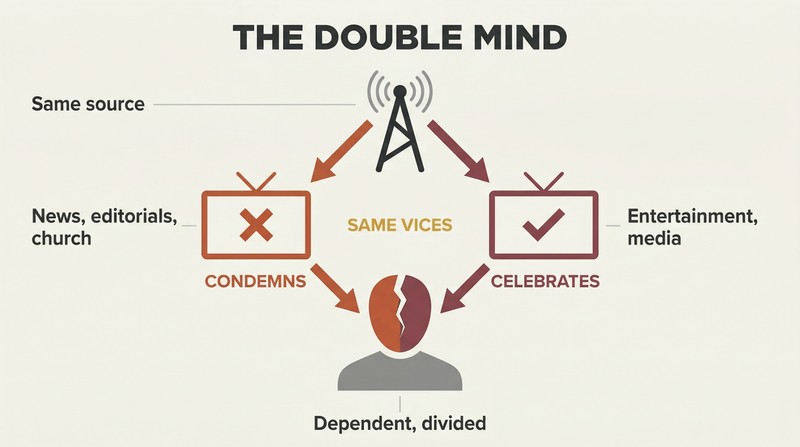
Condemn at six, celebrate at ten. The establishment operates two seemingly opposed channels simultaneously. The "Official Orthodoxy" — news editorials, church forums, police seminars — condemns sex, violence, and Satanism. The "Official Counter-Culture" — the entertainment arm of the same networks — lustily celebrates them with high production values.
Both sides are magnets. The orthodox side satisfies our self-image as moral beings. The counter-cultural side indulges what media critics openly call "guilty pleasures." Having reassured ourselves by sharing in the condemnation, we fling ourselves into the very content we agreed was execrable. This engineered schizophrenia — what Hoffman terms the "Double Mind" — creates a population internally at war, too divided to mount coherent resistance and therefore dependent on the very forces that created the rift.
Conspiracy exposure without prosecution advertises the criminal's power
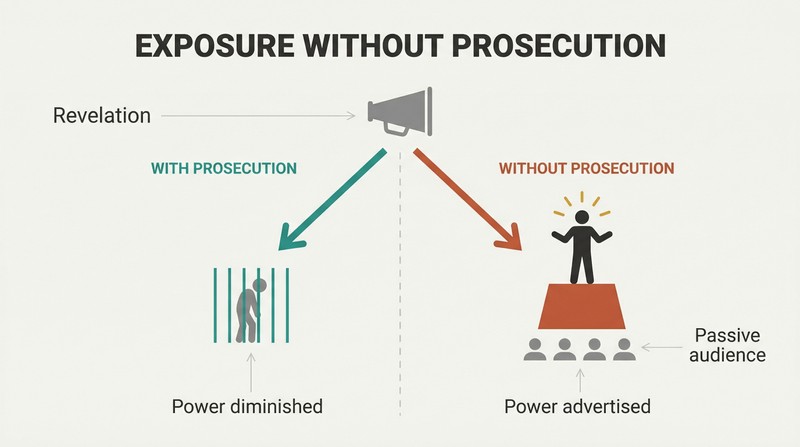
Sunlight doesn't disinfect invincibility. Most conspiracy researchers assume that exposure is a weapon — "If only we could get the facts out." Hoffman calls this bankrupt. When revelations are never followed by arrests or prosecutions, they achieve the opposite: they advertise the cryptocrats 'untouchability and magnify their mystique.
Shock becomes entertainment. The spectacular nature of revealed crimes generates titillation rather than outrage. The public becomes passive voyeurs who spread tales of criminal genius with a mixture of horror and admiration. "To whom are we directing the exposure?" Hoffman asks — presupposing an audience with the memory, will, and initiative to fight. Without that audience, the exposure feeds the alchemical process, further strengthening the psychological grip of those who committed the crimes and walked free.
Major public crimes function as open-air rituals processing millions
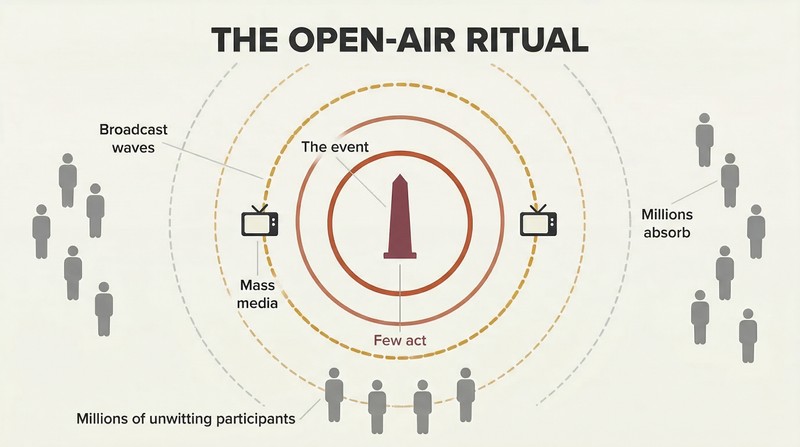
Rituals broadcast at scale. Hoffman argues that events like the JFK assassination and the Son of Sam murders are not merely crimes but choreographed ceremonies — what he calls "psychodramas" — designed to imprint the collective Group Mind. Amplified by mass media, they function like ancient rituals performed before millions of unwitting participants.
JFK's assassination transformed American culture. Dealey Plaza was the site of the first masonic temple in Dallas, near the Triple Underpass and Trinity River. Within a year, American culture lurched toward extremes — garish clothing, louder music, mainstream drugs, the Beatles arriving to "bind our wounds." A hidden government became a subliminal reality. The awareness that whoever could kill a president in broad daylight and escape could "get away with anything" transferred power from the visible government to an invisible one.
The 'lone nut' is a repeating script, not an anomaly
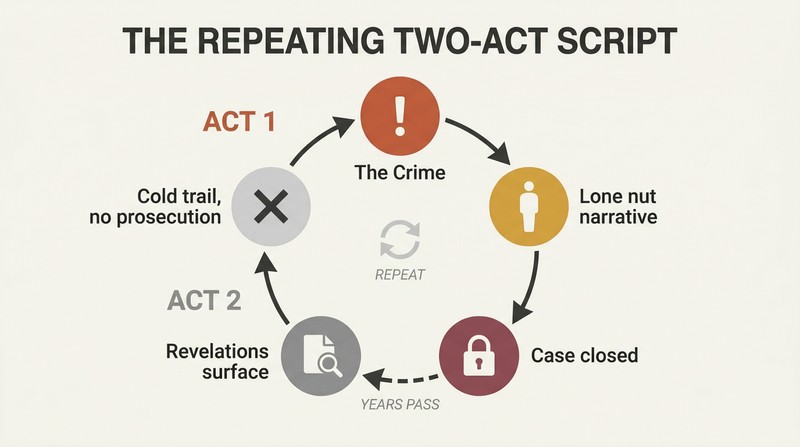
A two-act script spanning decades. Oswald. Berkowitz. Kaczynski. Each was presented as the sole perpetrator of spectacular crimes despite evidence of wider conspiracies. Hoffman identifies a repeating pattern:
1. The crime occurs; media and police establish an airtight "lone nut" narrative immediately
2. Years later, documented revelations emerge — but the trail is cold and no prosecutions follow
The Son of Sam case is instructive. Handwriting experts testified Berkowitz didn't write the famous letters. Witnesses gave descriptions that didn't match him. A phone list linking contacts "in high places" to the cult was never investigated. Commander Dowd declared the case "closed" the night of Berkowitz's arrest — the night the investigation should have begun in earnest. Berkowitz was never formally interrogated about accomplices.
The quest to 'perfect' nature through intellect always builds Babylon
Eden was already sufficient. Hoffman makes a radical claim: the very concept of civilization — from Stonehenge to Silicon Valley — represents humanity's original departure from paradise. Where New Age enthusiasts see ancient Druids harmonizing with nature, Hoffman sees the first technological tampering that "pinned down" natural forces for human exploitation.
The builder builds against the grain. The Hermetic Academy's philosophy holds that human intellect must "perfect" a flawed creation — symbolized by the masonic "Great Architect." Rosicrucian alchemist Robert Fludd dedicated himself to "regeneration of the natural world" amid vast virgin forests and pure waters. Hoffman's verdict: every attempt to artificially rebuild paradise produces Babylon. The "utopian" city of the Rosicrucians, he writes, "is before us today: New York and Los Angeles."

Science fiction trained you to accept a scripted, predetermined future
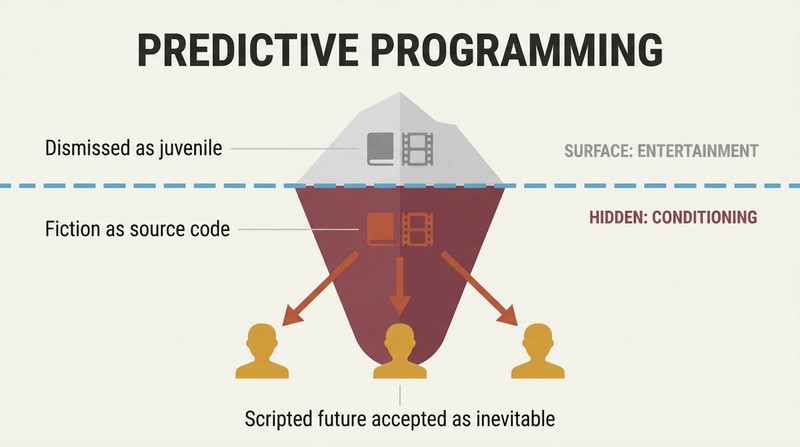
Fiction that programs reality. OTO initiates occupied key positions in science fiction publishing and Hollywood. Jack Parsons, founder of the Jet Propulsion Laboratory and leader of the California OTO lodge, worked alongside writers like Robert Heinlein and Arthur C. Clarke, whose novels shaped public expectations of an "inevitable" technological future.
The stealth advantage of derision. Clarke's Childhood's End depicts humanity calmly accepting the open rule of corporeal demons. Kubrick and Clarke's 2001: A Space Odyssey positions a mysterious monolith as the engine of evolution. Hoffman calls this "predictive programming" — the propagation of an infallibly accurate future through fiction. While serious thinkers dismissed the genre as juvenile, it was conditioning generations to accept genetic engineering, surveillance, and machine consciousness as progress rather than horror.
Electronic screens dissolve the private self into the collective hive
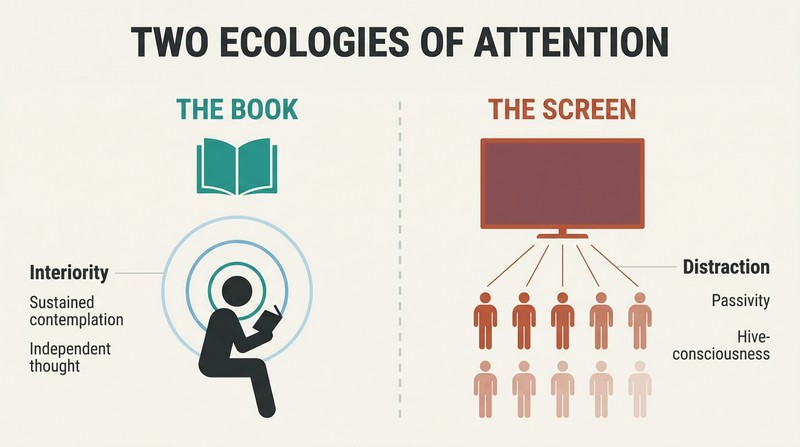
The Videodrome is the new temple. Drawing on Sven Birkerts' The Gutenberg Elegies, Hoffman argues that electronic media don't just deliver content — they restructure consciousness. The ecology of reading fosters interiority, sustained contemplation, and independent thought. The ecology of screens fosters distraction, passivity, and hive-consciousness.
The contrast is devastating. Birkerts found that his 1992 college students couldn't concentrate on Washington Irving's prose — raised on TV and video, they found it "verbose" and a "chore." Hoffman contrasts this with Puritan congregations so moved by Jonathan Edwards' read-aloud sermon that they clung to choir loft beams — though Edwards wore eyeglasses and read from papers held to his face. His words alone, received by undistracted minds, overwhelmed them. What changed was not the quality of sermons but the quality of attention.
Pursue discernment over data — information floods are themselves weapons
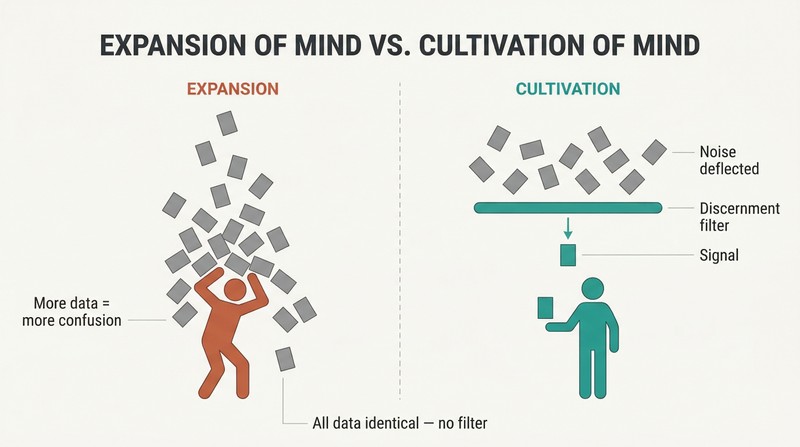
More data isn't the antidote. Hoffman received mountains of conspiracy research material and was struck by its "depressing similarity." The underlying premise across the genre was the "Expansion Principle": the belief that accumulating more information equals greater freedom. But without the ability to detect fraud and distinguish signal from noise, a data blizzard is a curse, not a cure.
The conspiracy genre can serve the conspiracy. When "expansion of the mind" replaces "cultivation of the mind," quantity reigns over quality. The X-Files television series debuted alongside renewed JFK assassination interest — generating what the FBI calls "noise" that dilutes legitimate inquiry. The goal should not be consuming ever more revelations but developing the discrimination to know which ones matter and the will to act on what survives scrutiny.
Analysis
Hoffman's book is a paranoid masterpiece — and 'paranoid' here carries both clinical and complimentary weight. It operates simultaneously as cultural criticism, occult history, and conspiracy cosmology, weaving threads that range from the plausible (documented FBI foreknowledge of the Oklahoma City bombing, police cover-ups in the Son of Sam case) to the wildly speculative (homunculi animated by atomic radiation at the Trinity Site).
The book's core intellectual contribution — the concept of 'Revelation of the Method '— is genuinely original and disturbingly applicable beyond its conspiracy context. The idea that power consolidates not through secrecy alone but through deliberate disclosure to a helpless audience anticipates later academic work on transparency without accountability. In an age of leaked documents, whistleblowers, and 24-hour news cycles that change nothing, Hoffman's central question — what good is revelation without response? — cuts deeper than its fringe packaging suggests.
Where Hoffman is strongest is in his analysis of psychological mechanisms: flattery as control, the double mind, the consent-through-inaction loop. These frameworks describe observable dynamics in advertising, political propaganda, and media consumption that don't require belief in Masonic cabals to be useful. His critique of electronic media's assault on interiority, written before smartphones existed, reads as prophetic.
Where the book falters is in its epistemological promiscuity. Hoffman treats symbolic correspondences — the word 'wicker' appearing across crime scenes spanning decades — as evidence of coordinated conspiracy, conflating pattern recognition with proof. His framework is unfalsifiable: coincidences that fit are evidence; those that don't are unrecognized elements of the pattern. The resulting text sometimes reads like a Rorschach test dressed as investigation.
Yet read as cultural philosophy rather than criminal journalism, the book raises genuinely urgent questions about spectacle, consent, and whether a society drowning in information but starving for wisdom can ever mount effective resistance to the forces that govern it.
Review Summary
Secret Societies and Psychological Warfare by Michael A. Hoffman II receives mixed reviews. Many praise its unique perspective on occult symbolism and mind control in modern society, while others find it confusing or far-fetched. Readers appreciate Hoffman's analysis of high-profile crimes and events through an occult lens. The book is seen as dense and challenging, best suited for those already familiar with conspiracy theories. Some criticize Hoffman's writing style and presentation, while others consider it a classic in the genre. Overall, it's viewed as thought-provoking but controversial.
People Also Read




Glossary
Revelation of the Method
Deliberate disclosure of hidden crimesHoffman's central concept describing the cryptocracy's strategy of intentionally revealing its crimes, methods, and symbols to the public after they have been accomplished. This disclosure strengthens rather than weakens their control, because a degraded public responds with passive fascination rather than revolt, and their inaction constitutes tacit consent to the process.
Cryptocracy
Hidden ruling secret society hierarchyHoffman's term for the concealed hierarchy of interconnected secret societies—including Freemasons, the OTO, Rosicrucians, and Kabbalists—that he argues has directed Western civilization for millennia. The cryptocracy operates through ritual, symbolism, and psychological warfare rather than conventional political power, using occult knowledge to manipulate the masses while concealing its true structure and aims.
Twilight language
Subliminal occult communication systemA nearly universal subliminal communication system used since antiquity, consisting of numbers, archetypal words, and symbols. In Hoffman's usage, twilight language appears embedded in modern advertising, news coverage, films, and the symbolic details surrounding ritual crimes. Derived from the Sanskrit concept of sandhyabhasa, it communicates meaning to the subconscious mind while the conscious mind remains unaware.
Group Mind
Collective psyche of mass audiencesThe psychic entity formed when large numbers of people are intently focused on the same object, image, or symbol—especially through electronic broadcast media. Also called the 'Dreaming Mind,' it is the primary target of ceremonial psychodramas. Hoffman argues that ritual murders and spectacular public events are designed to imprint this collective consciousness with terror, symbols, and occult significance.
Psychodrama
Staged ritual disguised as eventHoffman's term for elaborately choreographed public events—assassinations, serial murders, terrorist attacks—that function as mass occult ceremonies. Unlike random crimes, psychodramas are precisely staged with symbolic details, geomantic siting, and twilight language, then amplified by electronic media to process the Group Mind of millions of unwitting participants.
Mystical toponomy
Symbolic naming and siting of placesA concept attributed to researcher James Shelby Downard describing the deliberate naming and geographic siting of locations for ritual and symbolic significance. Examples include Truth or Consequences, New Mexico; Dealey Plaza in Dallas (site of the first masonic temple there); and Route 66's alignment from Chicago to the Mojave Desert. The cryptocracy treats the earth as a giant chess board for ritual operations.
Videodrome
Electronic media control apparatusBorrowed from David Cronenberg's 1983 film and expanded by Hoffman to describe the entire apparatus of electronic mass media—television, video, computers, Internet—as a system for psychological processing of the population. The Videodrome replaces physical masonic lodge ceremonies with broadcast spectacles that initiate millions simultaneously, creating what Hoffman describes as a population of passive, brutalized spectators.
Inevitabilism
Programming belief in predetermined futuresHoffman's coined term for the process of disseminating—through science fiction, media, and cultural programming—the sense that a particular technological or social future is unavoidable. By making a scripted future seem inevitable, the cryptocracy discourages resistance and ensures that alternatives are never seriously considered. The concept encompasses predictive programming through fiction, futurism, and self-fulfilling prophecy.
Hoodwink
Masonic term for secrecy/deceptionA masonic term defined by 33rd Degree Freemason Albert Mackey as 'a symbol of the secrecy, silence and darkness in which the mysteries of our art should be preserved from the unhallowed gaze of the profane.' Hoffman uses it broadly to describe the phase of concealment that preceded the current 'Revelation of the Method' era, when the cryptocracy's operations required maximum secrecy to succeed.
FAQ
1. What is "Secret Societies and Psychological Warfare" by Michael A. Hoffman II about?
- Exploration of occult influence: The book investigates how secret societies, especially Freemasonry and its successors, have shaped history, politics, and culture through psychological warfare and occult symbolism.
- Ritual murder and psychodrama: Hoffman argues that ritual murders and symbolic acts are used to manipulate the collective consciousness, imprinting terror and control on society.
- Critique of modernity: The work critiques the rise of scientism and technology as tools of mass manipulation, alienation, and spiritual death, contrasting them with traditional spiritual values.
- Case studies and analysis: The book examines events like the Kennedy assassination, Son of Sam murders, and the Unabomber case as orchestrated or manipulated rituals within a broader cryptocratic agenda.
2. Why should I read "Secret Societies and Psychological Warfare" by Michael A. Hoffman II?
- Unveils hidden agendas: The book exposes covert operations and psychological manipulation by secret societies, offering perspectives often omitted from mainstream discourse.
- Challenges mainstream narratives: Hoffman encourages readers to question official accounts of major events, fostering critical thinking and skepticism.
- Deepens understanding of symbolism: Readers learn to decode occult symbolism and "twilight language" embedded in media, politics, and crime.
- Encourages media literacy: The book urges readers to resist passive consumption of information and cultivate discernment in the digital age.
3. What are the key takeaways from "Secret Societies and Psychological Warfare" by Michael A. Hoffman II?
- Occult manipulation of society: Secret societies use ritual, symbolism, and psychological warfare to control public perception and behavior.
- Media as a control tool: Mass media and technology are depicted as instruments for mind control, fostering a hive mind and eroding individuality.
- Ritual murder as psychodrama: High-profile crimes and terror events are interpreted as orchestrated rituals designed to traumatize and program the masses.
- Revelation of the Method: The cryptocracy reveals its methods and crimes openly, relying on public apathy and consent to maintain dominance.
4. What are the best quotes from "Secret Societies and Psychological Warfare" by Michael A. Hoffman II and what do they mean?
- "Flattery is the first principle of mind control." This quote highlights how manipulation often begins by appealing to people's egos, making them more susceptible to deception.
- "The Revelation of the Method is not a defeat for the cryptocracy, but a triumph." Hoffman suggests that openly revealing secrets serves to demoralize and dominate the public, not to expose the perpetrators.
- "The media is the message and the massage." This phrase underscores the idea that media not only delivers information but also shapes and conditions the audience's perceptions and emotions.
- "The Golem is the symbol of the ultimate goal of secret societies: the creation of an artificial, controlled man." This quote encapsulates the book's thesis that technological and occult ambitions aim to transform humanity into programmable entities.
5. What is the "Revelation of the Method" in "Secret Societies and Psychological Warfare" by Michael A. Hoffman II?
- Deliberate exposure of secrets: Secret societies reveal their crimes and rituals publicly as a form of psychological warfare, mocking victims and asserting dominance.
- Consent through apathy: The effectiveness of this revelation depends on the populace’s passive acceptance, which strengthens the cryptocracy’s control.
- Exposure without resistance: Simply uncovering the truth without action deepens public demoralization and the aura of invincibility around the cryptocracy.
- Normalization of the occult: By making their methods visible, secret societies normalize their presence and power in society.
6. How does Michael A. Hoffman II explain the role of ritual murder and symbolic violence in psychological warfare?
- Ritual murder as psychodrama: Ritual killings are orchestrated to imprint terror and symbolic meaning on the collective mind, serving both initiates and the broader population.
- Amplification through media: Mass media transforms private cult rituals into public spectacles, conditioning society to accept and internalize occult symbolism and fear.
- Historical and modern continuity: Hoffman traces ritual murder from ancient fertility rites to modern assassinations and terror events, showing a continuous thread of occult practice.
- Examples in history: Cases like Jack the Ripper, Son of Sam, and the Oklahoma City bombing are interpreted as ritualistic psychodramas.
7. What is "twilight language" and how is it used in "Secret Societies and Psychological Warfare" by Michael A. Hoffman II?
- Coded, symbolic communication: Twilight language is a system of double-meaning codes, numbers, and archetypal words used by secret societies to embed hidden messages in public events and media.
- Roots in ancient traditions: The language draws from Kabbalah, Enochian magic, and Tantra, inverting literal meanings to convey occult truths.
- Manipulation of the subconscious: It manipulates the Group Mind by embedding occult knowledge in news, literature, and film, often unnoticed by the general public.
- Examples in the book: Hoffman decodes twilight language in media, crime cases, and films, revealing its role in psychological warfare.
8. How does "Secret Societies and Psychological Warfare" by Michael A. Hoffman II critique modern technology and media?
- Erosion of individuality: Electronic media and technology are said to foster a hive mind, diminishing private selfhood and deep thought.
- Information overload: The "Expansion Principle" leads to a culture addicted to rapid, fragmented data, mistaking quantity for wisdom.
- Loss of traditional reading: The decline of print culture and deep reading is lamented, replaced by instant, sensory-stimulating media that coarsen the soul.
- Call for resistance: Hoffman advocates separating from the digital empire and engaging with great books to preserve human dignity.
9. What is the "Golem" concept in "Secret Societies and Psychological Warfare" by Michael A. Hoffman II and why is it important?
- Artificial man creation: The Golem is a Kabbalistic concept of creating an artificial being through magical and technological means, symbolizing humanity’s attempt to play God.
- Historical to modern parallels: Hoffman traces the Golem idea from medieval mysticism to modern science, including computers and bioengineering.
- Symbol of human alchemy: The Golem represents the secret societies' goal to transform humanity into a controlled, hybrid man-beast, merging biology, technology, and occult power.
- Warning against dehumanization: The concept serves as a warning about the dangers of technological and occult ambitions to remake humanity.
10. How does Michael A. Hoffman II connect secret societies to modern political and social control in "Secret Societies and Psychological Warfare"?
- Cryptocracy’s pervasive influence: Secret societies like Freemasonry and the OTO are depicted as operating at the highest levels of government, finance, intelligence, and media.
- Psychological warfare tactics: These groups use ritual, symbolism, and media manipulation to control public perception and engineer societal decay.
- Manufacture of crises: Events like Oklahoma City and the Unabomber bombings are seen as orchestrated or exploited to justify police state measures and distract the populace.
- Suppression of dissent: Media and government collaborate to propagate official stories and stigmatize resistance as paranoia or extremism.
11. What is the significance of the year 2001 in "Secret Societies and Psychological Warfare" by Michael A. Hoffman II?
- Symbolic climax of occult agenda: Hoffman interprets 2001 as the "Year One" of a new epoch of human alchemy and occult control, referencing the monolith from "2001: A Space Odyssey."
- Transition to overt Satanic rule: The year marks the phase where the devil, or dark overlord, is to be openly accepted as ruler, facilitated by advanced technology.
- Cultural programming milestone: Media and secret societies use 2001 as a psychological milestone to program the masses into accepting a new, artificial reality.
- Marker of spiritual death: The year symbolizes the triumph of artificiality and the loss of spiritual connection in society.
12. How does "Secret Societies and Psychological Warfare" by Michael A. Hoffman II interpret the impact of films like "The Matrix" and "Videodrome"?
- Media as mind control: Films like "The Matrix" and "Videodrome" are analyzed as tools for psychological programming, blending occult teachings with violence and spectacle.
- Desensitization and programming: Such films are said to desensitize youth, glamorize violence, and co-opt rebellion, serving the cryptocracy’s agenda.
- Revelation of the Method: These movies openly reveal control mechanisms and occult symbolism, normalizing trauma and manipulation.
- Cultural zombification: The result is a society of passive consumers, disconnected from nature and spiritual reality, and more easily controlled.
Download PDF
Download EPUB
.epub digital book format is ideal for reading ebooks on phones, tablets, and e-readers.








































