
Key Takeaways
1. Stories are Living Beings, Earth's Ancient Voice
The tale that emerged was like a living thing, bounding around, throwing itself at all of us there listening.
Myth's vital essence. Stories are not mere human constructs but living entities, ancient wisdom that allows the earth itself to speak through words. They are a profound form of communication, carrying the "dreaming of a sensual, powerful, reflective earth" rather than just human imagination. This perspective elevates storytelling beyond entertainment to a sacred act of listening and transmission.
Beyond human creation. To suggest myths are solely human creations, born from fear or reasoning, is an insult to archaic cultures. It denies the possibility of a dialogue with the sensate energies of the world, shutting down the concept of animism. True stories emerge from a moment when our capacity to consume was drawn into the "immense thinking of the earth itself," a "Wild Land Dreaming" where we "got dreamt."
A call to remember. These old tales, whether faerie tales, folktales, or myths, contain the paradoxes of our storm-jagged times and offer a path to remember where we belong. They are not simple or painless, but they are here, waiting for us to regain the capacity to behold them, to move from devouring to lively conversation with the world.
2. To Be "Of a Place" Requires Deep Claiming
To be of is to hunker down as a servant to the ruminations of the specific valley, little gritty vegetable patch, or swampy acre of abandoned field that has laid its breath on the back of your neck.
Beyond mere belonging. Being "of a place" transcends simply being "from" it; it demands a profound, reciprocal relationship, an indebtedness to a stretch of earth that has claimed you. This involves deep listening, commitment, and a willingness to be shaped by the land's unique contours, weather patterns, and subtle energies. It's about participation, not conquest.
A servant's stance. This deep connection requires submission, a willingness to spend time "on one knee" and bend your head to something vaster than your own ambitions. It means staying even when you don't feel like it, performing the mundane tasks of tending to the land, and allowing your own being to become a temporary human form of that place. This is a radical departure from the modern impulse to consume or exploit.
More than personal ambition. True health and purpose arise not from individual desires but from laboring towards a stance in the world that is far more than personal ambition. This "of-ness" is not indiscriminately available wherever you travel; it is a unique claim that may happen once or twice in a lifetime, demanding loyalty to the land's rhythms and secrets.
3. Modern Amnesia Disconnects Us from Earth's Wisdom
We have turned our face away from the pelt. Underneath our wealth, the West is a lonely hunter.
The fox-woman's departure. Modern society suffers from a profound "amnesia," having lost the capacity to behold the earth's speaking through stories. Like the hunter who complained about the wild scent of the fox-woman's pelt, we have turned away from the "sharp, regal, undomesticated scent" of real relationship to wild nature, leaving us lonely and disconnected.
Interior over exterior. A significant glitch in modern psychology's engagement with myth is its overemphasis on stories as entirely "interior dramas," removing rather than forging relationship to the earth. This focus on the "inner" makes us believe that the tumult of forces in old tales resides solely within us, ignoring the clamor of the more-than-human world.
Superficial engagement. We scan stories for what serves our polemic, impatiently moving on, fundamentally "askew in our approach." Our sophistication has our sensual intelligence "in a headlock," squeezing the life out of our capacity to truly behold. This leads to a culture that seeks "new stories" as a painless solution, rather than listening to the ancient wisdom already present.
4. The Storyteller: A Liminal Bridge Between Worlds
Storytellers weren’t always cosy figures, dumping allegories into children’s mouths; they were edge characters, prophetic emissaries.
Beyond entertainment. The true storyteller is a liminal figure, an "edge character" and "prophetic emissary" who mediates between human communities, the natural world, and the spirit realm. Their vocation is weighty, acting as cultural historians of place, translating "secret or sacred matters overheard from the speaking earth."
Apprenticeship in wildness. A storyteller's apprenticeship involves deep immersion in the wild, being "caught up in a vaster scrum of interaction," not merely squatting atop nature. This means wilderness fasting, allowing oneself to be "devoured" by the wild, and experiencing submission to something vaster than personal destiny.
Bridging the seen and unseen. Storytellers are not just recounting tales; they are "echolocation," echoing signals from the expressive terrain, participating in a dialogue where the deep earth speaks and listens. They are "link people" between human issues and magical happenings, capable of bringing prophetic information back to the community.
5. Orality vs. Literacy: Reclaiming Sensuous Language
In oral culture, a word is an event. It carries weight and mighty influence.
Words as events. In oral cultures, words are not abstract symbols but "events" carrying immense weight and influence, directly informing and active. This contrasts with the "boundless chaos of living speech" that early literary figures sought to tame, preferring "dry stone walls of considered and permanently reflective bedrock writing."
Mnemonic imperative. Oral cultures rely on collective memory, making "recall" paramount. Information is stored in shared patterns, influencing community syntax and making early poetry a way to store cultural knowledge. This "mnemonic imperative" ensures that words of true significance are remembered, making the mind a "fetching tip of an arrow."
The alphabet's double edge. While literacy offers miraculous possibilities, it can also lead to a "Narcissus" effect, where written words become a mirror reflecting only our human nature, trapping us in a "wider picture" of ourselves. Reclaiming sensuous language means tuning our ears to the rhythms, tones, and inflections of the local landscape, allowing speech to be "tenderised and inflected and challenged."
6. True Wildness Nourishes, Feralness Destroys
When a society rejects something, it invites that something to turn ugly. If the concept of people living under canvas or on the road is unacceptable, then myth tells us it will regress—what was once beautifully wild turns savage.
Wildness as generative. True wildness, as embodied by the "wudu-wasa" or wild man/woman, is a source of profound wisdom, ethical clarity, and spontaneous vitality. It represents a "leaf-bowed morality," a reminder of an ancient value system that calls civilization to account for its indulgences and offers regeneration of the soul.
The danger of repression. When wildness is rejected or suppressed by society, it doesn't disappear; it regresses and turns "feral." This is seen in the "dilapidated council estate on wheels" of some modern travelers, a "nightmarish mirror" to the straightlaced environment that rejects them. What was once beautifully wild becomes savage and destructive.
Mediating the liminal. Cultures worthy of the name position initiations, fairs, art, and music as conduits between the margins and the center, handling and being edified by wildness while keeping the community safe. Without this mediation, the longing for wildness remains but turns destructive, leading to "mayhem without the magic."
7. Stories and Animals Migrate, Demanding New Listening
It may be that stories are being forced to move from their old geographical habitations because they have something important to say about this wider crisis.
Nomadic nature of myth. Stories, like animals, are not always static; some are "wanderers amongst the steadies," migrating across seas and cultures, carrying their wisdoms and disclosures. This challenges the notion that folklore is solely bound to its place of origin, suggesting a "Commons of the Imagination" where myths are traded and weighted.
Climate change and mythic flux. The accelerating migrations of animals due to climate change—snow geese moving north, cranes wintering in new forests—mirror the movement of stories. These chaotic times induce a "rapid move back to frontier consciousness," where animals and stories alike are wrenched from their home ground, demanding new mythologies and new ways of listening.
Beyond statistical data. The messages from these migrations and desperations arrive not as statistical data but as "images that tug on the psyche of the listener," weighty and startling enough to shed new light on coming storms. This requires a "furry receptivity" to absorb emerging myths, connecting human stories to the vast, evolving narratives of the more-than-human world.
8. Embrace the Underworld: Growth from Grief and Darkness
The wound is part of a passage, not the end in itself. It can rattle, scream, and shout, but there has to be a tacit blessing at its core.
Grief as sanity. Deep openings into wilderness or profound life transitions often bring an "enormous braid of grief" enmeshed in the raptures. This grief is not merely lostness but "sanity," a waking up to the true state of the world and oneself. It is a necessary passage, not an end, leading to generative wisdom.
Confronting the chthonic. True growth involves confronting the "underworld information" and allowing it to gestate into lived wisdom. This means embracing the "dark places"—caves, forgotten haunts, the depths of a Welsh mountain—where words slow down, and luminosity comes from ebony worlds, revealing images from a future yet to have.
Beyond superficial healing. The West often seeks "healing" as a painless, quick fix, but myths insist on submission and struggle. The "wound" is not enough; it must be transformed into a "gift for a wider circle." This process is a "surgery of the Underworld," reassembling us, straightening our shoulders, and pumping more blood into the heart.
9. The Enduring English Rebel and Pagan Spirit
The English pagan spirit, for thousands of years fed by images and ornate mythologies, may have just about been able to tolerate Catholicism with its pantheon of angelic and saintly wanderers, but when it was so diligently pruned, when the instinctual magical thinking of the people was given such heavy penalty, then the church inadvertently opened a door back to animism.
A history of dissent. England has a rich history of rebel and pagan spirits, from the "Wudu-Wasa" to figures like Gerrard Winstanley and the Diggers, who embodied a strident cry against existing social and religious orders. This "revolution that never happened" represents a persistent dream of communal property and a challenge to the "sacred rights of property."
Cunning folk and hedge magic. When the Anglican Church pruned the rich symbology of Catholicism, it inadvertently opened a door back to animism, creating a space for "cunning men" and "hedge women." These edge characters, with their hedgerow knowledge and magical practices, offered immediate responses to the medieval era's magical reasoning, filling the void left by "ecclesiastical counter-magic."
The "Norman Yoke" and greenwood rebellion. The brutal Norman conquest flattened the land and its people, but also ignited a "leaf-bowed morality" in on-the-run nobles and bandits. This "Greenwood rebellion" established the idea that the margins hold an ethical clarity, a true conscience of the English, rooted in the dream-consciousness of the land and its ancient value systems.
10. Love as a Profound, Transformative Initiation
Falling in love renders us open to a world in full disclosure, ensures we dance on the tips of the spears of grievous vulnerability, dream big, understand risk as an aching tang in our heart, not just a distant concept.
Beyond romantic ideals. Love, as seen in Sally Applegarth's story, is not just a full bloom of spring and summer but an entire "scrubland of elms, muddy rivulets, silent deserts, and ghoulish owls." It's a profound initiation that educates, deepens, and calls us forth, revealing character in our relationships to others and the world.
Absolute and relative love. Love encompasses both "absolute love"—a fleeting radiance that connects us to the wider cosmos—and "relative love," which is dependent on time, circumstance, and the "ravenous hounds of unfinished business." The challenge is to accept the "salty crash" that follows euphoric connection as an aspect of love, not a sign of failure.
A sacred courtship. Falling in love is one of the few initiations still left to us, a "metaphysical courtship" that demands increased listening to what this divine entry calls forth in our lives. It's a call to forge a body robust and deep enough to absorb its transformative power, rather than compartmentalizing or neutering it for fear of its derailing force.
11. Ancestral Language: A Map to Deep Connection
No one had told me that the language that was the real glory of English literature was still being used in the field by unlettered men like these.
The storied tongue. The true glory of English language lies not just in its literary canon but in the "storied tongue" of unlettered earth folk, rich with concrete, descriptive, and ingenious phrases. This language, like "beet-singling time" for early summer, keeps close to the image and reveals a "tactile nature" that is slowly disappearing.
Echoes of migration. Animal call words and place names offer a secret history, a "threaded field" that contains the footfall of epic migrations and the urging cry of human speech renewing itself in a wider animal sphere. From Arabic "hoit, hoit" for camels to Devonian "hoit, hoit" for birds, these linguistic remnants map ancient connections across continents.
Preserving the cadence. The rhythmic cadence of old farming language, like the "yan, tan, tethera" sheep-counting system, is a Brythonic remnant that grounds us in a deep, ancestral past. This "guttural burr" delivered to the herd is a tribal enterprise, full of love and practical wisdom, a vital link to a time when language was intimately woven with the land and its creatures.
Review Summary
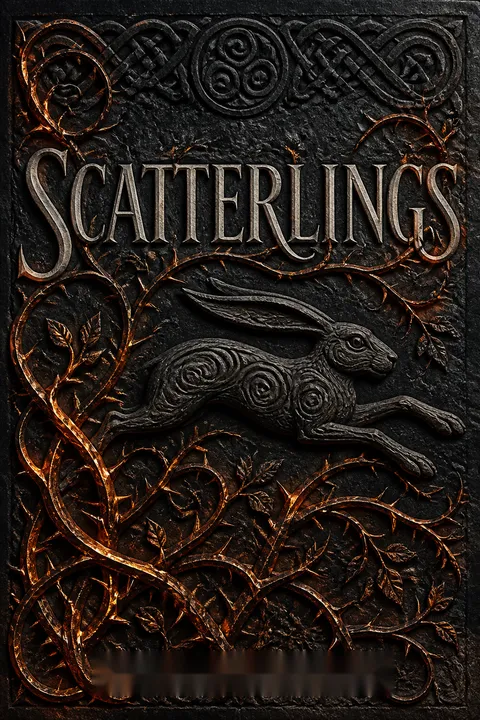
Scatterlings receives an overall 4.64/5 rating, with readers praising Shaw's gorgeous prose and skillful treatment of Devon folktales rooted in landscape. Reviewers appreciate his mature storytelling approach, rich metaphors, and profound exploration of place-based narratives. Some find it deeply moving and transformative, touching on mythic wisdom and human connection to land. Critics note the book's meandering structure, occasionally preachy tone about rootedness, and dense, overly clever writing. Several recommend slow reading to absorb its richness, calling it a masterclass in storytelling that challenges anthropocentric worldviews.
People Also Read
Download PDF
Download EPUB
.epub digital book format is ideal for reading ebooks on phones, tablets, and e-readers.








































