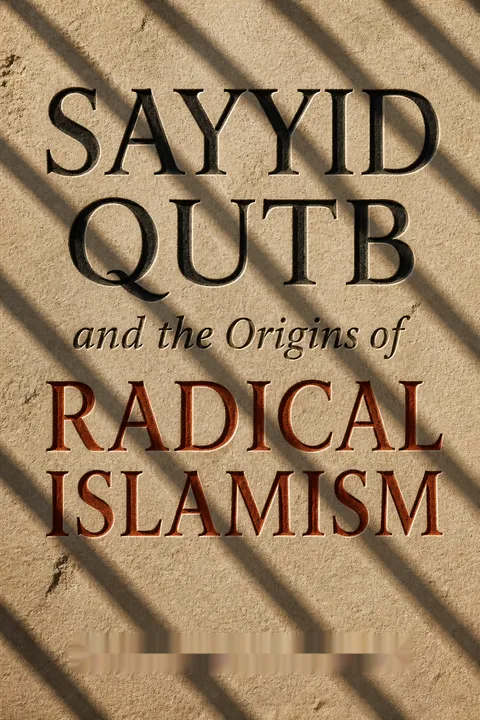

Key Takeaways
1. From Village Life to Nationalist Awakening: Qutb's Early Influences
"This recording of them will give the new generation a picture of what is good and what is bad in our nation’s countryside. Perhaps they will have an opinion as to what should remain and what should be discarded."
Rural roots. Sayyid Qutb, born in 1906 in Musha, Upper Egypt, grew up immersed in a traditional village life shaped by the Nile's rhythms and strong communal identity. His family, once prosperous landowners, instilled in him a quiet, dignified religiosity and a keen awareness of social hierarchy and local customs, including folk beliefs in jinn and afarit. This early exposure to a world where the spiritual was palpable laid a foundational layer for his later mystical inclinations.
Modernity's intrusion. Despite its traditional veneer, Musha was not isolated from the sweeping changes initiated by Muhammad 'Ali and the British occupation. Qutb witnessed the dual education system firsthand, attending a modern state school that emphasized "practical" subjects over the traditional kuttab. This exposure, coupled with his father's involvement in the Nationalist Party and the 1919 anti-British uprising, sparked Qutb's early nationalist sentiments and a desire to transcend rural limitations through education.
Social conscience. Qutb's childhood autobiography, A Child from the Village, reveals his burgeoning social conscience, particularly his sympathy for the impoverished itinerant laborers who worked his family's land. He lamented the "sorrows of the countryside"—indebtedness, disease, and exploitation—and implicitly advocated for reforms like land redistribution and healthcare. This early concern for social justice, rooted in his observations of rural inequality, would become a cornerstone of his later ideological development.
2. The Effendi's Disillusionment: Critique of Westernization and Political Failure
"A nation that does not complain about a situation like this is senseless and is certainly doomed to be destroyed."
Cairo's dual reality. Moving to Cairo in 1921, Qutb encountered a city sharply divided between Europeanized districts of wealth and power, and decaying historical neighborhoods. This urban landscape mirrored Egypt's broader political and economic failures post-1922, where partial independence left Britain in control of key sectors and the Wafd party struggled against royal interference. Qutb, an effendi (educated middle-class professional), felt the sting of limited opportunities and national humiliation.
Literary nationalism. Under the mentorship of 'Abbas Mahmud al-'Aqqad, Qutb immersed himself in romantic poetry, advocating for authentic individual expression over neoclassical imitation. He saw literary modernism as a path to cultural regeneration, but his personal alienation in the bustling city also found solace in this introspective art. His early writings, like The Mission of the Poet, championed a "new" Arabic poetry that reflected genuine feeling and aimed to elevate national consciousness.
Cultural critique. Qutb's disillusionment deepened in the 1930s and 40s as the Great Depression and the 1936 Anglo-Egyptian Treaty exposed the fragility of Egypt's economy and sovereignty. He vehemently criticized the "imposed Western culture" for eroding Egypt's unique ethical sensibility and spiritual depth, fearing that Egyptians were losing their soul to materialism and individualism. He argued that true national progress required a "genuine national culture" rooted in indigenous Islamic civilization, not blind imitation of the West.
3. Rediscovering the Qur'an: The Genesis of Qutb's Islamist Thought
"We can set aside—temporarily—the religious sanctity of the Qur’an and the intentions of the Islamic call…in order that we may find absolute artistic beauty, a distinct element having an essence unto itself, everlasting in the Qur’an, which expresses art independently of all interests and purposes."
Aesthetic revelation. Qutb's literary studies of the Qur'an in the 1940s marked a pivotal shift. In works like Artistic Depiction in the Qur'an, he argued that the Qur'an's power lay in its "artistic depiction" (al-taswir al-fanni), which excited the imagination and transformed sensibility through vivid imagery and rhythmic language. This aesthetic appreciation, distinct from traditional scholarly exegesis, led to a "rebirth of the Qur'an" within him, revealing it as a profound source of spiritual and emotional power.
From culture to creed. This "rediscovery" of the Qur'an, coupled with the escalating political and social crises of the post-WWII era, propelled Qutb towards a political understanding of Islam. He began to frame Egypt's predicament in terms of Islamic ethics and morality, seeing Islam as a comprehensive "nizam" (integrated system) for society, economy, and politics. This marked a departure from his earlier secular nationalism, as he now sought an ideological solution rooted in divine principles.
Social justice as Islamic imperative. Qutb's seminal work, Social Justice in Islam (1949), explicitly grounded his call for a just order in the Qur'an and the Prophet's example. He introduced concepts like "mutual social responsibility" (al-takaful al-ijtima'iyya) and "complete human equality," arguing that Islam uniquely balanced individual freedom with communal welfare. This work, along with The Battle of Islam and Capitalism, positioned Islam as a transformative ideology against both Western capitalism and communism, resonating with the emerging Third Worldist sentiment.
4. America as the Embodiment of Jahiliyya: Reinforcing Qutb's Anti-Western Stance
"I am afraid, “Qutb wrote, “that there is no correlation between the greatness of the American material civilization and the men who created it…in both feeling and conduct the American is primitive (bida’a).”"
A critical lens. Qutb's 1948-1950 study mission to the United States solidified his anti-Western views. He arrived with preconceived notions of Western materialism and found them confirmed in New York's frantic pace and Greeley, Colorado's civic-minded but seemingly joyless existence. His letters and articles, an example of "Orientalism in Reverse," painted America as spiritually vacuous, obsessed with material gain, and lacking moral depth.
Experiences of alienation. Qutb's discomfort was personal as well as ideological. He felt isolated, yearning for intellectual conversation beyond "money, movie stars, and car models." His experience of racism in Greeley, where he was mistaken for an African-American, further fueled his indignation against the "White man's" arrogance. These encounters reinforced his conviction that Western civilization, despite its technological prowess, was fundamentally flawed and a threat to authentic human values.
"American Islam" and conspiracy. Qutb saw America's global influence as a deliberate attempt to undermine Islamic empowerment. He coined the term "American Islam" to describe a distorted version of the faith, promoted by Western powers and their "collaborators," that emphasized piety and ritual over social and political activism. This "paranoid style" of thinking, attributing Muslim woes to a "Zionist-Crusader" conspiracy, became a defining feature of his later radicalism, reflecting a deep-seated sense of victimization and a need for ideological clarity in a complex world.
5. The Muslim Brotherhood's Orbit: Initial Cooperation and Growing Conflict with the Free Officers
"No other movement,” he wrote, “can stand up to the Zionists and the colonialist Crusaders."
Return and engagement. Returning to Egypt in 1950, Qutb found his Islamist ideas gaining traction, particularly after meeting Abu Hasan Nadwi and reading Abu l-A‘la Mawdudi, which clarified his critique of modern jahiliyya. He began his influential Qur'an commentary, Fi Zilal al-Qur'an, in the Muslim Brotherhood's journal al-Muslimun, signaling his growing alignment with the movement. The "Burning of Cairo" in 1952, a popular uprising against foreign and elite establishments, further underscored the need for decisive action.
Alliance with the Free Officers. The 1952 Free Officers' coup, led by Gamal 'Abd al-Nasser, initially offered hope. Qutb, already a respected Islamist thinker, was invited to advise the Revolutionary Command Council (RCC) and even offered a position as General Secretary of the Liberation Rally. He saw the officers as potential vehicles for an Islamic resurgence, urging them to cleanse the country of corruption and implement Islamic principles.
The inevitable clash. However, the alliance quickly soured. The RCC, aiming for a secular nationalist state, began to consolidate power, banning political parties and suppressing Communists. Qutb, formally joining the Muslim Brotherhood in 1953, grew suspicious of Nasser's autocratic tendencies and perceived American influence. He criticized the regime's refusal to implement Shari'a, viewing it as a betrayal of God's sovereignty. The escalating tensions culminated in the RCC's dissolution of the Brotherhood in January 1954 and Qutb's subsequent arrest and imprisonment.
6. Imprisonment and Radicalization: The Birth of the Modern Jahiliyya Doctrine
"Our whole environment, people’s beliefs and ideas, habits and art, rules and laws—is jahiliyyah…."
The crucible of Tura. Qutb's nine years in Tura prison (1954-1964) were a period of profound transformation. Subjected to harsh conditions and torture, he experienced a "true conversion" to a more radical Islamism, explicitly breaking with his past intellectual influences. Cut off from the world, he found solace and certainty in the Qur'an, deepening his mystical temper and forging an unshakeable conviction in divine truth.
The modern Jahiliyya. The 1957 massacre of Muslim Brothers in prison solidified Qutb's anger and led him to articulate his most radical concept: jahiliyya. Excising the term from its historical context, he declared that all modern societies, including ostensibly Muslim ones, were steeped in jahiliyya due to their willful ignorance of God's hakimiyya (sovereignty). This uncompromising dualism—Islam versus jahiliyya—delegitimized not only Nasser's regime but all human-made systems of governance.
Hakimiyya and its implications. Qutb, influenced by Mawdudi, asserted that hakimiyya was God's exclusive prerogative, making any human claim to legislative authority an act of usurpation. This doctrine meant:
- No compromise: There could be no middle ground between divine law and human prejudice.
- Universal mission: Islam was inherently expansionist, aiming to liberate humanity from all forms of tyranny.
- Rejection of secularism: Any system not based on God's law was fundamentally flawed, regardless of its claims to progress or justice.
This theological framework provided a powerful justification for revolutionary action against the existing world order.
7. The Vanguard and Universal Jihad: Qutb's Call for Revolutionary Transformation
"Preaching alone is not enough to establish the dominion of Allah [mamlakat Allah] on earth, to abolish the dominion of man, to take away sovereignty from the usurper and return it to Allah, and to bring about the enforcement of the Divine shari‘ah and the abolition of man-made laws."
A new path for change. Faced with the perceived failure of mass movements and the state's brutal repression, Qutb shifted his strategy from advocacy politics to revolutionary transformation. He argued that the pervasive jahiliyya required a new approach: the formation of a "vanguard" (tali'a) of purified believers. This elite cadre, separated from corrupting influences, would dedicate itself to:
- Spiritual preparation: Long years of internal purification and deep understanding of Islamic principles.
- Preaching and persuasion: Disseminating the true message of God's sovereignty to awaken the masses.
- Confronting obstacles: Eventually, tackling the "material obstacles" (tyrannical regimes) in Islam's path.
Jihad as liberation. Qutb reinterpreted jihad not merely as defensive warfare or spiritual struggle, but as the instrument of a universal Islamic revolution. He explicitly endorsed the classical doctrine of aggressive combat against polytheists and those who prevent humanity from submitting to God alone. For Qutb, this was a fight for human freedom—the freedom to realize one's God-given nature—and an inevitable step in Islam's manifest destiny to establish justice on earth.
The Meccan paradigm. Qutb drew inspiration from the Prophet Muhammad's Meccan period, where a small group of believers patiently prepared before confronting the established order. This model justified a gradualist, yet ultimately confrontational, approach. While Qutb cautioned against hasty action, he also sanctioned defensive force "to repel aggression if it occurs," even discussing plans for assassinating Nasser and destroying infrastructure if the organization was attacked. This blend of spiritual preparation and readiness for decisive action defined his revolutionary vision.
8. Martyrdom and Enduring Legacy: Qutb's Sacrifice and its Impact on Global Islamism
"Never! I would not exchange this temporary life [for] a life which will never disappear!"
The final confrontation. Released from prison in 1964, Qutb quickly became the spiritual guide for a secret organization of Muslim Brothers planning to re-establish the movement. Despite his caution against premature action, his radical ideas, particularly from Milestones, fueled their revolutionary fervor. The regime, sensing a threat amid economic woes and public discontent, launched a massive crackdown in 1965, arresting Qutb and thousands of others.
A martyr's death. Accused of subversion and plotting to overthrow the government, Qutb was tried by a military tribunal. Despite his frail health and the lack of conclusive evidence for an imminent coup, he refused to recant or apologize, proclaiming his loyalty solely to Islam. On August 29, 1966, Qutb, along with two companions, was executed. His defiant last words, rejecting a conditional pardon, cemented his image as a martyr for the Islamic cause.
The trajectory of "Qutbism". Qutb's martyrdom profoundly impacted subsequent generations of Islamists. His ideas, particularly hakimiyya and jahiliyya, were adopted and adapted by radical groups like the Jihad Group and Takfir wa al-Hijra in Egypt, who saw Sadat's assassination as a direct application of Qutb's call to confront the "Near Enemy." While mainstream Muslim Brotherhood leaders attempted to "whitewash" Qutb's more extreme views, his uncompromising vision of a world alienated from God's truth resonated deeply with those seeking radical change. His legacy, though often distorted, continues to inspire global jihadis like Ayman al-Zawahiri and Usama bin Laden, who saw in Qutb's writings a justification for their cosmic battle against the forces of unbelief.
People Also Read

Download PDF
Download EPUB
.epub digital book format is ideal for reading ebooks on phones, tablets, and e-readers.








































