
Plot Summary
Absence of Promises Kept
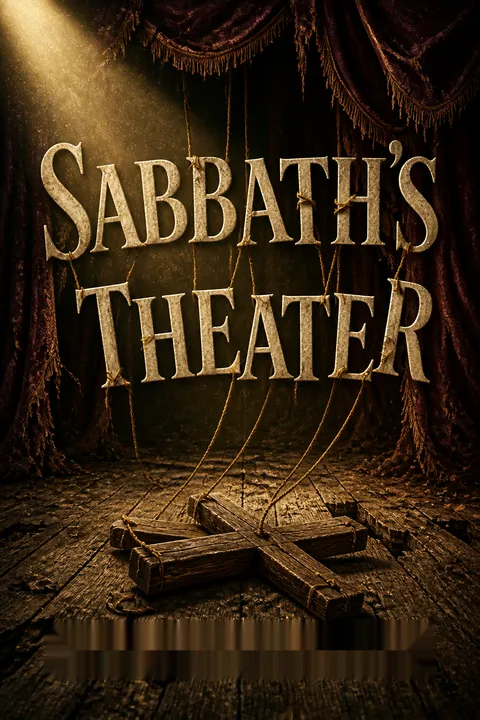
Mickey Sabbath, a disgraced elderly puppeteer with aching, arthritic fingers, reflects grimly on how nothing in life keeps its promise. He juggles the final years of a licentious but decaying affair with Drenka, the married Croatian innkeeper. Their secret union is a riot of transgressions and candid intimacy but is shadowed by the inevitability of mortality and the sense that all connections erode. Even the body fails, and the mind can't keep up with the rapid unraveling of family memory and meaning. Sabbath's world balances precariously between nostalgia for the irretrievable past and the bitterness of present betrayals.
Illicit Harmony in the Woods
Sabbath and Drenka retreat to a hidden "Grotto" in the woods, a makeshift Eden for their secret trysts and role reversals. Their bond is marked not by romance but by a shared taste for exploring the taboo—threesomes, storytelling, and reciprocal fantasies. The outside world, with its rules and routines, is locked away as they invent their own code of freedom, pleasure, and unspoken loyalty. Yet, the happiness they forge is fleeting and fragile, eroded by jealousy and the slow intrusion of real-life demands, aging, and the threat of exposure.
Puppets and Human Frailty
Sabbath's fingers, once the instruments of his theatrical mastery and subversive art, are now throbbing and useless from arthritis. The puppets that mirrored human excess and hypocrisy become ironic reminders of lost agency. Sabbath, surrounded by memories of departed loved ones and professional ruin, vacillates between mocking his own powerlessness and longing for the control over life and death he once wielded on stage. His need for puppets, and for women as co-conspirators in mischief, highlights the complex interplay of seduction, manipulation, and inescapable mortality.
The Gravity of Desire
Sexual hunger is Sabbath's abiding drive, but it never brings salvation. His pursuit of pleasure is compulsive and repetitive, an act of defiance against bodily decline and social disapproval. Every act of carnality, especially with Drenka, is narrated, analyzed, and immortalized as both a protest against suppressing norms and a desperate affirmation of vitality. Yet, as aging progresses and partners die or leave, desire itself becomes burdensome: a cruel reminder of youth and energy already lost, rendering both erotic and emotional fulfillment elusive.
Rooted in Loss
The deaths within Sabbath's family—especially the heroic brother Morty's death in World War II—undergird all of his relationships and responses to intimacy and loss. His mother's lifelong descent into grief and detachment after Morty's passing becomes a recurring symbol of permanent absence. Sabbath is unable to form enduring bonds or move forward, compulsively revisiting and conversing with the dead, morphing his losses into an ongoing dialogue that clouds all present joys and sorrows, making closure impossible.
Adultery's Double Edges
Sabbath's affair with Drenka is at once a liberation and a burden, an escape hatch from the unbearable routines of marriage and sobriety with Roseanna. Their trysts are driven by mutual complicity in breaking rules, but jealousy and possessiveness surface as Drenka demands monogamy from Sabbath, disrupting the foundations of their arrangement. The consequences of their duplicity ripple outward, affecting spouses, children, and the wider community, blurring the lines between empowerment, destruction, and longing.
Cancer: Sorrow and Sacrament
Drenka's cancer, sudden and merciless, transforms the rhythm of Sabbath's life. The inevitability of death radicalizes her and Sabbath's confessions, obsessions, and sexual experimentation. Hospital visits become rites of passage; reminiscences and last words turn into sacraments. Drenka's eventual death leaves Sabbath emotionally stranded, clinging to graveside rituals that merge grief, lust, memory, and guilt. In the shadow of mortality, the pursuit of pleasure acquires new pathos and futility.
Grief's Daily Routines
Sabbath becomes obsessed with Drenka after her death, enacting nightly rituals at her grave that blend masturbation, memory, and mourning. His jealousy extends even into the afterlife, envying Drenka's other lovers, both past and imagined, who come to grieve or desecrate her grave. Grief does not resolve but intensifies, turning into a compulsive theater of longing for what is irrecoverable. Sabbath's rituals are performed with both irony and devoutness, blurring any clean boundary between defilement and reverence.
The Diary's Secret Testament
After Drenka's death, Sabbath learns that she chronicled their escapades, secrets, and betrayals in a diary. The possibility of its discovery by her husband and son laces Sabbath's obsession with dread. Diaries, letters, Polaroids, and tapes—these artifacts of sexual exploration and confession—are both treasures and time bombs, threatening to explode the constructed boundaries between private vice and public reputation. Their existence raises endless questions about truth, legacy, shame, and the enduring, dangerous allure of secret selves.
Haunted by the Dead
Throughout the story, Sabbath is pursued by the shades of his lost mother, brother, lovers, and former selves. His ongoing conversations with these ghosts reveal a mind lost in the past, unable to disentangle fantasy from reality or break the cycle of self-reproach and longing. The dead are both punishment and solace, reminders of meaning but also accusatory presences that glue the present to unresolved guilt and regret. These hauntings drive Sabbath's spiral toward self-destruction and hesitation before the abyss.
The Shadow of Nikki
Nikki, Sabbath's first wife, a talented but disturbed actress who disappeared decades before, remains an open wound and a symbol of irretrievable chaos. Her vanishing—whether suicide, murder, or escape—is a mystery Sabbath cannot solve or leave behind. She becomes a measure of every other relationship's failure and an emblem of the destruction at the heart of love, intimacy, and identity. Sabbath's ceaseless search for her is also a doomed hunt for resolution in a universe of incoherence.
The Cost of Rebellion
Sabbath's lifelong refusal to conform—personally, sexually, artistically—carries a steep cost. His career is ruined by charges of sexual harassment, his workshops and theater shut down, his marriage emptied out, his name spat on throughout his small town and professional circle. Yet he clings mordantly to his 'indecency' as a last fortress of authenticity, ever skeptical that the 'normal' or 'moral' life offers anything but quiet desperation. His provocations, once exhilarating, become sources of isolation and sad repetition.
Marriage by Attrition
With his wife Roseanna, Sabbath endures decades of mutual hostility, cold war, and reluctant routines. Roseanna's alcoholism and recovery through AA, her own struggles with parental trauma, and Sabbath's compulsive infidelity create a stalemated, loveless marriage. Both are stuck, unable to leave but incapable of joy together. Their interactions, full of sarcasm, deflection, and old wounds, show the way marriage can become a zone of slow mutual undoing, an arrangement maintained only by inertia and fear of the unknown.
Masters of Disgrace
Sabbath's downfall is not only self-made: institutions, communities, and reformers become eager collaborators in his public shaming. Whether through his own scandalous tapes with a student or through shifting social norms, Sabbath is made the "degenerate," a scapegoat on whom collective anxieties are projected. The machinery of disgrace extends even to his friends, whose attempts at charity mask contempt or bafflement. Sabbath's attempts at connection only reiterate his role as the designated outsider.
Suicides and Survivors
Death, especially suicide, is both feared and envied in Sabbath's orbit. Friends and relatives fall to despair, and Sabbath contemplates taking his own life repeatedly—but is never able to go through with it. His mother's collapse, his brother's death, his father-in-law's suicide, the psychic devastation left behind: all these experiences color Sabbath's sense that survival itself is a baffling, pointless, but inescapable obligation. Ultimately, dying proves harder than living, and Sabbath is trapped in an endless rehearsal of endings.
Death in the Family
Sabbath's journey to secure his own grave encounters bureaucracy, lost plots, and the decayed civic rituals surrounding death. He is left pondering what is left—objects, letters, flags, memorabilia—when the real substance of relationships and selves has vanished. The Jews' graves, his mother's sideboard discovered in a relative's run-down house, his brother's letters from the Pacific: these relics of family become both ballast and chain, feeding Sabbath's compulsion to "make order" from ruins but yielding only more incompleteness.
Return to the Shore
Sabbath's journey back to his childhood home at the Jersey Shore, scene of youthful joy and family unity, is both a pilgrimage and a farce. The town is changed, the past inaccessible, the dead unrecoverable. Even so, Sabbath finds remnants—keepsakes, a flag, echoes of his brother and grandparents—that break open a wave of emotion, leaving him weeping by the sea. All the layers of nostalgia and regret lead him to confront that memory cannot fix what was lost, and neither can ritual or return.
Refusing the End
Despite numerous attempts at orchestrating his own end—suicide, arrest, provoking violence—Sabbath survives, sometimes against his own wishes. He seems fated to endure, not because of hope or faith, but because losing and losing again is the only script he can keep rehearsing. Each brush with death echoes the old longing for dissolution, but the world, indifferent or absurd, keeps him alive, repeating his lines of resentment, craving, and loss.
Analysis
Philip Roth's Sabbath's Theater is an unflinching, often excruciatingly comic anatomy of desire, disgrace, and grief at the edge of oblivion. Through the grotesquely charismatic Mickey Sabbath, Roth confronts the contradictions at the heart of transgression, memory, and the search for meaning at life's end. Sabbath is both an avatar of sexual freedom and a casualty of his own compulsions—a figure who cannot reconcile the pleasures that once defined him with the loneliness, shame, and decay that now consume him. The novel refuses easy sentiment; instead, it insists that the mess and violence of longing, the inability to move on from loss, and the inability to die or heal are integral to the human condition. Roth's narrative structure—dense, recursive, and performative—mirrors the mind of his protagonist: haunted, self-sabotaging, always at war with coherence. The book's provocations, not only sexual but existential, raise uncomfortable questions about what is left to us when dignity, family, and love collapse. In a post-illusory age, Sabbath's Theater proposes that acceptance of incoherence, defeat, and endless craving—without the false hope of transcendence—is both the curse and dark, desperate liberation of modern life. The lesson Roth offers is not redemption, but the possibility of enduring, and even, in the shadow of disgrace and death, relishing life's raw immediacy before the curtain falls.
Review Summary
Reviews of Sabbath's Theater are largely positive, praising Roth's virtuosic writing and the complex, provocative character of Mickey Sabbath—a dissolute, sex-obsessed puppeteer grappling with grief, mortality, and self-destruction. Many readers consider it Roth's masterpiece, noting its dark humor, emotional depth, and unflinching exploration of human depravity alongside genuine tenderness. Critics acknowledge the explicit sexual content as deliberately transgressive rather than gratuitous. Some readers found it exhausting or repellent, unable to connect with Sabbath's relentless amorality, while others were profoundly moved by its tragic undercurrents.
People Also Read

Characters
Mickey Sabbath
Mickey Sabbath is an aging, once-renowned puppeteer, marked by his nihilistic wit, sexual bravado, and profound, self-cannibalizing grief. His relationships—with women, family, art—are structured around breaking taboos and mocking societal norms, yet beneath his unrelenting provocations lies a desperate hunger for intimacy, security, and meaning. Sabbath's psyche is shaped by formative losses: his brother's heroic death, his mother's life-long mourning, his vanished first wife, and a career capsized by scandal. His sexuality is compulsive and performative—more protest than pleasure—while his emotional life is tormented by cycles of self-loathing, longing, and refusal to relinquish the past. Sabbath is both the cause and victim of disgrace, a figure who stages his own downfall as both an aesthetic and existential endgame.
Drenka Balich
Drenka is Sabbath's lover and co-conspirator—a Croatian émigré innkeeper whose vivacious sensuality and unfiltered candor enable their erotic adventures. Her generosity and maternal warmth are as notable as her hunger for risk and transgression; she eagerly becomes Sabbath's equal in orchestrating secrecy and pleasure. Yet her emotional complexity deepens as she grapples with her troubled family history, her son's dangerous job, and her own mortality when cancer strikes. Drenka's demand for monogamy late in life reflects a longing for singular meaning amid plural engagements. Her confessions, both verbal and written, become dangerous posthumous artifacts, entwined with pride, shame, and a final affirmation of her own desires.
Roseanna Sabbath
Roseanna is Sabbath's wife: intelligent yet cautious, alternately resentful and vulnerable. Her years of alcoholism and eventual dedication to AA reveal her constant battle with dread, guilt, and the aftershocks of parental trauma. Roseanna's emotional vocabulary is shaped by self-help language, but deep wounds from abandonment and her father's suicide permeate her interactions. Her marriage to Sabbath is both a refuge and a cage; she cannot fully leave, yet endures daily pain and humiliation. Her journey toward "serenity" is perpetually undermined by her own need for connection and meaning, never wholly healed, nor wholly resolved.
Matija Balich
Drenka's husband, Matija, is the personification of stubborn resilience—an immigrant who built his business and home through relentless labor and adherence to rules. Though admired by staff and guests, his emotional life is coldly compartmentalized. He is both betrayed and shielded by Drenka's secret life. His inability to understand his wife or son opens a rift that is never bridged, yet he remains a silent but constant counterweight to the tumultuous desires of those around him.
Nikki Kantarakis
Nikki, Sabbath's first wife, epitomizes the mystery and impossibility of fulfilled longing. A gifted actress incapable of managing ordinary life, Nikki is both Sabbaths's inspiration and his curse. Her sudden disappearance—possibly suicide, possibly self-preservation—becomes the pivot around which much of Sabbath's inner chaos turns. Her absence is a psychic wound that is never stitched closed, serving as a point of reference for every subsequent failure of connection or caretaking in Sabbath's life.
Matthew Balich
Drenka's son Matthew inherits his mother's energy and his father's sternness but channels it into law enforcement and rigid order. His fraught relationship with both parents fills him with resentments he is unable to reconcile until loss exposes his vulnerability. After Drenka's death, Matthew's confrontation with Sabbath is driven by a blend of outrage, grief, and a need to restore family honor, even as he is haunted by what he cannot fully understand.
Christa
Christa is a young German runaway who participates in erotic games with Drenka and Sabbath, then turns away, feeling exploited. Her youthful autonomy, impenetrable accent, and sexual precocity make her simultaneously a fantasy object and an embodiment of difference and pain. Christa's presence lays bare the exploitative power differentials in Sabbath's world, as well as the limits of his charm and control.
Norman Cowan
A former patron of Sabbath's art and permanent inhabitant of the professional New York world, Norman represents everything Sabbath is not: stability, familial responsibility, functional relationships. Norman's patience, generosity, and moments of exasperation reveal both the limitations of empathy and the inevitability of judgment. As Sabbath's crisis deepens, Norman's attempts at rescue become entangled with his own anxieties about aging, success, and the uncrossable gulf between ordinary and "indecent" life paths.
Michelle Cowan
Michelle is Norman's accomplished, sharp wife, a periodontist whose inner boredom and sense of lateness match Sabbath's own, but who is more circumspect about acting on desire. Her flirtation with Sabbath is both a test of boundaries and a reflection of the restless dissatisfaction animating her middle years. The revelation of her secrets, both innocuous and incendiary, serves as a catalyst for Norman's and Sabbath's reckoning with the irreducible complexity of marriage and the temptations lurking outside its bounds.
Fish (Fischel Shabas)
Sabbath's centenarian cousin Fish is the stoic embodiment of survival and the slow erasure of memory. The summit of resilience and limited self-awareness, Fish is both a figure of pathos and of comic stubbornness. In his rambling, diminished state, Fish offers Sabbath a fleeting, almost sacred link to the past—a final confirmation that the self may outlast disaster but never overcomes it.
Plot Devices
Interwoven Memory and Present
Roth structures the novel as a relentless interweaving of memory and immediate experience. Sabbath's actions are ceaselessly interrupted or redirected by vivid, looping recollections of childhood, war, lost love, and personal disgrace. This narrative fragmentation mirrors Sabbath's psychological fragmentation, forcing readers to ride the currents of obsession, regret, and projection along with the protagonist. Time is cyclical, not linear, reflecting the impossibility of closure.
Explicit Self-Narration and Metafiction
The concept of performance—whether Sabbath as puppeteer, as lover, as mourner—pervades the novel. The central metaphor of the puppet show allows Roth to set up layers of irony, as Sabbath repeatedly calls attention to his own "scripts," masks, and roles. Life is staged, self-consciously, sometimes as farce, sometimes as tragedy; self-narration becomes the chief means of agency and also of self-punishment.
Artifacts and Confessions
The plot turns on the discovery, creation, and possible exposure of "dangerous" artifacts: Drenka's diary, Sabbath's tapes of student seductions, sets of Polaroids, keepsakes from the dead. These objects embody both the allure of forbidden memory and the threat of scandal, surfacing the tension between public and private self, between the pleasure of secret confession and the risk of exposure, shame, and destruction.
Foreshadowing through Loss and Decay
The reality and inevitability of death are foreshadowed from the book's opening—a quote from The Tempest, Sabbath's lifelong obsession with his dead, and characters' attention to funerals, graves, and illness. Even moments of comedy or eroticism are shadowed by the knowledge of their own transience, with the book's narrative arc bending inexorably toward mortal endings.
Motif of Inescapable Cycles
Addiction in all its forms—sexual, emotional, nostalgic—is reflected in the structural repetition of scenes, language, and actions. Sabbath relives his desires, betrayals, and losses multiple times, unable to break free from cycles of self-destruction. This repetition serves as both narrative engine and psychological diagnosis, reinforcing the book's argument about the impossibility of final escape from the self.
Unreliability of Truth and Memory
The book repeatedly problematizes the notion of truth, positing that memory is unreliable, confessions and diaries are self-serving or accidental, and testimony is always incomplete or falsified. Sabbath himself is a manipulator and magician, never trustworthy as a narrator; this instability invites the reader to question every account, every motivation, and the moral boundaries in play.
About the Author

Download PDF
Download EPUB
.epub digital book format is ideal for reading ebooks on phones, tablets, and e-readers.








































