
Key Takeaways
1. Public Welfare's Core Functions: Regulating Labor and Civil Order
Relief arrangements are ancillary to economic arrangements. Their chief function is to regulate labor, and they do that in two general ways.
Beyond Charity. Public welfare, often perceived as a humanitarian safety net, fundamentally serves the economic and political order. Its primary roles are to manage the labor force and to suppress social unrest. This perspective challenges the popular notion that social policies are progressively becoming more humane.
Dual Mechanisms. When mass unemployment leads to civil disorder, relief programs expand to absorb and control the jobless, restoring stability. Once order is re-established, the system contracts, pushing people back into the labor market. Even in its shrunken state, relief enforces work norms by making the conditions for the "unemployable" so degrading that it deters others from seeking aid.
Societal Control. The existence and fluctuation of relief systems are not accidental; they are a direct response to the inherent instabilities of capitalist economies. By controlling access to vital resources, relief agencies can exert immense power over individuals, shaping their behavior and reinforcing societal expectations, particularly the work ethic.
2. Relief Policies Operate in Predictable Cycles of Expansion and Contraction
As for relief programs themselves, the historical pattern is clearly not one of progressive liberalization; it is rather a record of periodically expanding and contracting relief rolls as the system performs its two main functions: maintaining civil order and enforcing work.
Cyclical Nature. Public welfare systems do not evolve linearly towards greater generosity or responsibility. Instead, they exhibit a distinct cyclical pattern, expanding dramatically during periods of widespread social unrest and contracting sharply once political stability is restored. This ebb and flow is a consistent feature across centuries and nations.
Responding to Crisis. Expansive relief policies are typically a reactive measure, implemented by governments to "mute civil disorder" when large segments of the population are dislocated from the economic system and become volatile. These periods are characterized by mass unemployment, economic collapse, or rapid modernization that renders labor obsolete.
Restoring Norms. Conversely, restrictive policies emerge when the immediate threat of disorder subsides. The focus then shifts to reinforcing "work norms," ensuring that the laboring masses remain dependent on market incentives, no matter how meager. This contraction often involves harsh measures to deter reliance on public aid.
3. Capitalism's Inherent Instability Necessitates Public Welfare Interventions
Continual change in labor requirements also means that, at any given moment, some people are left unemployed.
Chronic Instability. Capitalism, driven by constant innovation and market fluctuations, inherently creates unemployment and social dislocation. Unlike subsistence economies where everyone works, capitalism makes labor conditional on market demand, leading to a permanent segment of the population without work.
Catastrophic Shifts. Periodically, these changes escalate to catastrophic proportions due to:
- Depressions: Collapse of market incentives, leaving no monetary rewards to guide work.
- Rapid Modernization: Technological advancements (e.g., mechanization, factory system) render portions of the labor force obsolete or maladapted.
Weakened Control. Mass unemployment breaks the fundamental bond between individuals and their work roles, which are crucial for regulating civil behavior. When large numbers are barred from traditional occupations, the entire structure of social control weakens, leading to questioning of the social order and potential civil disorder.
4. Historical Precedent: European Relief Quelled Early Capitalist Disorder
Western relief systems originated in the mass disturbances that erupted during the long transition from feudalism to capitalism beginning in the sixteenth century.
Early Responses to Unrest. As Europe transitioned from feudalism to capitalism, population growth and economic instability led to widespread beggary and vagrancy. Local authorities initially imposed severe penalties, but when these proved insufficient to deter large numbers of distressed people, some localities began to offer relief.
Lyons' Example. The French town of Lyons, facing a doubling population and economic instability in the early 16th century, experienced food riots and mob overruns. In response, in 1534, it established the "Aumone-Generale," a centralized relief administration that provided aid while strictly prohibiting begging and enforcing work for the employable.
English Evolution. England, a pioneer in capitalism, also developed nationwide public relief. The emergence of the wool industry displaced peasants, leading to statutes against vagrancy and, by the 1570s, the Elizabethan Poor Laws, which established local taxes for pauper care. Later, the Speenhamland plan (1795) subsidized agricultural wages to control a turbulent, landless proletariat.
5. Work Enforcement: Relief Systems Compel Labor, Especially Low-Wage Work
Any institution that distributes the resources men and women depend upon for survival can readily exert control over them: the occasion of giving vitally needed assistance can easily become the occasion of inculcating the work ethic, for example, and of enforcing work itself, for those who resist risk the withdrawal of that assistance.
Conditional Aid. Relief is rarely given unconditionally. Historically, aid has been tied to behavioral expectations and, crucially, to work. This ensures that even when laborers are temporarily unneeded, they remain disciplined and available for the market.
Methods of Enforcement:
- Public Works: During depressions, when private demand for labor collapses, governments create public work projects (e.g., English labor yards, US Works Progress Administration).
- Private Market Channeling: When labor supply is maladapted (e.g., agricultural workers resisting factory discipline), relief agencies channel paupers into private employment, sometimes through indentures or wage subsidies (e.g., English textile mills using parish children, Speenhamland system).
The Workhouse Deterrent. The workhouse, a common feature of early relief systems, served to "instill in the laboring masses a fear of the fate that awaits them should they relax into beggary and pauperism." Its degrading and punitive conditions ensured that only those with no other options would seek aid, thereby exalting even the "meanest labor at the meanest wages."
6. The Great Depression: Mass Unemployment Ignites Federal Relief Expansion
What led government to proffer aid, we shall argue, was the rising surge of political unrest that accompanied this economic catastrophe.
Unprecedented Collapse. The Great Depression saw unemployment soar to 15 million by 1933, yet federal government initially remained aloof, advocating local charity and self-help. This stance persisted despite widespread destitution and the collapse of local relief efforts.
Rising Disorder. As economic hardship deepened, so did civil unrest. Unemployed Councils organized protests at relief offices, rent riots erupted in cities like Chicago, and national hunger marches on Washington occurred. The Bonus Expeditionary Force's confrontation in 1932 highlighted the dangerous level of discontent.
Electoral Realignment. This widespread disorder, coupled with the fiscal collapse of localities, led to a dramatic electoral shift in 1932. Franklin D. Roosevelt, campaigning on themes of federal responsibility for the "forgotten man," won a landslide victory, signaling a mandate for governmental action to restore order and provide relief.
7. Post-Depression Stability: Relief Contracts, Reasserting Work Norms
The years of discontent and disaffection, of protest and possibility, were over; the people had lined up behind the New Deal.
Shift to Work Relief. Direct relief, though necessary, was ideologically unpalatable. The Civil Works Administration (CWA) was a first attempt to shift to work relief, creating millions of jobs but facing business opposition due to cost and perceived government interference in the private market.
WPA's Role. After breaking with business interests, Roosevelt launched the Works Progress Administration (WPA) in 1935, a massive public works program. WPA provided jobs for millions, restoring the "habit of work" and significantly moderating civil disorder. This helped consolidate public support for the New Deal, culminating in Roosevelt's overwhelming re-election in 1936.
Concessions Withdrawn. With political stability restored, concessions to the poor were rapidly reduced. WPA was cut back and eventually terminated with World War II. The able-bodied unemployed were pushed back into a labor market with insufficient work, while categorical assistance programs for the "impotent poor" (aged, blind, orphaned) remained, but with control largely returned to states and localities, often with restrictive practices.
8. Welfare as a Tool for Enforcing Low-Wage Labor: Statutory Methods
Thus relief systems ordinarily exclude able-bodied men (as well as, at times, able-bodied women and children) no matter how severe their destitution or prolonged their unemployment.
Exclusionary Statutes. State legislatures, given broad license by the Social Security Act, designed welfare laws to align with local economic interests, particularly the need for low-wage labor. Key statutory methods for enforcing work include:
- Excluding Able-Bodied Men: Until 1961, federal reimbursement for aid to families with unemployed fathers (AFDC-UP) was not available, keeping men out of the relief system.
- "Man-in-the-House" Rules: These provisions denied aid to mothers associated with men, ensuring men's vulnerability to marginal employment and often forcing women and children to work.
Regional Adaptations. The principle of local responsibility allowed for wide variations in relief practices, tailored to regional labor markets. The South, with its lower wage levels and reliance on cheap black labor, exemplifies this:
- Lower Payments: Southern relief payments were consistently lower than in other regions, directly correlating with lower agricultural wages.
- Racial Discrimination: Southern states used "employable mother" rules and "suitable home" laws to deny aid to black women, forcing them into low-wage agricultural or domestic work.
9. Administrative Barriers: How Bureaucracy Keeps the Poor Off the Rolls
Administrative obstacles thus reinforce legal exclusions in ensuring that those who are or might be workers do not get aid.
Deterrence by Design. Beyond formal statutes, relief agencies employ administrative procedures to deter applicants and limit caseloads. This is driven by public hostility towards relief and the need for agencies to appease influential groups who demand fiscal restraint and the enforcement of work norms.
Methods of Deterrence:
- Information Control: Agencies avoid publicizing entitlements, keeping potential recipients ignorant of their rights. Manuals are complex and not readily available.
- Intimidation and Red Tape: Applicants face hostile interviews, demands for extensive documentation, and long waiting periods. These tactics are designed to frustrate and discourage, leading many to abandon their applications.
- Arbitrary Rejections/Terminations: Many eligible applicants are denied aid without clear justification, and cases are frequently closed even when families remain in need, often for vague reasons like "failure to comply" or "unsuitable home."
Underbudgeting. Even those who get on the rolls often receive less than their entitled benefits. This can be due to:
- Failure to Adjust Grants: Budgets are not updated for growing children or special needs.
- Deducting Uncollected Support: Assumed child support payments are deducted even if not received.
- Denial of Special Grants: Funds for essential items like clothing or furniture are rarely disbursed unless aggressively demanded.
10. The 1960s Welfare Explosion: Urban Unrest Forces a New Expansion
The welfare explosion occurred during several years of the greatest domestic disorder since the 1930's—perhaps the greatest in our history.
Unresponsive System. Despite massive black migration to cities and high rates of urban unemployment in the 1950s, the welfare system remained largely unresponsive. Millions of eligible poor, particularly blacks, received little to no aid, leading to a buildup of impoverished populations in urban centers.
Rising Disorder and Politicization. The 1960s saw a dramatic escalation of civil disorder, fueled by:
- Weakening Social Controls: Chronic unemployment and family breakdown in ghettoes led to rising crime, drug addiction, and juvenile delinquency.
- Politicization of Grievances: The Civil Rights Movement's denunciation of racism, coupled with white elite shifts, politicized black discontent, turning disorder against white institutions and symbols of oppression.
- Urban Riots: Widespread and destructive riots, often triggered by perceived police brutality, became a prominent feature of the mid-to-late 1960s, predominantly involving young, single, marginally employed black individuals.
Local Concessions. Faced with growing black voting power and escalating unrest, urban governments began to make concessions. While major reforms in housing or employment were resisted, expanding relief benefits became an easier way to placate discontented populations, leading to a significant rise in urban welfare rolls in the early 1960s, especially in the North.
11. Federal Intervention: Great Society Programs Catalyzed the Welfare Rise
Although we shall discuss each of these political disturbances in a separate chapter, they are, of course, intertwined.
Presidential Initiative. The Kennedy and Johnson administrations, concerned by urban unrest and the fragmentation of the Democratic Party, launched Great Society programs (e.g., Juvenile Delinquency Act, Community Mental Health Centers Act, Economic Opportunity Act, Model Cities). These programs were designed to address political problems in cities, particularly by cultivating black allegiance.
Circumventing Local Government. A key strategy was to bypass recalcitrant state and local governments, channeling funds directly to "inner-city" (ghetto) neighborhoods. This involved creating new service agencies, hiring "community workers," and fostering "citizen participation," often leading to conflict with established municipal authorities.
Catalyzing Welfare Rights. These federal programs inadvertently fueled the welfare explosion by:
- Welfare Rights Services: Storefront centers, staffed by social workers and lawyers, informed the poor of their entitlements and advocated on their behalf, leading to a surge in applications.
- Litigation: OEO-funded legal services challenged restrictive welfare laws (e.g., residence laws, employable mother rules) and arbitrary administrative procedures, leading to landmark court decisions that expanded eligibility and protected recipients' rights.
- Grass-roots Protest: Federal funds and rhetoric stimulated the formation of welfare rights groups, culminating in the National Welfare Rights Organization (NWRO), which organized demonstrations and campaigns for increased benefits, further pressuring welfare departments.
Review Summary
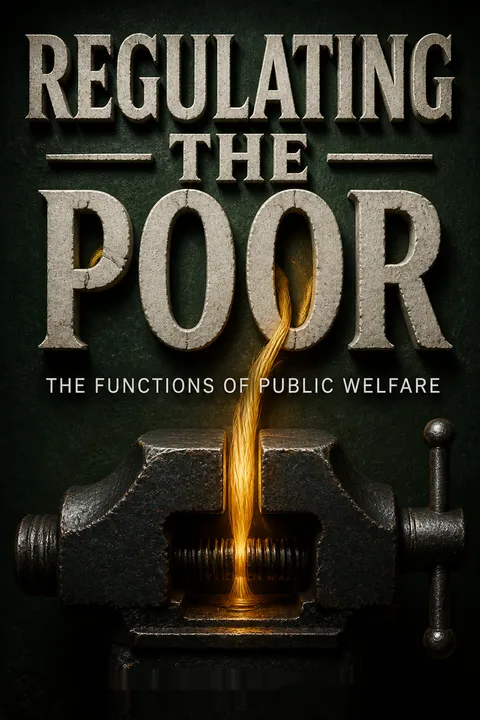
Regulating the Poor by Frances Fox Piven and Richard Cloward argues that welfare programs serve to pacify civil unrest during unemployment crises and enforce work norms when stability returns. Reviewers consistently praise the book's enduring relevance since its 1971 publication, noting how it reframes welfare not as charity but as a control mechanism maintaining labor discipline and social order. The analysis spans historical examples from 16th-century England through American programs like the New Deal and Great Society, demonstrating how relief systems protect capitalism by preventing revolution while keeping wages low and workers compliant.
People Also Read







Download PDF
Download EPUB
.epub digital book format is ideal for reading ebooks on phones, tablets, and e-readers.








































