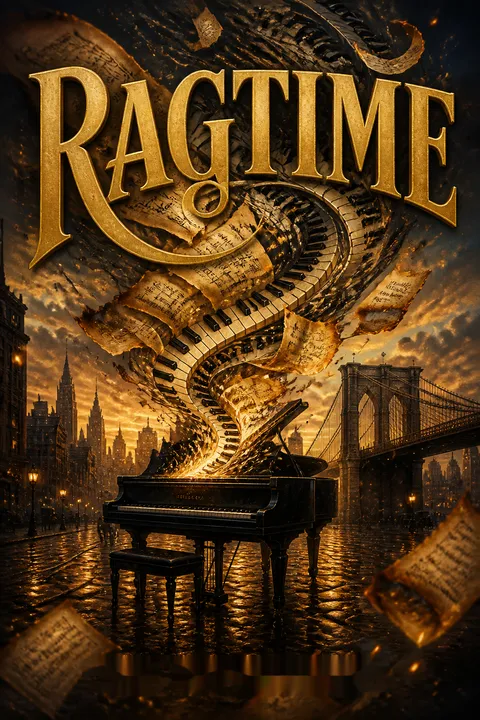

Plot Summary
A New Century Dawns
The novel opens in 1902 with an upper-middle-class family living in New Rochelle, New York. Father manufactures patriotic goods and plans to join an Arctic expedition, leaving Mother and their son (the Little Boy) behind with Mother's restless Younger Brother. Their orderly life, marked by tradition and social status, stands in contrast to a rapidly changing America—one poised on the edge of wave after wave of technological and social upheaval.
Scandal, Desire, and Injustice
Mother's Younger Brother becomes obsessed with Evelyn Nesbit, a beautiful chorus girl at the heart of a media scandal after her jealous husband, Harry Thaw, murders her lover, the architect Stanford White. Evelyn is commodified and victimized by the men around her, illustrating the limited agency of women. Meanwhile, Evelyn's notoriety sets in motion the interweaving fates of working class, immigrant, and black characters whose lives will collide with the family's.
The Immigrant's Burden
Tateh, a Jewish silhouette artist from the Lower East Side, fights poverty and exploitation with his daughter ("the little girl"). Humiliated by bosses and society, Tateh's family endures the hopeless cycle of tenement life. Yet they persist, clinging to dreams of transformation. Doctorow explores America's promise and hypocrisy: the city is a place of endless opportunity and relentless hardship, fueled by prejudice and class division.
Explosions of Fame and Tragedy
The country is fascinated by larger-than-life figures: Harry Houdini, who performs death-defying escapes; Sigmund Freud, pondering the chaos of a brash America; Evelyn Nesbit, forever infamous. But the age's modern wonders—trains, parades, moving pictures—mask deep social unrest. Immigrants strive to enter society, laborers fight for survival, and social revolutionaries stir. The myth of upward mobility is tested as each stratum of society strains against its cage.
Intersections and Unrest
Evelyn, seeking meaning beyond her own sordid celebrity, becomes entangled with Tateh and his daughter, supporting them materially and emotionally. Emma Goldman, anarchist and radical, challenges Evelyn and society's moral codes. Passions turn political and personal: the collision of desire, ideology, and longing for redemption set new alliances and conflicts in motion, even as the privileged family's world starts to unravel.
Private Passions, Public Strife
Mother's Younger Brother's infatuation with Evelyn Nesbit spirals, leading him into New York's radical underworld. Acquaintance with Goldman exposes him to anarchist ideals and his own dissatisfactions. Meanwhile, Mother's chance discovery of an abandoned black baby in her garden—and her insistence on sheltering both mother (Sarah) and child—presents a quiet but radical challenge to her husband and their way of life, touching off consequences that ripple through every household.
Love, Politics, and the Lower East Side
Evelyn's escape from celebrity is short-lived: her empathy with Tateh's family, and her own loneliness, cannot overcome the strictures of class, gender, and fate. As union strikes, especially in Lawrence, Massachusetts, erupt around the country, Tateh invents the flipbook "movie book"—a small moment of triumph—and reinvents himself and his daughter, setting off for a better life beyond New York. The world's possibilities seem, for a moment, open.
An Innocent's Fatal Error
Coalhouse Walker Jr., a dignified black pianist and Sarah's lover, courts her in the family's home. His new Model T Ford—symbol of progress and dignity—is vandalized by racist volunteers. Every effort at legal redress fails; his insistence on dignity is met with mockery and dismissal. Sarah, desperate, attempts to petition the Vice-President for help but is misunderstood and killed by guards. Her innocence and hope are destroyed by the indifference and violence of power.
Grief Turned to Fury
Sarah's death radicalizes Coalhouse. His grief hardens into righteous fury after humiliating legal defeats. He turns to direct action, forming a disciplined "gang" of black supporters (and eventually, Mother's Younger Brother) and launching a campaign of increasingly dramatic violence against the institutions and figures responsible for his victimization. The violence he unleashes is a radical assertion of self-respect in a society structured to deny it.
Descent Into Violence
Coalhouse's gang embarks on a campaign of arson and murder, terrorizing the city. The family is swept into public scandal—Sarah's baby now in their care, their home besieged. Tensions mount between Mother and Father as their relationship frays under pressure. The authorities notify J.P. Morgan, whose opulent library becomes the gang's stronghold, a stand-off between revolutionary fury and the highest echelons of capitalism. Ancient grievances and new technologies—bombs, cars, the press—collide.
A Nation in Turmoil
The country reels. Booker T. Washington attempts to mediate, the press casts Coalhouse as a madman, and Morgan's treasures hold the city hostage. The political machinery is paralyzed; the riots stir fears of anarchy and unleash the underlying violence in American life. Private lives and public fate entwine: each character's aspirations and failings—ambition, love, despair, vindication—mirror a nation's struggle with its own ideals.
Revolutions Small and Large
The family flees to Atlantic City, seeking anonymity and renewal. There, Tateh, now a successful film director, unexpectedly reunites with Mother and her son; the mingling of the white family, Jewish immigrant, and black child forms a makeshift new American family. Coalhouse's gang's last stand in Morgan's library ends with his death and the dispersal of his followers. The violence of revolution resolves into compromise and loss.
Ragtime's Last Chord
In the aftermath, time leaps forward. Younger Brother vanishes; Father dies in the sinking of the Lusitania. Mother marries Tateh, forging a blended future for their children. Mass culture flourishes, ethnic divisions blur, wars loom, and celebrities like Houdini fade. The era of Ragtime concludes as the machine age, mass entertainment, and revolutionary dreams both fulfill and betray the promises of a new century.
Analysis
Ragtimeserves as both chronicle and cautionary tale about America's early twentieth century. Through its kaleidoscopic narrative, it exposes the fragile nature of social order and the constant churn of invention, immigration, race, and revolt beneath the country's confident surface. The novel argues that beneath the myths of democracy, meritocracy, and moral progress, the nation is always at war with itself: new technologies and freedoms run parallel with exploitation, violence, and disappointment. The lines between public and private, famous and forgotten, the powerful and powerless are porous and always shifting. Doctorow's "ragtime" is not simply a soundtrack: it is the American condition—unpredictable, sometimes joyous, often tragic, always improvisational. Characters who seek escape—Houdini, Coalhouse, Mother's Younger Brother—find only limited, bittersweet liberation. Yet through compassion, reinvention, and the unexpected formation of new "families" across boundaries of class, race, and origin, Doctorow gestures toward hope: the country's story is not fixed. Each person, marginalized or mighty, is part of a larger, unfinished composition. The lesson: America's greatest dangers, and greatest possibilities, lie in our refusal to listen to the syncopated rhythms already within us, to see ourselves in others, and to fight endlessly for justice, dignity, and transformation.
Review Summary
Reviews of Ragtime are largely positive, with readers praising Doctorow's masterful blending of fictional characters with real historical figures like Houdini, J.P. Morgan, and Emma Goldman. Many admire the novel's syncopated, fast-paced narrative style and its vivid portrayal of early 20th-century America, touching on racism, immigration, class inequality, and social unrest. The Coalhouse Walker Jr. storyline is frequently highlighted as the most compelling. Some critics find the characters emotionally distant and the structure fragmented, but most consider it an essential, brilliantly crafted piece of American historical fiction.
People Also Read
Characters
Mother
Mother embodies the quietly transformative power of empathy and moral courage. Initially sheltered and defined by her role as wife, Mother grows in self-assurance through acts of compassion—especially her decision to shelter Sarah and her child, defying social and marital expectations. Her journey is one of self-realization: as she takes command of family and business during Father's absences, she moves toward independence, ultimately forming a new, blended family with Tateh and the children. Mother's disgust with Father's rigid thinking and her refusal to yield her principles drive the family's evolution, reflecting the changing roles of women.
Father
Father is a dignified, well-meaning but fundamentally limited patriarch whose sense of mastery is unsettled by the rapid changes of the era. Adventurous at heart (joining Arctic expeditions, fascinated by technology), he is nonetheless unable to adapt emotionally to the transformations in his family and society. Defensive of order and propriety, he cannot grasp the emerging demands for justice and equality, especially in the face of Coalhouse's ordeal. His emotional distance from Mother and the boy grows; his death in the sinking of the Lusitania marks the end of an era.
Mother's Younger Brother
Younger Brother, restless and yearning, searches for meaning through obsession (with Evelyn Nesbit), sex, politics, and ultimately violence. Socially awkward and introverted, he is driven by intense emotion. His path from infatuation to involvement with radicals like Emma Goldman, and then to a role in Coalhouse's campaign, reflects the era's underlying currents of social dissatisfaction and revolutionary longing. Ultimately, he leaves for Mexico, dying as an anonymous revolutionary, never finding lasting solace or belonging.
The Boy
As a precocious, sensitive child, the boy processes the tumult of his family and the world through play, observation, and intellect. He embodies the possibility of reinvention—the new American type—as his household evolves, friendships cross boundaries, and childhood certainties are transformed. His curiosity and ability to adapt mark the resilience and hope threading through the narrative's darker themes.
Tateh
Tateh rises from desperate immigrant poverty to prominence as an inventor and film director. His creative ingenuity (e.g., "movie books") symbolizes the possibility of transformation, both personal and social. Fiercely protective of his daughter, he is initially embittered by exploitation but embraces American reinvention as he sheds old identities. Tateh's union with Mother and their collective children forms a new model of family and societal hope, bridging past and future, difference and unity.
The Little Girl
Tateh's daughter is the stoic anchor and motivation behind his struggles. She silently endures poverty, loss, and change; her ability to adapt marks her as a survivor and, eventually, a bridge to new worlds through her friendship with the boy. Her muteness, reserve, and resilience reflect the stories of countless immigrant children—seen but seldom fully heard—whose futures shape the nation.
Coalhouse Walker Jr.
Coalhouse is a sophisticated, accomplished black pianist whose demand for justice after a racist affront—his car is desecrated—drives the novel's emotional and political climax. Proud, patient, and unyielding, he is transformed by grief and rage into a revolutionary. His insistence on dignity amid relentless humiliation exposes the limits and violence of American democracy. Coalhouse's journey from courtship to tragedy, vengeance to martyrdom, embodies the price of denied humanity.
Sarah
Sarah is the young black mother taken in by Mother, and Coalhouse's beloved. Scarred by trauma and disappointment, her hope is tragically misplaced in institutions incapable of mercy. Her naïve attempt to petition authority for redress (resulting in her death) foregrounds the destructive impact of systemic cruelty; her unwavering goodness and vulnerability provide the narrative's deepest moral stakes.
Emma Goldman
Goldman, the formidable anarchist leader, shapes the novel as a prophetic voice demanding justice and freedom, especially for women and workers. She exposes the hypocrisies of sexual and societal norms, challenges the complacent, and catalyzes others' self-awareness. Her relationships with Evelyn Nesbit and Younger Brother illuminate the intersections of private passion and public ideology; her presence is both disruptive and indispensable.
Harry Houdini
Houdini, the famed escape artist, appears throughout the novel as a symbol of the era's (and humanity's) longing for transcendence, control, and liberation—whether from physical, social, or existential constraints. Though he connects briefly with the family, with celebrities, and with the immigrant crowd, he remains haunted by doubts, driven by personal loss (the death of his mother), and finally terrified by the limits even he cannot escape: mortality, grief, and the inexorable churn of history.
Plot Devices
Interwoven Narratives and Iconic Figures
Doctorow crafts the novel as a tapestry, blending historical and fictional characters into intersecting storylines. Iconic figures (Houdini, Morgan, Goldman, Ford, Nesbit) cross paths with invented families, blurring fact and fiction. This technique exposes the interconnectedness of all lives and the permeable boundaries between individual destiny and collective history.
Symbolism and Recurring Motifs
The Model T Ford, pianos, player pianos, and fireworks represent progress, aspiration, and illusion; vehicles of social mobility or traps of violence. The motif of "ragtime"—music of syncopation—recurs as both a literal genre and a metaphor for social unpredictability, improvisation, and the tension between order and chaos. The recurring theme is that personal and societal transformation can be both revolutionary and destructive.
Foreshadowing and Metafiction
Hints of the coming world wars, revolutions, and tragedies—the death of family members, the end of "Ragtime," the assassination of the Archduke—pervade the novel, creating an atmosphere of impending rupture. Characters sometimes sense their own endings; the reader, guided by the author's narrative control, is invited to see beyond the immediate to the shape of the century.
Shifting Perspectives, Compression of Time
The narrative frequently jumps between times, places, and characters, sometimes in a single paragraph. This compression, echoing the rise of cinema itself, keeps the story moving relentlessly forward, creating a sense of inevitability. The personal, the political, the tragic, and the comic are all shown as part of one historical development—a ragtime rhythm of America.


Download PDF
Download EPUB
.epub digital book format is ideal for reading ebooks on phones, tablets, and e-readers.








































