
Key Takeaways
1. The Enigma of "After This, Nothing Happened"
But when the buffalo went away the hearts of my people fell to the ground, and they could not lift them up again. After this nothing happened.
A profound declaration. Plenty Coups, the last great chief of the Crow nation, uttered these haunting words to Frank B. Linderman, refusing to speak of his life after the buffalo disappeared and his people were confined to a reservation. This statement isn't merely about depression or a lack of events; it suggests a deeper "breakdown of happenings," where the very framework for understanding what constitutes an event ceased to exist for the Crow. It challenges our conventional understanding of history and time.
Beyond psychological malaise. While a psychological interpretation might suggest the Crow became depressed, Plenty Coups's active life post-reservation—farming, lobbying in Washington, advocating for education—belies simple depression. His claim implies that the significance of events, as defined by Crow culture, vanished. He suggested that any competent observer could tell his story from that point, indicating a loss of a uniquely first-person narrative, a profound shift in subjective experience.
A peculiar vulnerability. This enigmatic statement points to a unique human vulnerability: the collapse of a "way of life" itself. Humans are cultural animals, and when the cultural scheme that gives meaning to actions and experiences breaks down, it can feel as though "nothing happened." This isn't just a historical event but an ontological shift, where the very possibility of things occurring in a meaningful way is threatened.
2. Crow Identity: Forged in Warfare and Symbolic Boundaries
War was not the concern of a class nor even of the male sex, but of the whole population, from cradle to grave.
A warrior culture. The Crow were a nomadic, hunting, warrior tribe, with their entire way of life—from childhood training to religious rituals—permeated by warfare. Their identity, known as Absarokee ("children of the Large-Beaked Bird"), was intrinsically linked to their ability to defend their territory and way of life against rivals like the Sioux, Blackfeet, and Cheyenne. This constant struggle shaped their values and social structures.
The power of "counting coups." Central to Crow warfare was the practice of "counting coups," acts of bravery that involved striking an armed enemy without killing them, taking their weapons, or stealing horses from their camp. This wasn't just about military victory; it was a symbolic act of asserting Crow reality and forcing the enemy to recognize their boundaries.
- Planting a coup-stick: A warrior would stick his staff in the ground, vowing not to retreat, symbolizing an unyielding boundary.
- Recognition by the enemy: The act of counting coup forced the enemy to acknowledge Crow dominance before being defeated.
- Honor and status: These acts brought immense honor, access to marriage, and social prestige, organizing much of Crow imaginative and desiring life.
Protecting a way of life. These rituals were not foolhardy but strategically vital for a nomadic tribe whose boundaries constantly shifted. Counting coups established the reality of Crow life, ensuring that even their enemies recognized the cultural lines they drew. This practice was a "gamble with necessity," asserting their existence against existential threats.
3. The Collapse of Meaning: When a Way of Life Becomes Unintelligible
The issue is that the Crow have lost the concepts with which they would construct a narrative.
Beyond mere change. The transition to reservation life, marked by the disappearance of buffalo and the prohibition of intertribal warfare, was more than a change in circumstances; it was a conceptual catastrophe. The very acts that defined Crow life—hunting buffalo, counting coups, performing the Sun Dance—ceased to be intelligible. One could physically perform the motions, but they no longer carried their traditional meaning.
Loss of conceptual framework. The Crow's "law of excluded middle"—"Either our warriors will be able to plant their coup-sticks or they will fail"—lost its validity. It wasn't that they failed to plant coup-sticks; the act itself became meaningless. This wasn't just a shift in narrative power but a loss of the conceptual tools needed to construct any meaningful narrative within their traditional framework.
- "Horse-stealing" vs. "counting coup": What was once a brave act became a criminal offense in the eyes of the U.S. government, stripping it of its cultural significance.
- The Sun Dance: A prayer for revenge, it became unintelligible when warfare was forbidden, leading to its abandonment for decades.
- Everyday acts: Even cooking a meal lost its deeper significance of "preparing for battle," becoming merely "cooking-in-order-to-survive."
The end of temporality. Crow temporality, the experience of time, was tied to these meaningful "whens"—"now-when-we-are-hunting-buffalo." With the collapse of these categories, the Crow "ran out of time" in a profound sense. Plenty Coups's statement thus signifies not just a historical end, but the breakdown of the very possibility of "happenings" as understood by his people.
4. Psychological Devastation: The Loss of the Crow Subject
I am trying to live a life that I do not understand.
An assault on subjectivity. The cultural collapse inflicted a terrible blow not just on what the Crow might do, but on what they might be. The established social roles (warrior, chief, squaw), their associated standards of excellence, and the possibility of constituting oneself as a "Crow subject" (a person embodying those ideals) became problematic. This led to profound disorientation and a sense of living an incomprehensible life.
The irony of identity. The question "Among the Crow, is there a Crow?" became possible, reflecting a rupture between the social group and the ideals that once defined a Crow subject. Traditional roles, like that of a chief, lost their clear criteria for leadership, as the old metrics of battle prowess became irrelevant.
- Pretty Shield's lament: "I am trying to live a life I do not understand," expressed the deep confusion and shame of adapting traditional child-rearing practices (never striking a child) to new, desperate circumstances.
- Loss of internal compass: The psychological structures that guided behavior, like the internalized "joking-relative" or ego-ideal, lost their grounding, leaving individuals without a clear sense of appropriate action.
The death of mental states. If Crow subjectivity collapsed, so did the possibility of having the mental states—intending to plant a coup-stick, hoping for a good buffalo hunt—that constituted that identity. This wasn't just a psychological issue but a question of the "field in which psychological states are possible." Plenty Coups's "nothing happened" can be seen as witnessing the death of the Crow subject, clearing the ground for a potential rebirth.
5. Dreams as Radical Anticipation: Navigating the Unknowable Future
What is striking about young Plenty Coups’s dream—and the interpretation the tribe gave to it—is that it was used not merely to predict a future event; it was used by the tribe to struggle with the intelligibility of events that lay at the horizon of their ability to understand.
A communal response to anxiety. The Crow had a tradition of seeking dream-visions to access a spiritual order beyond ordinary understanding. Young Plenty Coups's prophetic dream, at age nine, was a profound manifestation of communal anxiety, transforming inchoate fears into a narrative that the tribe could collectively metabolize. It provided a way to anticipate a radically new future without fully grasping its details.
The prophetic dream's content:
- Disappearing buffalo: Countless buffalo emerge from a hole, then vanish, replaced by "Spotted-buffalo" (cattle) of the white man.
- The lone tree: A fierce storm destroys all trees except one, symbolizing the Crow's survival amidst devastation.
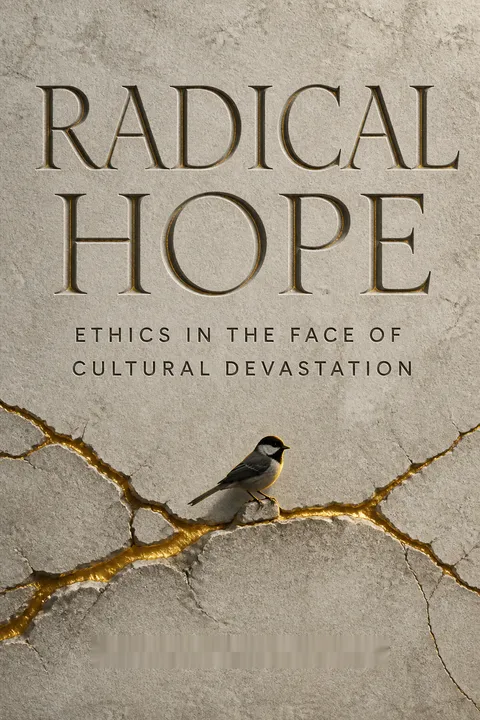
- The Chickadee: A small bird, "least in strength but strongest of mind," who learns by listening to others' successes and failures.
Oracular guidance. The elders interpreted the dream as a divine message: the buffalo way of life would end, the white man would dominate, but the Crow would survive and keep their land by adopting the "Chickadee virtue." This interpretation, while enigmatic, provided a framework for practical reason in the face of an unimaginable future, acknowledging their limited understanding while committing to a path forward.
6. The Chickadee Virtue: A New Form of Courage and Wisdom
Develop your body, but do not neglect your mind, Plenty-coups. It is the mind that leads a man to power, not strength of body.
A transformation of courage. The dream's advice to "become a chickadee" called for a new form of courage, one rooted in listening, learning, and working for wisdom, rather than traditional martial valor. This was a radical "thinning out" of the thick concept of Crow courage, adapting it to circumstances where old forms of bravery were no longer viable.
- Learning from others: The chickadee's strength lies in its ability to observe, listen, and learn from the successes and failures of others, without intrusion.
- Adapting to the unknown: This virtue didn't prescribe specific actions but a stance of openness and adaptability, crucial for navigating a future beyond current conceptual grasp.
- Internalized ideal: Psychologically, the Chickadee-person became a new ego-ideal for Plenty Coups, encouraging him to embrace learning and flexibility without shame, even when it meant departing from traditional Crow ways.
Psychological flexibility. This transformation addressed a core problem for moral psychology: how can a deeply ingrained courageous character adapt when its foundational ideals collapse? The dream provided a mechanism for Plenty Coups to alter his psychological structure, allowing him to experience shame appropriately in new contexts and pursue new forms of "fine" action. It enabled him to integrate traditional Crow reverence for the chickadee with a radical call for change.
7. Radical Hope: Commitment to a Good Beyond Comprehension
God— Ah-badt-dadt-deah—is good. My commitment to the genuine transcendence of God is manifest in my commitment to the goodness of the world transcending our necessarily limited attempt to understand it.
Hope at the abyss. Plenty Coups's dream fostered "radical hope"—a commitment to a future good that transcends one's current ability to understand it. This was not mere optimism but a profound act of faith in the world's inherent goodness, even as his familiar world crumbled. It allowed him to reason into an unimaginable future, acknowledging discontinuity while preserving integrity.
A peculiar form of reasoning:
- Acknowledging the end: Recognizing the inevitable collapse of the traditional Crow way of life and its associated goods.
- Beyond mere survival: Insisting on a dignified, honorable way forward, not just biological existence.
- Transcendent goodness: A commitment to the idea that something good would emerge, even if its nature was currently incomprehensible.
- Humility in the face of the unknown: The dream's enigmatic nature reinforced that the future's details were beyond their current grasp, fostering humility rather than arrogance.
Sustaining purpose. This radical hope provided a bedrock for action when traditional practical reason was attenuated. It allowed Plenty Coups to lead his people, committed to the idea that their efforts were worthwhile, even as their understanding of "the good life" vanished. This commitment, rooted in a belief in a transcendent goodness, offered a path to avoid despair and seek new forms of flourishing.
8. Radical Hope vs. Wishful Optimism: Plenty Coups's Enduring Legacy
Sitting Bull insisted that authentic tribal leaders would never cooperate with the American government. To do so would be to surrender one’s personal authority and sacrifice one’s followers to the whims of petty officials.
The challenge of Sitting Bull. Sitting Bull, the Sioux chief, sharply criticized Plenty Coups's strategy of cooperation, viewing it as a craven capitulation. He advocated for resistance, famously supporting the Ghost Dance, a messianic movement promising the magical return of buffalo and the destruction of whites. This contrast highlights the difference between radical hope and mere wishful optimism.
Wishful thinking's pitfalls. The Ghost Dance, while a powerful expression of hope, was rooted in a "wishful" belief that the world would conform to desires without realistic practical steps. It led to a "turning away from reality," where symbolic rituals superseded engagement with the actual challenges, ultimately resulting in tragedy for the Sioux, including Sitting Bull's death.
- Magical transformation: The belief that ghost shirts would stop bullets and that ancestors would return, bypassing the need for strategic action.
- Short-circuiting reality: Using a dream-vision to avoid rather than engage with the harsh realities of their situation.
Plenty Coups's realistic hope. Plenty Coups's radical hope, by contrast, was a "sustained thoughtful engagement with the world." His dream, while prophetic, was interpreted as a call to learn and adapt, not to expect magical intervention. He recognized the destruction but committed to finding new ways to flourish, even if those ways were initially unclear. This distinction is crucial for understanding the legitimacy of his hope as a component of courage.
9. The Vindication of Adaptive Leadership
Look at our country! It was chosen by my people out of the heart of the most beautiful land on all the world, because we were wise. And it was my dream that taught us the way.
A confirmed vision. Plenty Coups's life choices, guided by his dream and the Chickadee virtue, were ultimately vindicated. The Crow, unlike many other tribes, were never defeated and retained the "heart of Crow country" as their reservation. This outcome, though radically different from traditional nomadic life, was seen by Plenty Coups as a confirmation of his boyhood vision.
Strategic adaptation and enduring ideals:
- Alliance with the U.S.: The Crow's alliance against common enemies (Sioux) secured their land, even amidst treaty revisions and encroachments.
- Education and legal defense: Plenty Coups encouraged learning the "white man's ways" to protect Crow interests, exemplified by Robert Yellowtail's legal battles.
- Preservation of land: Despite pressures for allotment, the Crow retained mineral rights and set conditions for land division, preventing its sale to outsiders.
- Cultural transmission: Plenty Coups's act of telling his story to Linderman, and his donation of his home as a park, ensured the preservation and transmission of Crow values and memories to future generations.
A complete life. Plenty Coups's fidelity to his dream allowed him to unify his life across radical discontinuity, seeing his purpose confirmed by events. His legacy, embodied in institutions like Little Big Horn College, demonstrates that his radical hope was not mere optimism but a courageous, imaginative response that yielded tangible positive results, enabling the Crow to survive and revive their traditions in new forms.
Review Summary
Reviews of Radical Hope are largely positive, averaging 3.88/5. Readers praise Lear's accessible yet philosophically rich exploration of cultural devastation through the lens of Crow chief Plenty Coups. Many highlight the emotional depth and multidisciplinary approach combining philosophy, psychoanalysis, and anthropology. Common criticisms include repetitiveness and limited scope, with some feeling the book could have been condensed. Several reviewers note the absence of broader political critique, while others appreciate the book's relevance to modern challenges like climate change and personal identity crises.
People Also Read
Download PDF
Download EPUB
.epub digital book format is ideal for reading ebooks on phones, tablets, and e-readers.








































