


Key Takeaways
Your biggest lie isn't what you said — it's what you're withholding
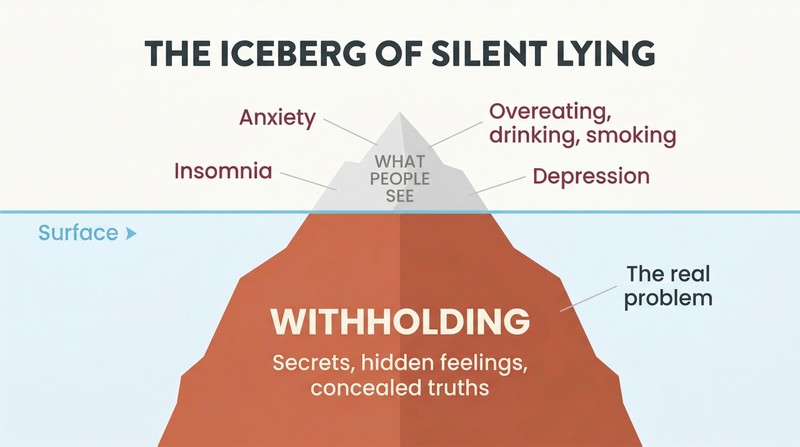
Brad Blanton, a Washington D.C. psychotherapist for over 30 years, argues the most dangerous form of lying isn't fabrication — it's withholding. Keeping secrets, hiding feelings, and strategically concealing information from people who'd be affected by it. This silent lying is the engine of anxiety, depression, insomnia, and a catalog of psychosomatic diseases.
Withholding eats you alive. According to CDC data Blanton cites, 53% of people who die before age 65 do so for reasons directly related to lifestyle — smoking, drinking, overeating, and other compensatory behaviors. Blanton argues these aren't root causes but symptoms of a deeper starvation: being cut off from the nourishment of honest, present-tense experience. We poison ourselves with socially acceptable substitutes because we can't stand living behind a mask.
Your mind was built to protect you, then it became your prison
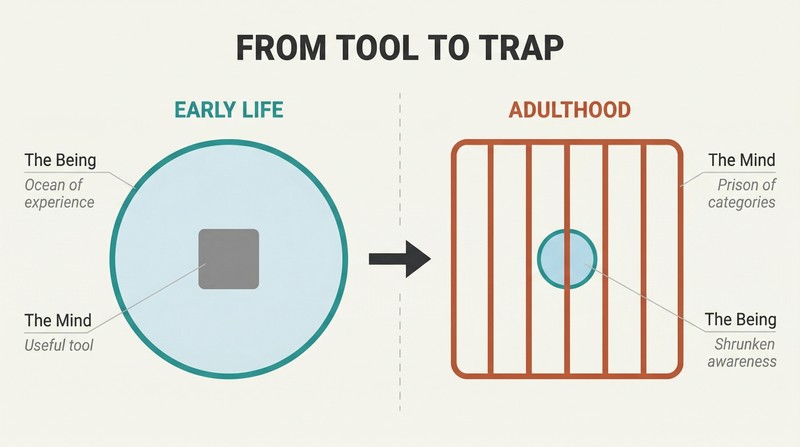
Blanton distinguishes between "the being" — the raw sensory awareness that first arose around four to five months in the womb — and "the mind," which develops through abstraction and categorization. A baby watches an airplane in full fascination. A three-year-old glances up, thinks "airplane," and looks away. That efficiency is how the mind grows. The problem: we eventually treat people the same way — filing them into categories and never really seeing them again.
The mind becomes a parasite on being. Originally a tool for survival, it gradually dominates the being that created it. What Blanton calls the "ocean of experience" — our original undifferentiated awareness — shrinks into a "sea of suggestions", a nest of learned interpretations we mistake for reality. As Fritz Perls advised: "Lose your mind and come to your senses."
The rules that made you 'good' are the same ones making you sick
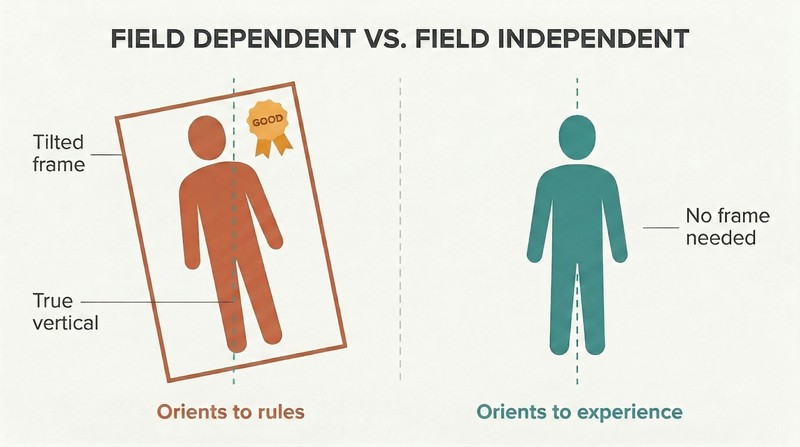
Blanton defines "moralism" as the intense emotional attachment to principles about how things should be — a disease that's incurable but manageable. When children learn to prioritize being "good" over being alive, they learn to lie, hide, and perform. The result: rigid, angry, sick adults. Lawyers, his most common client group, exemplify this — years of rule-memorization and obedience produce workaholics who argue brilliantly but can't have a real conversation with their spouse.
Moralism produces field dependence. Research Blanton cites shows that "field dependent" people orient by external frames of reference — even tolerating a 33-degree body tilt if the room tilts with them. Field-independent people trust their own senses. Moralists are psychologically tilted, orienting to rules instead of experience, and proudly calling it strength.
Truth-telling has three levels: confess facts, share feelings, expose your fiction
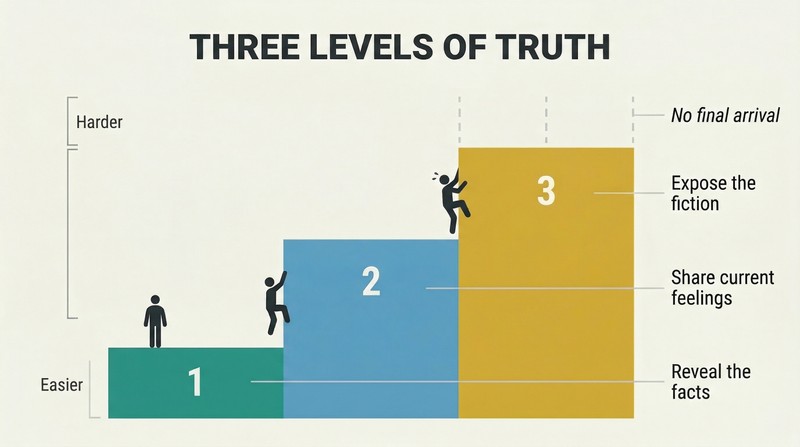
Blanton's core framework progresses through three levels:
1. Reveal the facts — clear up past lies, secrets, and withholds with the people affected
2. Share current feelings and thoughts — express ongoing judgments, attractions, and resentments in real time
3. Expose the fiction — admit that the identity you've constructed is an act, including your vanity, your hero story, and your false modesty
Each level is harder than the last. Blanton compares it to golf: getting from unskilled to good is easier than going from good to professional, even though the score difference shrinks. Level three never ends — it requires constant vigilance against the ego that proudly congratulates itself for having reached level three. There is no final arrival.
What was true at 8pm may be a lie by 8:45 — update accordingly
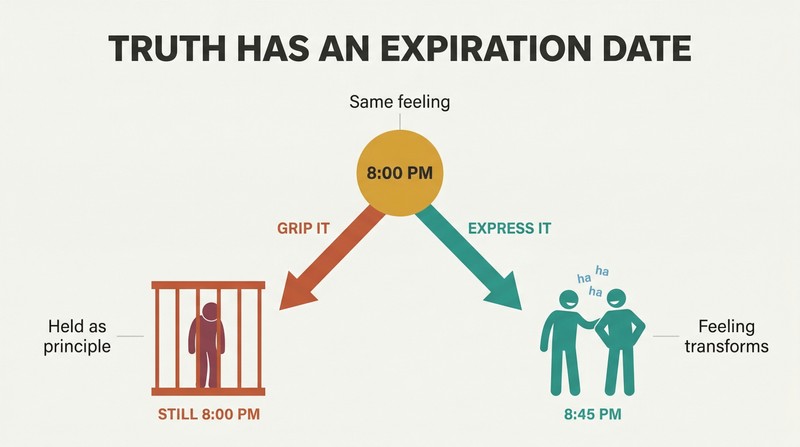
Truth has an expiration date. If you're furious at someone at 8:00pm and you express it fully — out loud, face-to-face — there's a good chance you'll be laughing together by 8:45. But people who live by principles like "I was right to be angry, so I'm still angry" get trapped in yesterday's truth. They are, as Blanton puts it, "reasonably stupid."
This applies to love, too. A couple Blanton describes loved each other madly — then tried to freeze the feeling, turning a living experience into an obligation. The truth of romantic love changes, and when you grip it as a principle, it curdles into resentment and nostalgia. Roles, rules, and self-images all become prisons when held past their expiration.
Say 'I resent you for...' face-to-face until the anger burns clean
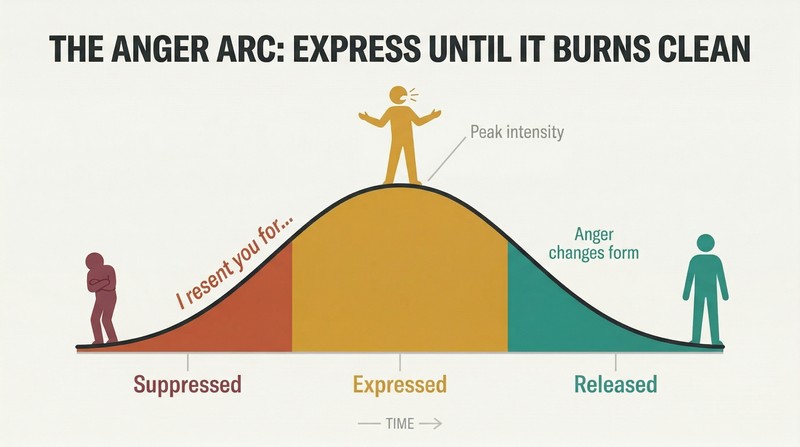
Blanton's anger protocol is deliberately uncomfortable. Start sentences with "I resent you for..." followed by something specific the person said or did. Not "I resent you for being a snob" but "I resent you for turning your head when I said hi at the grocery store." Speak in present tense, maintain eye contact, and pay attention to bodily sensations. Let the anger escalate before it subsides.
In therapy, a client named Anne kept saying she "couldn't" talk to her husband David. Coached through progressively louder, more specific resentments, she shouted, shook, threw a tissue — then laughed. Underneath the anger was a decades-old resentment toward her father. After telling him the truth face-to-face on a family vacation, she was elated for the first time in years.
Withheld secrets don't just stress your mind — they attack your body
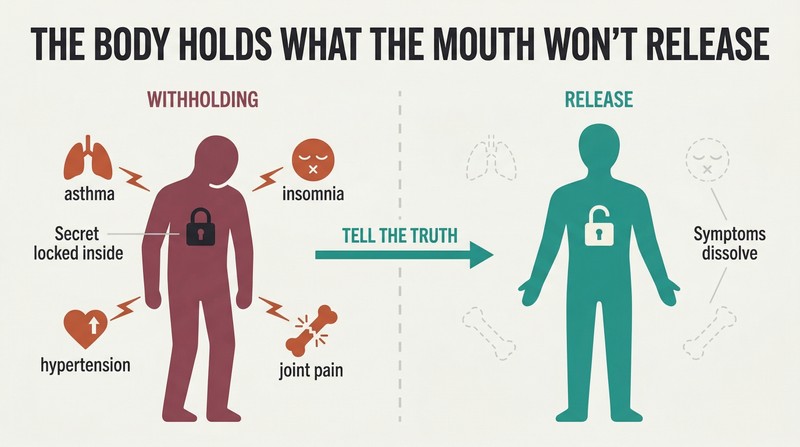
Kathleen, 35, ran a thriving business but suffered from asthma, insomnia, hypertension, and inability to orgasm. Her hidden secret: an abortion eight years earlier, concealed from her pro-life Catholic family. After years of resistance, she finally told her parents. Her father's first response? "Oh, thank God" — he'd assumed she had a terminal disease. Within months, Kathleen's asthma disappeared, she began a relationship, and she could sleep and climax.
Another client, Linda, had chronic joint pain twice misdiagnosed as arthritis. When she revealed her affairs to her husband, the pain vanished. When she started hiding again, it returned. Blanton sees this pattern repeatedly: the body holds what the mouth won't release. Physical withholding mirrors psychological withholding.
Your 'struggle to change' is a smokescreen for what you already chose
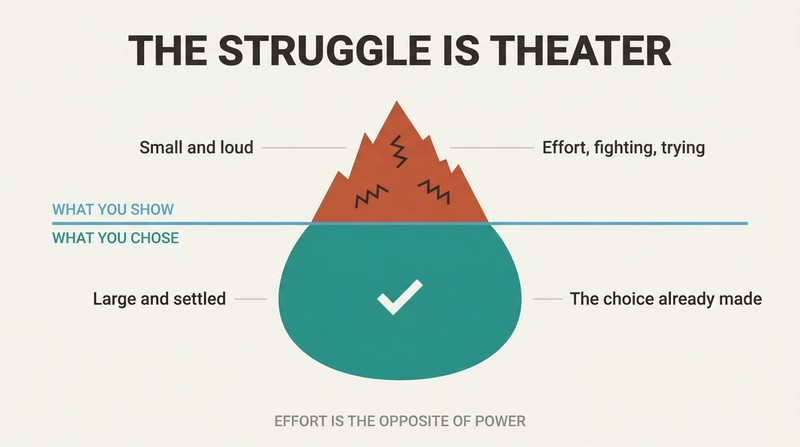
We pretend to fight ourselves. The person who says "I want to lose weight but I can't stop snacking" has already chosen to keep snacking. The "struggle" is theater — a conspiracy we maintain to avoid admitting we are whole beings who produce exactly the results we choose. Blanton illustrates this with Steinbeck's one-eyed man in The Grapes of Wrath, who wallows in self-pity while doing nothing. Tom Joad tells him bluntly: "Ya jus' askin' for it. Ya like it. Lets ya feel sorry for yaself."
Real change requires abandoning the fake fight. You must accept yourself as the imperfect, choosing being you already are — angry, selfish, petty — before transformation becomes possible. Freedom to change only arrives after you stop "trying" and admit what you've actually been doing all along.
Freedom tastes like insecurity — learn to savor it
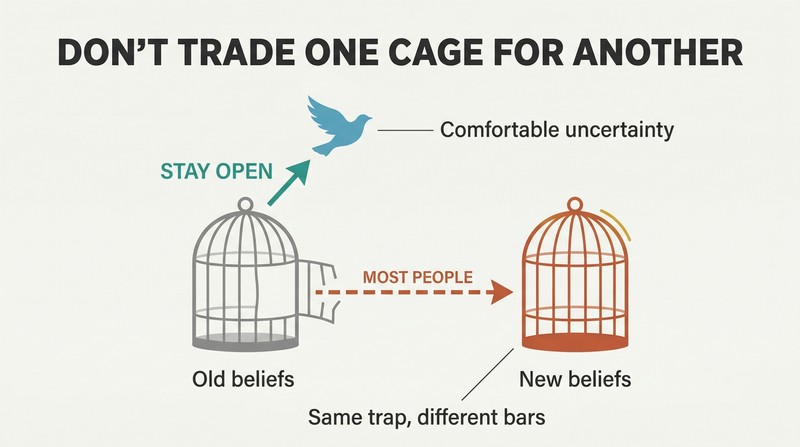
Honest people trade security for aliveness. When you stop lying, you lose the insulation that beliefs provide. You feel exposed, uncertain, vulnerable. Blanton compares it to learning to enjoy a rollercoaster — the unpleasant uncertainty eventually becomes exhilarating. This "comfortable uncertainty" is a prerequisite for creativity and genuine connection.
Most people can't tolerate it. After a breakthrough — some moment of radical honesty that shatters the old self — they quickly build a new nest of beliefs to hide in. Today's liberating insight becomes tomorrow's prison. The practice of truth-telling is never finished because the truth keeps changing. There is no permanent enlightenment — just ongoing willingness to be uncertain, alive, and slightly terrified.
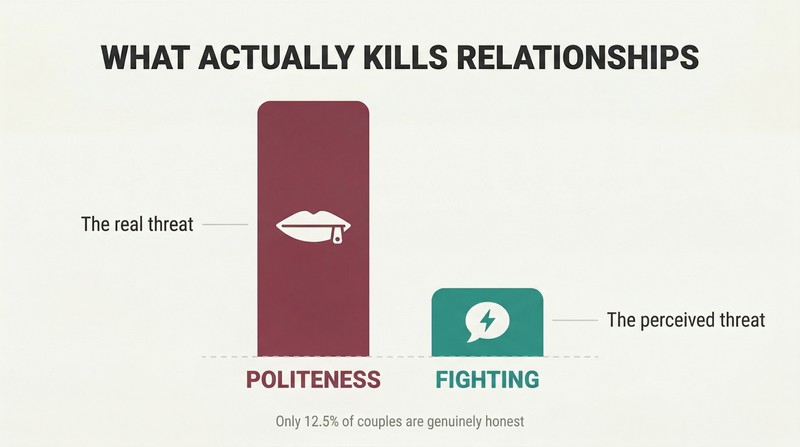
Couples die from politeness, not from fighting
Blanton estimates roughly 12.5% of couples have genuinely alive, honest, intimate relationships. The rest are divorced, angry-codependent, or what he calls "spacecadet compromises." The culprit isn't too much conflict — it's too little honesty. His couples checklist includes: tell your complete sexual history in graphic detail, share all attractions and affairs since you've known each other, and do alternating 30-minute monologues of resentment and appreciation.
Romance isn't intimacy. Blanton distinguishes between "falling in love" — a temporary reconnection with being — and a powerful relationship built on ongoing truth-telling. According to a survey he cites, 35% of married people are having secret affairs. Whether you're monogamous or not matters far less than whether you tell the truth about what you actually do and feel.
Analysis
Radical Honesty occupies a peculiar position in the self-help canon: it is simultaneously more radical and more ancient than almost anything on the shelf beside it. Blanton's core insight — that withholding is the primary mechanism of psychological suffering — synthesizes Gestalt therapy, existential philosophy, and Yogic tradition into a single imperative: say what's true, right now, to the person standing in front of you.
What distinguishes Blanton from the mindfulness movement he superficially resembles is his insistence on interpersonal disclosure rather than private awareness. Meditation is necessary but insufficient; the real work is telling your Catholic father about the abortion, telling your spouse about the affair in graphic detail, telling your boss you resent him. The path runs through other people, not around them. This is a genuinely contrarian position in a culture that has largely privatized psychological healing.
The book's framework of 'being 'versus 'mind' mirrors the phenomenological tradition from Heidegger through Laing, but Blanton strips it of academic pretension and delivers it with the vocabulary of a Virginia hillbilly trained in Gestalt. This is both its strength and its limitation. The profanity and provocation function as performance — modeling the radical honesty he prescribes — but they also serve as deflection, a kind of meta-pose that sometimes obscures which claims are clinical observations and which are philosophical opinions dressed as facts.
The weakest sections are the political digressions and the Futilitarianism material, which dilute the book's therapeutic core. The strongest are the clinical vignettes — Kathleen's asthma, Anne's anger, Beth's letter, Mark's suicide — which carry an evidential weight his polemics cannot match. The most dangerous misreading of this book is that it licenses cruelty. Blanton's actual protocol — the 'I resent you for...' structure — forces specificity, present-tense embodiment, and willingness to stay in contact until completion. This isn't venting; it is a disciplined practice requiring as much courage to do well as recklessness to do badly.
Review Summary
Radical Honesty receives mixed reviews. Many praise its thought-provoking ideas about truthfulness and its potential to improve relationships and personal well-being. Readers appreciate the author's straightforward approach and insights into human behavior. However, some find the writing style rambling and unpolished, and disagree with certain extreme ideas. Critics argue that radical honesty can be harmful in some situations. Despite these criticisms, many readers find value in the book's core message about the importance of honesty in personal growth and relationships.
People Also Read




Glossary
Bullshit
Value-assigned abstraction from experienceA technical term borrowed from Fritz Perls, founder of Gestalt Therapy. In Blanton's usage, bullshit is any interpretation of reality that the mind creates and assigns value to—e.g., 'You don't love me' or 'This is beautiful.' All interpretations of reality qualify. Perls distinguished three grades: chickenshit (empty greetings like 'How are you?'), bullshit (meaningless abstractions in normal conversation), and elephant shit (discussing the theory of bullshit itself).
Moralism
Disease of attachment to principlesBlanton's term for the intense emotional attachment to moral rules, standards, and 'shoulds' that develops through childhood conditioning. He considers it a terminal but manageable disease—incurable because the mind naturally generates evaluative judgments, but manageable through telling the truth. Moralism makes 'good' and 'bad' more important than 'alive' or 'dead,' producing rigidity, anger, and psychosomatic illness.
The Being
Pre-mind sensory awareness itselfBlanton's term for the raw, sensing, electrical awareness that first arose approximately four to five months after conception—the 'light coming on' in the womb. The being notices; the mind thinks. The being creates the world through perception; the mind interprets it. Radical Honesty, at its core, is simply reporting what the being notices rather than what the mind evaluates.
Ocean of Experience
Original undifferentiated experiential awarenessBlanton's metaphor for the primal, unified field of sensory experience that exists before and beneath the mind's categories. In the womb and early infancy, consciousness exists as an undifferentiated ocean. As the mind develops through learning and abstraction, this ocean recedes from awareness, replaced by the sea of suggestions. All religious and mystical experiences are attempts to recapture this original unity.
Sea of Suggestions
Mind's learned interpretations of realityBlanton's metaphor for the mind—the accumulated set of abstractions, categories, memories, and interpretations that gradually replaces direct experience as our primary mode of orientation. Born out of the ocean of experience, the sea of suggestions eventually obscures it. We come to mistake this smaller sea—our personality, beliefs, and self-image—for the totality of who we are.
Three Levels of Telling the Truth
Progressive framework for radical honestyBlanton's core framework for practicing honesty, progressing in difficulty: Level One involves revealing withheld facts and secrets to the people affected. Level Two involves ongoing honest expression of current feelings, judgments, and thoughts in real time. Level Three involves admitting that your constructed identity—your self-image, vanity, and hero story—is a fiction. Each level builds on the previous, and Level Three is never fully completed.
Field Dependence
Orienting by external reference framesA psychological research concept Blanton applies to moralism. In experiments, 'field dependent' subjects orient by the tilt of a room or frame rather than their own bodily sense of vertical—tolerating up to 33 degrees of tilt. Blanton correlates field dependence with social dependence: moralists orient by external rules and others' expectations rather than their own sensory experience. Field independence—trusting one's own perception—correlates with creativity.
Futilitarianism
Blanton's philosophy of embracing futilityA tongue-in-cheek 'religion' Blanton founded in the book's later editions, built on two beliefs: (1) all human effort is futile, and (2) 'pygmies are stealing my luggage.' Despite its humor, it articulates a serious therapeutic principle: that despair and the acceptance of meaninglessness—rather than positive thinking—are the gateway to genuine freedom and creativity. From the Latin 'de sperare' (down from hope), Blanton argues that giving up hope is paradoxically the beginning of liberation.
FAQ
What's Radical Honesty by Brad Blanton about?
- Core Concept of Honesty: The book emphasizes the transformative power of truth-telling in all life aspects, arguing that withholding truth leads to psychological distress.
- Being vs. Mind: It distinguishes between the "being" (authentic self) and the "mind" (critical self), crucial for practicing radical honesty.
- Practical Application: Offers advice on expressing feelings and thoughts openly without fear of judgment, aiming for personal freedom.
Why should I read Radical Honesty by Brad Blanton?
- Transformative Potential: It helps identify and break free from lies and moralism, leading to emotional freedom and improved relationships.
- Unique Perspective: Challenges conventional views on morality and communication, encouraging readers to embrace their true selves.
- Practical Exercises: Includes exercises and examples illustrating the benefits of radical honesty for mental health and relationships.
What are the key takeaways of Radical Honesty by Brad Blanton?
- Honesty as Liberation: Telling the truth is essential for personal liberation and mental well-being, leading to a fulfilling life.
- Understanding Emotions: Discusses how suppressed emotions like anger can lead to neurosis, advocating for healthy expression.
- Three Levels of Truth-Telling: Revealing facts, expressing current feelings, and exposing identity fiction are key to deeper connections.
What are the best quotes from Radical Honesty by Brad Blanton and what do they mean?
- “We all lie like hell.”: Highlights the commonality of lying and its role in stress and unhappiness, urging acknowledgment as a first step.
- “The mind is a jail built out of bullshit.”: Emphasizes that thoughts can trap us in negativity, requiring honesty to escape.
- “Telling the truth frees us from entrapment in the mind.”: Stresses honesty's liberating power, breaking mental constraints.
How does Radical Honesty by Brad Blanton define radical honesty?
- Complete Truthfulness: Involves being truthful in all situations, sharing feelings, thoughts, and experiences openly.
- Freedom from Lies: Aims to free individuals from lies and secrets that cause emotional distress, leading to clarity and connection.
- Authentic Relationships: Fosters deeper relationships through open communication, promoting genuine understanding.
What are the levels of telling the truth in Radical Honesty by Brad Blanton?
- Level One: Revealing the Facts: Involves disclosing past lies and secrets to clear the air, focusing on honesty about past events.
- Level Two: Expressing Current Feelings: Articulating feelings and judgments as they arise, fostering emotional awareness.
- Level Three: Exposing the Fiction: Acknowledging false identities and roles, embracing the true self.
How can I apply the principles of Radical Honesty by Brad Blanton in my life?
- Start Small: Practice honesty in low-stakes situations, gradually moving to more significant truths.
- Create a Safe Environment: Surround yourself with people committed to honesty, facilitating open expression.
- Reflect on Your Emotions: Understand your feelings and their reasons, aiding effective and authentic communication.
What role does anger play in Radical Honesty by Brad Blanton?
- Anger as a Natural Emotion: Recognizes anger as valid and natural, advocating for its expression rather than suppression.
- Direct Expression: Encourages direct expression of anger to process feelings and improve relationships.
- Healing Through Honesty: Expressing anger aids healing from past wounds, essential for practicing radical honesty.
How does Radical Honesty by Brad Blanton address the concept of moralism?
- Moralism as a Disease: Describes moralism as leading to judgment and self-criticism, hindering personal growth.
- Managing Moralism: Suggests managing moralism through honesty, allowing compassionate self-understanding.
- Freedom from Judgment: Practicing radical honesty frees individuals from moralism's constraints, enabling genuine living.
What’s Practicing Radical Honesty by Brad Blanton about?
- Core Concept of Honesty: Focuses on radical honesty in relationships and self-awareness, leading to deeper connections.
- Transformative Process: Outlines confronting emotions, especially anger, and expressing them authentically.
- Community and Support: Advocates for supportive communities to practice honesty, breaking free from societal norms.
What is the method for expressing anger in Practicing Radical Honesty by Brad Blanton?
- Direct Communication: Encourages face-to-face conversations, starting with “I resent you for…” to personalize expression.
- Staying Engaged: Stresses staying engaged until all feelings are expressed, acknowledging emerging emotions.
- Specificity is Key: Emphasizes being specific about behaviors triggering anger, aiding understanding and resolution.
How does Practicing Radical Honesty by Brad Blanton suggest handling guilt?
- Confronting Guilt: Encourages examining guilt and recognizing accompanying anger to understand root causes.
- Expressing Truth: Suggests expressing truth about actions to alleviate guilt, involving honesty with oneself and others.
- Transformative Experience: Posits that facing guilt openly leads to personal transformation and healing, moving toward forgiveness.
Download PDF
Download EPUB
.epub digital book format is ideal for reading ebooks on phones, tablets, and e-readers.








































