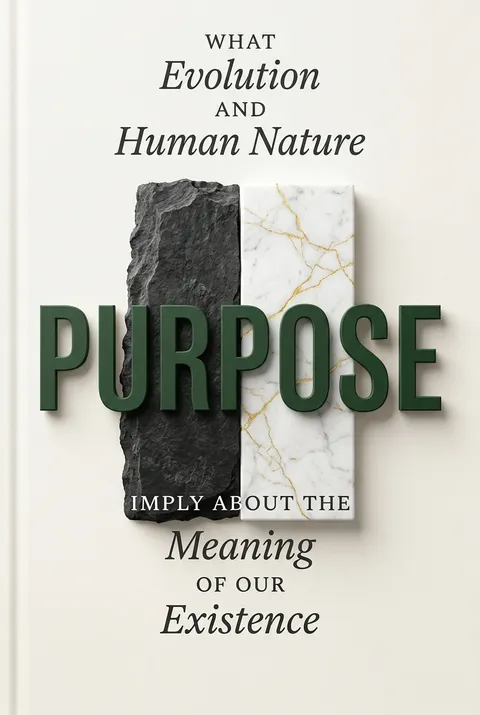

Key Takeaways
1. Evolution is a Guided Process, Not Random Chance.
Evolution wasn’t a totally random process; it had a direction and was guided by natural principles.
Challenging randomness. The traditional view of evolution as a purely random, haphazard process, leading to a meaningless existence, is increasingly being questioned by science. This "doctrine of randomness" suggests that if life's clock were rewound, a completely different biological world would emerge, seemingly at odds with a benevolent Creator.
Convergent evolution. A key insight is the ubiquity of convergent evolution, where unrelated species independently develop similar structures or abilities to solve common problems. Examples include:
- Wings in bats, birds, and butterflies.
- Streamlined bodies and fins in dolphins and sharks.
- Echolocation in bats, dolphins, and shrews.
- Camera-type eyes in humans and squids.
This widespread convergence suggests that evolution is constrained by higher-order natural laws, guiding outcomes even if initial mutations are random.
Inevitable outcomes. This implies that life, as we know it, was not a mere accident but an inevitable outcome of underlying physical and chemical laws. Just as an injection mold guides liquid plastic into a predetermined shape, these "deeper organizational principles" direct evolutionary change. This perspective reconciles scientific inquiry with the possibility of a purposeful creation, suggesting that randomness plays a limited, albeit important, role within a larger guided framework.
2. Human Nature Possesses a Dual Potential: Good and Evil.
No wonder the human spirit is in constant turmoil.
Conflicting drives. Evolution has paradoxically endowed humans with opposing capacities, creating an inherent tension within our nature. While individual selection favors traits like selfishness, aggression, and lust for survival and reproduction, other evolutionary mechanisms have fostered altruism, cooperation, and love. This dual potential explains the vast "moral range" observed in humanity.
Multilevel selection. The concept of multilevel selection clarifies how these opposing traits co-exist. Individual selection promotes self-serving behaviors, as seen in the "survival of the fittest." However, kin selection drives altruism towards relatives to ensure shared genetic material propagates, and group selection favors cooperation within groups, as cohesive groups often outperform selfish ones.
Inherent opposition. This means we are hardwired for both the best and worst aspects of human behavior. Examples include:
- Selfishness vs. Altruism
- Aggression vs. Cooperation
- Lust vs. Love
This internal conflict is a fundamental aspect of the human condition, making life fraught with tension and difficulty, but also rich with moral choice.
3. Free Will Empowers Our Choices Between Competing Natures.
The ability to choose among ideas and possible courses of action may be the most important of all human attributes.
Beyond determinism. The common-sense belief in free will, where we can choose among alternative possibilities and our intentions causally control our actions, is often challenged by scientific determinism. However, the universe is not entirely deterministic, as quantum mechanics demonstrates. Furthermore, the concept of "emergence" suggests that higher-level systems, like the human mind, can possess properties not found in their lower-level components, such as the brain.
Brain's indeterminacy. Evidence increasingly shows that even brain systems are not rigidly deterministic, exhibiting elements of unpredictability and spontaneity. Experiments with simple organisms like fruit flies and leeches reveal behaviors that are "indistinguishable from a fundamentally indeterminate process." This suggests that alternative options are genuinely open to us, even at the neural level.
Causal mental control. Our conscious thoughts and intentions are not mere byproducts but actively influence our behavior. Research on goal achievement, mental practice, and implementation intention consistently demonstrates that consciously planning and imagining actions significantly increases the likelihood of their execution. This "causal mental control" is a powerful, empirically supported aspect of human experience, essential for navigating our dual nature.
4. Life's Purpose: To Choose Between Our Dual Potentials.
A fundamental purpose of our existence is to choose between the good and evil natures inherent within each of us.
The ultimate test. Integrating the dual potential of human nature with the reality of free will reveals a profound purpose for our existence. Given that evolution has instilled within us conflicting predispositions—for both virtue and vice—and that we possess the capacity to choose, life itself becomes a test. Our journey is defined by the continuous choices we make between these opposing impulses.
Explaining human extremes. This framework explains the vast "moral range" of humanity, from "unspeakable viciousness to heartbreaking generosity." History is replete with examples of both tyrants inflicting suffering and heroes demonstrating immense compassion. This paradox is not a flaw but a consequence of our freedom to choose which aspect of our evolved nature to express.
Daily moral crucible. Most decisions are not grand heroic acts but countless small, daily choices that cumulatively shape our character and society. Whether to act selfishly or altruistically, to forgive or retaliate, to love or hate—these choices define our purpose. While biological and cultural factors influence us, our free will allows us to consciously "nudge" ourselves towards our better angels, making life a continuous process of moral development.
5. Deep Relationships, Especially Family, Are Key to the Good Life.
Good relationships keep us happier and healthier. Period.
Relationships as core. Decades of research, including the Harvard Study of Adult Development, consistently show that strong, enduring relationships are the most critical factor for human happiness, health, and life satisfaction. This finding transcends wealth, social status, and education, highlighting relationships as fundamental to well-being.
Evolutionary imperative. This profound importance of relationships is rooted in our evolutionary history. Human infants are born utterly helpless, requiring prolonged parental care. This necessity fostered deep parent-child attachment, which evolution made intensely rewarding. This attachment system was likely repurposed for romantic love, making committed relationships intrinsically satisfying and crucial for survival in unpredictable ancestral environments.
Beyond physical needs. John Bowlby's attachment theory challenged the Freudian view that relationships merely satisfy physical drives, demonstrating that humans have deep social needs independent of biological ones. The emotional rewards of altruism, even to non-kin, further underscore the high evolutionary value placed on social bonds. This explains why loneliness is as detrimental to health as obesity, and why family and children are consistently cited as the most meaningful aspects of life.
6. Marriage and Engaged Fatherhood Civilize Men and Strengthen Society.
Fatherhood, more than any other male activity, helps men to become good men: more likely to obey the law, to be good citizens, and to think about the needs of others.
Transformative power of family. Given that our deepest prosocial capacities stem from family relationships, nurturing these bonds is vital for a good society. This is particularly true for men, who are disproportionately responsible for social problems like violence and crime. Marriage and engaged fatherhood act as powerful civilizing forces, channeling male energy and aggression towards constructive, prosocial ends.
Bridging the biological gap. While women have strong biological ties to their children, men's link is more fragile, requiring cultural reinforcement. Marriage serves this purpose by formally committing men to their partners and offspring, enhancing paternal investment. Studies show married fathers spend more time with children and exhibit greater prosocial behavior than single or unengaged fathers.
Societal benefits. The "package deal" of marriage and fatherhood leads to:
- Lower rates of crime and violence among men.
- Improved health and reduced risky behaviors.
- Increased economic productivity and stability.
Societies that support strong marital and family structures thus reap immense communal benefits, fostering a more virtuous and stable populace.
7. Strong Families Lead to Better Outcomes for Children and Communities.
On the whole, two parents—a father and a mother—are better for a child than one parent.
Foundation for the next generation. Beyond civilizing men, strong family relationships are crucial for the healthy development of children, which in turn builds a better society. Decades of sociological research consistently demonstrate that children from intact families with married biological parents experience significantly better outcomes across various measures.
Improved child well-being. Children with married biological parents are less likely to suffer from:
- Depression, anxiety, and behavioral problems.
- Academic struggles, including dropping out or repeating grades.
- Poverty, due to the economic stability and specialization within two-parent households.
Girls from intact families also face a lower risk of teenage pregnancy, while boys are less likely to engage in criminal activity or substance abuse.
Community-wide impact. The benefits extend beyond individual families, influencing entire communities. Research shows that family structure is a stronger predictor of upward mobility in a neighborhood than even the proportion of college-educated adults. This underscores that the natural, evolutionarily-driven investment of biological parents in their children creates a powerful foundation for societal success, reducing child abuse and fostering a safer, more prosperous environment for all.
8. The Quest for Status and Unlimited Freedom Often Undermines True Happiness.
The more people seek to achieve personal fulfillment at the expense of relationships, the more social problems they develop and the less happiness they actually realize.
Cultural illusions. Modern Western culture often promotes a misleading quest for status, material possessions, and maximum personal freedom as paths to happiness. This drive, rooted in our evolutionary past when resources were scarce, now often leads to a "cognitive illusion" that more material goods or career achievements will bring lasting satisfaction.
Sacrificing relationships. This pursuit frequently comes at the expense of deep personal and family relationships, which are the true sources of enduring happiness. The emphasis on individual fulfillment, particularly since the 1960s, has contributed to declining commitment to family and community, evidenced by rising divorce rates, falling fertility, and decreased civic engagement.
The paradox of choice. The "trap of keeping your options open" also undermines happiness. Studies show that commitment, as seen in marriage, often leads to greater satisfaction than maintaining maximum freedom. While professional achievement offers measurable, short-term highs, the long-term, immeasurable rewards of nurturing relationships are often neglected, leading to increased depression, anxiety, and "deaths of despair" in affluent societies.
9. Evolution as God's Creative Mechanism Reveals a Grand Purpose.
There is grandeur in this view of life, with its several powers, having been originally breathed by the Creator into a few forms or into one.
Reconciling science and faith. The book argues that evolution, far from disproving God, reveals His method of creation. The non-random, guided nature of evolution, evidenced by convergent evolution, suggests an overarching purpose rather than mere genetic chance. This perspective harmonizes scientific understanding with a belief in a benevolent Creator.
Divine design in human nature. God, through evolution, endowed humanity with a dual potential for good and evil, coupled with free will. This design implies a divine purpose: to choose between these competing natures, making life a test of our moral agency. The deepest joys and meaning are found in developing and nurturing family relationships, which evolution has made profoundly rewarding.
Enduring hope. This framework suggests that our purpose extends beyond this life. If life is a test, it implies a continuation. The profound love and attachment fostered in family relationships, being the "greatest forms of affection that God has created in the flesh," point to an enduring hope for these bonds to persist beyond death. Thus, evolution, when properly understood, unveils a grand, purposeful design for human existence.
People Also Read







Download PDF
Download EPUB
.epub digital book format is ideal for reading ebooks on phones, tablets, and e-readers.








































