


Key Takeaways
The legendary "ice" was cocaine and terror wearing a mask
The unshakable front was chemical. Iceberg Slim earned his nickname in a bar when a stray bullet ripped his hat off his skull and he didn't blink, calmly draining his Coke while everyone else scattered. But that famous coldness was manufactured. He snorted and injected cocaine daily, and it was his dealer-pal Glass Top who named him after the drug that froze his nerves.
The persona required constant fuel. Behind the diamonds, the Cadillac, and the frozen face sat a man riddled with nightmares, insomnia, and self-loathing. He confessed that only he and a few dealers knew his icy exterior was backed by narcotics. When he finally kicked heroin in Seattle at a doctor's house, the withdrawal was, in his words, the flu multiplied a thousandfold.
What's striking is how honestly Beck exposes the machinery beneath a masculine legend. The "cool" that hip-hop later mythologized was, by his own account, a dissociative anesthetic. Neuroscience supports him: cocaine blunts the amygdala's fear response, literally chemically producing the affectlessness he sold as character. The performance and the addiction were inseparable. This anticipates modern research on "toxic masculinity" as a costly, brittle mask rather than genuine strength. The lesson generalizes: invulnerability that must be chemically or performatively sustained is not power but a debt, one that came due for Beck in five prison terms and a wrecked body.
Pimping is a skull game, not a sex game
Control lives in the mind, not the bed. The master pimp Sweet Jones drilled this into him: a good pimp could cut off his own genitals and still pimp perfectly, because the trade is pure psychology. The cardinal rules were to always take the money before any sex, never confide in a woman, and remain a permanent mystery.
Be God, and stay unknowable. Sweet's teaching held that a pimp must feed a woman "something new and confusing every day," never pairing two new women together (they would compare notes and flee), and binding her instead through the sunk cost of money she believed she was owed. Sexual attachment was the amateur's trap. The professional weaponized unpredictability, scarcity, and false intimacy.
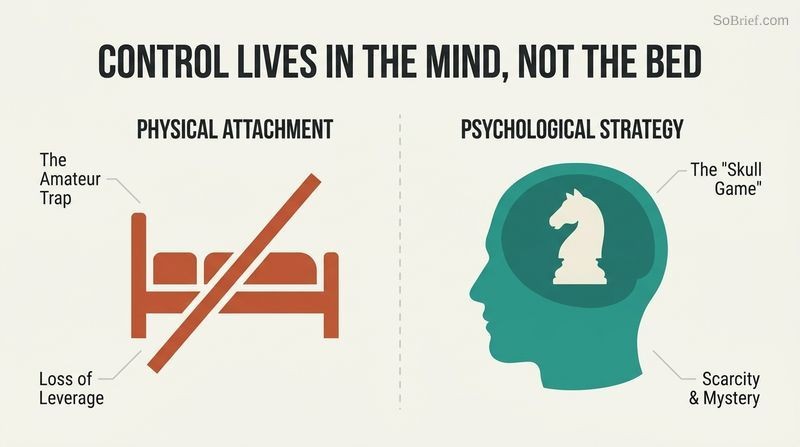
Beck is describing what criminologist Evan Stark named "coercive control": domination through psychological entrapment rather than force alone. The tactics map disturbingly onto cult recruitment and abusive relationships generally: intermittent reinforcement, isolation from peers, manufactured dependency, and the withholding of the manipulator's true self. What reads as underworld exotica is in fact a textbook of intimate-partner abuse. The uncomfortable value here is diagnostic: recognizing these levers helps readers spot them in ordinary relationships, workplaces, and demagoguery. Beck's clinical candor, honed by the psychology books he devoured in prison, makes the memoir double as an unintended field guide to manipulation.
"Cop and blow": the whole enterprise runs on nothing lasting
Acquire and lose, endlessly. Sweet Jones summarized the entire trade in three words: cop and blow. A pimp's job was to get (cop) as many women as fast as possible and expect to lose (blow) them just as fast. Over roughly two decades Beck churned through sixty to seventy women, some staying years, others hours.
Fame was an icicle under a blowtorch. A pimp's status depended entirely on today's flash: a spotless new Cadillac, a spectacular wardrobe. The moment his luck dipped, the young women who once competed for him wouldn't give him the time of day. After his prison escape he was reduced to stealing a broken-down thief just to rebuild a bankroll. Nothing he built ever held; everything had to be perpetually re-won.
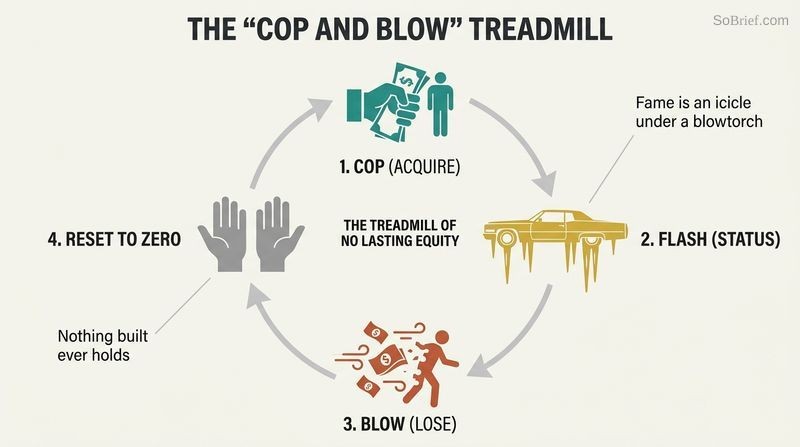
"Cop and blow" is a bleak economic model: a business with no retained earnings, no equity, no durable asset, only high churn and relentless replacement. It resembles the psychology of the compulsive gambler, where the next score must always fund the illusion. Sociologist Elijah Anderson, in "Code of the Street," describes how respect in marginalized economies is chronically unstable precisely because it rests on display rather than institutions. Beck lived that instability to its logical end. The insight for any reader: a status system with no permanence forces its players onto a treadmill that consumes them faster than it rewards them.
His whole descent traced back to being betrayed as a child
The rot started in the nest. Beck opens with two wounds. At three, a churchgoing babysitter named Maude sexually molested him, an early lesson that intimacy could be predatory. Then his adored, kind stepfather Henry, who rescued him and his mother from starvation, was abandoned when his mother ran off with a slick con man named Steve. The boy watched Henry beg on his knees and was torn away.
A prison psychologist offered the diagnosis. Beck reports being told he became a pimp out of unconscious hatred for his mother. Recurring nightmares had him whipping a bloodied woman who turned out to be Mama. Watching his mother "cross" (con) his own father cemented, he believed, a corrosion of his faith in love and women.
Beck essentially narrates attachment theory before it was popular vocabulary. The early rupture of a secure bond (Henry) and the eroticized violation of trust (Maude) prefigure exactly what trauma researchers like Bessel van der Kolk link to later exploitation of others: the abused often reenact power reversals. Yet the memoir resists pure determinism. Plenty of children survive worse without becoming predators, and Beck himself, by squaring up, proves biography is not destiny. The honest reading holds both truths: trauma loaded the gun, but agency, culture, and addiction pulled the trigger repeatedly. The mother-hatred thesis is suggestive, not exculpatory, and Beck seems to know it.
Every hold he had ran on a rainbow that didn't exist
Manufactured hope is the leash. When federal heat forced Beck into hiding, he held his stable together with a fantastical lie: a genius engraver friend was printing flawless counterfeit hundreds, and soon they'd all live in a Hawaiian mansion. The women humped harder chasing a fortune that was never coming.
The pimp feeds the same illusion he lives by. Glass Top explained why he drove aging women insane rather than releasing them: a pimp promises a woman an "easy chair at the end of the rainbow," then keeps her grinding until she realizes there was never a rainbow. Beck's own life mirrored this. He, too, chased a glory that dissolved into prison cells and a skeletal, addicted body.
This is the darkest structural insight in the book: exploitation is sustained less by force than by engineered false expectation. Behavioral economics calls it the sunk-cost fallacy fused with hyperbolic hope, the same mechanism that keeps people in bad jobs, bad investments, and rigged games. What elevates Beck's account is the recursion. The manipulator is himself manipulated by a cultural promise (flash, respect, escape) that pays out to almost no one. The counterfeit-money con becomes a perfect metaphor for the entire life: dazzling, worthless paper. Readers can extract a general defense: interrogate any arrangement whose glue is a payoff perpetually deferred to tomorrow.
Segregation turned pimping into a warped ladder out of the "stockade"
Two passports to the good life. Beck repeatedly frames the Black ghetto as a barbed-wire stockade, and observes that white America honored only two passports out of it: a white skin or a bale of money. Denied the first, he chose to pimp his way toward the second. Standing on Sweet's penthouse patio, he marveled that an illiterate Georgia sharecropper's son had reached a sky-high apartment among white gamblers.
Sweet's origin myth. Sweet told him the first Black pimps were freed slaves who refused cotton and "reversed the game" on a white world that still exploited Black women for free. It was a defiant, self-aggrandizing history, but it captured a real economic truth: legitimate ladders were bolted shut, so the vice economy became a perverse meritocracy.
Eldridge Cleaver and later Black intellectuals read Beck as an unflinching document of how structural racism warps ambition, and the point holds. When Beck later applies for legitimate sales jobs, white interviewers admit he's gifted but won't risk a Black man among white staff. That scene, more than any sermon, indicts the system that made the racket rational. The nuance worth adding: this framing risks romanticizing predation on Black women as resistance, a contradiction Beck never fully resolves. The stockade metaphor explains the demand for illicit ladders without excusing what he climbed them by. Both the indictment and the discomfort deserve to stay in view.
Total power demands total isolation: the pimp is the loneliest man alive
God cannot have friends. Sweet's grimmest lesson: a pimp must be God all the way, which means he can never let anyone know him. He belongs to a hate club he can never quit. Beck describes the peculiar solitude of the trade, saying a good pimp is his own best company because his inner life is so consumed with scheming to out-think the women he controls.
Emotion is the fatal leak. The whole edifice required suppressing every genuine feeling. When Sweet threatened to expose that Beck secretly loved him like a father, Beck begged him not to, because that single human weakness could destroy him in the eyes of the street. Domination and intimacy were mutually exclusive.
There is a philosophical paradox here worth naming. Beck sought status and admiration to cure a childhood of abandonment, yet the only route he knew required severing every real connection, guaranteeing the loneliness he was fleeing. It is the tyrant's dilemma in miniature: control purchased with the currency of relationship leaves the controller starved of the very thing he wanted. Hannah Arendt observed that power built on fear isolates the powerful most of all. Beck's redemption, tellingly, arrives only when he reverses this, choosing a wife and children over the stable. The book quietly argues that connection, not conquest, was the missing nutrient all along.
He controlled through staged reality, from the hanger whip to a fake murder
Violence and theater, deployed coldly. Beck's toolkit was calculated, not hot-blooded. Sweet taught him that a wire coat hanger braided into a whip would break a woman's will where fists failed. But his signature weapon was staged reality. To keep his prized "bottom woman" Rachel from leaving, he orchestrated an elaborate hoax: she "robbed" a man who was secretly a hired wino, a fake doctor pronounced him dead, and Beck welded her to him for years with a murder she believed she'd committed.
The Murphy game, the con behind the con. Even as a teenager he ran the Murphy, steering lustful marks to a nonexistent brothel and pocketing their "checked" valuables. His trade was always more illusion than muscle.
The manufactured-murder cross is a chilling illustration of gaslighting escalated to its logical extreme: rewriting another person's memory of reality to imprison them. Coercive-control researchers note that fabricated guilt and manufactured complicity are among the most durable bonds an abuser can forge, more binding than fear because the victim polices herself. Beck's cold precision, deciding a hanger over fists, staging a corpse over pleading, reveals manipulation as a craft with its own grim engineering. The takeaway is not admiration but literacy: the most effective control rarely looks like brute force. It looks like a carefully arranged story the target cannot escape without indicting herself.
A solitary cell nearly destroyed him, then rebuilt his mind
The steel casket. Recaptured at forty-two after a thirteen-year fugitive run, Beck was locked in a cramped, filthy punishment cell built to crush the human spirit. Men around him went mad, screaming and smearing feces; he was bombed with excrement, threatened, and began hearing voices. He lost thirty pounds the first month.
The skull-guard technique. Drawing on an old convict's advice that the mind is a movie screen where you alone write the script, plus the psychology books he'd read in prison, Beck built an internal sentry. He resolved to stand guard over every thought, shouting down each hallucination and suicidal impulse before it took root. This mental discipline let him survive the year intact and, crucially, forced the insight that pimping was a young fool's game he had outgrown.
Beck independently reinvented the core of cognitive behavioral therapy: catch the intrusive thought, label it as unreal, and refuse it before it spirals. Victor Frankl found the same freedom in the camps, the last human liberty being the choice of one's inner response. What's remarkable is that the very isolation designed to break Beck became the only condition capable of remaking him, precisely because it stripped away the drugs, the flash, and the stable that had insulated him from self-reckoning. It is a hard paradox worth sitting with: transformation sometimes requires an involuntary confinement that no comfortable circumstance would ever impose.
The bill for the life: five prisons, a ruined body, and redemption arriving too late
A career that suckered its own operator. Beck tallies the cost bluntly. He served time in five institutions. He mangled his body with cocaine and heroin. He calculates that the eight years he spent mastering the "pimp book" could instead have made him a doctor or lawyer. He'd been, he concludes, a bigger sucker than any mark, since a mark only loses money while he lost half a lifetime and his freedom five times over.
Squaring up. After the steel-casket year he kicked drugs, quit the life, married Catherine, and had children. Yet redemption came bruised: white employers admitted his sales talent but wouldn't hire a Black man. His mother died begging his forgiveness before he could fully repay her.
The memoir's moral force lies in refusing a triumphant ending. Beck squares up but into a world that still bars the legitimate door, exposing the same racial trap that produced the pimp in the first place. This is why the book resists being read as either glamorization or tidy morality tale. Its power is documentary: this is what the life costs, and this is how narrow the exits remain. Written under his real name Robert Beck, it launched the genre of street literature and shaped generations of hip-hop, yet its truest legacy is the ledger it keeps honest, counting the years, the prisons, and the mother he reached one visit too late.
Analysis
"Pimp" (1967), written by Robert Beck under his street name Iceberg Slim, is the founding text of American street literature and among the most influential Black underground books of the twentieth century, shaping figures from Eldridge Cleaver to Ice-T (who took his name from Beck) and much of hip-hop's self-mythology. Its genre is confessional memoir, but it operates simultaneously as ethnography, cautionary tale, and, uncomfortably, instruction manual. That tension is the central interpretive problem. Beck lingers on technique (the Murphy game, the hanger whip, the counterfeit con, Sweet Jones's rules of coercive control) with a craftsman's relish that can read as boasting, even as the frame narrative insists it is a purgation meant to save "one intelligent young man or woman" from the slime.
Read sociologically, the book is invaluable. Beck's "stockade" metaphor and Sweet's freed-slave origin myth articulate how Jim Crow economics rendered vice a rational ladder when legitimate ones were bolted shut, a thesis the closing job-rejection scenes drive home with documentary bluntness. Read psychologically, it is a startlingly precocious account of trauma reenactment, coercive control, dissociative anesthesia via cocaine, and, in the steel-casket chapters, cognitive self-regulation decades before CBT entered the mainstream.
The book's unresolved contradiction is its misogyny. Beck's entire craft was the industrial exploitation of Black women, and his framework treats them as instruments, never fully as victims of the same system that trapped him. His redemption centers his mother and his own soul; the women he broke largely vanish from the moral accounting. A twenty-first-century reader must hold two things at once: the memoir's genuine literary and testimonial power, and its participation in the very harm it narrates. Its enduring worth is diagnostic, not aspirational. It maps how domination, addiction, and racial confinement interlock, and how narrow the exits remain.
Review Summary
Pimp: The Story of My Life is a controversial and influential semi-autobiographical novel that provides a raw, unfiltered look into the world of pimping in mid-20th century America. Readers praise Slim's vivid writing style and unique perspective, while acknowledging the book's brutal content and misogynistic themes. Many consider it an important cultural document, though some struggle with its graphic depictions of violence and exploitation. The book's impact on hip-hop culture and its exploration of race and power dynamics in America are frequently noted.
People Also Read

Glossary
Cop and blow
Acquire and lose womenThe core operating philosophy of the pimp trade as taught by Sweet Jones: a pimp constantly "cops" (acquires) new women and expects to "blow" (lose) them just as fast. It frames the entire enterprise as high-turnover with no lasting loyalty, requiring perpetual replacement rather than retention.
The Georgia
Conned sexually without payingTo be taken advantage of sexually and left without payment, a cardinal humiliation in Beck's world. Pimps were warned never to let a woman "Georgia" them. The rule that flowed from it: always get the money first, treating the woman like a trick who must pay before sex.
The Murphy
Con game on lustful marksA short con in which the operator steers a sexually eager man toward a nonexistent brothel, then persuades him to "check" his valuables into a sealed envelope for safekeeping before going up, ultimately robbing him. Beck ran a crude teenage version and later admired the polished form built on flattery and false exclusivity.
Bottom woman
Pimp's most trusted leadThe senior, most trusted woman in a pimp's stable, his foundation, who manages the other women and handles his money in his absence. Sweet Jones taught that a pimp gets only three or four good bottom women in a lifetime and must guard his game tightest around her.
The pimp book (skull game)
Unwritten psychological rules of pimpingAn unwritten body of rules, supposedly authored in the minds of freed-slave pimps, governing control through psychology rather than sex. Its core tenets: be God, never confide, stay a mystery, take money before sex, and never pair two new women. Beck treated mastering it as a scholarly pursuit.
Stockade
Segregated Black ghettoBeck's recurring metaphor for the racially segregated Black ghetto, imagined as a barbed-wire enclosure. He argued white America honored only two exit passports: a white skin or a large sum of money. Denied the former, he pursued the latter through pimping.
Prat
Feign rejection to increase desireA manipulation tactic of pretending to reject or dismiss someone in order to intensify their desire to stay. Beck "pratted" women threatening to leave, coldly telling them to go, which typically triggered them to beg to remain and surrender withheld money.
Skull-guard
Internal mental sentry techniqueBeck's self-devised survival method during solitary confinement: an internal sentry that monitors every incoming thought, identifies hallucinations or suicidal impulses as unreal, and refuses them before they take hold. Rooted in a convict's "mind as movie screen" idea and prison psychology reading, it anticipates cognitive behavioral therapy.
FAQ
1. What is Pimp: The Story of My Life by Iceberg Slim about?
- Autobiographical memoir: The book is Iceberg Slim’s raw, unfiltered autobiography, chronicling his life as a pimp in the black underworld from childhood through his criminal career and eventual attempts at redemption.
- Insight into pimp culture: It exposes the harsh realities, rules, and psychology of pimping, detailing the dynamics between pimps, whores, and the broader criminal ecosystem.
- Personal transformation: The narrative explores Slim’s internal conflicts, his relationship with his family (especially his mother), and his struggle to leave the pimp life behind.
- Social critique: The book critiques the societal and racial conditions that fostered Slim’s lifestyle, serving as both a cautionary tale and a study of resilience.
2. Why should I read Pimp: The Story of My Life by Iceberg Slim?
- Unprecedented honesty: Slim provides a brutally honest, firsthand account of the pimp lifestyle, demystifying and deglamorizing a world often misunderstood or romanticized.
- Cultural and historical significance: The book offers a window into African American urban life, systemic racism, and the underground economy of mid-20th-century America.
- Literary impact: Slim’s narrative style, blending street slang with poetic imagery, has influenced hip-hop, literature, and film, making it a cornerstone of urban and African American literature.
- Powerful social message: Slim’s story is intended as a warning, hoping to deter others from following his destructive path.
3. What are the key takeaways and themes from Pimp: The Story of My Life by Iceberg Slim?
- Pimping as a cold game: Success requires emotional detachment, strict control, and constant vigilance—pimping is depicted as a ruthless survival game, not a glamorous lifestyle.
- Cycle of violence and exploitation: The narrative reveals how abuse, betrayal, and violence perpetuate within the pimping world, often rooted in childhood trauma.
- Cost of the lifestyle: The book highlights the physical, emotional, and legal dangers of pimping, including addiction, imprisonment, and personal loss.
- Possibility of redemption: Despite the darkness, Slim’s journey suggests that transformation and hope are possible, even after a life of crime.
4. Who was Iceberg Slim and how did his early life influence Pimp: The Story of My Life?
- Traumatic childhood: Born Robert Beck, Slim endured sexual abuse, family dysfunction, poverty, and violence, which deeply scarred him and shaped his worldview.
- Family instability: His father’s abandonment and his mother’s troubled relationships created a chaotic home, further destabilizing his youth.
- Early exposure to crime: Encounters with hustlers and petty criminals introduced Slim to street life, setting him on the path to pimping.
- Academic promise and downfall: Despite early academic success, Slim’s notoriety and poor choices led to expulsion and incarceration, pushing him deeper into the underworld.
5. What is the “pimp by the book” method or philosophy in Pimp: The Story of My Life by Iceberg Slim?
- Structured rules of pimping: The “pimp by the book” method, taught by Sweet Jones, emphasizes discipline, secrecy, and emotional coldness as keys to survival.
- Maintaining control and mystery: Pimps must remain a “puzzle” to their whores, never revealing true feelings or weaknesses, to prevent being manipulated or “Georgiaed.”
- Financial discipline: Always get paid upfront, avoid emotional entanglements, and practice “cop and blow”—constantly acquiring and letting go of whores as needed.
- Psychological warfare: The method is a mental game, requiring constant scheming and emotional armor to outwit both rivals and one’s own stable.
6. How does Iceberg Slim describe the relationship between pimps and whores in Pimp: The Story of My Life?
- Transactional and manipulative: The relationship is based on control and exploitation, with pimps viewing whores as assets to be managed for profit.
- Constant power struggle: Whores test pimps for weakness, while pimps must respond with emotional coldness and authority to maintain dominance.
- Violence and psychological games: Physical abuse and emotional manipulation are used to enforce discipline and loyalty.
- Complex emotional dynamics: Despite the harshness, moments of dependency and conflict arise, revealing the emotional complexity beneath the surface.
7. What are the main characters in Pimp: The Story of My Life by Iceberg Slim and what roles do they play?
- Iceberg Slim (Robert Beck): The narrator and protagonist, whose journey from naive youth to hardened pimp and eventual self-reflection drives the narrative.
- Sweet Jones: Slim’s mentor and the archetypal pimp, teaching him the rules and philosophy of the game.
- The Runt, Chris, Ophelia, and other whores: Members of Slim’s stable, each with distinct personalities, illustrating the complexities of pimp-whore relationships.
- Top, Patch Eye, and other pimps: Fellow players in the underworld, providing advice, rivalry, and context for Slim’s development.
8. How does drug use and addiction influence the world of Pimp: The Story of My Life by Iceberg Slim?
- Integral to the lifestyle: Drug use, especially cocaine and heroin, is pervasive among both pimps and whores, serving as both a coping mechanism and a destructive force.
- Impact on control: Addiction can undermine a pimp’s authority and a whore’s productivity, threatening the stability of the operation.
- Tool for manipulation: Pimps sometimes use drugs to control or sedate whores, further entrenching dependency.
- Symbol of escape and destruction: Drugs represent both an escape from harsh realities and a path to self-destruction, with Slim’s own struggles marking key turning points in his life.
9. How does Iceberg Slim portray the criminal justice system and racism in Pimp: The Story of My Life?
- Harsh and unforgiving: Slim’s experiences with arrest, trial, and incarceration reveal a system quick to punish and slow to rehabilitate.
- Systemic racism: The narrative highlights how black men face harsher treatment and limited opportunities, with racism shaping Slim’s choices and worldview.
- Corruption and bias: Encounters with police and lawyers expose incompetence, fear, and complicity in maintaining the status quo.
- Cycle of recidivism: The justice system is depicted as a trap, making escape from the underworld difficult and perpetuating criminal behavior.
10. What is the significance of the “degree in pimping” and “jungle fauna” sections in Pimp: The Story of My Life by Iceberg Slim?
- “Degree in pimping”: Symbolizes Slim’s formal initiation into the pimping lifestyle, learning the rules, strategies, and emotional armor needed to survive.
- Dreams and nightmares: These sections reveal Slim’s internal conflict, guilt, and the psychological toll of his choices, especially regarding his mother.
- “Jungle fauna”: Introduces the complex ecosystem of the urban underworld, including rival pimps, whores, hustlers, and the social dynamics they navigate.
- Preparation for the fast track: These chapters mark Slim’s transition from novice to seasoned player, setting the stage for his rise and eventual downfall.
11. What are the most memorable quotes from Pimp: The Story of My Life by Iceberg Slim and what do they mean?
- “A pimp is the loneliest bastard on Earth.” Highlights the emotional isolation required to maintain control and authority in the pimping world.
- “A pimp is really a whore who has reversed the game on whores.” Captures the cyclical nature of exploitation and the manipulative essence of pimping.
- “To be a good pimp, you gotta be icy, cold like the inside of a dead-whore’s pussy.” Emphasizes the necessity of emotional detachment for survival.
- “The name of the pimp game is ‘Cop and Blow.’” Summarizes the constant turnover and instability inherent in the lifestyle.
12. What is the significance of the epilogue in Pimp: The Story of My Life by Iceberg Slim?
- Reflection on transformation: The epilogue details Slim’s life after pimping, highlighting his struggles to adapt to the “square world” and find acceptance.
- Continued challenges: Despite leaving the game, Slim faces ongoing racism and rejection, underscoring the lasting impact of his past.
- Hope and humanity: The narrative ends with a warm image of family life, suggesting redemption and the possibility of a new beginning.
- Closure and resilience: The epilogue offers a sense of closure, emphasizing Slim’s growth and the enduring effects of his experiences.
Download PDF
Download EPUB
.epub digital book format is ideal for reading ebooks on phones, tablets, and e-readers.








































