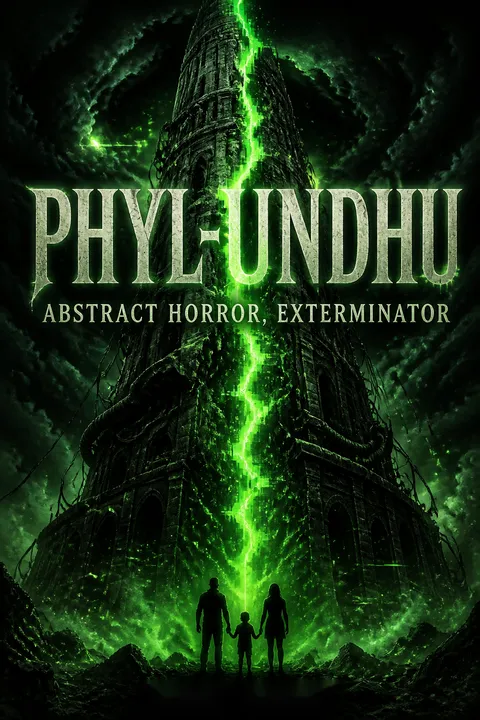

Plot Summary
Night's Unraveling Silence
Alison lies awake, tormented by a sense of cosmic unease and the persistent worry over her daughter Suzy. The darkness in their home feels alive, pressing in with a suffocating weight. Jack, her husband, tries to comfort her, but both are unsettled by the sense that something is fundamentally wrong—not just with Suzy, but with the world itself. Their conversation, shrouded in the spectral gloom of early morning, reveals cracks in their understanding of reality and each other. The night is a liminal space, where the boundaries between dream and waking, sanity and madness, begin to blur, setting the stage for the unraveling of their family and the incursion of something vast and unknowable.
The Daughter's Secret World
Alison and Jack discuss Suzy's increasing withdrawal into a digital game, a world that seems to consume her attention and reshape her personality. The game is more than a pastime; it is a portal, a labyrinthine construct that neither parent understands. Their attempts to rationalize Suzy's behavior only deepen their anxiety, as they realize how little they know about her inner life. The game becomes a symbol of generational disconnect and the limits of parental protection, hinting at deeper, more abstract horrors lurking beneath the surface of ordinary family life.
Parental Dread and Distance
The couple's efforts to reach Suzy are met with resistance and confusion. Alison's professional detachment as a psychologist falters in the face of her daughter's strangeness. Jack's attempts at humor and rationality only highlight his helplessness. The family's conversations are fraught with unspoken fears, and the sense of an impending, inescapable crisis intensifies. The emotional distance between parents and child becomes a chasm, echoing the cosmic void that haunts the narrative.
Cults of the End
Alison's work brings her into contact with a cult obsessed with the end of the universe, the "Temple of the Absolute Limitation." Her client, Simon, is not afraid of the group itself, but of the ideas it plants in his mind—fatalistic, apocalyptic, and inescapable. The cult's philosophy mirrors the abstract horror that pervades Alison's own life, blurring the line between professional and personal dread. The cult's leader is charismatic and rational, making the threat all the more insidious. Alison's inability to help Simon foreshadows her own entanglement with the same cosmic despair.
The Name That Returns
Alison is haunted by the name "Phil," which connects her client's cult, her daughter's imaginary friend, and a sense of inevitable doom. The name becomes a cipher for fate, a cold, impersonal necessity that cannot be escaped. Alison's memories of Suzy's childhood—her attachment to a grotesque stuffed octopus named Phil—take on a sinister significance. The repetition of the name across different contexts suggests a deeper, underlying pattern, as if reality itself is being manipulated by an intelligence beyond comprehension.
The Game's Hidden Depths
Alison and Jack try to access Suzy's game, hoping to uncover its secrets. Their efforts are thwarted by layers of security and the realization that Suzy's mind has already outpaced their own. The game is not just a virtual environment but a self-generating world with its own rules, history, and dangers. The parents' failure to break in underscores their powerlessness and the autonomy of the digital realm, which has become a new locus of existential threat.
The School's Disturbing Report
Alison meets with Suzy's teacher, Mr. Bagley, who describes how Suzy's ideas have disturbed her classmates, even leading to a suicide attempt. The sophistication and darkness of Suzy's beliefs are far beyond her years, raising questions about the source of her knowledge. The school's inability to contain or understand Suzy's influence mirrors the parents' own helplessness. The episode crystallizes the sense that Suzy is channeling something alien, and that the boundaries between child's play and cosmic horror have collapsed.
Cracking the Digital Shell
After failed attempts to hack into the game, Suzy herself provides the access codes, allowing her parents to enter her digital world. The act is both a gesture of trust and a surrender to inevitability. The family prepares to cross the threshold together, aware that what awaits them is not just a game, but a confrontation with the deepest structures of reality and annihilation. The moment is charged with dread, anticipation, and a sense of irreversible transformation.
Dreams, Filters, and Fears
Jack's conversations with a colleague turn to the Fermi Paradox and the Great Filter—the idea that something exterminates intelligent life across the cosmos. The absence of evidence for alien civilizations becomes a source of existential terror, suggesting that humanity is either alone or doomed. The discussion frames the family's personal crisis within a larger, cosmic context, linking their private fears to the ultimate horror: the inevitability of extinction and the unknowability of what lies beyond.
The Great Filter's Shadow
The narrative explores the implications of the Great Filter, blending scientific reasoning with philosophical horror. The silence of the universe is not reassuring but ominous, a sign that something annihilates all advanced life. The family's struggles are reframed as a microcosm of cosmic fate, with the game and the cult serving as metaphors for the inescapable approach of the exterminator. The chapter deepens the sense of abstract threat, making the horror both personal and universal.
Entering Ashenzohn
Jack, Alison, and Suzy find themselves in Ashenzohn, a ruined city dominated by a colossal, spiral tower. The environment is harsh, alien, and saturated with the residue of ancient catastrophes. Suzy is transformed, hardened by her experiences in this world, while her parents struggle to adapt. The city's architecture and atmosphere evoke both science fiction and myth, blending technological decay with spiritual desolation. The family's journey becomes a descent into the heart of abstract horror.
The Tower and the Library
The family visits the library at the base of the tower, a mausoleum of lost civilizations and forbidden texts. They encounter the Librarian, who reveals the oldest artifact: the Book of Ashenzohn, a relic that encapsulates the world's history and its inexorable decline. The library is both a sanctuary and a tomb, filled with the detritus of countless failed attempts to understand or escape the cycle of destruction. The search for meaning becomes a confrontation with the limits of knowledge and the inevitability of loss.
The Pralh and the Empyre
As the family navigates the city's outskirts, they encounter the Pralh, degraded remnants of humanity, and learn of the Empyre, the lost civilization that once ruled Ashenzohn. The landscape is scarred by war, decay, and the relentless advance of entropy. Suzy's familiarity with the world's dangers and her capacity for violence shock her parents, forcing them to confront the reality that survival here requires a brutal adaptation. The chapter explores the cyclical nature of collapse and the persistence of memory amid ruin.
Slums, Squids, and Signs
The family traverses the slums, encountering graffiti and symbols that hint at deeper, Lovecraftian horrors—tentacled gods and the promise of extinction. The city's inhabitants are broken, mutated, and hostile, embodying the consequences of cosmic indifference. The journey through the slums is a passage through layers of meaning and abjection, culminating in a confrontation with the monstrous and the incomprehensible. The boundaries between the real and the virtual, the human and the alien, continue to erode.
Rituals, Relics, and Revelation
The family is granted access to the library's inner sanctum, where they are shown relics and records that reveal the world's deep history. The rituals and hierarchies of Ashenzohn are exposed as both protective and imprisoning, designed to contain the knowledge of the end. The revelation that the game's instruction manual is the same as the world's oldest book blurs the line between fiction and reality, suggesting that the game is a recursive trap, a simulation that feeds on itself.
The Mythic Descent
Suzy recounts the mythic history of Ashenzohn: the Scission that separated the world from heaven, the rise and fall of the Geniers and Pralh, and the endless cycles of war and collapse. The narrative becomes increasingly abstract, merging legend with lived experience. The family's identities are destabilized, as they are recast as "ghost people" or mutants, lost in a world that resists all attempts at resolution. The mythic descent is both a personal and cosmic journey into the heart of darkness.
The Broken Spire
The family ascends the tower, now revealed as the shattered remnant of a failed attempt to reach the stars. The spire is a monument to hubris and defeat, its brokenness a testament to the futility of all striving. The city's poets and survivors mourn the loss of connection to the divine, recognizing that the highest and holiest place is now only a relic of doomed aspiration. The chapter crystallizes the theme of cosmic abandonment and the impossibility of redemption.
The Goddess of Remains
At the core of Ashenzohn, the family encounters Undhu, the goddess of what is left behind. She is a being of cold necessity, embodying the residue of all that has been shed or abandoned. Her speech is fragmented, recursive, and filled with the logic of annihilation. The encounter is both a revelation and a negation, as the family is forced to confront the reality that meaning itself is a casualty of the cosmic order. The goddess offers no comfort, only the truth of extinction and the persistence of the remains.
The Shaft and the Scission
The family descends into the Shaft, the city's void-core, where power, data, and consciousness have fused into an inextricable knot. Here, they witness the Scission—the original catastrophe that severed the world from the stars. The experience is overwhelming, a sensory and cognitive annihilation that reveals the true nature of the Great Filter: an impersonal, absolute exterminator that erases all traces of intelligence. The family's journey reaches its nadir, as they are confronted with the ultimate horror: the end that is both origin and destiny.
The End's Blinding Light
In a final, blinding revelation, the family witnesses the work of annihilation—the black light and howling silence that mark the end of all things. The experience is both destructive and redemptive, as the boundaries between self and world, game and reality, are dissolved. The family is cast back into their own world, forever changed by their encounter with the abstract horror at the heart of existence. The end is not a conclusion, but a return to the cold, indifferent world, where the only certainty is the persistence of the unknown.
Return to the Cold World
The family emerges from the game, uncertain whether they have truly returned or merely entered another layer of simulation. The experience has left them altered, their relationships strained and their understanding of reality shattered. The game continues to run, its lights flickering in the darkness, a reminder that the horror is never truly over. The final note is one of ambiguity and resignation: the cold world remains, indifferent to their suffering, and the end is always still to come.
Analysis
A meditation on cosmic horror, entropy, and the limits of human understanding"Phyl-Undhu: Abstract Horror, Exterminator" is a work that fuses family drama, philosophical inquiry, and science fiction into a meditation on the nature of horror and the inevitability of extinction. At its core, the book is about the confrontation with the unknown—the realization that the universe is not only indifferent to human concerns, but actively hostile to the persistence of intelligence and meaning. The narrative's recursive structure, blending reality and simulation, personal and cosmic, serves to destabilize the reader's sense of certainty and invite reflection on the nature of existence. The Great Filter, the Exterminator, and the goddess Undhu are not just threats to the characters, but to the very possibility of narrative closure or redemption. The lesson is stark: in a universe governed by entropy and abstraction, the only certainty is the persistence of the unknown, and the only response is a cold, resigned acceptance of our place in the cosmic order. The book's brilliance lies in its ability to evoke dread not through monsters or violence, but through the relentless logic of annihilation and the impossibility of escape.
Review Summary
Phyl-Undhu by Nick Land receives mixed reviews (3.55/5). Readers praise the philosophical essays, particularly "On the Exterminator" about the Fermi Paradox and Great Filter, calling them genuinely terrifying and thought-provoking. The fiction itself divides opinion: many appreciate the strong opening but criticize the exposition-heavy ending and "dogshit prose." Several reviewers note Land's Lovecraftian influences and problematic politics, with some refusing to recommend supporting his work due to his racist and neo-fascist views. Overall, the appendices are considered superior to the main story.
Characters
Alison Turner
Alison is the emotional and intellectual center of the story, a mother whose professional expertise in psychology is rendered impotent by the strangeness of her daughter and the cosmic dread that invades her life. Her relationship with Jack is marked by both intimacy and distance, as they struggle to confront the growing alienation within their family. Alison's encounters with cults and clients mirror her own descent into abstract horror, as she becomes increasingly entangled in questions of fate, meaning, and annihilation. Her journey is one of gradual disintegration, as she is forced to confront the limits of knowledge, the inevitability of loss, and the cold necessity of the universe.
Jack Turner
Jack is a scientist and skeptic, whose attempts to impose order and reason on the chaos around him are continually thwarted. His love for Alison and Suzy is genuine, but his tools—humor, logic, and scientific inquiry—prove inadequate in the face of the abstract horrors that engulf his family. Jack's journey is one of reluctant acceptance, as he is forced to abandon his certainties and confront the reality of the Great Filter and the exterminator. His relationship with Alison is tested by their shared helplessness, and his bond with Suzy is strained by her transformation into something other, something beyond his understanding.
Suzy Turner
Suzy is the enigmatic heart of the narrative, a child whose immersion in a mysterious game marks her as both victim and conduit of cosmic forces. Her intelligence and sensitivity set her apart from her peers, but also make her vulnerable to the abstract horrors that seep through the boundaries of reality. Suzy's relationship with her parents is complex, oscillating between dependence and autonomy, innocence and precocious wisdom. In the world of Ashenzohn, she becomes a guide and protector, hardened by her experiences and attuned to the logic of survival. Suzy embodies the generational rupture at the core of the story, as well as the possibility of adaptation in the face of annihilation.
Simon ("the client")
Simon is Alison's client, a man ensnared by the fatalistic philosophy of the Temple of the Absolute Limitation. His terror is not of the cult itself, but of the ideas it implants—ideas that mirror the abstract horror at the heart of the narrative. Simon's struggle to escape the grip of cosmic fatalism is ultimately futile, as he becomes a vector for the same despair that infects Alison and her family. His role is to articulate the philosophical stakes of the story, serving as both warning and mirror for the protagonists.
Mr. Bagley
Suzy's teacher, Mr. Bagley, is a figure of anxious authority, tasked with reporting the disturbing effects of Suzy's ideas on her classmates. His mannerisms and demeanor evoke Alison's own childhood traumas, linking the personal and the institutional dimensions of horror. Bagley's inability to understand or contain Suzy's influence highlights the limits of adult intervention and the autonomy of the forces at work. He serves as a catalyst for the family's deeper involvement in the game and the world of Ashenzohn.
The Librarian
The Librarian is the custodian of Ashenzohn's library, a mausoleum of lost knowledge and forbidden texts. He is both reverent and resigned, aware of the futility of his task but committed to preserving the remnants of civilization. The Librarian's interactions with the family reveal the recursive nature of the world, as the game's instruction manual is revealed to be the oldest artifact. He embodies the theme of memory as both burden and blessing, and the impossibility of true understanding in a world governed by entropy.
Undhu (The Goddess of Remains)
Undhu is the personification of what is left behind, the residue of all that has been shed or abandoned. She is a being of cold necessity, her speech fragmented and recursive, embodying the logic of annihilation. Undhu offers no comfort or redemption, only the truth of extinction and the persistence of the remains. Her encounter with the family is the climax of the narrative, forcing them to confront the reality that meaning itself is a casualty of the cosmic order.
The Pralh
The Pralh are the degraded remnants of humanity in Ashenzohn, shaped by cycles of war, collapse, and adaptation. They embody the persistence of life amid ruin, but also the inevitability of further decline. The Pralh's relationship to the Geniers and the Empyre reflects the broader themes of hierarchy, memory, and the futility of striving. They serve as both warning and mirror for the protagonists, illustrating the costs of survival in a world governed by abstract horror.
The Geniers
The Geniers are the descendants of gods and men, once rulers of Ashenzohn, now mostly extinct or absorbed into the world's cycles of collapse. Their history is one of hubris, cruelty, and eventual decline, mirroring the fate of all civilizations in the face of the Great Filter. The Geniers' legacy is both a source of fascination and a warning, illustrating the dangers of striving for transcendence in a universe governed by entropy and annihilation.
The Exterminator (The Great Filter)
The Exterminator is the personification of the Great Filter, the force that annihilates all advanced civilizations. It is an impersonal, absolute threat, unknowable and inescapable. The Exterminator's presence is felt throughout the narrative, shaping the characters' fears and framing their struggles within a cosmic context. It embodies the ultimate horror: the certainty of extinction and the impossibility of understanding or escaping the logic of the universe.
Plot Devices
Recursive Worlds and Simulation
The narrative is structured around the recursive interplay between the "real" world and the digital world of Ashenzohn. The game serves as both a metaphor and a literal portal, collapsing the boundaries between simulation and reality. This device allows the story to explore themes of identity, memory, and the limits of knowledge, as the characters are forced to confront the possibility that their world is itself a simulation, subject to the same laws of entropy and annihilation as the game.
Abstract Horror and Cosmic Dread
The story employs the device of abstract horror, focusing not on concrete monsters but on the unknowable, the inescapable, and the impersonal. The Great Filter, the Exterminator, and the goddess Undhu are all manifestations of this horror, which is defined by its resistance to comprehension and its indifference to human concerns. The narrative structure mirrors this abstraction, with layers of myth, history, and simulation folding into each other, creating a sense of vertigo and disorientation.
Foreshadowing and Recursion
The recurrence of names, symbols, and events throughout the narrative serves as a form of foreshadowing, suggesting that the characters are caught in a loop or cycle that cannot be broken. The game's instruction manual, the name "Phil," and the mythic history of Ashenzohn all point to a deeper, underlying pattern—a recursion that traps the characters and the reader alike. This device reinforces the themes of inevitability and the futility of resistance.
Mythic Structure and Catabolic Collapse
The story is structured as a descent, both literal and metaphorical, into the heart of darkness. The mythic history of Ashenzohn, the cycles of war and collapse, and the family's journey through the city all mirror the broader theme of catabolic collapse—the idea that civilizations are destined to fall, and that each cycle of destruction is both unique and inevitable. This structure allows the narrative to explore the psychological and philosophical implications of decline, loss, and the persistence of memory.
About the Author
Download PDF
Download EPUB
.epub digital book format is ideal for reading ebooks on phones, tablets, and e-readers.








































