
Key Takeaways
1. Consciousness Resides in the Brain, Not the Body
Consciousness depends entirely on the brain. If the brain ceases to function, nothing is left: not us and not the world around.
Brain's central role. Galileo's journey begins by establishing that consciousness is inextricably linked to the brain. When the cerebrum, the brain's largest part, is severely damaged, as in the case of Copernicus, consciousness vanishes entirely, even if basic bodily functions like breathing and heartbeat persist. This stark observation underscores that the brain is the seat of subjective experience.
Not all brain parts are equal. While the brain is essential, not all its regions contribute equally to consciousness. The cerebellum, despite having more neurons than the cerebrum, does not generate consciousness. This suggests that the sheer number of neurons is less important than how they are organized and interact. The distinction highlights a fundamental puzzle: what specific properties of brain organization give rise to conscious experience?
Beyond mere life. The fading of consciousness with brain death, even when the body can be kept alive, challenges traditional notions of the soul. It implies that our private universe—people, objects, colors, sounds, thoughts, and feelings—dissolves when the brain's intricate activity ceases. This sets the stage for a scientific inquiry into consciousness, moving beyond metaphysical assumptions.
2. Integrated Information, Not Just Neurons, Generates Consciousness
The cerebrum, where citizens of all kinds and manners can argue with each other, and as they speak decide on things together. And the cerebellum, a city even more populous, but there instead everyone lives alone, without talking to anyone, in his own cell taking care of his business.
Connectivity matters. The key difference between the conscious cerebrum and the unconscious cerebellum lies in their organizational structure. The cerebrum functions like a "great and lively city" where specialized groups of neurons constantly communicate, forming dynamic coalitions and exchanging information. This rich interconnectivity allows for a unified and diverse experience.
Isolated modules. In contrast, the cerebellum is described as an "immense, silent prison" or a city where "everyone lives alone, without talking to anyone." Its many parts perform specialized tasks accurately and quickly but do so in isolation, without integrating their information into a coherent whole. This lack of integration, despite a higher neuron count, explains why the cerebellum does not generate consciousness.
The "two cities" analogy. This powerful analogy illustrates that consciousness requires a system where information is not merely processed by many parts, but where these parts are able to interact and influence each other extensively. It's the ability of different specialists to "talk to each other" and "decide on things together" that distinguishes a conscious system from a collection of independent automatons.
3. Sensory Input and Motor Output Are Not Essential for Consciousness
If the images of consciousness are created in the cerebrum, not in the retina, thought Galileo, then of course the lady’s eyes could be alive and blind, but the blind man could see.
Inner vision persists. Consciousness does not depend on direct sensory input from the outside world. The "blind painter" who lost his eyes could still vividly imagine colors and shapes, and dream of paintings. Conversely, the "old lady" with cortical blindness had intact eyes but could not "see" consciously, demonstrating that vision is a function of the brain's internal processing, not merely the retina.
Action is not a prerequisite. Similarly, motor outputs and pathways are not necessary for consciousness. Galileo's friend M., suffering from "locked-in syndrome," was completely paralyzed and unable to speak or move, yet remained fully conscious. His mind was active, thinking, and feeling, even though he could only communicate through subtle eye blinks. This highlights that the manifestation of thought is distinct from thought itself.
Brain's internal world. These cases reveal that consciousness can exist as a rich, internal world, independent of its external interfaces. The brain's intricate loops for memory, language, and action are "slaves of consciousness," performing complex tasks without necessarily being part of the conscious experience itself. This suggests that consciousness is generated by a core set of brain regions, while many other systems serve its needs.
4. Consciousness Is a Unified Entity That Can Be Divided
Ishmael split into Ishma and El, and Ishma saw the lady, and El the brute, but no one saw them both—there was no Ishmael who could see the adultery, as long as the two hemispheres were split.
The indivisible self. A hallmark of consciousness is its unity; we experience the world as a single, coherent whole. However, this unity is not absolute and can be experimentally disrupted. When the connections between the two cerebral hemispheres are severed, as in the case of Ishmael, consciousness itself can split into two independent streams, "Ishma" and "El," each with its own perceptions and awareness.
Functional disconnections. This phenomenon is further illustrated by "hysterical blindness," where a person might unconsciously avoid obstacles but consciously deny seeing them. This suggests a temporary, functional split within the brain, where different "coalitions of neurons" operate in isolation. When these disconnections are overcome, as by a familiar song, the fragmented consciousness can reintegrate.
The "one and many" paradox. The ability to split and merge consciousness implies that it is not an immutable, indivisible soul, but rather a dynamic entity dependent on the brain's integrated structure. The experience of a unified self arises from the seamless communication and integration of information across various brain regions. When this integration breaks down, so does the unity of consciousness.
5. Consciousness Fades with Excessive or Uniform Neural Activity
So consciousness can fade not only if neurons are destroyed and cannot fire, as with Copernicus—consciousness also fades if all neurons fire at the same time.
The paradox of activity. Counterintuitively, consciousness can be lost not only when brain activity is too low (e.g., brain damage) but also when it is too high or too uniform. During epileptic seizures, when cortical neurons fire "strongly and synchronously," consciousness fades. This is likened to a crowd where "if everybody shouts together, nobody can listen."
Dreamless sleep's uniformity. Similarly, in dreamless sleep, despite intense neural activity, consciousness is absent. The brain's activity shifts from "shallow, changing waves" (wakefulness) to "deep, slow waves" where neurons are "on and off only together." This "totalitarian" state, where "everybody behaves like everybody else," lacks the differentiated activity necessary for conscious experience.
Information requires differentiation. The key insight is that consciousness requires not just activity, but differentiated activity. If all neurons are doing the same thing, or firing in an undifferentiated, synchronous burst, the system cannot distinguish between many different states. This reduction in the repertoire of distinguishable states leads to a loss of information and, consequently, a loss of consciousness.
6. A Vast Repertoire of Distinguishable States Is Necessary for Consciousness
To a photodiode, the whole universe merely was: this or not this.
Beyond simple detection. Galileo's thought experiment with the photodiode reveals a crucial insight: simply responding to a stimulus (like light or dark) is not enough for consciousness. The photodiode, with its binary "on or off" states, can distinguish only one bit of information. While it can accurately report light or dark, it lacks any conscious experience of them.
The richness of experience. In contrast, when Galileo experiences "dark," his brain is not just distinguishing dark from light. It's distinguishing dark from countless other possibilities:
- Not red, blue, or any color
- Not a face, a place, or a shape
- Not a sound, smell, or taste
- Not a feeling or a thought
This immense "repertoire of alternatives" that the brain can distinguish is what gives even a simple experience like "dark" its rich, specific quality.
Information as reduction of uncertainty. The concept of information, as introduced by S., is defined as the "reduction of uncertainty." A system with a large repertoire of possible states has high uncertainty about its current state. When it settles into a particular state, it "rules out" a vast number of other possibilities, thereby generating a large amount of information. This vast informational capacity is a prerequisite for consciousness.
7. True Consciousness Requires Information to Be Integrated (Φ)
Integrated information is the information generated by a system above its parts, where the parts are those that, taken independently, generate the most information.
The camera paradox. While a digital camera sensor has a vast repertoire of states (millions of photodiodes, 2^1,000,000 possible images), Galileo concludes it is not conscious. The crucial distinction is that the camera's information is merely the sum of its independent parts. Each photodiode acts alone, unaware of what its neighbors are doing.
The "minimum cut." To be truly conscious, information must be integrated. This means the system must generate information as a unified whole, above and beyond what its individual parts could generate independently. The measure of this integrated information is denoted by Φ (Phi), calculated by finding the "minimum cut" that maximally reduces the information generated by the whole.
A single entity of experience. A system with high Φ forms a "complex"—a single, irreducible entity of experience. Unlike the camera, where splitting the sensor into parts changes nothing about the information generated, splitting a conscious brain (like Ishmael's) divides consciousness itself. This demonstrates that consciousness is not merely a collection of parts, but a whole that is "more than the sum of its parts."
8. The Quality of Experience Is a Unique Shape of Integrated Information
It is the shape that matters—a crystal kaleidoscopic, conjured by a chrysalis of mechanisms; a crystal of beauty phenomenal, begotten by the light that shines through a trillion lenses. It is the quale—the shape that is the quality of experience.
Beyond quantity. Having established that consciousness is integrated information (Φ), the next challenge is to explain the quality of experience—why red looks red, or pain feels painful. This is addressed by conceiving of experience as a "shape" in a multi-dimensional "qualia space." Each "irreducible concept" (a specific distinction made by a mechanism) is a "point of light" in this space.
Mechanisms as concepts. The brain's elementary mechanisms (neurons and their connections) act like "lenses" that focus "light" by ruling out possibilities and specifying concepts. For example, a mechanism for "light" specifies that it's not dark, not colored, not a shape, and is visual. Each mechanism generates a unique "light" (a probability distribution of past and future states) in qualia space.
The palace of light. The entire constellation of these "lights"—generated by individual mechanisms and their constructive interference—forms a unique, complex "shape" in qualia space. This shape, called a "quale," is the specific quality of a conscious experience. It is "maximally irreducible" and defines what an experience is by how it differs from all other possible experiences.
9. Consciousness Is Present in Animals and Develops Gradually
There is less soul in a slumbering human embryo than in a poor old donkey when he tastes his freedom—this much I know, said Galileo.
Continuum of consciousness. The theory suggests that consciousness is not an all-or-nothing phenomenon but exists on a continuum. Animals, like the "donkey human" or the "human ox," possess consciousness, albeit potentially different in quality and complexity from human consciousness. Their experiences, though perhaps less reflective or self-aware, are no less real.
Embryonic development. Consciousness is also not instantly present at conception but develops gradually as the brain forms and its integrated information (Φ) increases. An early embryo, with its simple neural tube, has a Φ value likely less than a fly's, implying minimal or no consciousness. As the brain grows and its mechanisms become more complex and integrated, the "light of consciousness" slowly illuminates its "chambers."
Ethical implications. This gradual development of consciousness has profound ethical implications. It suggests that respect for life should be proportional to the degree of consciousness present, rather than being an absolute based on species or mere biological existence. This perspective challenges traditional views on the sanctity of life at its earliest stages.
10. Consciousness Grows Through Exploration, Imagination, and Integration
The more we learn, the more we bring under the light of consciousness, the more the dark, scattered dust that is the world outside is tied together into a single shape, one that we see and understand.
Expanding the repertoire. Consciousness is not static; it grows and evolves. This growth occurs through various means:
- Exploration: Discovering new aspects of the external world, like Galileo's telescope revealing new stars or Shackleton's Antarctic expeditions.
- Imagination and Art: Creating new "shapes" in the mind that nature hasn't produced, as sculptors and painters do, or writers with words.
- Learning and Education: Integrating new concepts and knowledge, thereby expanding the repertoire of what can be distinguished and understood.
The "mannequin's" wisdom. The mannequin emphasizes that understanding involves tying together disparate facts and events into a single, coherent "quale." For instance, understanding evolution means integrating ancient molecules with modern species, seeing them as part of one "immense tree of possible experiences." This process of integration makes the world "more real" by bringing it under the "light of consciousness."
Responsibility and freedom. As consciousness grows through learning and self-knowledge, so does responsibility. A more conscious choice, informed by a richer context of integrated motives, is a more determined and therefore a more truly "free" choice. This suggests that the pursuit of knowledge and understanding is not just about external facts, but about actively shaping and enriching our internal conscious universe.
11. Consciousness Is the Only True Reality, Unique and Precious
Consciousness is maximally irreducible, and it is unique; consciousness is the shape of understanding, the only shape that’s really real—the most real thing there is.
The ultimate reality. The theory posits that consciousness, as integrated information (Φ), is the "only thing that exists in and of itself" and is "really real." Unlike aggregates (like a heap of sand or a galaxy), which exist as one only from an external, conscious perspective, a conscious complex exists intrinsically. This makes consciousness the fundamental phenomenon, the "fountain of phenomena."
Death as dissolution. Death is the ultimate loss because it signifies the "extinction of that inner light," the dissolution of one's unique quale. The idea of an immortal soul is challenged by the brain's role in shaping and sustaining consciousness. When the brain disintegrates, the "diamond" of consciousness shatters, and its unique shape vanishes forever.
The value of uniqueness. The concept of making perfect copies of consciousness, as proposed to Zeno and Galileo, highlights the preciousness of individual experience. While such copies might achieve virtual immortality, they would diminish the uniqueness and intrinsic value of each consciousness. Galileo's refusal to be copied, even to avoid death, underscores that the "twisted shape" of his unique, lived experience, including its sorrows and connections, is what makes it precious and irreplaceable.
Review Summary
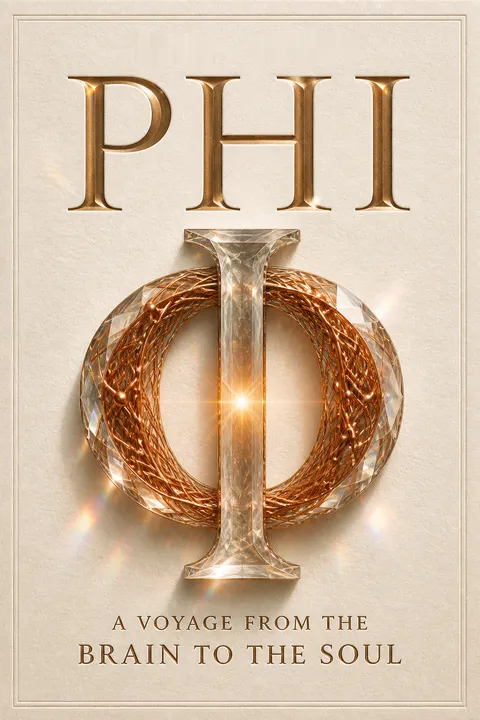
Phi presents neuroscientist Giulio Tononi's Integrated Information Theory through an allegorical journey modeled on Dante's Divine Comedy. Galileo travels with guides Francis Crick, Alan Turing, and Charles Darwin through consciousness-related scenarios. The lavishly illustrated book explores how consciousness arises from integrated information (symbolized by Φ). Reviews are polarized: some praise its originality and interdisciplinary approach, comparing it to Gödel, Escher, Bach, while others find the metaphors confusing and the target audience unclear. Most agree the format is ambitious but opinions split on its effectiveness for communicating scientific concepts.
People Also Read



Download PDF
Download EPUB
.epub digital book format is ideal for reading ebooks on phones, tablets, and e-readers.








































