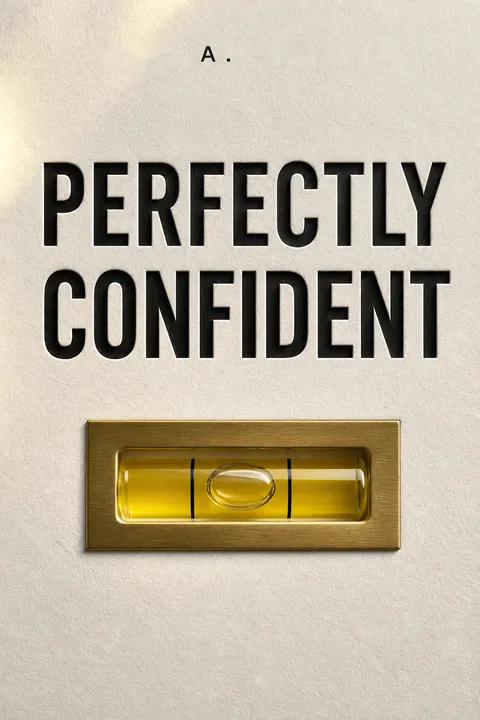

Key Takeaways
1. Calibrated Confidence is the Goal, Not Just More Confidence
The middle way between these two is a narrow path and is not always easy to find.
Rethink confidence. The popular self-help narrative often suggests that more confidence is always better, but this book argues that such a view is fundamentally flawed. True confidence isn't about boundless self-belief; it's about an accurate assessment of your abilities, potential, and the likelihood of future outcomes. Both overconfidence and underconfidence are errors, leading to mistakes of action or inaction, respectively.
Three forms of confidence. The author introduces three distinct manifestations of confidence to help readers understand where their judgments might be miscalibrated:
- Estimation: How good you think you are or how likely you are to succeed. Overestimation leads to overcommitment.
- Placement: How you compare yourself to others. Overplacement makes you believe you're better than average, even when you're not.
- Precision: How sure you are that your beliefs are correct. Overprecision is common, making people too certain of their knowledge.
The "mother of all biases." Overconfidence, particularly overprecision, is identified as one of the most pervasive and potentially catastrophic cognitive biases. It has been implicated in major disasters like the sinking of the Titanic and the 2008 financial crisis. Conversely, underconfidence can lead to missed opportunities, such as talented low-income students not applying to top universities. The goal is not to maximize confidence, but to calibrate it to reality.
2. Challenge Your Beliefs: Ask "How Might I Be Wrong?"
I beseech you, in the bowels of Christ, think it possible you may be mistaken.
Confirmation bias. Humans naturally seek out information that confirms their existing beliefs, a tendency known as confirmation bias. This can lead to excessive certainty, as seen in Harold Camping's followers who were absolutely convinced of an impending apocalypse, refusing to consider any evidence to the contrary. This selective search for evidence makes it difficult to identify flaws in our own reasoning.
Consider the opposite. The most effective debiasing strategy is to actively challenge your own hypotheses by asking, "Why might I be wrong?" This approach, championed by figures like Oliver Cromwell and Karl Popper, forces you to seek disconfirming evidence rather than just confirming data. For example, when assessing a project, don't just look for reasons it will succeed; actively brainstorm reasons it might fail.
The value of disagreement. Engaging with people who hold different viewpoints is a powerful way to stress-test your own beliefs. Ray Dalio, founder of Bridgewater Associates, transformed his investment strategy after a public failure by actively seeking out independent thinkers who disagreed with him. This "idea meritocracy" fosters a culture where honest criticism and rigorous analysis lead to better decisions, rather than everyone simply agreeing and being wrong.
3. Embrace Uncertainty: Think in Probabilities, Not Point Predictions
It’s silly to pretend you can forecast the future with certainty, when in fact you face a distribution of possible outcomes.
Beyond a single guess. Most organizations and individuals rely on "point predictions"—a single best guess for an uncertain future. However, this approach is inherently flawed because the future is rarely precise. A single number neglects the full range of possibilities and exacerbates overprecision, making people too sure of their forecasts.
Probability distributions. A superior alternative is to think about uncertainty as a probability distribution, like a histogram. This involves considering a range of possible outcomes and assigning probabilities to each. For example, instead of predicting exact sales figures, estimate the likelihood of sales falling within different ranges (e.g., 90,000-110,000 units, or below 30,000). This forces a broader, more realistic assessment of the future.
Calibrating with distributions. While some find probabilistic thinking unfamiliar, it's a skill that can be cultivated. The "Good Judgment Project" successfully trained forecasters to improve their accuracy by teaching them to recognize and calibrate uncertainties. Even for unique historical events, thinking probabilistically is the most accurate approach, as it acknowledges the inherent complexity and unpredictability of life, from coin flips to civil wars.
4. Calculate Expected Value: Weigh Outcomes and Likelihoods
To assess the present value of an uncertain prospect (like an insurance policy), multiply its probability by its value.
Rational decision-making. Every decision involves a forecast of its consequences. The logic of expected value provides a rational framework for making choices under uncertainty. It requires you to quantify both the probability of an outcome and its value (or cost). For instance, when offered an insurance policy, you calculate the expected value of accepting versus declining based on the likelihood of the event occurring and the financial implications.
Beware of wishful thinking and fear. Our assessment of probabilities is often biased by our desires or fears. Wishful thinking can lead us to overestimate the likelihood of positive outcomes (e.g., sports fans overestimating their team's chances, Jerry Yang overvaluing Yahoo!). Conversely, exaggerated fears can inflate the probability of undesirable events (e.g., Americans overestimating the risk of terrorism). These biases distort expected value calculations, leading to suboptimal decisions.
Distinguish probability from utility. A common mistake is to confuse the emotional impact (utility) of an outcome with its objective probability. A terrifying event like a plane crash might loom large in our minds, but its actual probability is minuscule. Similarly, a huge lottery jackpot might be alluring, but the chance of winning remains incredibly small. Accurate expected value calculations require separating these two components and making the most objective estimates for each.
5. Clarify Definitions to Avoid Self-Delusion
As the standards become clearer, people are less likely to believe that they are better than others.
Ambiguity fuels overplacement. People often believe they are "better than average" in ambiguous domains like driving skill, honesty, or intelligence. This isn't always intentional deception; it's often because individuals hold idiosyncratic definitions of what "good" means in these areas. If everyone defines "good driving" differently, everyone can genuinely believe they are the best.
The power of clear standards. Clarifying performance standards significantly reduces overplacement. When criteria are specific and measurable, self-assessments become more calibrated. For example, students are less likely to claim superior intelligence when asked about their performance on a specific test, and employees better understand promotion criteria when they are clearly defined. This clarity helps inoculate against self-aggrandizement and fosters a more realistic self-view.
Beyond results-orientation. While clarity is crucial, being solely "results-oriented" can be problematic. If success is rewarded and failure punished, it incentivizes caution and discourages risky, but potentially high-expected-value, innovation. Instead, organizations should reward "well-intentioned failure"—projects that had a positive expected value but didn't pan out due to chance. This requires defining and measuring not just outcomes, but the quality of the decision-making process itself.
6. Learn from Failure: Use Postmortems and Premortems
Better than understanding a tragedy is anticipating it and avoiding it altogether.
Postmortem analysis. Learning from past failures is crucial for improvement. The airline industry, for example, meticulously conducts postmortem analyses of crashes and near-misses to identify systemic weaknesses and implement safety improvements. Companies like Google also use postmortems to understand what went wrong and prevent similar mistakes, fostering a "fail fast, fail often" culture.
Premortem analysis. Even better than reacting to failure is proactively anticipating it. A "premortem analysis" involves imagining that a project has spectacularly failed and then brainstorming all the possible reasons why. This technique, recommended by Gary Klein and Daniel Kahneman, helps uncover hidden risks and weaknesses that might otherwise be ignored due to optimistic bias or fear of speaking up. It allows for proactive mitigation strategies.
Disaster preparedness. Defensive pessimism, a personal form of premortem, motivates individuals to work harder by vividly imagining potential failures. On an organizational level, disaster preparedness involves anticipating calamities and planning for them, as seen in Facebook's Project Storm or earthquake drills. These practices, though seemingly negative, are essential for building resilience and avoiding catastrophic outcomes, often thanks to unsung heroes like Vasily Arkhipov who avert disasters we never even know about.
7. Seek Diverse Perspectives: The Wisdom of the Crowd
It is only by the collision of adverse opinions that the remainder of the truth has any chance of being supplied.
The value of disagreement. Ray Dalio's transformation at Bridgewater Associates highlights the power of seeking out diverse perspectives. When smart people disagree, it forces a critical examination of underlying assumptions and evidence. This "thoughtful disagreement" is a gift, helping individuals and organizations understand their own blind spots and increase their probability of being right.
"Wanna bet?" The challenge "Wanna bet?" is a powerful tool for clarifying beliefs and exposing overconfidence. When someone is willing to bet against your confident claim, it signals that they possess information or a perspective you might be missing. Warren Buffett's million-dollar bet on passive investing against hedge funds demonstrated this principle, showing that even experts can be wrong when their confidence isn't calibrated.
Crowds are wiser. The "wisdom of crowds" suggests that the average of many independent judgments is often more accurate than any single expert's opinion. This works because individual errors tend to cancel each other out. However, the crowd's wisdom depends on the diversity and independence of its members. Biased groups, where members reinforce shared views, can lead to "group polarization," making the crowd a "mob" that moves further from the truth.
8. Balance Optimism and Realism: Avoid Extremes
The optimist believes that he lives in the best of all possible worlds. The pessimist fears that this is the case.
Optimism's double edge. While optimism can feel good and sometimes motivate effort, excessive optimism can lead to significant costs. Delusional optimism often results in greater disappointment when reality falls short of grandiose expectations. It can also be a "self-negating prophecy" if it reduces the effort needed for success, as seen in Hillary Clinton's 2016 campaign or the fable of the tortoise and the hare.
Pessimism's pitfalls. Conversely, excessive pessimism can lead to missed opportunities and unnecessary worry. The author's father, a "consummate pessimist," missed out on substantial stock market gains due to his fear of crashes. While caution is wise in the face of real risk, ruminating on unlikely disasters or exaggerating risks can be just as dysfunctional as overconfidence, leading to inaction and regret.
The middle way. The ideal approach is a "middle way" between overconfidence and underconfidence, rooted in truth and accuracy. This means making realistic estimates of probabilities and consequences, acting boldly when justified by rigorous analysis, and cautiously when risks are too great. It's about having "well-founded confidence" that acknowledges both potential and limitations, rather than indulging in either unbridled hope or paralyzing fear.
9. Confidence is a Practice, Not a Feeling
The way to wisdom treads the line between overconfidence and underconfidence.
Mastering self-assessment. Confidence is not merely a gut feeling or a fixed personality trait; it is a practice that can be developed and refined. The book offers research-based tools to help readers calibrate their confidence, moving towards a "Goldilocks zone" where confidence is "just right." This involves continuous self-examination, learning from feedback, and applying logical frameworks to uncertain situations.
Tools for calibration. Key practices for developing calibrated confidence include:
- Thinking in probability distributions for forecasts.
- Calculating expected values for decisions.
- Conducting postmortems and premortems to learn from success and failure.
- Actively seeking diverse perspectives and challenging one's own assumptions.
- Clarifying definitions to avoid ambiguity in self-assessment.
Courage and humility. Achieving perfectly calibrated confidence requires an uncommon blend of courage to act when justified and humility to admit when one might be wrong. It means resisting wishful thinking and confronting uncomfortable truths. This ongoing process of honest self-reflection and levelheaded analysis builds a solid foundation for beliefs and expectations, leading to wiser life choices.
10. Lead with Calibrated Confidence, Not False Certainty
Honestly communicating the real uncertainty about uncertain things is a viable strategy for aspiring leaders.
The leader's dilemma. Leaders face a constant tension between needing to inspire confidence in their vision and the necessity of making decisions based on accurate, often uncertain, information. While displaying confidence can increase influence and status, as seen in research, faking certainty or indulging in "puffery" carries significant risks, as exemplified by figures like Elizabeth Holmes, whose overconfidence was built on lies.
Substance over show. To avoid being swindled or losing credibility, leaders should prioritize substance over mere show. This means backing up confident claims with credible evidence and binding commitments. Instead of vague promises, offer specific, verifiable claims. When challenged, be willing to "bet" on your forecasts through contractual guarantees or performance-contingent incentives, demonstrating genuine belief in your assessments.
Credibility through honesty. Research suggests that leaders gain greater credibility not by claiming absolute certainty about uncertain events, but by expressing well-informed and well-calibrated confidence in probabilistic predictions. Acknowledging uncertainty, while uncomfortable, is a cornerstone of rationality and fosters trust. This approach allows leaders to inspire followers while making better decisions, ultimately benefiting their organizations and society by promoting truth and critical inquiry over dogmatic ideologies.
People Also Read







Download PDF
Download EPUB
.epub digital book format is ideal for reading ebooks on phones, tablets, and e-readers.








































