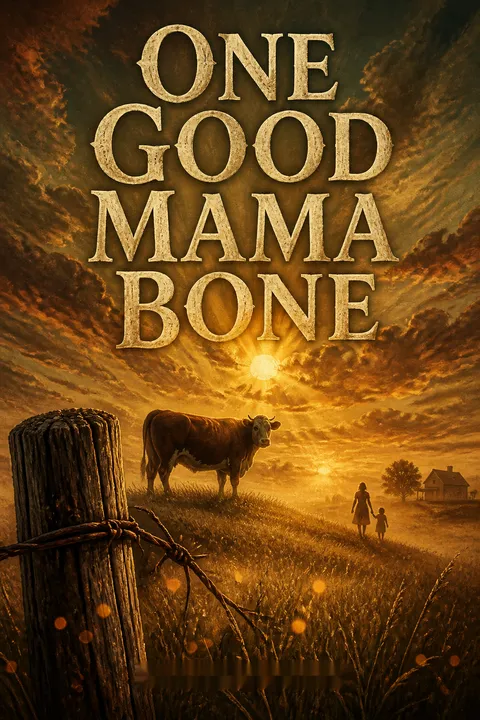

Plot Summary
Night of Two Mothers
In the darkness of 1944 South Carolina, a baby's first screams echo in Sarah Creamer's kitchen—echoes Mattie, her best friend and the actual mother, won't answer. In a desperate cycle of loss, Mattie, broken by fear and shame, flees and takes her own life, leaving Sarah with the baby boy, Emerson Bridge. Overwhelmed by her own mother's condemnation that she has "no good mama bone," and sensing the void within herself, Sarah outright rejects the role thrust upon her. But faced with the baby's helplessness, the stains of blood, and a moonlit, abandoned field, a kernel of reluctant resolve forms. Sarah's bone-deep emptiness, Mattie's brutal absence, and a blood promise made in shock and sweat lay the uneasy foundation for a new, unexpected kind of family.
A Cow's Fury and Birth
On a cold November night, a Hereford cow, later called Mama Red, separates from her herd and gives birth to twin calves beneath a cedar. Her own maternal instinct is her only teacher. In a cruel twist, one calf survives while the other is descended upon by buzzards. The mother's agony is animal and elemental—her defense is brutal but not enough to save both. Blood and milk, loss and animal love, set a primal tone. Witness to the limits and endurance of maternal power, Mama Red's story is interlaced with Sarah's—a parallel of what it means to nurture or fail, and a quiet harbinger that the wisdom of nature may guide flawed humans.
Sorrow Inheritance
By 1951, Sarah is scraping together meals, still feeling herself unworthy as a parent, dogged by her dead mother's words and the heavy inheritance of shame and lack. Her husband Harold is vanishing into alcohol and illness. Emerson Bridge (the boy) is growing but their poverty is relentless. Sarah's self-doubt deepens as she fears she will fail to sustain, love, and truly claim the boy—not just as a duty, but as her own. The prospect of losing the house, the memory of Mattie's blood in the floorboards, and the chorus of ghosts—of mothers, siblings, and the unclaimed dead—make her desperate and resourceful, stoking, slowly, her hidden "mama bone."
Poverty's Daily Bread
Sarah's house is shadowed by hunger. She trades the last of her fabric for flour, bargains pride for food, and walks miles to sell a handmade dress, only to confront richer neighbors' petty troubles and her own exhaustion. With Harold's sudden death—quiet and unremarked—Sarah is thrust into bare survival. While she tries to shield Emerson Bridge from the harshest realities, the tasks of nourishment, burial, debt, and the need for human comfort become both obstacle and epiphany. It's never enough, but the women, animals, and children dream despite the stark margin between survival and beggary.
Absence and Abandonment
As Sarah breaks the news of Harold's death, Emerson Bridge's heartbreak is compounded by the specter of abandonment—not only a dead father, but a mother so self-scorned that she can barely reach out to him. Sarah's isolation grows deeper. A pattern emerges: a lineage of mothers leaving, children left uncertain whether they are wanted or seen. It is only through the animal kingdom—particularly the ever-present Mama Red and her grieving moo—that both Sarah and the boy find a rudimentary, wordless empathy that the humans struggle to articulate.
Trading Dresses, Trading Hope
Sarah's attempt to exchange her meager craft for cash brings her into direct contact with privilege—Mrs. Dobbins and the world of the prosperous Dobbins clan, whose son, Little LC, is bullied and belittled despite the family's comfort. The Dobbins home becomes a mirror of Sarah's own, revealing that pain and deficiency are not only the province of the poor. The transaction of money for dresses becomes a lifeline for Sarah and a silent healing for Mrs. Dobbins, hinting at friendships and forgiveness possible even in unequal relationships.
Sudden Widowing
Harold's death, both a sorrow and a release from years of disappointment, leaves Sarah with both practical and existential debts. She must mother the boy, settle financial accounts, bargain with creditors, and finally admit to herself, if not yet to Emerson Bridge, that his survival now depends on her capacity to provide—not only in body but in spirit. Grief, guilt, and shame intermingle with a new, hesitant will. Both Sarah and her boy begin searching, in their muted ways, for signs—divine or otherwise—that they are not alone.
Fatherless Boys, Silent Bonds
The boys both poor and rich—Emerson Bridge and Little LC—struggle with the absence or disappointing presence of fathers. In the Dobbins house, "winning" a steer show is a war for paternal approval, with glory constantly deferred. In Sarah's home, small gestures between mother and son, and between girl and animal, substitute for language and emotional certainty. The building of fences, both literal and figurative, keeps hope in and fears out, but also maintains the dangerous distance that only touch—animal, maternal, or childish—can bridge.
Rival Houses and Animal Hearts
As Sarah dreams of winning the $680 prize by entering Emerson Bridge's steer, the Dobbins family measures worth and love by blue ribbons on their wall. Emerson Bridge, yearning for connection, is granted a young steer (Lucky) by way of a complicated, shared investment with Mr. Thrasher, the bank, and the Dobbinses. Mama Red, frantic for her calf, knocks down barbed wire to be beside him, her maternal devotion teaching Sarah more than her own mother ever did. The parallel heartbreaks in both households underscore the hollowness in victories and losses measured only by men.
Emerson Bridge's Steer
Lucky, the young steer, and Emerson Bridge bond as solace and surrogate kin. Lucky's cries without his mother, and Sarah's aching to mother well, expose wounds old and new. The hard lessons of animal husbandry—feed, weaning, discipline—become metaphors for the loves and limits of human care. Sarah, striving to follow "the natural course," must separate the calf from Mama Red, just as she cannot shelter her own boy from suffering. Emerson Bridge finds dignity and self-worth by championing Lucky, a project that, unbeknownst to him, demands the ultimate sacrifice.
Mama Red Knocks Down Fences
Just as Sarah's understanding of love and duty is deepened by watching Mama Red fight for her calf, the literal fences between people and animals blur. Sarah's journey to "learn how to be a mama" is catalyzed by watching animal resilience and grief. When the money for Lucky's feed is impossible to raise, and Sarah is offered a cruel trade—her mother-cow for debt relief—she chooses loyalty over practicality, severing the last pretense that "doing the right thing" and "doing the necessary thing" are the same. In the process, she discovers the cost of both.
Lessons in Kindness
As the county 4-H program shapes boys into cattle-show rivals, it also forces them to confront the cost of kindness—particularly Little LC, whose father berates tenderness as weakness. LC and Emerson Bridge, desperate for approval and safety, begin to see in each other (and in their animals) the possibility of friendship unconditioned by competition or cruelty. By trading halters, exchanging small Christmas gifts, and defending one another from bullies, they push back against the hardness the adult world demands.
Fences In Flesh and Spirit
As winter deepens and both steers and children grow, the practical and psychic costs of "finishing" a steer become clear. Fences—between animals and their mothers, between black and white neighbors, between Sarah and her own son—are both a cruelty and a protection. Sarah, haunted by her own abandoned child and her mother's rejection, seeks solace in play, memory, and the fleeting joys of laughter and friendship. Meanwhile, her boy, ever hungrier, learns that love may mean giving up the thing you want most.
Steer, Son, and Survival
Money for grain runs out, debts mount, and Sarah faces the temptation to trade Mama Red for one more month of survival. An accidental steer bloat—caused by too much kindness, too little caution—almost kills Lucky. As white and black neighbors, children, and cattle all struggle, the danger of trying to "do it right" grows clearer. The rescue of Lucky with an icepick and Pepsi bottles is a vivid, communal act—but one underwritten by the ever-present threat that loss, when it comes, will be irrevocable.
The Truth About Champions
As show time approaches, the dark reality of the steer project comes due. The boys must now sign papers acknowledging that their animals are destined for slaughter; the notion of "champion" is tainted by loss. Sarah and Emerson Bridge wrestle with the moral cost of proceeding, their collective memory of abandonment and longing for redemption colliding with the demands of poverty and pride. The choices they make—torn between affection and necessity—will reverberate painfully across families and generations.
The Dark Side of Glory
With the competition near, the Dobbinses unravel: LC is battered by his father, unable to live up to the "dynasty"; Sarah, haunted by departed friends and mothers (Mattie, Mama Red), teeters at the edge of too much pain to bear. Within the world of men—be it farmers, creditors, or drunken husbands—violence is both threat and inheritance. The costs of pride, bitterness, and old violence (racial and familial) are measured out in trauma to children, animals, and even the landscape itself.
Best-Laid Plans
As cheerless victories, broken deals, hospitalizations, and relentless bills accumulate, Sarah's resolve to "carry it" for her boy and for herself is tested to the breaking point. Revisiting her own mother only brings further disappointment—proving that intergenerational pain is not so easily healed. Still, the seed of healing resides in small acts of play, honesty, and connection, often enacted not among humans, but between human and animal. The final removal of Mama Red from her calf—and then from Sarah—becomes an act of heartbreak, necessity, and eventual mercy.
A Daughter's Reckoning
Sarah's journey to see her own mother leads not to closure, but to the realization that a mother's love—as well as her meanness—can never be forced. The encounter is a recapitulation of old wounds; Sarah's mother is unkind, resentful, broken, and unable to comfort or accept comfort. Yet, through her own son, and through Mama Red, Sarah comes to forgive, if not reconcile, the unchangeable past and commits herself to being the kind of mother she wished she'd had.
Show Time and Sacrifice
The great day dawns and the show and sale are held. Emerson Bridge's hard work and love for Lucky culminate in victory: his steer is named Grand Champion. Yet, the triumph is bitter—winning means surrendering Lucky, just as so many mothers, cows, and humans have lost their own. Simultaneously, tragedy strikes elsewhere: Little LC, unable to bear his father's pressure and the unrelenting expectation of hardness, uses a family gun to take his own life, marking his father with a burden he can never shake.
Forgiveness in the Blood
The aftermath of competition and violence is marked by grief: for the lost steer (Lucky), for the ruined Dobbins family, and for childhoods lost to circumstance and pain. But Sarah, tasked once again with facing the cost of survival, commits to redeeming at least one hurt—using her winnings to buy back Mama Red, to keep what love she can within her own fence. Emerson Bridge, in caring for his mother and their animals, inhabits both the best and worst of inherited love, learning that forgiveness—of others, of oneself—is the only way forward.
One Good Mama Bone
In the final reckoning, the cycle of maternal love and frailty begins anew. Mama Red, old and spent, births a calf with Sarah's help—an act that is both a restitution and an initiation. This ritual affirms what Sarah has learned from all the mothers, animal and human, who came before her: loving well means enduring sorrow, forgiving hurts done and received, and knowing, at last, that a "good mama bone" is less about perfection and more about willingness, persistence, and heart.
Analysis
In One Good Mama Bone, Bren McClain takes the ancient myth of mother love—its selflessness, its limits, its essential animality—and refracts it through the hard lens of mid-century rural poverty, shame, and generational trauma. The story indicts the cruelty of societal norms: the way poor mothers are maligned, gentle boys broken, and even the most basic animal bonds (between cow and calf, mother and child) repeatedly severed by need and pride. And yet, the novel refuses simple binaries; its vision of motherhood is one of humility, imperfection, struggle, and learned (not innate) grace. McClain's sustained parallel between animal and human need is not sentimental but pedagogical: animals—by living, grieving, surviving—teach humans the elemental lesson that "to mother" is less about birthright than about willingness to try and try again. For modern readers, the book remains timely: it calls for a reevaluation of how care is cultivated, how cycles of injury are broken, and how love, when finally extended freely and persistently, is strong enough to cross any fence, heal old wounds, and—most importantly—endure. The story's final affirmation is not triumph, but forgiveness: not one perfect mama bone, but one good enough.
Characters
Sarah Creamer
Sarah is a woman devastated by her own mother's coldness and her belief that she lacks "one good mama bone." Pressed by poverty, the loss of her best friend (Mattie), and the burden of raising another's child, Sarah at first refuses love and shrinks from her own maternal duties. As the novel expands, her struggles—through loss, resourcefulness, and witnessing Mama Red's devotion—force an internal transformation. Gradually, she uncovers a capacity for love and sacrifice rooted less in nature than in chosen courage. Through small gestures, failures, and redemptive persistence, Sarah develops a "good mama bone" that is uniquely her own, finally embracing her boy, forgiving herself, and extending her compassion to a wider world.
Emerson Bridge
Born of an illicit union and bequeathed instantly both abandonment and maternal guilt, Emerson Bridge suffers for facts and feelings beyond his understanding. Starved for affection and stability, his joys are tentative; his sorrows, deep. He bonds with animals—first his steer Lucky, then Mama Red—expressing his tenderness when human channels fail. Enduring poverty, bullying, and the emotional reticence of adult caregivers, Emerson Bridge nonetheless embodies the hope that forgiveness and kindness can undo, if not erase, the legacy of hurt. His decision to "sacrifice" his beloved Lucky to save his mother is the ultimate paradox of filial love: painful, mature, and redemptive.
Mama Red
Mama Red, the Hereford cow, is the book's recurring spirit-guide—the living emblem of what it means to risk everything for a child. Her impulses are not reasoned, yet her love is both fierce and quiet, undeterred by fences, pain, or human interference. Her suffering at the loss of her calves—some to violence, others to necessity—mirrors and instructs the humans around her. In old age, she offers up her own body to birth again (with Sarah's help), closing and renewing the cycle of care, compassion, and wrenching loss.
Harold Creamer
Sarah's husband Harold is unable to recover—emotionally or financially—from grief and his own failings. Drifting toward self-annihilation via alcohol and disengagement, he is yet marked by several acts of goodness: teaching his son practical skills, encouraging him to call Sarah "Mama," and in his final moments, giving his blessing to the found family around him. Harold is a vessel of regret, but not of malevolence; his love is real, if insufficient.
Mattie Parnell
Sarah's best friend, Mattie, is a spectral presence—her betrayal with Harold, her suicide, and her unacknowledged motherhood to Emerson Bridge haunt Sarah at every turn. Mattie represents both Sarah's deepest connection and her greatest wound. The echo of her voice ("It ain't the child's fault he was born") lingers, shaping Sarah's choices in the raising of Emerson Bridge and the acts of mercy she commits for others as compensation or atonement.
Little LC Dobbins
LC, son of the wealthy Dobbins family, is bullied by both his father's zeal to win cattle shows and the family's persistent comparisons with his older brother. He is pressured to embody the hard, stoic masculinity of "Dobbins men," but his tenderness, kinship with animals, and emotional vulnerabilities make this impossible. His tragic end—suicide under the shadow of his father's expectations—is the darkest consequence of unchecked pride and a world that mistakes meekness for weakness.
Luther Dobbins
As the principal patriarch and rival cattleman, Luther is the embodiment of flawed Southern masculinity: obsessed with legacy, infected by old grievances (racial and familial), unable to love or guide his son without violence. His understanding of worth is transactional and his own moments of tenderness are short-lived. The suicide of his son, his own remorseful reckoning, and his inability to undo the damage he has done leave him a figure more to be pitied than hated—a warning against the poison of unexamined power.
Mrs. Mildred Dobbins
Initially the archetypal Southern lady, Mrs. Dobbins grows in complexity; her struggles with addiction, her need for love, and her recognition of Sarah's goodness facilitate a rare alliance across class lines. She enables Sarah's survival through the buying of dresses, offers friendship where loneliness is the norm, and becomes a conduit for small redemptions—culminating in mutual recognition of each other's suffering and value.
Ike Thrasher
Mr. Thrasher, a failed preacher and uncertain cattleman, is driven by a longing for manhood, validation, and connection—both with Sarah's family and his own unapproving late father. His arc is one of fumbling good intentions, intermittent wisdom, and gradual, humble acceptance of the limits of striving. His generosity helps save animal and human lives, and his eventual acceptance of himself offers a small, hard-won redemption on the book's margins.
Billy Udean Parnell
Mattie's husband, Billy Udean, is more specter than solid presence: his failures and abandonment set the tragedy in motion, but his later return, reflections on change, and gift of a coat for Emerson Bridge suggest the possibility of growth, even if it comes too late. His acknowledgement of the truth and kindness to the boy provide late, fragile closure for long-standing wounds.
Plot Devices
Parallelism of Animal and Human Bonds
The story is rooted in the tight, sometimes brutal analogy between animal and human motherhood. Mama Red's struggles—birthing, losing, defending, and grieving her calves—mirror Sarah's own failings and redemptions. Observing animal resilience and instinct gives Sarah the strength to enact care even in the absence of instruction or tradition; the fences that separate species and family members alike become sites of trial, trespass, and ultimately reunion.
Cyclical Trauma and Redemption
The narrative structure weaves back and forth between present pains and recollected injuries, making explicit how wounds travel through families—through mothers to children, from wealth to poverty, from whites to blacks, and animals to humans. Yet, within this, the possibility for cycles to be broken—through small acts of care, refusal to perpetuate violence, and sacrificial kinship—offers hope.
Motifs of Fences, Hunger, and Naming
Fences literalize the divisions in the story—rich and poor, animal and human, mother and child, self and other. Hunger represents not only physical need but unfulfilled emotional longing; the lack of names (for babies, for animals) and the reclamation of naming (Little Claudia's grave, Lucky's name) speak to the power of claiming, belonging, and identity.
Show Structure and Foreshadowing
The cattle show is both a plot climax and an existential device: it promises riches but demands sacrifice, it decorates the winner but marks all participants (animal and human) for loss. From the outset, foreshadowing of sorrow is constant—steers must be sold, mothers and children are sundered, and glory is always underwritten by grief.
Multiperspective, Interlaced Voices
The book's narrative voice shifts fluidly: animal perspectives offer primal insight; the thoughts and speech of children reveal truths occluded by adult shame and complication; multiple households and families are juxtaposed to show commonality amid division.
Download PDF
Download EPUB
.epub digital book format is ideal for reading ebooks on phones, tablets, and e-readers.








































