


Plot Summary
Owen Falls
The alarm rings before dawn. Seventeen-year-old Aster1 straps on daggers and pistols, then chases her eldest brother Owen3 onto the main deck. Nightweavers have already overwhelmed the ship. Through choking smoke, she cuts down two human attackers before spotting Owen.3 He parries a blow meant for her, but a Nightweaver's blade pierces his chest.
A dark shadow with glowing red eyes seeps from the killer's body and flees into the captain's quarters. Grief and fury propel Aster1 after it, pistols drawn. Inside, she finds only a frightened little girl13 with black ringlets hiding there. A blow from behind sends her into darkness. When she wakes, her wrists are bound, her family is in chains, and the Lightbringer has sunk beneath the waves.
The opening establishes Aster's fatal limitation: she is never fast enough to save the people she loves. Owen's death is not merely a plot catalyst but a primal wound that shapes every subsequent choice. The shadow creature introduces the true antagonist while complicating the human-versus-Nightweaver binary Aster has been taught. Her instinct to pursue rather than flee reveals core identity: she is a hunter, not prey, even when outmatched. The girl she spares (Annie) becomes the first domino in a chain of moral choices that will eventually dismantle her entire worldview.
Will's Bargain
Ashore in a foggy port town, Aster1 and her chained family are paraded before a crowd. Captain Shade,4 the legendary masked pirate, interrupts the proceedings with red smoke and an iron-ball weapon. He offers Aster1 escape, but she refuses when her brother Charlie takes a bullet.
Then a young Nightweaver named Will Castor2 shoulders through the crowd. He heals Aster1's raw, chained wrists with a touch, presents a contract of service for the entire Oberon family, then burns it before her eyes, telling her the choice to stay or go is hers.
On the train to his estate, Will2 explains the difference between Nightweavers and Underlings, revealing the shadow she saw was a Sylk, a possessing entity. He admits the girl she spared is his little sister Annie.13
The marketplace is a crucible testing Aster's priorities. Captain Shade offers individual freedom; Aster chooses collective survival. Will's arrival introduces moral ambiguity into a world she understood in absolutes. His destruction of the contract is a radical act: he refuses to hold her through legal bondage, betting instead on her loyalty to family. This establishes their central dynamic: he offers agency even when it risks his own goals. The Sylk revelation reframes the cosmology, transforming Nightweavers from monsters into flawed guardians of a broken world.
Bludgrave Manor
The estate rises above the valley like a stone crown. The family receives assignments: Father9 in the kitchen, Mother8 as housekeeper, Margaret7 as Annie13's nanny, the boys as footmen, Aster1 as kitchen maid. That first night, Annie13 sleepwalks with blood on her hands. Her pet atroxis is found gutted. Henry,5 Will2's scarred younger brother, corners Aster1 in her room and tortures her with nerve-burning fire magic until Will2 intervenes.
Later, Aster1 discovers Owen3's bracelet left on her pillow. Will2 returned it. She also glimpses glowing red eyes watching her through a brass grate in the ceiling. The cast of servants includes Dorothy,15 a maid Henry5 secretly loves, and Jack,12 a cheerful stable boy who becomes Margaret7's romantic interest.
The manor is a gilded cage where comfort masks constant surveillance. The family's rapid acceptance of servitude contrasts with Aster's stubborn grief, creating a rift. The atroxis murder and Annie's sleepwalking signal that even the safest spaces have been infiltrated. Henry's attack establishes him as both threat and victim: his cruelty speaks the language of his own unhealed trauma, not innate evil. Will's return of Owen's bracelet is an unspoken promise: he sees her grief, he did not forget.
Among the Pixies
Will2 takes Aster1 to a hidden conservatory where glowing pixies dance and hybrid flowers bloom. He explains that his bonewielding affinity also lets him communicate with living things and grow plants. He confesses he joined the League of Seven at fourteen to prevent the family chauffeur from being drafted, and that his first mission required him to execute sixty possessed soldiers by feeding them to wolves.
The confession transforms Aster1's perception of him. They make a pact: together they will hunt the Sylk that killed Owen.3 As they lie beneath an ancient oak, he weaves her a crown of mystik blossoms and whispers that she would make an excellent queen. Wolves howl, interrupting the moment before he can kiss her.
The conservatory is Eden after the Fall: beauty persisting despite violence. Will's confession about the possessed soldiers reveals the moral injury beneath his composed exterior. He is not innocent, but he is not unfeeling. Their pact externalizes what has already begun internally: they are bound by shared purpose, and that purpose is revenge. The interrupted kiss is the first acknowledgment that their relationship has moved beyond alliance toward something more dangerous and forbidden. The crown of mystiks foreshadows Aster's connection to an ancient queen.
Hello Aster
A scream shatters the night. At the manor's fountain, the Hackneys' decapitated heads are impaled on the statue's sword, their eyes gouged out. Carved into their foreheads: HELLO ASTER.1 A pocketknife from the knapsack Will2 once gave her lies at the fountain's base, wet with blood. Aster1 wades into the blood-filled basin and retrieves Dearest's collar from the statue's goblet.
DID YOU MISS ME? is etched inside. Something grabs her leg and drags her under. Charlie pulls her out, and her eyes glow gold. Will2 compels Charlie to forget what he saw. Later, Will2 admits his own eyes changed because he drew power from the blood, revealing that blood is the purest source of Manan, the magical dust that fuels Nightweaver power.
The Hackney murders transform the story from domestic mystery to active pursuit. The killer is not just a monster but a tormentor who knows Aster's name, her gift, her weaknesses. The message format (carved flesh, bloody water, animal collar) mimics the language of intimate violence: the killer wants Aster to feel seen and hunted simultaneously. Will's compelled alteration of Charlie's memory is ethically monstrous but pragmatically protective, a pattern that defines his approach to Aster. The revelation about blood establishes the world's economy of power and foreshadows Aster's own connection to it.
Will Goes to War
Late one night in Elsie17 and Albert18's room, Aster1 sees a figure standing over her sleeping sister. It turns, revealing Owen3's face but with glowing red eyes and seeping shadows. The Shifter leaps through the window and vanishes. In the conservatory, Will2 admits he has not been entirely honest: he used magic on Aster1 at the fountain to make her sleep. She forgives him.
But then he tells her he is leaving. The prince4 has summoned him to Hellion, and he cannot refuse. He asks his uncle Killian6 to assist Aster1 while he is away. Aster1 does not tell him about the bloody knife Margaret7 found hidden under Annie13's bed, deciding she must hunt alone. The morning he departs, she watches from the window, refusing to say goodbye.
The Shifter's appearance wearing Owen's likeness is psychological warfare, weaponizing Aster's grief against her. Will's departure marks a critical rupture: the person who made her feel less alone abandons her, confirming her belief that trust is weakness. Her decision to withhold the knife evidence signals her retreat into isolation, a survival mechanism from her pirate past that will prove counterproductive. This section dramatizes the cost of secrecy: both Will and Aster withhold information for the other's protection, but the result is mutual isolation and vulnerability.
Death to the King
Killian6 begins training Aster1 in the conservatory while Will2 is away. He gives her twin daggers forged from Elysian Iron, capable of banishing Sylks, and a flintlock loaded with special bullets. He reveals the Order of Hildegarde, a secret coalition of humans, Nightweavers, and surviving Myths working to overthrow the king.
When Aster1 joins, Killian6 enchants a winged dagger tattoo onto her arm. He also confirms the Red Island is real: he was rescued there after a shipwreck and nursed back to health by its inhabitants. The island was founded by Hildegarde's heir as a sanctuary hidden from Morana, the Underling queen. But Killian6 cannot tell Aster1 how to reach it; his rescuers blindfolded him before releasing him.
The Order provides Aster with an institutional framework for her rage, transforming individual vengeance into collective revolution. The daggers are symbolic baptism: she is being armed not just with weapons but with purpose. Killian's confirmation of the Red Island's existence validates Owen's dream while deepening the tragedy of his death. The island represents a potential future where Aster could be free, but it also functions as a taunt: she can believe in it but cannot reach it alone. The tattoo marks her body as belonging to something larger than herself.
Percy's Brand
In Ink Haven, Percy14 and his gang ambush Aster,1 Margaret,7 and Jack.12 Percy14's men hold Margaret7 at knifepoint while Percy14 presses a hot iron to Aster1's forearm, branding her with a P for pirate. When he reaches for Owen3's bracelet, blood suddenly streams from Percy14's eyes and he collapses screaming. The humans in the street rise up with pitchforks, crying for the king's death.
Later, Lord Bludgrave,10 Henry,5 and Aster1 track Percy14 to a coaching inn. Percy,14 now possessed by the Sylk, reveals Dorothy15 has been taken and mutilated. Aster1 cuts off his hands and stabs him, but the Sylk escapes as fire engulfs the inn. Owen3's knave of clubs playing card lies on a dead child's body outside.
The branding scene is a baptism of fire and blood that reconnects Aster with her pirate identity. The mysterious power that bursts from her (blood streaming from Percy's eyes) is the first undeniable manifestation of her Nightweaver bloodletter affinity, though she does not yet understand it. The coaching inn confrontation reveals the Sylk's strategy: it is not merely hunting Aster but psychologically dismantling her. The playing card is the cruelest touch: it suggests Owen might still exist in some form, dangling hope as bait.
The Prince and the Pirate
Henry5 escorts Aster1 to the Reckoning Day Ball in a canary-yellow gown embroidered with nine silver stars, one for each Oberon sibling. The prince of the Eerie, Titus,4 arrives unannounced. To everyone's shock, he bows to Aster1 and asks her to dance. During their waltz, he is teasing and disarmingly human, named after the constellation of the first pirate.
Later, in the garden, his demeanor shifts completely. He pins her against Hildegarde's statue and threatens to kill her family unless she reveals the Order's secrets. When she refuses, choosing death over disloyalty, he laughs and reveals a winged dagger tattoo on his arm: he is the Order's secret weapon, the prince4 working to bring down his own family.
The ball is Aster's public reckoning with her dual identity. The dress and the nine stars are acts of defiance cloaked in compliance. Titus's test mirrors Will's earlier complex dynamics: he offers terror before trust, forcing Aster to prove herself before he reveals himself. The revelation that the prince is a rebel recasts the entire political landscape. The enemy of her enemy is not just a friend but an ally embedded in the heart of power. His vulnerability about his own scars deepens their connection beyond tactical alliance.
Father's Sacrifice
The ball erupts into nightmare. Trudy Birtwistle16 is possessed by the Sylk that killed Owen,3 and a host of Gores and possessed corpses descend on the guests. Dorothy,15 also possessed, advances on the children. In the kitchen, a compelled Father9 attacks Aster1 with a knife before turning the blade on himself rather than harm her.
Aster1 unleashes the full fury of her hidden bloodletter power, banishing the Sylk from Trudy16 and then from Dorothy,15 who dies in Henry5's arms. Henry5's grief ignites the ballroom. Aster1 and Titus4 work together to command the fountain's water to extinguish the flames, draining themselves nearly to death. When the smoke clears, young Annie13 is missing.
This is the novel's emotional and narrative climax. Father's compelled suicide is the ultimate cost of Aster's hidden heritage: her very existence made her family a target. The bloodletter power that saves the manor is the same force that marks her as dangerous and other. Dorothy's death in Henry's arms completes his tragic arc: love cannot save anyone in this world. The fire and water battle externalizes Aster's internal war between rage and her emerging identity. Annie's disappearance launches the final, most devastating sequence.
Owen Returns
Aster1 tracks Annie13 into the woods and finds Lord Bludgrave10 bound to a tree, bloody from compelled self-harm. Then Owen3 steps from the shadows, alive. He wears a fine purple suit and moves with fluid, predatory grace. He reveals the truth: when the Sylk's blade killed him, the Guild of Shadows resurrected him as a Shifter.
He has been watching Aster1 for months, taking the form of a raven, leaving clues, compelling Father,9 orchestrating every attack. Everything was designed to lure her beyond the estate's wards. He explains that Aster1 was bitten by an Underling as a child, that a Sorceress enchanted the bracelets to hide her, and that when Owen3 removed his own bracelet, he broke the protection, allowing the Sylks to find the Lightbringer.
Owen's return is the story's most destabilizing twist, forcing Aster to confront that her grief, her guilt, and her entire quest for revenge were built on incomplete information. The brother she mourned has become the thing she hunts. His explanation retroactively illuminates every strange occurrence: the raven, the playing cards, the messages. The revelation that Owen's own choice (removing his bracelet) triggered the family's destruction adds a devastating layer of tragedy: his search for freedom doomed them all. His new identity as a Shifter literalizes what grief does: the dead return, but changed, monstrous.
The Bracelet Falls
Owen3 gives Aster1 a choice: remove her enchanted bracelet, allowing him to turn her into a Shifter, or watch Annie13 die. Lord Bludgrave,10 helpless and bleeding, begs silently. Annie13 stands nearby, compelled and holding a bloody knife. Aster1 looks into Owen3's cold, tawny eyes and sees no trace of her brother. She slides the leather band from her wrist and drops it in the leaves.
Owen3 drives his black dagger into her chest, but the blade stops short of her heart. Henry5's enchanted handkerchief, tucked into her dress earlier that night, shields her from the fatal wound. Still, the Underling venom floods her system. She collapses. The last thing she sees is Will2's terrified face as he finds her.
The bracelet's removal is Aster's ultimate act of free will. The protection it offered was always a cage: as long as she wore it, she could never be found, but she also could never fully know herself. Removing it is a choice to face the consequences of her heritage rather than hide from them. Owen's inability to see that his logic (join us and be free) is identical to what the Nightweavers offer (serve us and live) reveals his complete corruption. The handkerchief, Henry's accidental gift, saves her, underscoring that connection, not isolation, is what preserves life.
Captain Shade Unmasked
Aster1 wakes in a four-poster bed aboard a ship. Captain Shade4 sits at a desk nearby. Will2 bursts in and crushes her in an embrace, weeping. Shade4 removes his scarlet mask and turns: it is Titus,4 the prince.
He has been Captain Shade4 all along, the pirate who rescued her from the Deathwail, who offered her escape at the gallows. Will2 confesses he knew Aster1 was part Nightweaver from the start, that he kept her bracelets because a Sylk compelled him aboard the Merryway, and that he brought her to Bludgrave to protect her while he searched for answers about her heritage.
Titus4 reveals that Morana, the Underling queen, has possessed the princess of Hellion. There may be a cure for Aster1's venom if they can trap Morana and force her into corporeal form.
The mask removal is the story's final narrative restructuring: every past event must now be reinterpreted through the knowledge that Titus is Shade. Will's confession is a mea culpa delivered too late, and Aster's anger is justified even as his motives were protective. The revelation about Morana possessing the princess transforms the sequel setup into a rescue mission: to save herself and Will, who is also dying from a curse, Aster must walk into the heart of the Eerie's power. The cure replaces revenge with survival as the driving goal.
The Cure Dangled
Titus4 offers Aster1 a bargain: accompany him and Will2 to Castle Grim, where the princess resides, and use her ability to see Sylks to confirm whether Morana truly possesses the bride-to-be. If they can trap the Underling queen and force her to produce a cure, both Aster1 and Will2 will be saved from their respective curses.
He also dangles the bronze medallion Aster1 once stole from him, which he now says belongs to the heir of Hildegarde and can grant access to the Red Island. Overwhelmed, Aster1 flees the cabin, climbs the ship's taffrail, and dives into the ocean. The sea does not reject her. It wraps around her like a living thing, pulling her deeper into darkness laced with shimmering gold dust.
Aster's dive is both suicide attempt and baptism. The ocean, which has been her sanctuary her entire life, now reveals itself as something more: a sentient force that recognizes her bloodletter heritage. Titus's underwater pursuit and his kiss to share air create an unresolved romantic tension that complicates her feelings for Will. The whirlpool and gold dust signal divine intervention: something older and more powerful than Underlings or Nightweavers has taken an interest in Aster's fate. She is no longer merely a hunted girl but a player in a cosmic drama.
Daughter of the Sea
At the ocean floor, a vortex of dark water surrounds Aster1 in a pocket of air. Gold dust coalesces into a luminous female figure who calls her daughter of the sea. The being speaks of a risen queen, of blood healing the land, of truth mending the past. She asks who Aster1 is. Aster1 realizes she is no longer just a pirate, a kitchen maid, or a victim.
She is the judgment. When she surfaces twelve hours later, Titus4 and Will2 haul her into a rowboat. Her choice is made. She will go to Castle Grim, face Morana, find the cure, avenge her father,9 and reclaim the legacy that belongs to her ancestor Hildegarde's bloodline. The pirate has become the storm.
The ocean vision completes Aster's transformation from reactive fury to deliberate purpose. The judgment is coming ceases to be a threat and becomes a promise she intends to keep. The figure (implied to be Hildegarde or a divine messenger) offers not answers but questions, forcing Aster to author her own identity. Her final resolve is not about revenge alone but about claiming power: she will no longer be hunted. She will become the hunter. The trilogy is set: a pirate who is half Nightweaver, carrying Underling venom in her veins, will march into the seat of power and demand the world change.
Analysis
Nightweaver operates at the intersection of inherited hatred and radical empathy, arguing that oppression survives not through uniform cruelty but through the complicity of kind individuals who benefit from unjust systems while claiming to oppose them. Aster1's journey from pirate to servant to revolutionary mirrors the psychological process of moving from inherited prejudice toward strategic resistance: her hatred of Nightweavers must first be complicated by human connection (Will,2 Henry,5 Titus4) before it can be refined into targeted action against the actual architects of suffering.
The central metaphor is blood. Manan flows through it, granting power. Underling venom corrupts it, threatening transformation. Nightweaver affinity expresses through it, marking identity. Family ties bind by it. Aster1's half-Nightweaver heritage literalizes the central tension: she is both oppressor and oppressed, both human and monster, both the weapon and the target. Her body becomes the contested ground where competing claims of identity, loyalty, and power are fought. The ocean, which has protected her since childhood, reveals itself as an extension of her own latent power, a force that recognizes her blood before she does.
Choice under constraint is the novel's philosophical engine. Aster1 repeatedly insists she has none, yet the narrative demonstrates otherwise with punishing clarity. She chooses her family over individual freedom, vengeance over safety, truth over comfortable lies. The bracelet represents protection purchased at the cost of agency: to wear it is to be hidden and safe, but also to be unknown, even to oneself. Removing it, knowing the mortal consequences, is her first fully autonomous act. In that moment she chooses not what is safe but what is hers.
The Sylks represent something more existentially terrifying than monsters. They are the externalization of internal corrosion, the shadow that follows trauma, the seductive voice that insists you are already lost and might as well surrender. Aster1's ability to see them marks her as liminal, belonging fully to neither world. The Guild of Shadows does not merely want her dead; it wants her to choose damnation willingly, to become the thing she has been taught to fear. Owen3's transformation into a Shifter is the story's darkest warning: anyone can fall, and the fall feels like freedom until it is too late.
Review Summary
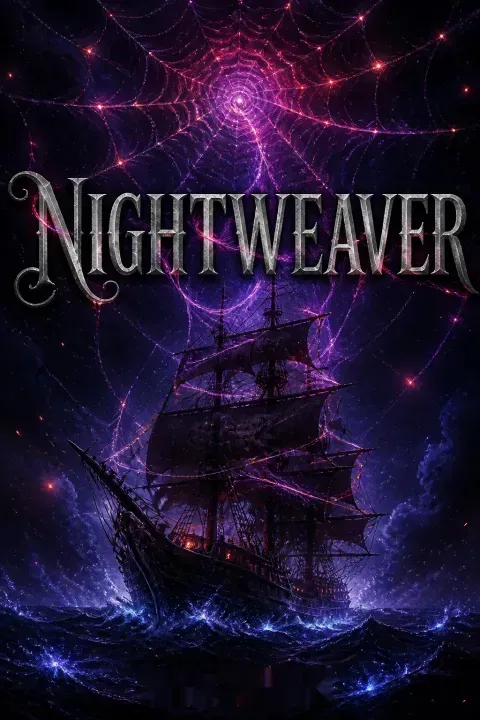
Nightweaver by R.M. Gray receives mixed reviews with a 3.91/5 rating. Fans praise its fast-paced plot mixing pirates, angels, and demons with intense action and emotional depth. Many love protagonist Violet (renamed Aster in reprints) and the forbidden romance with minimal spice. The gothic fantasy features plot twists, family dynamics, and potential love triangles. Critics note the limited pirate scenes despite marketing, predictable plot points, slow pacing in parts, and an underdeveloped main character. Several readers found it underwhelming or DNF'd early, though many call it a masterpiece worth reading.
Characters
Aster Oberon
Pirate turned kitchen maid, secret bloodletterSeventeen-year-old pirate of the Western Sea. Fierce, loyal, and violent when provoked, she has spent her entire life aboard the Lightbringer with her parents and six siblings, trained to fight and kill from childhood. When her eldest brother Owen3 is murdered by an Underling-possessed Nightweaver, her grief transforms into a consuming, singular thirst for revenge. She carries crushing guilt for his death, believing she distracted him at the fatal moment. Unknown to her, she possesses latent Nightweaver blood and the rare ability to see the shadowy Sylks that others cannot perceive. Her defining internal conflict is between her inherited hatred of Nightweavers and her growing, unwanted feelings for Will Castor2, who is everything she was taught to despise. Her arc moves from reactive fury toward deliberate, self-authored agency.
Will Castor
Nightweaver lord, bonewielder, rebel allyEighteen-year-old Nightweaver lord, heir to Bludgrave Manor. A bonewielder with the rare ability to heal flesh, grow plants, and communicate with animals. He presents as calm and occasionally amused, but carries deep trauma from his military service, including executing possessed soldiers. Unlike most Nightweavers, he treats humans with dignity and secretly works against the Crown's oppressive regime through the Order of Hildegarde. He is driven by guilt over his brother Henry5's kidnapping by the Deathwail and a relentless need to protect those he cares about. His feelings for Aster1 conflict with his pragmatic understanding that their relationship is forbidden and dangerous. He keeps many secrets, convinced that full knowledge would put her at greater risk.
Owen Oberon
Aster's eldest brother, navigator, dreamerAster1's eldest brother, twenty-one years old. Charismatic, adventurous, and fiercely protective. He was Aster1's closest companion and the family's navigator, obsessed with finding the fabled Red Island, a pirate sanctuary hidden deep within the Dire. He always carried a lucky playing card, the knave of clubs, tucked up his sleeve. His death at the hands of a Sylk-possessed Nightweaver during the attack on the Lightbringer shatters Aster1 and sets the entire plot in motion. He represents both the life Aster1 lost and the dream of freedom she cannot relinquish. His relationship with Aster1 was built on shared adventure and an unspoken pact to find the Red Island together.
Titus Anteres
Prince of the Eerie, secret rebel, bloodletterThe prince of the Eerie, eighteen years old. A bloodletter with dominion over water. Widely feared throughout the kingdom as a cruel, monstrous ruler who drinks human blood. In reality, he secretly leads a double life as the masked pirate Captain Shade, working with the Order of Hildegarde to undermine his own family's tyrannical reign. He is charming, arrogant, and genuinely deadly, but also capable of surprising warmth and unwavering loyalty, particularly toward Will2, whom he considers a brother. His motives are layered: he seeks both justice for the oppressed and personal redemption for his family's centuries of sins. He carries his own scars, both physical and psychological.
Henry Castor
Will's scarred younger brother, firebreatherWill2's sixteen-year-old brother, a firebreather with the power to manipulate heat, light, and electricity. His face and psyche are scarred from being kidnapped and tortured by the cannibal crew of the Deathwail as a child. He initially despises Aster1 and all pirates, going so far as to attack her with his nerve-burning magic. Beneath his cruelty lies deep, unhealed pain and a hidden capacity for genuine love, revealed through his secret devotion to Dorothy15, a human maid. He finds an unexpected outlet in the kitchen, where he bakes alongside Aster1's father9. His arc traces a slow, reluctant thawing toward Aster1 as they bond over their shared trauma of surviving the Deathwail.
Killian Bancroft
Admiral, Will's uncle, Aster's mentorWill2's uncle, an admiral in the king's fleet and a bonewielder like his nephew. Nicknamed the Lion of the Eerie, he is a world-weary war veteran who secretly belongs to the Order of Hildegarde. After Will2 departs for Hellion, Killian becomes Aster1's reluctant mentor, giving her twin Elysian Iron Daggers and teaching her the true history of Underlings, Nightweavers, and the lost human queen Hildegarde. He survived a shipwreck years ago and was nursed back to health by inhabitants of the Red Island, giving him unique knowledge of the hidden sanctuary. Cynical but dedicated, he serves as a bridge between Aster1's pirate past and her revolutionary future.
Margaret Oberon
Aster's older sister, surgeon, nannyAster1's older sister, the Lightbringer's ship surgeon. Practical and resilient, she adapts more quickly than Aster1 to servant life at Bludgrave, serving as Annie13's nanny. She finds unexpected happiness with Jack12, the stable boy, which initially frustrates Aster1, who sees Margaret's contentment as betrayal of their former life. When Percy14's gang brands her with a hot iron, her dormant fighting spirit reawakens. Margaret has always dreamed of wearing a beautiful gown and sleeping in a real bed, desires that mark her as different from Aster1, who would trade every comfort for a view of the open sea.
Grace Oberon
Mother, former pirate captain, housekeeperAster1's mother, former captain of the Lightbringer. Dignified, strategic, and deeply pragmatic. She becomes housekeeper at Bludgrave with a practiced ease that unsettles Aster1, who cannot understand how her fierce, commanding mother accepts servitude so readily. Grace knows far more about Aster1's heritage and the enchantments on the family's leather bracelets than she reveals, having made desperate, secret choices years ago to protect her daughter from the Underlings hunting her. Her core philosophy is survival now, fight later. This guides the family's adaptation to captivity but creates tension with Aster1's more impulsive nature.
Philip Oberon
Father, ship's cook, Bludgrave chefAster1's father, the Lightbringer's cook. Kind-eyed and gentle, with a warmth that anchors the entire family. He finds unexpected fulfillment as Bludgrave's head chef, his culinary talents finally matched to a proper kitchen. He carries the weight of secrets about Aster1's past, including the enchantment placed on her bracelet to protect her. His bond with Aster1 is particularly strong, forged through their shared work in the kitchen. He teaches Henry5 to bake, creating an unlikely bridge between the Castor and Oberon families. His presence represents the possibility of finding peace and purpose even in captivity.
Lord Bludgrave
Will's father, conflicted Order memberSilas Castor, Will2's father, a firebreather and ruling lord of Ink Haven. He appears jovial and progressive, welcoming the Oberons warmly and treating his human servants with unusual dignity. Secretly a senior member of the Order of Hildegarde, he works against the Crown while maintaining the public persona of a loyal nobleman. He is a devoted father, particularly to young Annie13, and his love for his children becomes the leverage by which enemies manipulate him. His affable exterior conceals a man crushed between impossible loyalties: to his family, to the rebellion, and to the dangerous secrets he must keep.
Lady Isabelle
Will's mother, elegant rebel leaderWill2's mother, a bonewielder like her son. Elegant, kind, and quietly subversive. She is the true strategic mind behind much of the Order of Hildegarde's local operations, hosting secret meetings in the conservatory while presenting the image of a devoted noblewife. She treats the Oberon family with genuine warmth and respect, seeing their potential as allies rather than servants. Her bond with her children is fierce, and like her husband, she is willing to break rules and defy expectations to protect them. She represents the possibility that institutional power can be wielded for liberation rather than oppression.
Jack Aldrin
Human stable boy, Will's friendThe Castors' human stable boy, orphaned as a child when both his parents were drafted into the League of Seven and never returned. Cheerful, loyal, and brave despite his youth. He has been with the Castor family since he was six and serves as Will2's trusted confidant. He becomes Margaret7's love interest, their gentle romance offering a counterpoint to the more fraught, forbidden dynamic between Aster1 and Will2. Jack is also secretly a member of the Order of Hildegarde. He serves as living proof that humans can find safety, purpose, and even love on land, challenging Aster1's belief that only the sea offers freedom.
Annie Castor
Will's little sister, innocent windwalkerWill2's young sister, a windwalker with emerging power over air. Innocent, playful, and beloved by everyone in the household. She befriends Elsie17 and Albert18 immediately, her lack of prejudice reflecting her family's values. Her vulnerability becomes a central vulnerability for the entire Castor family when the Guild of Shadows begins using her as leverage, compelling her to commit acts she cannot remember and cannot control. Her pet atroxis, Dearest, is the first casualty of the Underling infiltration of Bludgrave. Annie represents what is at stake: the innocent who will be sacrificed if the war against the Underlings is lost.
Percy
Human-hating gang leader, Sylk hostA Nightweaver gang leader in Ink Haven, leader of the Hounds. Vicious, cruel, and deeply resentful of the Castor family's progressive treatment of humans. He kidnaps and abuses human girls, brands Aster1 and Margaret7 with hot irons, and openly defies Lord Bludgrave10's authority. His hatred is both personal and political: he represents the old guard of Nightweaver society that views humans as livestock. Eventually he becomes a host for the Sylk that killed Owen3, his body used as a puppet in the Guild of Shadows' campaign to isolate and torment Aster1.
Dorothy
Human maid, Henry's secret loveA human maid at Bludgrave who initially distrusts Aster1 and the Oberon family, believing the rumors of pirate brutality. She is Henry5's secret love, and her quiet devotion helped him survive the nightmares that plagued him after his ordeal aboard the Deathwail. She ties her dark hair with a black velvet ribbon. Her kidnapping by Percy14's gang becomes one of the Guild's most potent weapons against Henry5 and, through him, against the entire Castor household.
Trudy Birtwistle
Henry's unwanted suitor, Sylk hostA Nightweaver noble girl from Fell, daughter of the Trademaster. Jealous, spiteful, and obsessively pursuing Henry5 despite his obvious disdain. Her presence at the Reckoning Day Ball is part of her father's scheme to align their houses through marriage. She publicly humiliates Aster1 by throwing wine at her. Unknown to everyone, she has become the final host for the Sylk that killed Owen3, making her the instrument through which the Guild of Shadows launches its devastating attack on the ball.
Elsie Oberon
Aster's bookish youngest sisterAster1's youngest sister, around eight years old. Bookish, precocious, and surprisingly brave. She has spent her life protected from the violence her older siblings endured, sheltered by their parents. Her extensive knowledge of Myths and land-creatures comes from the stolen books she treasures. She befriends Annie13 immediately and serves as a reminder of the innocence Aster1 is fighting to preserve.
Albert Oberon
Aster's sensitive younger brotherAster1's young brother, eleven years old. Sensitive and easily frightened, he struggles most with the transition from pirate life to servitude. He worships Charlie and follows Jack12 the stable boy like a shadow. His recurring nightmares about Owen3 suggest a sensitivity to the supernatural disturbances plaguing the manor. He represents the cost of this new life for the youngest Oberons: safety purchased with the loss of identity.
Plot Devices
The Enchanted Bracelets
Protective charms hiding Aster from UnderlingsBraided leather bands worn by every Oberon sibling, created by their mother8. Unknown to most of the family, the bracelets were enchanted by a human Sorceress when Aster1 was a child, after she survived an Underling bite. The enchantment shields Aster1 from being tracked by Sylks and makes her nearly impossible to compel. The magic is tied to the ocean, which strengthens the spell. Removing a bracelet breaks the protection for the entire family, which is exactly what happened when Owen3 removed his bracelet a week before the Nightweaver attack. Will2's accidental decision to take Aster1's bracelets aboard the Merryway, then later return Owen3's bracelet to her, inadvertently restored partial protection.
Manan
Magical dust powering Nightweaver abilitiesThe golden dust of creation, called gurash-vedil by humans. It exists in trace amounts in all living things but is most concentrated in human blood, making human blood the most potent and forbidden source of Nightweaver power. Nightweavers who consume human blood risk descending into mindless bloodlust, becoming as feral as Gores. The dust is harvested primarily from Bloodrose flowers, but fields have dried up over centuries, creating a kingdom-wide shortage. The king's secret facilities in Thorn are rumored to extract Manan from imprisoned human rebels. Aster1's blood, which carries Underling venom alongside Nightweaver and human magic, may be uniquely powerful.
Elysian Iron Daggers
Weapons that banish Sylks to HavokTwin daggers given to Aster1 by Killian Bancroft6. Forged from Elysian Iron, a metal originating from the Nightweavers' lost realm of Elysia, these weapons are among the few things capable of permanently banishing a Sylk from the mortal realm. Their blades shimmer with iridescent shades of purple, blue, and green. The hilts are adorned with citrine jewels and wing-shaped crossguards. Killian6 received them from inhabitants of the Red Island after they rescued him from a shipwreck. When a Sylk is stabbed with Elysian Iron, a golden light consumes the host's wound and expels the shadow entity, dispersing it like smoke. The daggers represent Aster1's evolution from passive victim to active hunter.
Captain Shade's Medallion
Token of the heir of HildegardeA bronze coin embossed with a skull and crossed daggers, worn on a chain around the neck. Aster1 stole it from Captain Shade4 after he rescued her from the Deathwail, keeping it as proof she had not imagined her mysterious savior. Shade4 reclaimed it during the chaos at the port town gallows. Later, aboard the Starchaser, he reveals its true significance: the medallion once belonged to the heir of Hildegarde, the ancient human queen, and serves as a token that can grant the bearer access to the fabled Red Island. Shade4 offers it to Aster1 as part of his bargain for her help at Castle Grim, knowing the island represents the freedom she and Owen3 always dreamed of.
The King's Marque
Legal pardon binding Oberons to the CrownA formal document that absolves the Oberon family of their crimes of piracy and indentures them as servants to House Castor. Lord Bludgrave10 presents it to Aster1's father9, who signs it without hesitation, a decision that enrages Aster1. The Marque functions as both cage and shield: it strips the Oberons of their pirate identities but also provides them with legal protection against Nightweavers like Percy14 who would harm them. During the Reckoning Day Ball, Prince Titus4 seals the document with his royal signet ring, making the Oberons' protected status official and impossible for local authorities to challenge. For Aster1, the Marque represents the death of her former self.
Download PDF
Download EPUB
.epub digital book format is ideal for reading ebooks on phones, tablets, and e-readers.








































