
Key Takeaways
1. Converse's "Ideological Innocence" Endures in the American Public.
In Converse’s judgment, most Americans were innocent of ideology.
Foundational argument. Philip Converse's seminal 1964 essay, "The Nature of Belief Systems in Mass Publics," concluded that the vast majority of Americans lacked a coherent ideological framework for understanding politics. This "ideological innocence" meant they were largely indifferent to or mystified by abstract political ideas like liberalism and conservatism. His findings were based on rigorous empirical analysis of national election surveys from the Eisenhower era.
Enduring evidence. Decades of subsequent research, including re-examinations of Converse's original data and new studies, largely reaffirm his conclusions. Despite significant societal changes like increased education levels and partisan polarization among elites, the mass public's engagement with ideology remains remarkably low. The core findings—limited use of ideological concepts, weak consistency in policy opinions, and widespread instability of beliefs—persist.
Not a pathology. Converse argued that ideological innocence was not a flaw limited to a marginalized segment of society, but a general condition of mass publics. Most citizens, preoccupied with daily life, lack the motivation and wherewithal to grasp complex political matters deeply. This fundamental insight continues to hold true, suggesting that the average American's approach to politics is fundamentally different from that of political elites.
2. Most Americans Remain Unideological, Often Choosing "Moderate" or Declining to Identify.
When offered the opportunity, many Americans say that they do not think of themselves as liberals or as conservatives.
Declining to identify. When directly asked to place themselves on a liberal-conservative scale, over a quarter of Americans (27.5% between 1972-2012) explicitly state that they do not think of themselves in ideological terms. This significant portion of the electorate actively rejects ideological labels, indicating a fundamental disengagement from this mode of political self-description. Their political choices are driven by other factors.
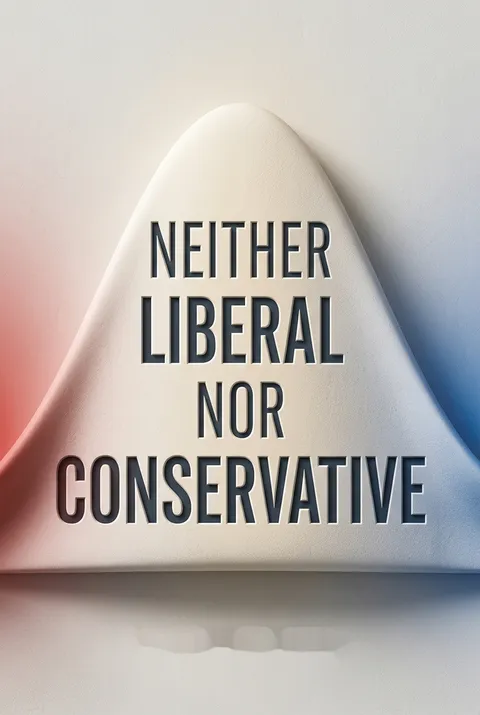
The appeal of moderation. Among those who do claim an ideological identity, a substantial number—one-third of those who identify—choose "moderate, middle of the road." This preference for the center suggests a reluctance to align with either end of the ideological spectrum. This "bell-shaped" distribution of ideological identification, with a large bulge in the middle, stands in stark contrast to the bimodal distribution often observed among political elites.
Conservative advantage. Historically, more Americans describe themselves as conservative than liberal, a trend that has remained consistent since the 1930s. This "conservative advantage" in self-identification exists even during periods when liberal policies or Democratic presidents are popular. This paradox highlights a disconnect between symbolic self-identification and operational policy preferences, where Americans often support liberal policies while identifying as conservative.
3. Political Information is the Bedrock of Ideological Engagement.
As information declines, basic comprehension of ideological systems—in the American case, almost always liberalism and conservatism—diminishes precipitously.
Information inequality. Converse's argument hinges on the vast differences in political information among citizens, ranging from "vast treasuries" among elites to "fragments" among the masses. This inequality is a fundamental feature of modern society, and it profoundly shapes how individuals engage with political ideas. The well-informed are far more likely to grasp abstract concepts and make connections between issues.
Strong correlation. Empirical tests consistently show a powerful link between political information and all aspects of ideological thinking:
- Use of concepts: More informed citizens are significantly more likely to use ideological terms in their political commentary.
- Understanding: Higher information levels correlate strongly with a better understanding of what "liberal" and "conservative" mean.
- Consistency: The opinions of the well-informed are more ideologically coherent, showing stronger correlations across different policy issues.
- Stability: Informed citizens hold more stable and enduring policy preferences, less prone to "non-attitudes."
Enduring ignorance. Despite dramatic increases in educational attainment since the 1950s, Americans are no better informed about public affairs today than they were decades ago. This persistent "ignorance of political affairs" means that the fundamental condition underlying ideological innocence—a lack of deep engagement with politics—remains unchanged. Ideological thinking requires a serious investment in public life that few are willing to make.
4. Ideological Identification is a Weak Predictor of Voting and Policy Preferences.
Ideological identifi cation may be meaningful, at least for some Americans, but it is not, by the analysis we have undertaken here, consequential.
Modest electoral impact. While self-described liberals tend to vote Democratic and conservatives tend to vote Republican, the overall effect of ideological identification on presidential voting is modest. This is especially true when controlling for other powerful factors like party identification, policy preferences, and economic assessments. In lower-profile contests, such as House elections, the influence of ideological identification becomes negligible.
Limited policy influence. The relationship between ideological identification and specific policy preferences is often weak and inconsistent. While some domain-specific effects appear (e.g., on women's or gay rights issues), these often disappear when additional factors like religious beliefs or group sentiments are considered. There is little evidence that Americans alter their policy preferences as a direct consequence of changes in their ideological self-identification.
Absence of ideological bias. Unlike party identification, which strongly biases citizens' perceptions of political reality (e.g., economic conditions, government performance), ideological identification shows no such effect. Liberals and conservatives do not systematically construct different "facts" about the economy or government actions to align with their ideological leanings. This suggests that ideological labels, for most, do not serve as a powerful lens through which to interpret the political world.
5. The American Electorate is Not Ideologically Polarized, Despite Elite Divisions.
Assessed in terms of ideological identifi cation, the American electorate is very far from polarized.
Bell-shaped distribution. Contrary to popular narratives of a deeply divided nation, the distribution of ideological identification in the American public remains bell-shaped, with a large concentration in the middle. This contrasts sharply with the bimodal, "two-camps" distribution that would characterize a truly polarized electorate. The idea of "red states" and "blue states" often oversimplifies the nuanced ideological landscape of the populace.
Slow, imperceptible shifts. While there has been a slight, gradual increase in the proportion of Americans identifying at the ideological endpoints (from ~3% to ~6% between 1972 and 2012), this movement is glacial. At this rate, it would take centuries for the American electorate to resemble an ideologically polarized society. The ideological center has shrunk slightly, and variance has increased, but the overall picture is one of remarkable stability.
No increased disagreement or animosity. Liberals and conservatives do not disagree more ardently on policy issues today than they did decades ago; the correlation between ideological identification and policy preferences has remained stable. Furthermore, while partisan animosity has risen sharply, animosity between self-identified liberals and conservatives remained largely stable until a slight uptick in 2012. This suggests that if Americans are divided, it is not primarily along ideological lines.
6. Partisanship Far Outweighs Ideology in Stability, Strength, and Political Impact.
The party and the affect toward it are more central within the political belief systems of the mass public than are the policy ends that the parties are designed to pursue.
Primacy of party. Party identification is a more fundamental and enduring political attachment for most Americans than ideological identification. Nearly all Americans are willing to embrace partisan labels, and these identifications are remarkably stable over time, strengthening with age and experience. This contrasts sharply with ideological identification, which is less universal, less stable, and does not strengthen with age.
Consequential commitment. Party identification is a powerful determinant of voting behavior, influencing choices across all levels of political engagement, from the highly informed to the barely attentive. It acts as a "perceptual screen," shaping how individuals interpret political events and candidates. Ideological identification, by comparison, has a much smaller and more contingent effect on the vote, primarily among the well-informed.
Concrete vs. abstract. The enduring strength of partisanship stems from the tangible reality of political parties. Parties are visible organizations with resources, candidates, and clear roles in government. Ideologies, however, exist primarily in the realm of abstract ideas, making them less accessible and less central to the political lives of ordinary citizens. This fundamental difference in nature contributes to the "primacy of partisanship" in American politics.
7. Ideological Identification Often Summarizes Experience, Rather Than Causing Behavior.
Ideological identifi cation seems more a refl ection of political decisions than a cause: ideological identifi cation as mere summary.
Self-perception theory. For many Americans, ideological identification appears to be an outcome, rather than a cause, of their political experiences. Consistent with Daryl Bem's self-perception theory, individuals may infer their ideological identity by observing their own past political behavior. For example, voting for an ideologically distinct candidate like Ronald Reagan could lead a young voter to conclude, "I must be conservative."
Reflection of social identity. Ideological identification is also influenced by an individual's social group memberships. Differences in income, race, and religion correlate with ideological leanings: the wealthy tend to be more conservative, Black Americans more liberal, and religious affiliations often align with specific ideological outlooks. This suggests that ideological labels can serve as a summary of one's social position and associated interests.
Generational imprints. Major historical events experienced during early adulthood can leave a lasting mark on a generation's ideological self-identification. For instance, reactions to the racial crisis of the 1960s profoundly shaped the ideological identities of the "class of 1965" later in life, particularly for those who were politically informed. In these instances, ideological identification acts as a retrospective summary of significant political and social experiences.
8. The "Moderate" Label is a Refuge for the Uninformed, Not a True Ideological Stance.
All things considered, the “moderate” category seems less an ideological destination than a refuge for the innocent and confused.
Lack of ideological substance. While a significant portion of Americans identify as "moderate," this label does not typically signify a coherent, centrist ideological position. Instead, it often serves as a default choice for those who are less engaged with politics and lack a clear ideological framework. This finding challenges the notion that moderates represent a distinct ideological bloc.
Indistinguishable from "don't knows." On key measures of ideological sophistication, self-described moderates are largely indistinguishable from those who explicitly state they "haven't thought much about" ideology.
- Consistency: Moderates show similarly low levels of ideological consistency in their policy preferences.
- Stability: Their opinions on policy issues are no more stable over time than those who reject ideological terms altogether.
- Conceptualization: While slightly more likely to use ideological terms than "don't knows," they are far less likely to do so than self-identified liberals or conservatives.
Not a political destination. The "moderate" category appears to be a demographic catch-all rather than a meaningful ideological destination. It often reflects a lack of interest, information, or a desire to avoid strong labels, rather than a principled commitment to centrist political ideas. This reinforces the broader argument that ideological engagement is limited for most Americans.
9. A Group-Centered View Better Explains Public Opinion Than Ideology.
Public opinion arises, we say, primarily from the attachments and antipathies of group life.
Beyond ideology. If ideological reasoning is largely absent for most citizens, how do they form political judgments? A more promising approach is a "group-centered" account of public opinion. This perspective posits that political views are primarily shaped by individuals' attachments to "in-groups" and antipathies towards "out-groups." These group dynamics are often rooted in persistent social inequalities.
In-groups and out-groups. Humans have a deep predisposition to categorize the social world into "us" and "them," leading to ethnocentrism. This manifests politically through:
- In-group solidarity: Affirmations of loyalty to groups like political parties (e.g., Catholics voting for Kennedy).
- Out-group hostility: Attitudes towards perceived outsiders (e.g., opposition to welfare driven by hostility towards the poor, or anti-immigrant sentiment).
Consequential social divisions. Broad social groupings like gender, race, and religion become politically salient when associated with persistent inequalities. These categorical opposites—black vs. white, Muslim vs. Jew, male vs. female—produce durable differences in access to resources and shape political conflicts. Public opinion on issues like affirmative action or immigration is often powerfully shaped by attitudes towards the social groups implicated.

Download PDF
Download EPUB
.epub digital book format is ideal for reading ebooks on phones, tablets, and e-readers.








































