
Key Takeaways
1. The Roman Republic's Foundational Strength: Consensus and Service
The Roman Republic was simultaneously a powerful state and a frightened one that recognized it could not afford to lose any war it fought.
Early resilience. In the 3rd century BC, the Roman Republic demonstrated remarkable resilience and unity, particularly when facing existential threats like Pyrrhus of Epirus and Hannibal. This strength stemmed from a political system designed to foster compromise and channel individual ambition towards the collective good. Leaders like Appius Claudius and Gaius Fabricius exemplified this ethos, prioritizing Rome's honor and security above personal gain.
Consensus-driven governance. The Republic's intricate system of paired, term-limited magistracies, assemblies, and the advisory Senate encouraged cooperation. Each consul could veto a colleague, pushing for negotiation. Tribunes, though powerful, generally worked within established norms. This structure ensured that:
- Decisions were broadly supported.
- No single individual could easily dominate.
- Political disputes were resolved through legislation, not violence.
Rewards of honor. Roman elites were motivated by a unique social currency: honor and public office, which the Republic alone could bestow. Wealth was secondary to a reputation earned through service to the state, especially military valor. This system incentivized loyalty and collective action, as seen when private citizens funded fleets during the Punic Wars, knowing their patriotism would be repaid with lasting prestige.
2. Imperial Expansion Fueled Internal Decay and Inequality
The Republic’s monopoly on the rewards that leading Romans sought was beginning to loosen.
Unprecedented wealth. Rome's victories in the Punic and Macedonian Wars brought immense wealth, including vast amounts of silver, gold, and slaves. This influx of resources transformed Rome from a regional power into the economic center of the Mediterranean. State revenues soared, funding massive infrastructure projects like aqueducts and roads, and enabling the abolition of direct taxes on Italian citizens.
Growing inequality. While some elites amassed unprecedented fortunes through war plunder, public contracts, and sophisticated investments, many ordinary Italians faced declining living standards.
- Population growth led to smaller, less viable farm plots.
- Rural Italians migrated to Rome, swelling the city's population.
- The gap between the super-rich and the struggling poor widened dramatically.
This created widespread frustration and a sense that the new imperial economy benefited only a select few, eroding the shared sense of purpose that once bound Romans.
Shifting values. The traditional Roman emphasis on honor and public service began to compete with a growing fascination for ostentatious displays of private wealth. Ambitious politicians increasingly used their fortunes to fund lavish games, public monuments, and soldier bonuses, creating an "arms race" of conspicuous consumption. This shift weakened the Republic's ability to channel elite ambition solely towards state-sanctioned honors, as personal wealth became a powerful, independent means of influence.
3. The Gracchi: Political Violence Enters Roman Life
This showed that the politics of consensus was dying.
Populist challenge. Tiberius Gracchus, a tribune in 133 BC, sought to address growing economic inequality by proposing land reforms to redistribute public land to the poor. His moderate proposals were met with senatorial obstruction, leading him to bypass the Senate and depose a fellow tribune who vetoed his bill. This unprecedented act, though not illegal, violated long-standing political norms.
Normalization of violence. Tiberius's actions, fueled by popular frustration and his own political ambition, introduced a dangerous new element: the implicit threat of mob violence.
- He encouraged crowds of supporters to accompany him.
- His attendants physically removed an opposing tribune.
- His eventual assassination by a senatorial mob, the first political murder in centuries, marked a turning point.
Gaius Gracchus's legacy. Tiberius's brother, Gaius, continued his populist agenda, enacting broader reforms like subsidized grain and judicial changes. His legislative success, however, was also achieved amidst growing political tension. When he lost office, the Senate, empowered by an emergency decree, sanctioned his murder and the slaughter of thousands of his followers. This established a chilling precedent: political disputes could now be resolved through lethal force, sanctioned by the state itself.
4. Warlords and Private Armies Shatter Republican Norms
All Romans now knew that the Republic could not protect itself or its citizens from the politics of intimidation and violence.
Marius's rise. Gaius Marius, a "new man" from outside the traditional senatorial elite, capitalized on public discontent with perceived aristocratic corruption and military incompetence. He built a powerful political brand by attacking entrenched families like the Metelli and promising swift military victories. His election to multiple consulships, often in defiance of custom, demonstrated the growing power of popular appeal over traditional aristocratic influence.
Professional armies. Marius revolutionized military recruitment by enrolling landless citizens, promising them land and bonuses upon discharge. This created armies intensely loyal to their commanders rather than the Republic. This shift transformed the military from a civic duty into a professional career, making soldiers dependent on their generals for their livelihoods and creating a dangerous new tool for ambitious individuals.
Sulla's march on Rome. The ultimate breakdown of the Republic's military monopoly came in 88 BC when Sulla, stripped of his command by a populist tribune allied with Marius, marched his army on Rome. This unprecedented act, followed by Marius and Cinna's own march on the city, demonstrated that Roman armies would now fight for their commanders in internal political struggles. The Republic could no longer control its own military, and political power increasingly flowed from the loyalty of armed legions.
5. Sulla's Dictatorship: A Violent, Failed Restoration
Sulla had ensured that the guilty were so numerous and powerful that the innocent feared confronting them.
Brutal consolidation of power. After defeating Marius and Cinna's forces in a devastating civil war, Sulla seized absolute control of Rome, declaring himself dictator indefinitely. His regime was marked by widespread proscriptions, where thousands of political opponents were executed and their property confiscated. This wealth was then used to reward his loyal supporters and veterans, creating a new elite bound to Sulla by shared guilt and financial gain.
Constitutional overhaul. Sulla attempted to "restore" the Republic by strengthening the Senate and weakening populist institutions.
- He expanded the Senate with his loyalists.
- He neutered the tribunate, preventing tribunes from holding higher office or proposing laws.
- He reformed the courts, returning senatorial control over juries.
These reforms aimed to prevent the rise of future figures like Marius and the Gracchi, but they were imposed through violence and fundamentally altered the Republic's delicate balance of power.
A legacy of instability. Sulla's retirement and death in 78 BC did not bring stability. His violent methods and the new political order he created left a legacy of fear, resentment, and opportunism. The Republic remained weak, unable to prevent further unrest (like Lepidus's rebellion or Spartacus's slave revolt) and still reliant on powerful individuals like Pompey and Crassus, who commanded their own private armies, to maintain order. The Republic's ability to enforce its own rules had been irrevocably damaged.
6. Political Gridlock and the Rise of the Triumvirate
The Republic of the mediocre.
Post-Sullan chaos. The 70s BC saw continued instability, with the Republic struggling to recover from Sulla's violence. Grain shortages, slave revolts (Spartacus), and a protracted war in Spain (Sertorius) highlighted the state's fragility. Powerful individuals like Pompey and Crassus, who had risen through Sulla's civil wars, commanded private armies and wielded immense influence, often bypassing traditional Republican channels.
Obstructionist politics. By the 60s BC, the Senate became paralyzed by political gridlock, largely due to the principled (and often hypocritical) obstruction of figures like Cato the Younger. Cato, a staunch defender of Republican ideals, frequently used his position to block legislation and appointments, frustrating ambitious politicians like Pompey, Crassus, and the rising Julius Caesar. This created a sense that the Republic was no longer functional.
The First Triumvirate. To overcome this obstruction, Caesar forged a private alliance with Pompey and Crassus in 60 BC, known as the First Triumvirate. This informal agreement, based on mutual support and a commitment not to impede each other's ambitions, effectively sidelined the Senate.
- Caesar, as consul, used the Triumvirate's combined influence to pass land reforms for Pompey's veterans and renegotiate tax contracts for Crassus's equestrian allies.
- He secured a lucrative military command in Gaul for himself, bypassing senatorial opposition.
This alliance demonstrated that the Republic's institutions could now be circumvented by powerful individuals acting in concert, further eroding its authority.
7. Caesar's Autocracy: The Illusion of Republicanism
If Caesar ever did what was right and voluntarily surrendered power, he would be prosecuted or executed.
Civil war and clemency. Caesar's Gallic conquests made him immensely powerful, leading to a civil war with Pompey and the Senate in 49 BC. Despite his military might, Caesar strategically offered clemency to his defeated opponents, distinguishing himself from Sulla's brutal proscriptions. This policy, combined with his rapid military victories across the Mediterranean, garnered him widespread popular support and undermined his enemies' claims that he was a tyrant.
Consolidation of power. After defeating all rivals, Caesar became the undisputed master of Rome. He held the dictatorship perpetually, controlled all armies, and effectively appointed magistrates, emptying traditional Republican offices of their real power.
- He used his vast personal wealth (from conquests) to fund public works and reward his soldiers, making himself indispensable.
- He experimented with honors like a golden throne and statues, and even flirted with the title of "king," further alarming traditionalists.
Caesar maintained the outward forms of the Republic—elections, laws, the Senate—but concentrated all actual authority in his own hands, creating an autocracy in all but name.
Assassination and miscalculation. Caesar's assassination on the Ides of March, 44 BC, by Brutus, Cassius, and other senators, was intended to restore the Republic. However, the conspirators misjudged public sentiment. Romans, weary of decades of civil strife, valued the stability Caesar had brought more than the abstract concept of Republican liberty. The assassination plunged Rome back into chaos, revealing that Caesar, the "tyrant," had also been the dam holding back further civil war.
8. Octavian's Strategic Ascent to Empire
Octavian had the political astuteness to understand that the Senate would feel compelled to retroactively validate whatever powers and honors his soldiers had arrogated to him.
Power vacuum and ambition. Caesar's death created a dangerous power vacuum. Marc Antony, Caesar's consul, initially maneuvered to claim Caesar's legacy, while the conspirators fled. However, the unexpected arrival of Octavian, Caesar's adopted son and heir, dramatically reshuffled the political landscape. Though young and inexperienced, Octavian skillfully leveraged Caesar's name and the loyalty of his veterans.
Manipulating public opinion. Octavian, often underestimated by older politicians, proved a master of political theater.
- He publicly committed to avenging Caesar and honoring his will, contrasting with Antony's compromises.
- He used Caesar's public funeral to inflame popular anger against the assassins.
- He strategically blamed Antony for obstructing his efforts to fulfill Caesar's promises, portraying himself as a pious son wronged by a cynical rival.
This allowed Octavian to build a powerful base of support among Caesar's veterans and the Roman populace, while simultaneously appearing as a potential ally to anti-Antony senators like Cicero.
The Second Triumvirate and proscriptions. Octavian eventually allied with Antony and Lepidus, forming the Second Triumvirate. This legally sanctioned triumvirate, unlike the first, wielded absolute power, immediately instituting brutal proscriptions to eliminate rivals and fund their armies. After defeating Brutus and Cassius at Philippi, the triumvirs divided the Roman world, setting the stage for the final struggle for sole power. Octavian's subsequent elimination of Lepidus and his eventual confrontation with Antony and Cleopatra solidified his control over the entire Roman world.
9. Augustan Liberty: Security Trumps Autonomy
Freedom from fear, freedom from famine, and freedom from danger now all came from Augustus and Augustus alone.
The promise of peace. After defeating Antony and Cleopatra, Octavian returned to Rome in 29 BC, celebrating a magnificent triple triumph. He promised Romans an era of unprecedented peace, security, and prosperity, symbolized by the closing of the Temple of Janus. This "Augustan Peace" was a stark contrast to the century of civil wars and instability that had preceded it, and Romans, weary of conflict, were ready to embrace it.
A new political order. Octavian, now known as Augustus, carefully crafted a new imperial system, the Principate, designed to be both enduring and palatable to the Roman elite.
- He formally "restored" the Republic, but retained ultimate control over armies and key provinces.
- He "excelled all in influence (auctoritas)" while claiming no more official power than his colleagues.
- He accepted titles like "Augustus" and "tribunicia potestas," which conferred immense authority and sacrosanctity without explicitly being "king."
This system allowed elites to hold traditional offices, but real power resided with Augustus, who could intervene with his personal authority and private wealth whenever the traditional system faltered.
Indispensable autocrat. Augustus made himself indispensable to the functioning of the state. He personally funded public works, ensured grain supplies, and provided retirement benefits for soldiers, demonstrating that he alone could deliver the stability and benefits Romans craved. The "Oath of All Italy," where millions swore personal allegiance to him, cemented his position. The Roman people, having experienced the chaos of a broken Republic, willingly traded their political autonomy for the security and order of Augustus's autocracy, ensuring the empire's longevity.
10. The Republic's Demise: A Century of Choices, Not Fate
When citizens take the health and durability of their republic for granted, that republic is at risk.
Erosion of norms. The Roman Republic's fall was not an inevitable outcome but the cumulative result of a century of choices made by its leaders and citizens. From Tiberius Gracchus's procedural breaches to Cato's obstructionism, and from Marius's professional armies to Sulla's proscriptions, each act chipped away at the Republic's foundational principles of compromise, shared power, and the rule of law.
Individual ambition over collective good. Ambitious individuals, including some of Rome's most talented figures like Pompey, Crassus, and Caesar, increasingly prioritized personal glory and power over the integrity of Republican institutions. They formed private alliances, used mob violence, and commanded personal armies, demonstrating that the Republic could no longer effectively channel or restrain their ambitions. The pursuit of "dignitas" became a zero-sum game, where the loser often paid with his life.
Citizen complicity. Ordinary Romans also played a role in the Republic's demise. Their willingness to support demagogues, accept bribes, tolerate political violence, and prioritize short-term benefits (like land grants or grain doles) over institutional health, gradually weakened the system. They failed to consistently condemn corrosive behaviors, allowing the Republic to be wounded repeatedly until it could no longer sustain itself. The transition to empire was a collective choice, born of a longing for stability after decades of self-inflicted chaos.
Review Summary
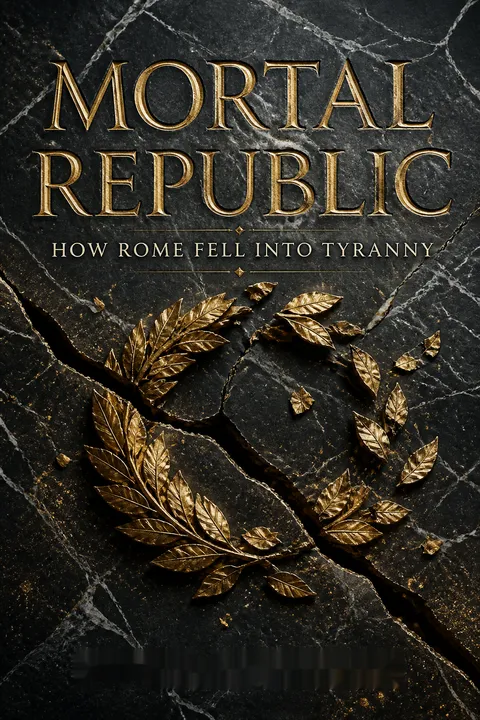
Mortal Republic examines the fall of the Roman Republic from 280 BC to 27 BC, focusing on how political dysfunction, violence, and elite self-interest gradually eroded democratic institutions. Readers praise Watts' accessible writing and relevant parallels to modern democracies, particularly how citizens who condone political obstruction and violence enable republic collapse. Most find it informative and thought-provoking, though some criticize its lack of deep analysis, slow pacing in early sections, and insufficient detail on key periods. Several note the book serves better as an overview than comprehensive examination, with mixed opinions on its treatment of contemporary political comparisons.
People Also Read







About the Author
Other books by Edward J. Watts

Download PDF
Download EPUB
.epub digital book format is ideal for reading ebooks on phones, tablets, and e-readers.








































