


Key Takeaways
Your therapist cries between sessions — that shared humanity is the cure
The healer needs healing too. Lori Gottlieb is a psychotherapist who, after a devastating blindside breakup, finds herself sobbing between patient sessions with mascara running down her face — then composing herself to greet the next person. She ends up on the couch of a therapist named Wendell. The book braids her therapy with four patients she's simultaneously treating: John, a narcissistic TV showrunner hiding catastrophic grief; Julie, a 33-year-old professor dying of cancer; Rita, a 69-year-old planning suicide by her 70th birthday; and Charlotte, a 25-year-old concealing alcoholism behind a "cool girl" mask.
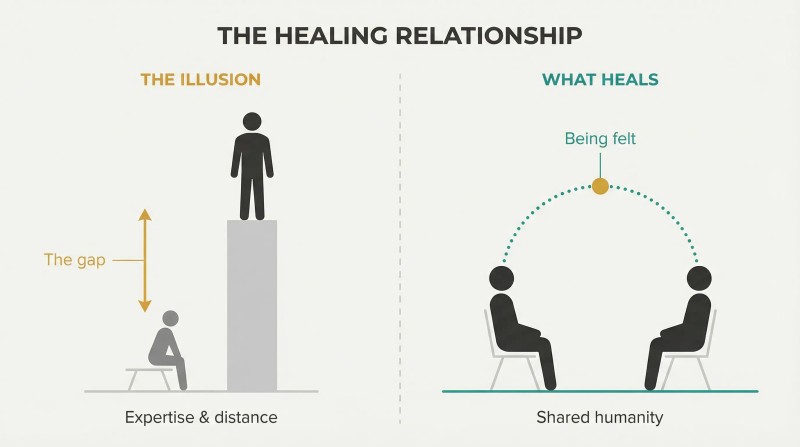
The book's thesis is deceptively simple: we change in relation to others. Research consistently shows the most important factor in therapy's success isn't the technique — it's the relationship, the experience of being "felt." By revealing herself as every bit as avoidant and self-deceptive as her patients, Gottlieb demolishes the illusion that therapists have their lives together — and argues that's precisely what makes them effective.
The thing you came to fix is almost never the actual problem
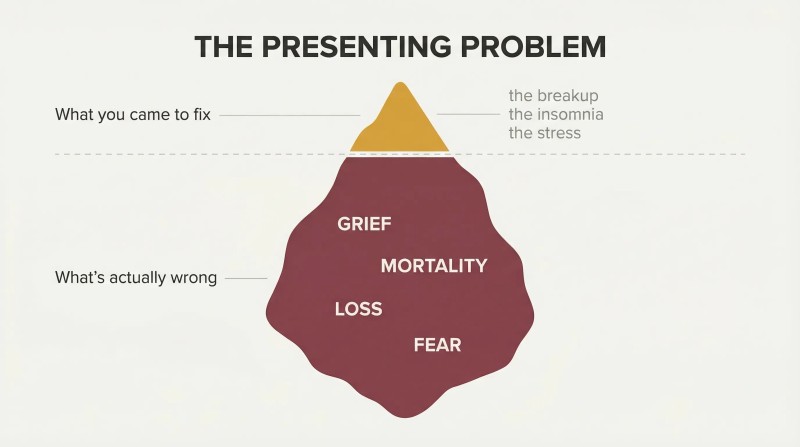
Therapists call it the presenting problem — the stated reason someone walks into the office. Gottlieb came to Wendell for "crisis management" after her breakup, insisting she just needed a few sessions. But Wendell saw deeper: she was grieving her mortality, hiding a failing book project, concealing a mysterious illness, and avoiding the dawning awareness that half her life was over. Similarly, John arrived claiming work stress kept him awake — but underneath lay the death of his six-year-old son Gabe in a car accident.
We all do this. We fixate on the surface complaint to avoid the terrifying thing beneath it. "Most people are brilliant at finding ways to filter out the things they don't want to look at," Gottlieb writes. The breakup, the insomnia, the irritability — these are symptoms, not the disease. Therapy's first job is helping you realize you're solving the wrong puzzle.
Your prison cell is open on both sides — walk around the bars
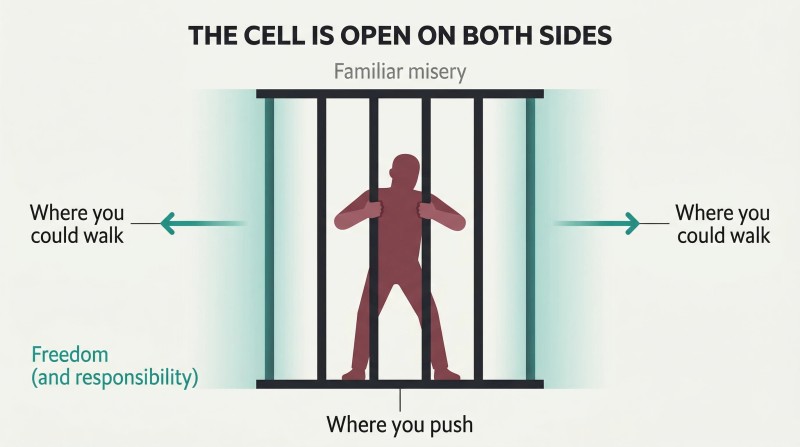
Wendell describes a famous cartoon: a prisoner desperately shaking the bars of his cell — while the cell is open on both sides. He just has to walk around. This becomes the book's central metaphor. Gottlieb was shaking the bars of her breakup, her unwritten book, and her health fears, unable to see that the way out was right there.
But seeing isn't enough. The real obstacle isn't the bars — it's that walking out means accepting you were never truly trapped by anyone but yourself. That's terrifying, because if you're free, you're responsible for what happens next. Many people prefer the familiar misery of their cell to the uncertain daylight outside. "Most of us come to therapy feeling trapped," Gottlieb writes, "imprisoned by our thoughts, behaviors, marriages, jobs, fears, or past." The question isn't whether the cell is open. It's whether you're willing to leave.
Stop layering suffering on top of the pain you can't avoid
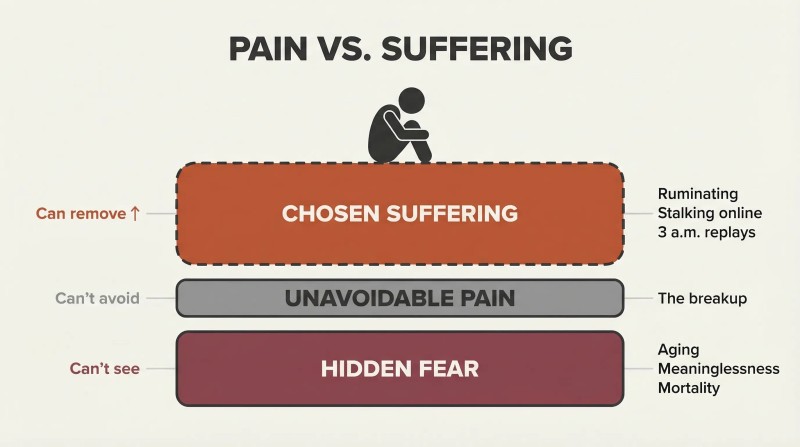
Wendell literally kicked Gottlieb's foot. After weeks of her obsessively Google-stalking her ex — documenting his social media, interrogating him for hours, bringing annotated notes to sessions — Wendell walked over and lightly kicked her. His point: pain from a breakup is unavoidable, but the rumination, surveillance, and circular arguments you replay at 3 a.m.? That's suffering you're choosing to pile on top.
The distinction is crucial. If you're clinging to suffering this tightly, Wendell suggested, it must be serving some purpose. For Gottlieb, stalking her ex online was a way to stay connected to him, to avoid facing the real grief beneath the breakup — her fear of aging, of meaninglessness, of dying. The suffering was a drug, numbing her to deeper pain. Once she could name what the suffering was protecting her from, she could begin to let it go.
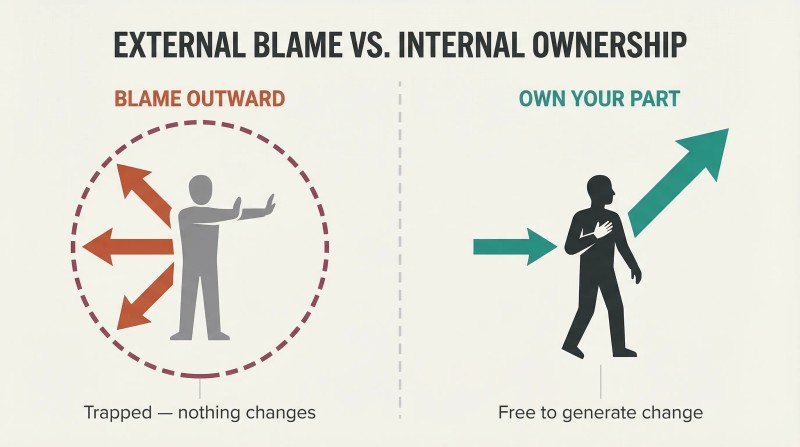
Change begins when you stop blaming circumstances and own your part
Wendell says this quietly. Gottlieb insists she doesn't want to be saved — but part of her does. She wanted Boyfriend to rescue her from loneliness. She wanted a book deal to rescue her finances. She wanted a diagnosis to explain her symptoms. But one of the most important steps in therapy, Gottlieb writes, is helping people take responsibility for their predicaments, because once they realize they can construct their own lives, they're free to generate change.
The trap is believing problems are external. If the world is full of "idiots" (as her patient John insists), why bother changing yourself? But sometimes, Gottlieb observes, "those difficult people are us." Boyfriend's avoidance was maddening — but so was Gottlieb's refusal to see warning signs she'd chosen to ignore. Owning your role doesn't mean accepting blame. It means reclaiming agency over a life you'd outsourced to others.
You keep choosing the same partner because familiar feels like home
Charlotte keeps dating unavailable men. After a date with a stable, kind guy, she reports flatly: "There just wasn't any chemistry." This is what Freud called repetition compulsion — an unconscious radar that draws people to partners who share characteristics of parents who hurt them. The pull toward that feeling of "home" makes what we want as adults hard to untangle from what we experienced as children.
The cycle is vicious but breakable. Charlotte's father was loving one moment, vanished the next — so she gravitates toward men who do exactly that. When someone reliable shows up, their emotional stability feels foreign, "not interesting." The fix isn't willpower or better dating apps. It's working through the original wound in a safe relationship — often the therapeutic one — until a different kind of partner starts to feel like home instead of a threat.

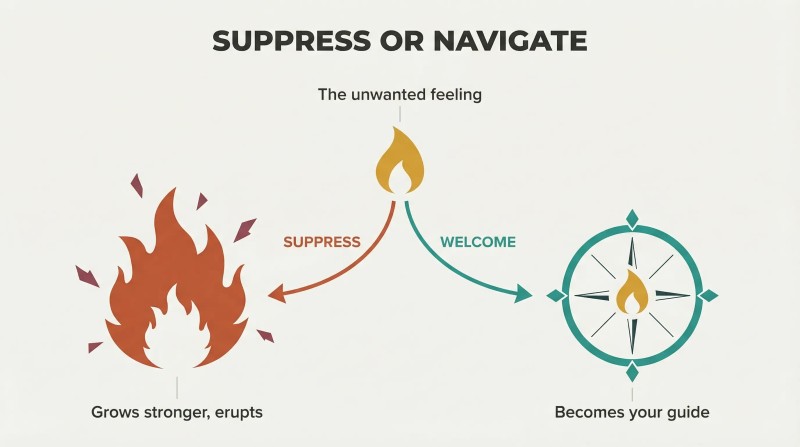
Welcome your unwanted feelings — they're a map, not a flaw
Gottlieb insisted she wasn't angry at her ex — just confused. Wendell didn't buy it. Of course she was furious. But acknowledging fury felt incompatible with being a "good person." Many patients do this: editing their emotions because they "shouldn't" feel jealous or relieved or resentful. The danger is that pushing feelings aside only makes them stronger. They resurface as insomnia, binge-eating, or snapping at your kid over a shower.
There's a clinical term for emotional blindness: alexithymia. Charlotte embodied it perfectly — reporting a sexual assault, workplace praise, and parental chaos in the same flat monotone. She couldn't access her feelings because, growing up with volatile parents, she'd learned that emotions were dangerous. Gottlieb's therapist Wendell modeled the alternative: "Don't judge your feelings; notice them. Use them as your map. Don't be afraid of the truth."
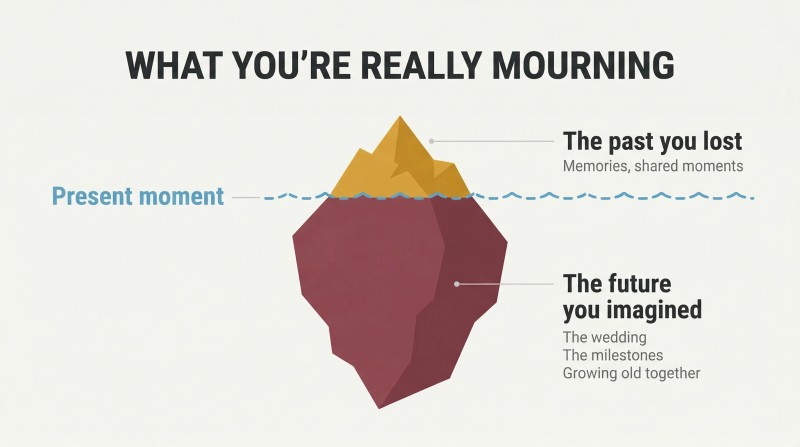
You're mourning the future you imagined, not just the past
Gottlieb hadn't just lost a boyfriend. She'd lost the wedding, the blended family, growing old together — a future she'd been constructing in her mind for two years. Wendell helped her see this: when the present collapses, the imagined future collapses with it. "Having the future taken away," Gottlieb writes, "is the mother of all plot twists."
This explains why breakups, diagnoses, and layoffs hit so hard. You're not just mourning what was but what will never be. Julie, dying at 33, grieved not memories but milestones — she'd never see her children grow up, never grow old with Matt. Even Gottlieb's Google-stalking was a symptom: she was watching her ex's future unfold while she stayed frozen in the past. The antidote isn't optimism — it's living in the present, which requires accepting the loss of the future you'd scripted.
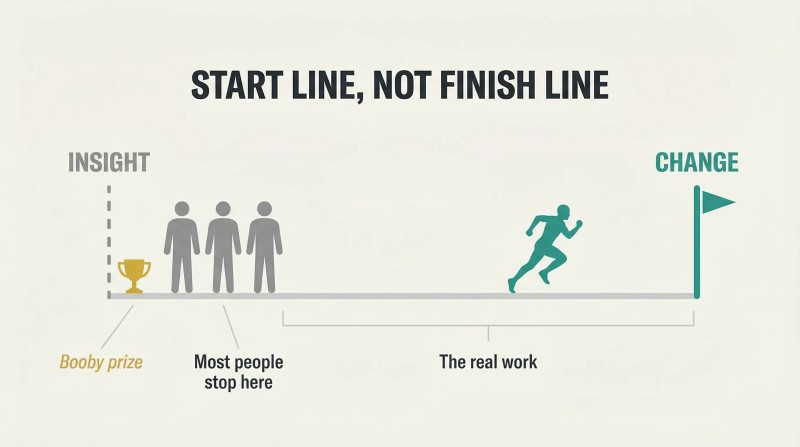
Understanding your patterns is just the starting line, not the finish
This is Gottlieb's favorite maxim of the trade. You can understand exactly why you keep choosing unavailable partners, why you drink, why you sabotage your career — and change nothing. Charlotte could describe her repetition compulsion with textbook precision while dating another version of the Dude. John could articulate his defenses while deploying every one of them. Insight lets you ask: "Is this being done to me, or am I doing it to myself?" But the answer only gives you choices. You still have to make them.
The real work happens outside the office. Wendell once compared therapy to shooting baskets against a backboard — necessary practice, but eventually you have to play in an actual game. Gottlieb had all the insight about her avoidance months before she actually stopped avoiding. Knowledge is the starting gun, not the finish line. As she puts it: "You can have all the insight in the world, but if you don't change when you're out in the world, the insight — and the therapy — is worthless."
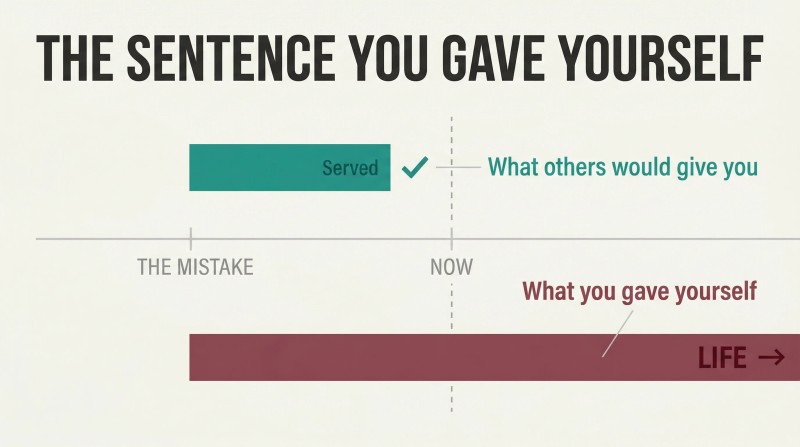
Stop sentencing yourself to life in prison for crimes decades old
Rita, almost 70, has punished herself for forty years for failing to protect her children from an abusive husband. She went to the other room while he hurt them. When Gottlieb asked what her sentence should be, Rita said: "Life in prison." Many of us carry this same internal tribunal — decades of self-torture for mistakes we've genuinely tried to repair. Wendell posed the same question to Gottlieb about her own regrets.
The question forces a reckoning. If you've felt remorse, attempted amends, and fundamentally changed, at what point does self-punishment stop serving justice and start serving self-destruction? A jury of people who actually know you — friends, partners, the neighbor kids you now mentor — might not hand down the verdict you've given yourself. Pain can be protective: staying miserable is a way to avoid the terrifying possibility that you might actually deserve happiness.
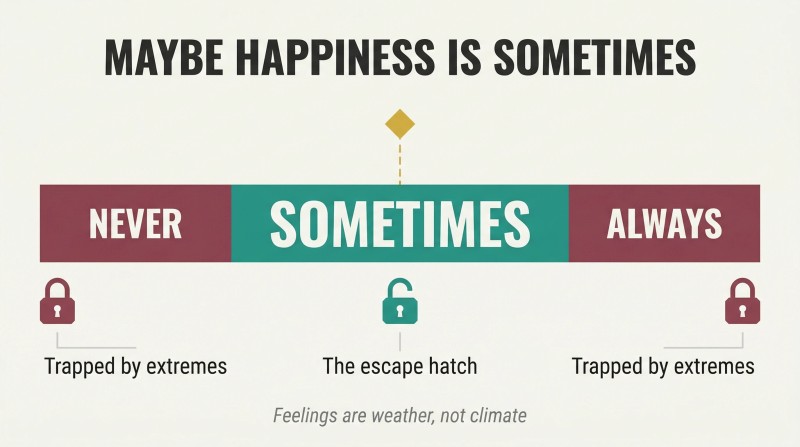
Happiness isn't always or never — it lives in the relief of 'sometimes'
John, the showrunner who lost his son, once believed he'd never be happy again. Then one night, rolling on the bedroom floor laughing with his wife and daughters and their ugly rescue dog, he felt something he hadn't expected: joy. He didn't understand how both could coexist — devastating grief and genuine happiness — until he landed on a phrase that brought him relief: "Maybe happiness is sometimes."
Feelings are weather systems, not fixed states. They blow in and blow out. Gottlieb describes how the psychological immune system — a concept from Harvard researcher Daniel Gilbert — helps people recover from devastating events far better than they anticipate. People who lose loved ones believe they'll never laugh again, but they do. The tyranny of black-or-white thinking — "I'll always feel this way" or "I'll never feel that way" — keeps people trapped. The word "sometimes" is an escape hatch from the extremes, permission to feel both broken and whole.
Analysis
Gottlieb's book represents a significant formal innovation in the therapy memoir by collapsing the traditional distance between practitioner and patient. Most therapy books position the therapist as knowing observer; Gottlieb positions herself as simultaneously healer and wounded. This parallel process — a term therapists use for the way dynamics between patient and therapist mirror dynamics in the patient's external relationships — becomes the book's structural principle. As Gottlieb helps John confront avoidance, Wendell helps her confront hers. The result is a hall of mirrors that democratizes suffering.
Philosophically, the book draws from existential psychotherapy, particularly Irvin Yalom's ultimate concerns — death, isolation, freedom, and meaninglessness. But Gottlieb wears frameworks lightly, embedding them in narrative rather than presenting them didactically. The book's most radical claim isn't psychological but relational: the mechanism of healing isn't technique or insight but the experience of being deeply known by another person. This aligns with empirical literature on common factors in psychotherapy, where the therapeutic alliance consistently outperforms any specific modality in predicting outcomes.
What Gottlieb doesn't fully explore is the privilege embedded in her model. Long-term psychotherapy remains inaccessible to most Americans; while thirty million adults seek treatment annually, the majority receive medication or brief interventions, not the depth work she describes. The book implicitly argues for a model of care that managed healthcare has systematically dismantled. There's also a tension between her emphasis on individual agency — 'nobody will save you' — and the systemic forces (economic precarity, inadequate healthcare, discrimination) that constrain people's choices in ways no amount of walking around metaphorical prison bars addresses.
Still, the book's lasting contribution is its insistence that vulnerability is not weakness but the precondition for connection. By showing the person behind the therapist's notepad as every bit as lost and self-deceptive as the person on the couch, Gottlieb normalizes the very struggle she helps others navigate. The message lands precisely because she earns it through confession rather than prescription.
Review Summary
Maybe You Should Talk to Someone is highly praised for its engaging and insightful look into therapy from both therapist and patient perspectives. Readers appreciate Gottlieb's honesty, humor, and ability to make complex psychological concepts accessible. Many found the book thought-provoking and relatable, with some calling it life-changing. While a few critics felt it lacked depth or credibility, the majority of reviewers were deeply moved by the stories shared and found value in Gottlieb's approach to understanding human nature and personal growth.
People Also Read










Glossary
presenting problem
the stated reason for therapyThe issue that initially brings someone into therapy—a panic attack, a breakup, job loss, depression. In practice, the presenting problem is often only one layer of a deeper issue or sometimes a 'red herring' entirely. It serves as the entry point for therapy but rarely captures the full scope of what needs attention.
idiot compassion
harmful avoidance of needed confrontationA Buddhist concept Gottlieb applies to therapy: avoiding rocking the boat to spare someone's feelings, even though the boat needs rocking. The compassion ends up being more harmful than honesty would be. Common with teenagers, spouses, and addicts. Its opposite is wise compassion—caring about the person while delivering a 'loving truth bomb' when needed.
repetition compulsion
recreating childhood wounds in relationshipsFreud's term for the unconscious tendency to seek partners who resemble those who hurt us in childhood, attempting to 'master' the original wound with someone new. The pull toward familiarity overrides the conscious desire for healthy relationships. Charlotte repeatedly chose emotionally unavailable men who mirrored her disappearing father, while perceiving stable partners as boring.
ultimate concerns
four core existential fearsPsychiatrist Irvin Yalom's framework identifying the four deepest human fears that underlie most therapeutic work: death (fear of extinction), isolation (fundamental aloneness), freedom (the terror of responsibility that comes with it), and meaninglessness (the need for purpose). Gottlieb uses these to understand her own midlife crisis and her patients' struggles.
rupture and repair
hurt-and-healing cycle in relationshipsThe therapeutic concept that in any intimate relationship, partners will inevitably hurt each other—not maliciously, but because they're human. What matters is the repair process afterward. If childhood ruptures came without loving repairs, adults may interpret every relationship conflict as catastrophic, never trusting that the bond can survive disagreement.
psychological immune system
the mind's recovery from adversityHarvard researcher Daniel Gilbert's concept: just as the physiological immune system helps the body recover from physical attack, the brain helps recover from psychological attack. Studies show people consistently overestimate how long and how intensely negative events will affect them. People who lose loved ones believe they'll never laugh again—but they do.
alexithymia
inability to identify one's feelingsA condition of emotional blindness in which a person cannot identify, describe, or access their feelings. Often develops in people who were 'talked out of' their emotions as children—told they were 'too sensitive' or that there was nothing to worry about. Gottlieb's patient Charlotte reported traumatic events and workplace praise in the same flat monotone.
doorknob disclosures
important revelations when leaving sessionThe phenomenon where patients drop their most significant information in the final seconds of a session—at the doorknob, literally on their way out. They may be embarrassed, want to avoid discussion, or wish to leave the therapist sitting with their turmoil until next week. Examples include 'I think I'm bisexual' or 'My biological mother found me on Facebook.'
flight to health
premature cure to avoid deeper workA phenomenon in which patients suddenly convince themselves they're over their issues, typically after a difficult session or a break from therapy. It's an unconscious defense against the anxiety that deeper therapeutic work is bringing up. The patient announces feeling great and wanting to stop—but the 'cure' is actually avoidance wearing a mask of wellness.
FAQ
What's "Maybe You Should Talk to Someone" about?
- Memoir and dual perspective: "Maybe You Should Talk to Someone" by Lori Gottlieb is a memoir that offers insights into the world of therapy from both the therapist's and the patient's perspectives.
- Human connection and struggles: It emphasizes the shared human struggles and the importance of connection, illustrating how therapy can be a transformative process.
- Therapeutic process: The book delves into the therapeutic process, showing how change occurs through relationships and self-exploration.
Why should I read "Maybe You Should Talk to Someone"?
- Insight into therapy: The book demystifies therapy, providing a rare glimpse into what happens in therapy sessions and how it can help individuals.
- Relatable and emotional: Filled with relatable stories, it explores universal themes of love, loss, and self-discovery, resonating emotionally with readers.
- Practical wisdom: Gottlieb shares valuable insights and advice on approaching life's challenges with compassion and understanding.
What are the key takeaways of "Maybe You Should Talk to Someone"?
- Therapy as growth: Therapy is portrayed as a powerful tool for personal growth and self-awareness, beneficial for anyone seeking to understand themselves better.
- Universality of struggles: The book highlights that everyone faces challenges, fostering empathy and understanding among readers.
- Authenticity and change: It underscores the importance of being authentic and embracing change as a journey toward personal growth.
What are the best quotes from "Maybe You Should Talk to Someone" and what do they mean?
- "People will do anything, no matter how absurd, to avoid facing their own souls." This Carl Jung quote highlights the lengths people go to avoid self-reflection.
- "Who looks inside, awakes." Another Jung quote, suggesting that self-awareness is key to personal awakening and growth.
- "You won't get today back." A reminder to live in the present and cherish each moment, emphasizing the fleeting nature of time.
How does Lori Gottlieb portray the therapeutic relationship in "Maybe You Should Talk to Someone"?
- Sacred trust: Gottlieb emphasizes the sacred trust required between therapists and patients for meaningful change to occur.
- Mutual reflection: The book illustrates how therapists and patients reflect each other's experiences, leading to mutual growth and understanding.
- Human connection: The therapeutic relationship is depicted as deeply human, involving empathy, vulnerability, and shared struggles.
What is the significance of the title "Maybe You Should Talk to Someone"?
- Encouragement to seek help: The title suggests that talking to someone, like a therapist, can be beneficial for personal growth and healing.
- Universal advice: It serves as universal advice, applicable to anyone facing challenges or seeking self-understanding.
- Invitation to explore: The title invites readers to explore the therapeutic process and consider the value of opening up to others.
How does Lori Gottlieb balance her roles as a therapist and a patient in "Maybe You Should Talk to Someone"?
- Personal vulnerability: Gottlieb shares her own vulnerabilities and experiences as a patient, offering an authentic view of therapy from both sides.
- Professional insight: As a therapist, she provides professional insights into the therapeutic process and the challenges therapists face.
- Interconnected stories: The book weaves together interconnected stories of her patients and her own therapy, highlighting the shared human experience.
How does "Maybe You Should Talk to Someone" address the concept of change and loss?
- Interconnectedness: Gottlieb shows how change and loss are interconnected, with change often involving some form of loss.
- Acceptance: The book encourages acceptance of change and loss as part of the human experience, rather than resisting them.
- Personal growth: Embracing change and loss can lead to personal growth and a deeper understanding of oneself.
What specific methods or advice does Lori Gottlieb share in "Maybe You Should Talk to Someone"?
- Facing discomfort: The book encourages readers to tolerate discomfort and face their emotions to facilitate change.
- Self-compassion: Gottlieb emphasizes the importance of self-compassion and understanding one's own limitations and strengths.
- Therapeutic techniques: It illustrates various therapeutic techniques, such as working in the here-and-now and exploring attachment styles.
How does Lori Gottlieb use her personal experiences to enhance the narrative in "Maybe You Should Talk to Someone"?
- Therapist as patient: Gottlieb shares her own experiences as a patient in therapy, providing a unique perspective on the therapeutic process.
- Interweaving stories: The book interweaves her personal journey with the stories of her patients, highlighting the universality of emotions.
- Lessons learned: She reflects on the lessons learned from her experiences, offering valuable takeaways for personal growth.
What impact does "Maybe You Should Talk to Someone" aim to have on its readers?
- Understanding of therapy: The book aims to demystify therapy and provide readers with a deeper understanding of its benefits.
- Encouragement to seek help: Gottlieb hopes to inspire readers to seek help when needed and embrace vulnerability as a path to healing.
- Fostering empathy: It fosters empathy by highlighting the shared human experience, encouraging reflection on one's own life and relationships.
How does Lori Gottlieb address the concept of change in "Maybe You Should Talk to Someone"?
- Stages of change: Gottlieb discusses the stages of change model, emphasizing that change is a gradual process requiring self-awareness and commitment.
- Resistance to change: The book explores common resistance to change, offering strategies for overcoming fears and uncertainties.
- Change as a journey: Change is portrayed as an ongoing journey, encouraging patience and compassion with oneself during the process.
About the Author
Other books by Lori Gottlieb

Download PDF
Download EPUB
.epub digital book format is ideal for reading ebooks on phones, tablets, and e-readers.








































