
Key Takeaways
1. Math is a universal language that empowers you
More people "speak maths" than any other language in the world.
Math is everywhere. From shopping discounts to recipe adjustments, math permeates our daily lives. It's not just about numbers; it's about logic, problem-solving, and critical thinking. These skills are invaluable in any career or life situation.
Universal communication. Math transcends language barriers. Whether you're in New York, Paris, or Tokyo, mathematical symbols and concepts remain the same. This universality makes math a powerful tool for global communication and understanding.
Empowerment through knowledge. Mastering math builds confidence and independence. It allows you to:
- Make informed financial decisions
- Understand and interpret data
- Solve complex problems in various fields
- Develop logical thinking skills
2. Fractions are like pizza slices: practical and delicious
Fractions are just fractions with denominators of 100. That's it!
Visualization is key. Thinking of fractions as pizza slices makes them more tangible and less intimidating. Just as you can divide a pizza into different numbers of slices, you can represent various quantities with fractions.
Real-world applications. Fractions are crucial in:
- Cooking and baking (e.g., 3/4 cup of flour)
- Measurements (e.g., 1/2 inch)
- Time (e.g., 1/4 of an hour)
- Probability (e.g., 1/6 chance of rolling a specific number on a die)
Simplification and equivalence. Understanding that fractions can be simplified and that different fractions can represent the same quantity (e.g., 1/2 = 2/4 = 3/6) is essential for working with fractions effectively.
3. Decimals and percentages: essential tools for savvy shoppers
Going back and forth between percentages and decimals is mostly very easy.
Decimal-percentage connection. Decimals and percentages are two ways of expressing the same concept. Converting between them is simple:
- To convert a percentage to a decimal, move the decimal point two places left
- To convert a decimal to a percentage, move the decimal point two places right and add the % symbol
Practical applications. Understanding decimals and percentages is crucial for:
- Calculating discounts (e.g., 30% off)
- Comparing prices (e.g., unit prices)
- Understanding financial concepts (e.g., interest rates)
- Interpreting data and statistics
Mental math shortcuts. Familiarity with common decimal-percentage equivalents (e.g., 0.5 = 50%, 0.25 = 25%) can make quick mental calculations easier in everyday situations.
4. Ratios and proportions: the key to understanding relationships
A ratio is just a comparison of two numbers or values, expressed in the same terms, or units.
Comparing quantities. Ratios allow us to express relationships between quantities, such as:
- Ingredients in a recipe (e.g., 2 parts water to 1 part coffee)
- Scale in maps (e.g., 1 inch represents 100 miles)
- Probabilities (e.g., 3 out of 5 chance)
Proportional thinking. Proportions help us understand how quantities change in relation to each other. This is useful in:
- Resizing recipes
- Understanding scale models
- Solving word problems involving similar figures
Real-world applications. Ratios and proportions are used in various fields:
- Architecture and engineering (e.g., structural design)
- Finance (e.g., exchange rates)
- Chemistry (e.g., concentration of solutions)
- Art (e.g., color mixing)
5. Algebra: solving for x demystified
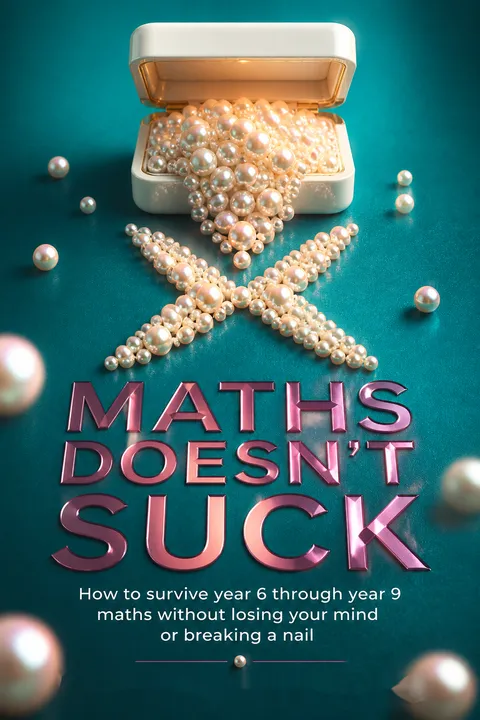
Think of x as a box or a bag of pearls—in fact, you can plug in "boxes" instead of x's, while working on the equation, if you prefer.
Variables as placeholders. Algebra introduces variables (like x) to represent unknown quantities. This allows us to solve problems with missing information.
Step-by-step problem-solving. Solving algebraic equations involves:
- Isolating the variable on one side of the equation
- Performing the same operations on both sides to maintain balance
- Simplifying until you find the value of the variable
Practical applications. Algebra is used in:
- Financial planning (e.g., calculating interest)
- Physics (e.g., motion equations)
- Computer programming (e.g., algorithms)
- Problem-solving in various fields
6. Word problems: translating English into math
Solving word problems using algebra is just like solving other word problems, in that you need to "translate" from English into maths.
Breaking down the problem. Approach word problems systematically:
- Identify the known and unknown information
- Choose appropriate variables to represent unknowns
- Translate the problem into mathematical equations
- Solve the equations
- Check if the solution makes sense in the context of the problem
Key words and phrases. Look for specific words that indicate mathematical operations:
- "Of" often means multiplication
- "Per" usually indicates division
- "More than" or "less than" suggest addition or subtraction
Visualization techniques. Drawing diagrams or using visual aids can help clarify the relationships between quantities in word problems.
7. Confidence and perseverance are crucial for math success
The difference between those who succeed and those who don't is not whether or not they feel scared. It's how they handle the fear.
Mindset matters. Approaching math with a positive attitude can significantly impact your success. Believe in your ability to learn and improve.
Embrace challenges. View difficult problems as opportunities to grow and strengthen your skills. Each problem you solve builds your confidence and expertise.
Strategies for success:
- Break complex problems into smaller, manageable steps
- Practice regularly to reinforce concepts
- Seek help when needed (from teachers, tutors, or peers)
- Use resources like textbooks, online tutorials, and study groups
- Celebrate your progress and accomplishments
Remember, everyone struggles with math at times. Persistence and a willingness to learn from mistakes are key to overcoming challenges and developing strong math skills.
Review Summary
Math Doesn't Suck receives mostly positive reviews, with readers praising its accessible approach to math concepts. Many find it helpful for middle school girls, adult learners, and math teachers. The book's girly style is both appreciated and criticized. Reviewers highlight its clear explanations, real-world examples, and confidence-boosting content. Some note it's best for basic math review rather than advanced topics. Overall, readers appreciate McKellar's ability to make math less intimidating and more relatable, though a few find the gendered approach unnecessary.
FAQ
What is Math Doesn't Suck by Danica McKellar about?
- Middle-school math focus: The book is a comprehensive guide for middle-school girls to understand and excel in math topics like fractions, decimals, percentages, ratios, and introductory algebra.
- Empowerment and confidence: Danica McKellar aims to break math stereotypes, especially for girls, and shows how math builds confidence and sharpens the mind.
- Engaging and relatable style: The author uses real-life examples, humor, testimonials, and quizzes to make math approachable and fun.
- Practical learning tools: The book offers troubleshooting guides, step-by-step explanations, and motivational advice to support different learning styles and real-life applications.
Why should I read Math Doesn't Suck by Danica McKellar?
- Breaks down math anxiety: The book addresses common fears and misconceptions about math, encouraging readers to embrace challenges and develop a positive mindset.
- Builds lasting confidence: Danica emphasizes that intelligence and math skills are lasting assets, more valuable than beauty or fame, and shares her own journey from math fear to success.
- Practical strategies and tools: Readers get clear, step-by-step methods for tricky topics, making it a valuable resource for homework, tests, and everyday math.
- Motivational and supportive: The book includes testimonials, personal stories, and advice on learning styles and study habits to keep readers motivated.
What are the key takeaways from Math Doesn't Suck by Danica McKellar?
- Math is for everyone: The book challenges stereotypes and encourages girls to see themselves as capable mathematicians.
- Step-by-step problem solving: It provides clear methods for understanding and solving math problems, making complex topics accessible.
- Confidence through practice: Consistent practice and a positive mindset are emphasized as keys to overcoming math anxiety and building confidence.
- Real-life relevance: Math skills are shown to be useful not just in school, but in everyday life and future careers.
What are the best quotes from Math Doesn't Suck by Danica McKellar and what do they mean?
- “Maths keeps your brain energized. And smart people can do a lot more with their lives than people who don’t exercise their brain.” —Geena, 12. This highlights the importance of using math to unlock your potential.
- “Being smart is something no one can ever take away from you.” —Jessica Tan. Intelligence is a lasting asset that empowers life choices.
- “Maths isn’t easy for anyone. It takes time and persistence to understand this stuff, so don’t give up on yourself just because you might feel frustrated.” Encourages perseverance and patience in learning math.
- “Maths really is power, and freedom.” Emphasizes that mastering math opens doors to opportunities and independence.
How does Danica McKellar explain factors, multiples, and prime factorization in Math Doesn't Suck?
- Prime numbers as "monkeys": Prime numbers are likened to monkeys swinging on the lowest branches of factor trees, making the concept memorable and fun.
- Factor trees method: The book teaches breaking down numbers into their prime factors using factor trees, ensuring the same prime factors are found regardless of the starting point.
- Divisibility tricks: Danica provides divisibility rules for numbers like 2, 3, 4, 5, 6, 8, 9, and 10 to quickly identify factors and speed up prime factorization.
- Practical application: These methods help students understand the building blocks of numbers and prepare for more advanced math topics.
What methods does Math Doesn't Suck by Danica McKellar teach for finding the Highest Common Factor (HCF) and Lowest Common Multiple (LCM)?
- Highest Crush Factor method: List all factors of both numbers, underline common ones, and pick the largest; best for small numbers.
- Multiplying Monkeys method: Use factor trees to find prime factors, underline common ones (including repeats), and multiply them for the HCF.
- Birthday Cake method: Write numbers side-by-side, divide by common factors layer by layer, and multiply the side numbers for the HCF; this is Danica’s favorite for larger numbers.
- LCM strategies: The book also covers finding the LCM using similar step-by-step approaches, making these concepts accessible and visual.
How does Math Doesn't Suck by Danica McKellar teach fractions, including operations and conversions?
- Understanding fractions: The book covers mixed numbers, improper fractions, equivalent fractions, and simplifying fractions with clear explanations.
- Adding and subtracting: It teaches finding the Lowest Common Denominator (LCD) using the LCM, and using "copycat fractions" to rewrite fractions with the same denominator before adding or subtracting.
- Multiplying and dividing: The book explains multiplying numerators and denominators directly, and for division, flipping the second fraction and multiplying.
- Converting between forms: Danica shows how to convert fractions to decimals (by dividing) and to percentages (by multiplying by 100), and vice versa.
What is the "Means and Extremes" method for simplifying complex fractions in Math Doesn't Suck by Danica McKellar?
- Complex fractions defined: These are fractions where the numerator and denominator are themselves fractions, often appearing tangled or complicated.
- Means and Extremes shortcut: Multiply the very top and very bottom numbers (extremes) for the new numerator, and the middle two numbers (means) for the new denominator, then simplify.
- Preparation step: Convert any mixed or whole numbers to improper fractions first, so the complex fraction is "tall and skinny" and ready for the shortcut.
- Simplification focus: This method streamlines what can otherwise be a confusing process, making it accessible for middle-schoolers.
How does Danica McKellar explain converting between decimals, fractions, and percentages in Math Doesn't Suck?
- Decimals to fractions: Count the digits after the decimal to set the denominator (10, 100, etc.), drop the decimal for the numerator, and simplify.
- Recurring decimals: For repeating decimals, use a denominator of 9s equal to the number of repeating digits, then simplify.
- Percentages to decimals and fractions: Drop the % sign and move the decimal two places left for decimals; write the percentage over 100 and simplify for fractions.
- Fractions to percentages: Divide numerator by denominator to get a decimal, then move the decimal two places right and add a % sign.
How does Math Doesn't Suck by Danica McKellar teach ratios, rates, and proportions?
- Ratios explained: Ratios compare two quantities with the same units and can be written as fractions, with colons, or in words; always simplify.
- Rates and unit rates: Rates compare quantities with different units (like miles per hour), and unit rates have a denominator of 1.
- Proportions as equivalent ratios: Proportions state that two ratios are equal, and the book teaches solving them using cross multiplication.
- Real-life examples: Danica uses relatable scenarios to help readers understand and apply these concepts in everyday situations.
What advice does Danica McKellar give in Math Doesn't Suck for overcoming math anxiety and building confidence?
- Recognize common feelings: The book normalizes feelings of fear, frustration, or confusion about math, showing that many students experience them.
- Positive mindset and practice: Danica encourages pretending enthusiasm, facing fear competitively, and practicing regularly to build confidence.
- Relaxation and test tips: She suggests skimming tests first, tackling easy problems, and using calming mental images or songs to reduce anxiety.
- Seek help and use resources: The author advises asking teachers or friends for help and using the book’s troubleshooting guide and website for extra support.
What learning styles and study tips does Math Doesn't Suck by Danica McKellar address?
- Auditory learners: Benefit from reading problems aloud, recording notes, and creating songs or dialogues to remember concepts.
- Visual learners: Prefer color-coding notes, making index cards, and rewriting key points to create mental images.
- Tactile/kinesthetic learners: Learn best through hands-on activities, acting out concepts, and using movement while studying.
- Personalized strategies: The book encourages readers to identify their learning style and use tailored study techniques for better understanding and retention.
Download PDF
Download EPUB
.epub digital book format is ideal for reading ebooks on phones, tablets, and e-readers.








































