

Key Takeaways
Math class secretly taught you to think — not to calculate
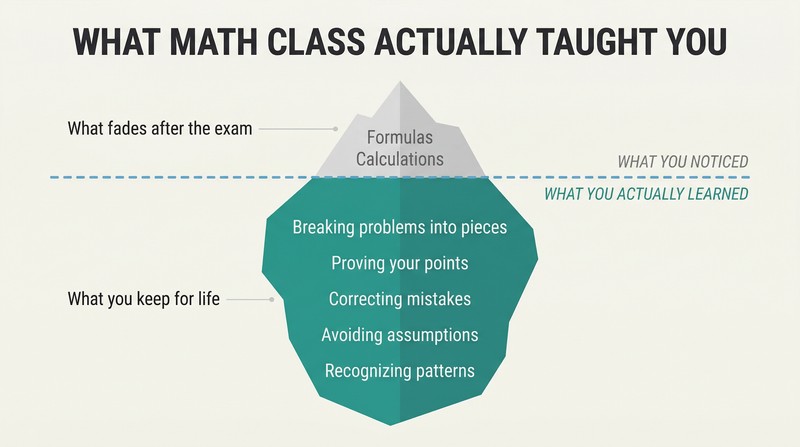
Equations are recipes, not expertise. Just as mastering baked Alaska teaches meringue, frosting, and blowtorch precision — skills transferable to any dessert — math class secretly builds transferable thinking skills: breaking tasks into pieces, proving your points, correcting mistakes, avoiding assumptions, and recognizing patterns. Mathematical thinking is the reasoning behind the formulas, not the formulas themselves.
The procedural math we need is vanishing. Apps measure angles, receipts calculate tips, and Google solves integrals. But the demand for abstract thinkers, problem-solvers, and analyzers keeps growing. Math has expanded from four basic operations to an estimated 60 – 70 categories, yet most job descriptions mention analytical skills — never trigonometry. Mathematical thinking is what actually transfers from every math class you endured.
Strip 'maybe' from your arguments — make claims true or false
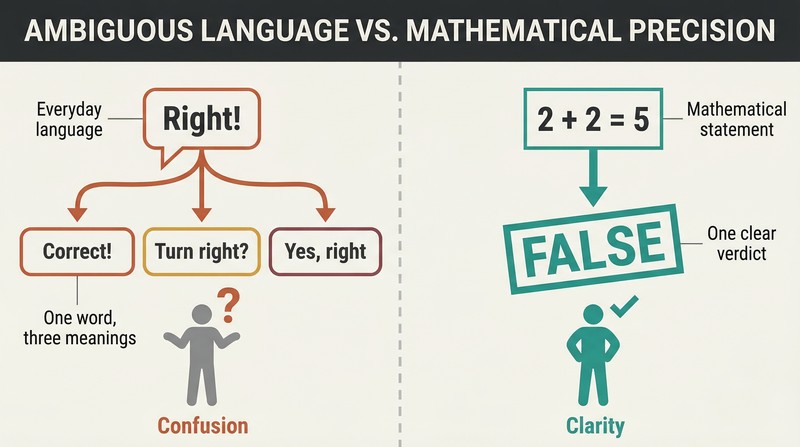
Math's sentences are airtight. In math, every statement must be provably true or false — no maybes allowed. An expression like 2+2 only becomes a meaningful sentence when punctuated with an equals sign producing a verifiable conclusion. English tolerates alarming imprecision: the CDC headline "One person dies every 36 seconds of cardiovascular disease" technically describes one unfortunate soul dying and resurrecting repeatedly.
Ambiguity costs us daily. Picture asking your navigator which way to turn. They yell "Turn here!" You ask, "Left?" They reply, "Right!" — and you're left guessing if they mean the direction or are confirming your question. Mathematical negations have clear, direct opposites; English antonyms are subjective. Adopting math's commitment to precision — saying exactly what you mean — makes your arguments sharper and more defensible.
Test one example, then ten, then make it a rule for life
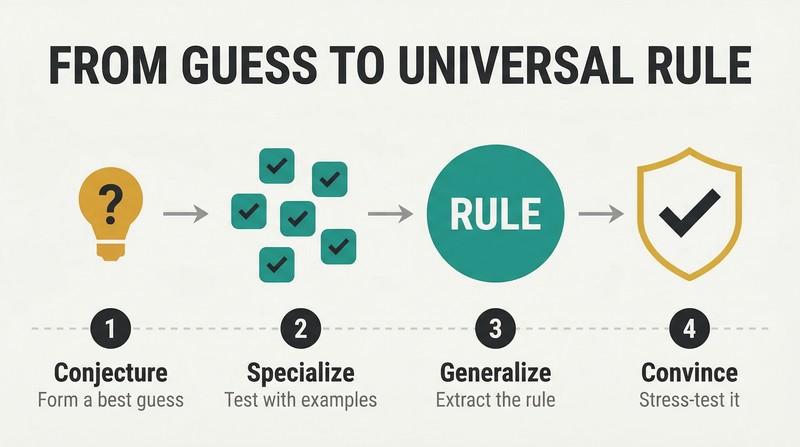
Four steps to mathematical problem-solving. John Mason's framework treats reasoning like a math proof:
1. Conjecture — form a best guess, even if wrong
2. Specialize — test it with specific examples
3. Generalize — extract a universal rule from those examples
4. Convince — present your conclusion to allies first, then skeptics who will challenge every assumption
The Black Friday test. Wondering whether to calculate tax or discount first on a $1,000 laptop? Test both orders: 30% off then 10% tax yields $770. Tax first then discount also yields $770. Plug in $800, $1,500, $2,000 — same result every time. You've specialized your way to a generalization: order doesn't matter. That single rule now serves you for life, far more powerful than one calculation.
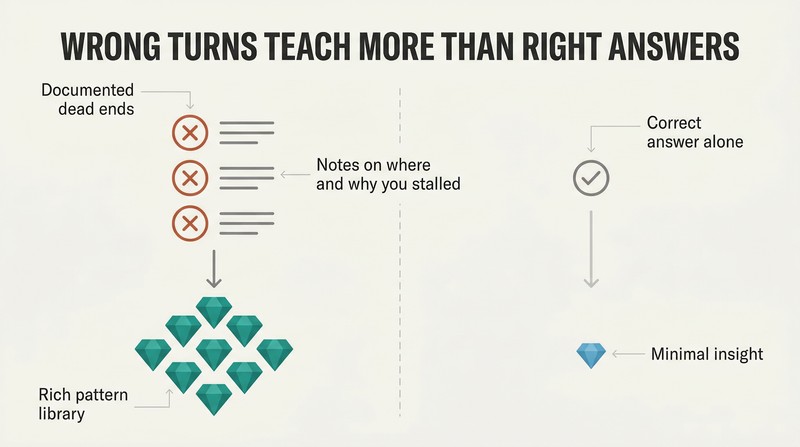
Document where you get stuck — wrong turns teach more than right answers
Mason's journal method. Mathematician John Mason argues that recording your thoughts, frustrations, dead ends, and half-formed ideas during problem-solving is as valuable as recording solutions. By documenting exactly where you stall, you build raw material for future convincing and generalizing. You also discover your own mental patterns — which assumptions misled you and which hunches proved useful.
Apply this beyond math. When facing any problem, write down your thoughts and opinions. Reimagine the scenario from someone else's perspective, in a different context, or at a different time. List pros and cons. Draw from past experiences. As you externalize your thinking, the answer often surfaces on its own — the act of writing clarifies the problem and naturally sorts through possible solutions.
Your first instinct often blocks the better answer
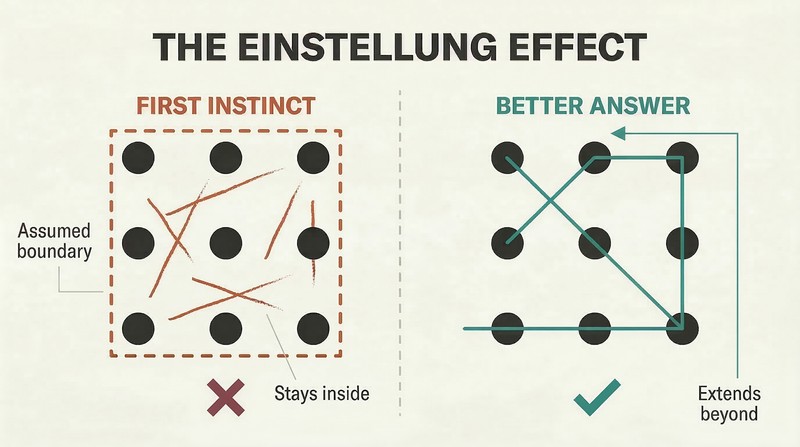
A cognitive blind spot with a name. The Einstellung effect is a phenomenon where preconceived ideas or familiar approaches prevent you from seeing superior solutions. It creates mental roadblocks even when — especially when — the old approach clearly isn't working. The classic demonstration: connect nine dots in a 3×3 grid using only four straight connected lines. Most people assume the lines must stay inside the grid and never find the answer, which requires extending lines beyond the dots.
Math class is the Einstellung effect in action. Students memorize formulas without understanding when or why to apply them — learning the grammar of a language before the vocabulary. This equation-first approach is like putting the cart before the horse, tricking students into thinking practice problems matter more than the conceptual reasoning behind them.
Walk away from hard problems — your brain solves them in the background
Two modes of thinking alternate. Focused mode is a narrow flashlight beam — intense concentration blocking out everything else. Diffuse mode is that same flashlight on wide beam — less precise, but illuminating broader connections. You can't run both simultaneously, but they work in tandem: learn through focused attention, then step away so your subconscious can process.
Dali and Edison weaponized this. Both would hold objects while napping; when they fell asleep and dropped them, the clatter would wake them at the boundary between focused and diffuse states. For everyday use, mundane autopilot tasks — washing dishes, walking, showering — work best for diffuse mode because they require minimal brainpower, leaving your subconscious free to work on the hard problem. Thinking about a concept right before bed is especially powerful.

Google nearby fakes mastery — recall from memory to truly learn
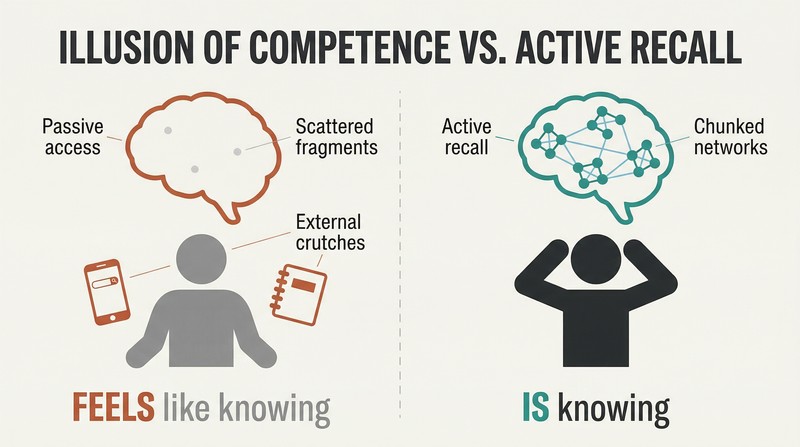
The illusion of competence. When answers are a Google search or notebook flip away, you feel like you know the material. Walk away from your notes and you realize how little you've retained. Having information accessible tricks you into thinking you've internalized it. Actively pulling ideas from memory — not passively re-reading — builds far stronger learning pathways.
Chunking cements understanding. Chunking is the process of sorting learned information into mental files by connecting related concepts. It progresses through three stages: absorbing raw data, identifying key points, then forming meaningful clusters tied to your own experience. Use bottom-up chunking (testing specific examples) or top-down chunking (understanding the big picture and fitting pieces in). Reviewing material right before sleep is especially powerful — your brain's diffuse networks continue processing overnight.
Stop assuming trends travel in straight lines
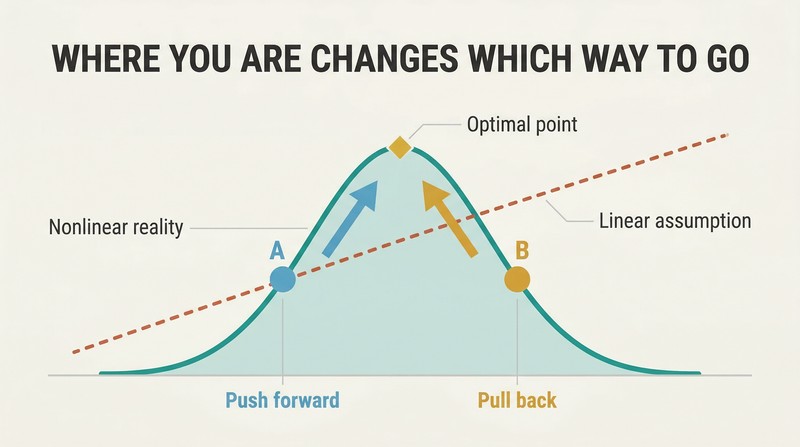
The Sweden paradox. When the Affordable Care Act was debated, critics argued the US shouldn't adopt Swedish-style welfare because even Sweden was cutting back. On a linear graph, this looks damning. But on a nonlinear bell curve, both moves are correct simultaneously: Sweden had overshot the prosperity peak and was pulling back, while the US hadn't reached it yet and needed to push forward. Context determines direction.
The obesity prediction trap. Researchers projected 100% of Americans would be overweight by 2048 by extrapolating rising BMI data in a straight line. But growth curves flatten near their limits — some people will never become overweight. By their own linear logic, 115% of Americans would be overweight by 2070, which is obviously impossible. Linearity can't capture feedback, saturation, or how past decisions affect present conditions.
Calculate expected value before any bet or big decision
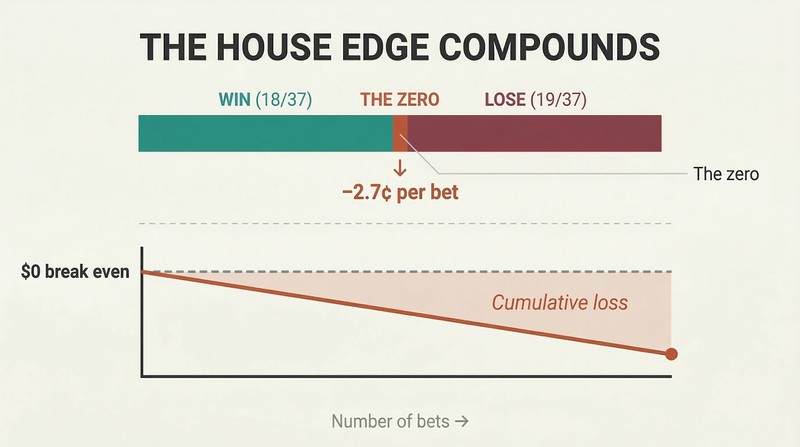
Expected value reveals the long game. Expected value multiplies the probability of each outcome by its payoff, then sums the results. In roulette, betting $1 on black gives 18/37 odds of winning and 19/37 odds of losing — the green zero slot tips the balance. Your expected value per bet: negative 2.7 cents. Play long enough and the math grinds you down.
Apply it to any gamble. Consider a lottery with 10 million combinations and a $7 million jackpot. A single $1 ticket gives one-in-ten-million odds. You'd need to spend $7 million in tickets just to break even — and even then face a 30% chance of losing. Insurance companies use this same math in reverse, calculating expected accident frequency times expected claim severity to set premiums. Thinking in expected value turns gut feelings into informed decisions.
On tests, tackle the hardest problem first for two minutes, then pivot
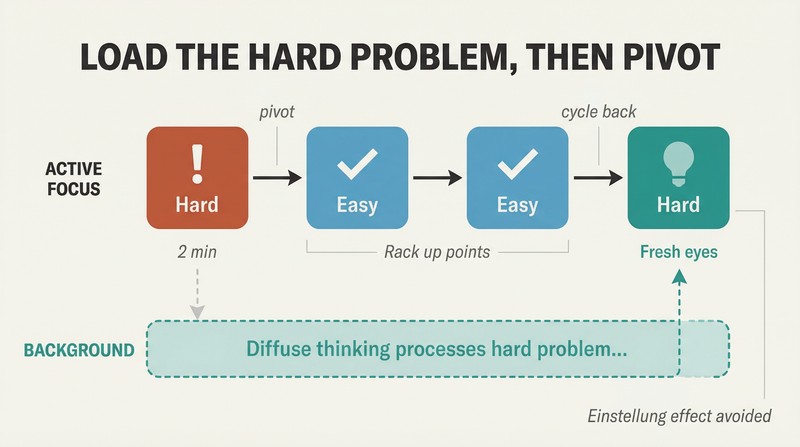
Barbara Oakley's test strategy. Scan the entire test immediately. Find the hardest problem and spend 2 – 3 minutes on it — just enough to load it into your conscious awareness. Then switch to easier problems. Your diffuse thinking will chew on the hard problem in the background while you rack up points elsewhere. Cycle back periodically to check if new ideas have surfaced. This also reduces the Einstellung effect — getting locked into one faulty approach.
Prep your mind, not just your notes. For multiple-choice questions, cover the answers first, read the question carefully, formulate your own answer, then reveal the options. To manage test anxiety, reframe your pounding heart and sweaty palms as your body gearing up to perform. Practice deep belly breathing weeks before the exam so calm becomes automatic under pressure.
Analysis
Rutherford's Mathematical Thinking occupies an unusual niche: a math book for math-haters, which must simultaneously argue for math's relevance while promising readers they'll never touch an equation. The result is an accessible but uneven tour through mathematical thinking, drawing heavily from Barbara Oakley's A Mind for Numbers and Jordan Ellenberg's How Not to Be Wrong while adding its own pedagogical scaffolding.
The book's strongest contribution is its reframing. By separating mathematical thinking from mathematical calculation, Rutherford gives math-phobic readers permission to engage with reasoning skills they've been unconsciously developing since grade school. The baker-recipe analogy works effectively: just as mastering baked Alaska teaches transferable techniques rather than one dessert, math class teaches pattern recognition, logical reasoning, and proof — skills that outlast any formula.
Where the book shines brightest is in its treatment of nonlinearity. The Sweden-welfare paradox and the obesity-prediction error are vivid demonstrations of how linear assumptions lead to absurd conclusions in a nonlinear world. These examples do what the best popular math writing does: make the reader see familiar news stories through a quantitative lens.
The book's weaknesses are structural. The chapter on analytical, synthetic, systemic, critical, and creative thinking reads like a taxonomy rather than an argument — five thinking types in rapid succession with insufficient depth on any. The probability chapter covers terrain well-trodden by Kahneman and Taleb without adding fresh perspective.
Still, for its target audience — professionals wanting sharper reasoning without reopening a textbook — the book delivers genuine utility. Mason's four-step framework (conjecture, specialize, generalize, convince) alone provides a repeatable process for approaching any unfamiliar problem. And the focused- diffuse thinking framework, borrowed from Oakley, remains one of the most practically useful concepts in learning science. Rutherford's contribution is making these ideas feel less like neuroscience and more like common sense.
Review Summary
Mathematical Thinking - For People Who Hate Math receives mixed reviews. Some readers find it a light, enjoyable read with systematic coverage of thinking methods, albeit shallow. The book's mathematical aspect is considered minimal, serving more as a marketing device. Readers appreciate the author's voice and writing style, making it an alternative to mindless entertainment. However, some expected more depth and mathematical content. The chapter on linear and non-linear thinking is highlighted as interesting. Overall, it's seen as a quick introduction to mathematical thinking, suitable for those seeking a basic understanding without deep mathematical exploration.
People Also Read







Glossary
Mathematical thinking
Reasoning skills behind math formulasThe conceptual, theoretical, and practical reasoning that underlies mathematical equations — as distinguished from procedural math (calculating, memorizing formulas). It encompasses skills like pattern recognition, logical reasoning, proving claims, breaking down problems, and applying strategies to novel situations. The author frames it as the transferable "life lessons" hidden within math class.
Vacuous truth
True because premise is impossibleA conditional (if-then) statement that is considered true because its premise is untrue or inapplicable, making the conclusion impossible to disprove. For example, 'If dragons existed, they would be pink' is vacuously true — since dragons don't exist, the claim about their color cannot be falsified. It parallels the legal concept of 'not guilty' versus 'innocent.'
Einstellung effect
Old ideas block better solutionsA cognitive phenomenon where a person's preconceived ideas, familiar methods, or first instincts prevent them from seeing superior solutions to a problem. It creates mental roadblocks that make thinking inflexible. The classic illustration is the nine-dot puzzle, where solvers assume lines must stay within the grid, blocking them from the correct answer that extends beyond it. Coined from the German word for 'setting' or 'attitude.'
Specializing
Testing ideas with specific examplesIn John Mason's problem-solving framework, specializing means selecting particular examples from a general idea and testing whether the idea holds in each case. By working through multiple concrete scenarios, you build evidence for or against a conjecture. For example, testing whether tax-before-discount and discount-before-tax yield the same total across different price points is an act of specializing.
Generalizing
Extracting universal rules from examplesThe process of taking distinct tested examples and distilling them into a universal rule applicable to broader situations. Done by breaking a scenario into base parts and identifying what changes versus what remains constant. Generalizing is the complement of specializing: where specializing provides evidence, generalizing creates the principle. Without specializing first, generalizations risk becoming unproven guesses or biases.
Conjecturing
Educated guess awaiting proofA hypothesis or best guess that seems plausible but has not been definitively proven true or false. In Mason's framework, conjecturing is the starting point of problem-solving — forming an initial idea that you then test through specializing. Goldbach's conjecture (every even number greater than two is the sum of two primes) is a famous example: widely tested and never disproven, but not provable for all numbers to infinity.
Focused mode
Intense concentration on one subjectA highly attentive state of thinking where the brain directs concentrated effort at a specific task, like a narrow flashlight beam. Used for active learning, reading, solving problems, and absorbing new information. It cannot operate simultaneously with diffuse mode. Drawing on Barbara Oakley's work, the author describes it as the mode activated when you deliberately study, practice, or engage with material.
Diffuse mode
Subconscious background problem-solvingA resting-state thinking mode where the brain processes information subconsciously, making broad connections between ideas without active effort. Like a wide flashlight beam illuminating a large area less precisely. Activated during mundane activities (walking, showering, sleeping) after focused effort has been applied. Salvador Dali and Thomas Edison deliberately used naps to trigger diffuse mode for creative breakthroughs.
Chunking
Sorting information into mental filesA learning technique where related pieces of information are grouped into meaningful clusters ('chunks') that are easier to recall than isolated facts. Progresses through three stages: absorbing raw data, identifying key points, then forming connected clusters tied to personal experience. Can be done bottom-up (testing examples to build understanding) or top-down (grasping the big picture and fitting pieces together). Relies on alternating between focused and diffuse thinking.
Illusion of competence
Mistaking access for understandingA false sense of mastery that arises when information is readily available — through notes, textbooks, or search engines — causing a person to believe they have internalized knowledge they haven't actually learned. The term, drawn from Barbara Oakley's work, explains why passive re-reading feels productive but produces shallow retention compared to active recall from memory.
Expected value
Average long-term outcome of decisionsA mathematical calculation that multiplies the probability of each possible outcome by its monetary (or other) payoff, then sums the results to reveal the average result over many repetitions. Used to evaluate bets, investments, insurance premiums, and other decisions involving uncertainty. A negative expected value means you lose money over time; a positive one means you gain. Critical for distinguishing smart risks from bad gambles.
Systemic thinking
Finding themes across grouped componentsA four-step analytical technique for understanding complex situations by adopting a system-wide perspective. The process: (1) list as many components as possible, (2) group common components together, (3) state what makes each group similar, (4) find a repeating theme across group descriptions. Distinct from systematic thinking (methodical process) and systems thinking (how things interact). Combines analytical thinking (listing/breaking down) with synthetic thinking (finding patterns).
FAQ
What's "Mathematical Thinking - For People Who Hate Math" about?
- Purpose of the book: The book aims to help those who dislike math develop analytical and creative thinking skills. It focuses on improving problem-solving and decision-making abilities.
- Beyond traditional math: It emphasizes understanding the theoretical, conceptual, and practical aspects of math rather than just procedural skills.
- Real-world application: The book highlights how mathematical thinking can be applied in everyday life to enhance logical, quantitative, and analytical skills.
Why should I read "Mathematical Thinking - For People Who Hate Math"?
- Enhance thinking skills: The book offers strategies to improve both analytical and creative thinking, which are valuable in various aspects of life.
- Practical benefits: It provides insights into how mathematical thinking can aid in real-world problem-solving and decision-making.
- Accessible approach: The author presents math in a way that is approachable for those who have traditionally struggled with or disliked the subject.
What are the key takeaways of "Mathematical Thinking - For People Who Hate Math"?
- Mathematical thinking: It's about understanding the concepts behind math, not just the procedures.
- Problem-solving skills: The book teaches how to break down tasks, find patterns, and make logical decisions.
- Real-world relevance: Mathematical thinking is applicable in everyday situations, from budgeting to strategic planning.
How does Albert Rutherford define "Mathematical Thinking"?
- Beyond equations: Mathematical thinking involves understanding the reasoning and skills behind mathematical concepts.
- Practical application: It focuses on using math to solve real-world problems and make informed decisions.
- Conceptual understanding: The book emphasizes the importance of grasping the big-picture ideas behind math.
What is the "Einstellung Effect" mentioned in the book?
- Definition: The Einstellung Effect refers to preconceived ideas that hinder finding better solutions.
- Impact on problem-solving: It can create mental roadblocks by making individuals stick to familiar methods.
- Overcoming the effect: The book suggests clearing away past notions and doing further research to find new solutions.
How does "Mathematical Thinking" relate to creative thinking?
- Interconnected thinking: Mathematical thinking requires both logical and creative approaches to solve problems.
- Divergent and convergent: While mathematical thinking is convergent, focusing on specific solutions, creative thinking is divergent, exploring multiple possibilities.
- Enhancing problem-solving: Creative thinking can help overcome roadblocks in mathematical thinking by providing new perspectives.
What are the benefits of "Focus and Diffuse" thinking as discussed in the book?
- Two modes of thinking: Focused thinking involves intense concentration, while diffuse thinking allows for broader, subconscious processing.
- Problem-solving strategy: Alternating between these modes can lead to breakthroughs and "aha" moments.
- Practical application: The book suggests using focused thinking for learning and diffuse thinking for processing and connecting ideas.
What is the role of "Precision" in mathematical thinking according to Albert Rutherford?
- Math as a language: Math is described as a universal language with strict rules for clarity and precision.
- Importance of accuracy: The book emphasizes the need for precise statements and logical conclusions in math.
- Avoiding ambiguity: Mathematical thinking requires clear, unambiguous communication, unlike the flexibility often found in everyday language.
How does the book address "Linearity and Nonlinearity"?
- Understanding linearity: The book explains linear thinking as a straightforward cause-and-effect relationship.
- Nonlinear complexity: It highlights that real-world problems often involve nonlinear interactions that are more complex.
- Practical examples: The book uses examples to illustrate how linear and nonlinear thinking apply to everyday situations.
What is the significance of "Probability and Risk" in the book?
- Lottery example: The book uses the lottery to explain the concepts of probability and risk.
- Expected value: It discusses how to calculate expected value to assess the risk and potential reward of decisions.
- Real-world application: Understanding probability and risk can help make informed decisions in various aspects of life.
What are some common "Errors in Reasoning" highlighted in the book?
- Cognitive fallacies: The book lists common errors such as synonym errors, non sequitur errors, and red herring errors.
- Impact on decision-making: These errors can lead to poorly reasoned decisions and misunderstandings.
- Avoiding mistakes: By recognizing these fallacies, individuals can improve their reasoning and decision-making skills.
What are the best quotes from "Mathematical Thinking - For People Who Hate Math" and what do they mean?
- "Mathematical thinking is much more useful than that.": This quote emphasizes that the book is about practical thinking skills, not just math.
- "It's about learning how to implement processes to find answers.": It highlights the importance of process-oriented thinking in problem-solving.
- "Understanding these concepts will help to shape your thinking to become more logical, quantitative, and analytical.": This quote underscores the book's goal of enhancing cognitive skills through mathematical thinking.
About the Author
Other books by Albert Rutherford
Download PDF
Download EPUB
.epub digital book format is ideal for reading ebooks on phones, tablets, and e-readers.








































