
Trama
Stars Disappear Overnight
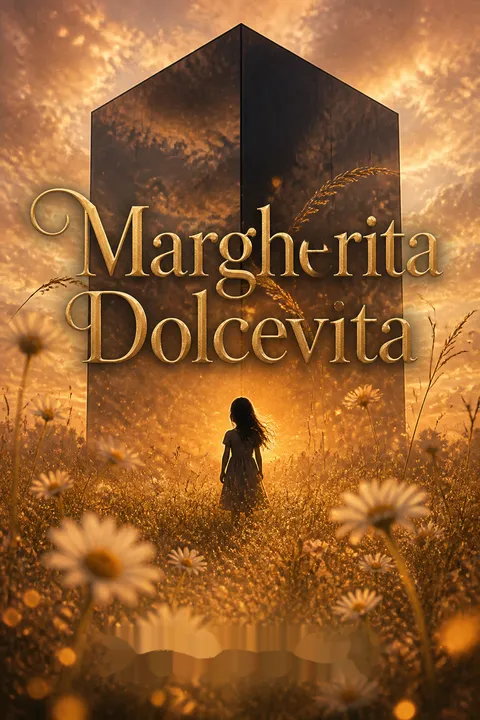
Margherita, a clever, overweight, and imaginative fourteen-year-old, notices the stars have vanished from her night sky. In their place, a massive billboard and construction trucks herald the arrival of new neighbors. Her home, once isolated on the edge of a meadow, is now shadowed by a mysterious black glass Cube. This sudden intrusion marks the end of her familiar world and the beginning of a strange transformation. Margherita's acute sense of loss and curiosity is palpable as she observes the changes, feeling both the excitement of novelty and the dread of something precious slipping away. The meadow, her sanctuary, is threatened, and with it, her sense of belonging and wonder.
Family of Eccentrics
Margherita's family is a collection of lovable oddballs: her meteoropathic father Fausto, who repairs everything but himself; her tear-addicted mother Emma, who smokes imaginary cigarettes and lives for soap operas; her brutish, lovesick brother Giacinto; her apocalyptic, genius younger brother Heraclitus; and her toxin-consuming, conspiracy-minded Grandpa Socrates. Each member is drawn with affection and irony, their quirks both shielding and exposing them to the world's encroaching changes. The family's rituals, jokes, and flaws create a warm, chaotic refuge for Margherita, but also make them vulnerable to the seductive power of the new neighbors and the consumerist spell they bring.
Arrival of the Cube
The Del Bene family arrives, bringing with them a black glass Cube, a fortress of modernity and secrecy. Their house is sterile, artificial, and intimidating, with perfect lawns, fake flowers, and a monstrous guard dog. The Del Benes—Frido, Lenora, Labella, and the enigmatic Angelo—exude wealth, refinement, and a chilling sense of control. Margherita's family is both fascinated and unsettled by their new neighbors, who seem to know everything about them and quickly begin to influence their habits and desires. The Cube becomes a symbol of the invasive, homogenizing force of consumer culture, threatening the messy, authentic life Margherita cherishes.
The Meadow's Wound
The meadow, once teeming with wildflowers, insects, and childhood memories, is poisoned by pesticides and cut off by fences. The Del Benes' arrival brings not just social change but environmental devastation. Margherita mourns the loss of the poplar tree and the death of countless small creatures, feeling the pain of the land as her own. The ghostly Dust Girl, a spirit of the meadow's past, appears as a warning and a comfort, embodying the grief and resilience of a world under siege. The wounded meadow mirrors Margherita's growing sense of alienation and her determination to resist the erasure of her world.
The Spell of Newness
The Del Benes' charm and generosity quickly ensnare Margherita's family. Fausto is seduced by business opportunities and hair regrowth schemes; Emma is hypnotized by Lenora's elegance and the promise of a giant plasma TV; Giacinto is infatuated with Labella; Heraclitus is bribed with rare video games. The family's individuality and skepticism begin to erode as they adopt the Del Benes' tastes and values. Margherita, increasingly isolated, senses the danger but struggles to articulate it. The spell of newness is both intoxicating and corrosive, promising happiness while hollowing out the family's identity.
Labella's Glittering World
Margherita meets Labella, the Del Benes' glamorous daughter, and is drawn into her world of beauty, consumerism, and superficiality. Labella is both a rival and a potential friend, offering Margherita advice on appearance and popularity while dismissing her love of books and authenticity. Their interactions are fraught with envy, admiration, and subtle cruelty. Labella's world is alluring but empty, a reflection of the Cube's artificial perfection. Margherita's struggle to maintain her sense of self in the face of Labella's influence becomes a microcosm of the larger battle between authenticity and conformity.
The Fallen Angel
Angelo, the Del Benes' fragile, troubled son, becomes Margherita's unlikely confidant and love interest. Their encounters are marked by vulnerability, shared secrets, and a sense of impending tragedy. Angelo is haunted by his family's expectations and his own mental health struggles, oscillating between tenderness and self-destruction. Through their conversations and adventures, Margherita glimpses the cost of the Del Benes' perfection: loneliness, repression, and the loss of innocence. Angelo's presence deepens Margherita's emotional journey, awakening her to love, grief, and the complexities of growing up.
Subtle Transformations
As the Del Benes' influence grows, Margherita's family undergoes subtle but profound changes. Fausto becomes obsessed with business and appearance, Emma with status and beauty, Giacinto with Labella and social climbing, Heraclitus with video games and cynicism. The family's rituals and bonds fray, replaced by competition, secrecy, and alienation. Margherita feels increasingly alone, her warnings dismissed as paranoia or childishness. The transformation is insidious, eroding the family's resistance from within and leaving Margherita desperate to hold onto what remains of their former life.
The Fatal Dinner
The families share a dinner that becomes a battleground of manners, manipulation, and hidden agendas. The Del Benes subtly assert their superiority, criticizing Margherita's family's habits, tastes, and even their dust. The meal is a performance, with each course exposing the family's vulnerabilities and the Del Benes' power. Margherita witnesses her parents' humiliation and her own marginalization, feeling both rage and impotence. The dinner crystallizes the threat posed by the Del Benes: not open hostility, but the slow, relentless undermining of dignity and autonomy.
The Dust Girl's Warning
The Dust Girl, the spirit of the meadow's lost innocence, appears to Margherita as both a warning and a guide. Her story—a child buried alive during the war, singing to be found—echoes Margherita's own sense of entrapment and longing for rescue. The Dust Girl's presence intensifies as the family's crisis deepens, urging Margherita to remember what is at stake and to resist the forces erasing her world. The ghost becomes a symbol of memory, grief, and the possibility of redemption, anchoring Margherita's struggle in something larger than herself.
The Seduction of Comfort
The family succumbs further to the comforts and distractions offered by the Del Benes: plasma screens, air conditioning, beauty treatments, and the illusion of security. The Cube's surveillance and control extend into every aspect of their lives, erasing privacy and spontaneity. Margherita observes with horror as her family becomes passive, compliant, and disconnected from reality. The seduction of comfort is revealed as a form of enslavement, trading freedom and authenticity for convenience and status. Margherita's resistance hardens, even as she feels increasingly powerless.
The Plot Unfolds
Margherita and Heraclitus begin to investigate the Del Benes, uncovering surveillance cameras, secret meetings, and a web of lies. They discover that the Cube is not just a home but a hub of control and manipulation, connected to a network of similar structures spreading through the city. The family's involvement in the Del Benes' schemes deepens, implicating them in activities ranging from arms dealing to social engineering. Margherita's sense of reality is shaken as she confronts the scale and complexity of the threat, but her determination to fight back grows.
The Vampire Returns
Angelo's struggles intensify, and Margherita is forced to confront the darkness within herself and her family. The metaphor of the vampire—someone who drains life and joy from others—becomes increasingly literal and personal. Margherita sees how the Del Benes' power feeds on the weaknesses and desires of those around them, turning love into dependency and hope into resignation. The return of the vampire is both a warning and a call to action, pushing Margherita to reclaim her agency and confront the forces consuming her world.
Grandpa's Warnings
Grandpa Socrates, exiled to a nursing home after a suspicious accident, becomes Margherita's last link to the wisdom and resilience of the past. His stories, jokes, and conspiracies take on new urgency as the family's crisis deepens. Grandpa warns Margherita not to trust appearances, to question authority, and to fight for what matters. His eccentricity is revealed as a form of resistance, a refusal to be assimilated or silenced. Margherita draws strength from his example, even as she mourns his absence and fears for his safety.
The Second Dinner
A second dinner at the Cube exposes the full extent of the Del Benes' control and the family's complicity. Lenora openly criticizes and humiliates Margherita's family, dictating their behavior and choices. The atmosphere is tense, with alliances shifting and secrets bubbling to the surface. Margherita challenges the Del Benes, demanding answers about Angelo, the surveillance, and the fate of missing friends. The dinner ends in confrontation and violence, shattering the illusion of civility and forcing the family to choose sides.
The Night of Truth
Margherita and Heraclitus break into the shed, discovering weapons, surveillance equipment, and evidence of the Del Benes' criminal activities. They are caught by the adults, leading to a tense standoff in which truth and lies are pitted against each other. The children demand accountability, refusing to be silenced or manipulated. The confrontation escalates, culminating in an explosion that destroys the shed and exposes the family's complicity. The night of truth is both a reckoning and a liberation, forcing everyone to confront the consequences of their choices.
The Battle for Innocence
In the aftermath of the explosion, Margherita mourns the loss of her childhood, her family's innocence, and the world she loved. The Dust Girl appears one last time, guiding Margherita through her grief and reminding her of the resilience of life. The family is shattered, but Margherita finds strength in memory, love, and the determination to rebuild. The battle for innocence is not just a fight against external threats, but a struggle to preserve dignity, compassion, and hope in the face of overwhelming loss.
The End of Childhood
As dawn breaks over the ruined meadow, Margherita reflects on all that has been lost and all that endures. The world has changed irrevocably, but the possibility of renewal remains. Margherita's journey from innocence to experience is complete, marked by pain, wisdom, and a fierce commitment to truth. The story ends with a vision of the Dust Girl leading Margherita toward the future, a reminder that even in the darkest times, the seeds of hope and resistance can take root and grow.
Analysis
A modern fable of resistance and lossMargherita Dolce Vita is a poignant, darkly comic meditation on the costs of progress, the seductions of consumerism, and the fragility of individuality. Through the eyes of a singular, unforgettable protagonist, Benni exposes the ways in which power infiltrates the most intimate spaces—family, memory, and imagination—eroding resistance from within. The novel's blend of magical realism, satire, and psychological insight makes it both a warning and a celebration: a warning against the dangers of conformity, surveillance, and the commodification of life; a celebration of the messy, resilient, and irreducible beauty of human connection. The Dust Girl's presence reminds us that memory and grief are not obstacles to happiness but the ground from which hope and renewal can grow. In an age of screens, algorithms, and endless distraction, Margherita's story is a call to remember, to mourn, and to fight for the right to name our own stars.
Sintesi delle recensioni
Margherita Dolce Vita presents a fourteen-year-old narrator who uses imagination and poetry to observe her quirky family and resist modern conformity. Reviewers praise Benni's linguistic creativity, humor, and social critique addressing consumerism, technology, environmental destruction, and loss of innocence. The novel begins lightheartedly but shifts dramatically into darker territory, depicting the protagonist's struggle against her neighbors' sinister influence. While many admire the poetic prose and satirical depth, some find the tonal shift jarring and the ending ambiguous or unsatisfying. Overall, readers appreciate Margherita's voice and the book's timely commentary on contemporary society.
Characters
Margherita Dolce Vita
Margherita is the heart and soul of the story—a witty, overweight, and physically fragile teenager with a poet's mind and a rebel's spirit. Her acute observations, humor, and vulnerability make her both relatable and heroic. She loves her eccentric family fiercely and mourns the loss of her childhood world as the Del Benes' influence grows. Margherita's journey is one of awakening: from innocence and longing for acceptance to a courageous resistance against conformity and erasure. Her relationships—with her family, the Dust Girl, and Angelo—reveal her capacity for empathy, love, and grief. Psychologically, she embodies the struggle to maintain individuality and hope in a world bent on homogenization and control.
Fausto (Father)
Fausto is a tall, thin, weather-sensitive man who clings to the past by repairing broken objects and resisting change. His insecurity about aging and relevance makes him susceptible to the Del Benes' promises of success and rejuvenation. As he becomes entangled in Frido's business schemes, Fausto's moral compass wavers, and he distances himself from his family's needs. His arc is tragic: a loving father who, in seeking to provide and belong, loses sight of what truly matters. His relationship with Margherita is strained by his complicity, but his vulnerability and regret are palpable.
Emma (Mother)
Emma is a devoted mother and housewife, defined by her emotional intensity and longing for romance and validation. Her addiction to soap operas and imaginary cigarettes reflects her desire for escape and meaning. Lenora's influence awakens Emma's insecurities about beauty and status, leading her to embrace superficial changes at the cost of her authenticity. Emma's journey is one of gradual disempowerment, as she trades her warmth and individuality for the approval of others. Her relationship with Margherita is tender but fraught, marked by mutual misunderstanding and love.
Giacinto (Brother)
Giacinto is Margherita's older brother, a soccer-obsessed, messy, and hormonally driven teenager. His bravado masks deep insecurities about love, masculinity, and belonging. Labella's arrival triggers a crisis of identity, as Giacinto abandons his old loyalties and values in pursuit of her approval. His transformation—from hooligan to fashion victim, from rebel to conformist—mirrors the family's broader capitulation to the Del Benes' world. Giacinto's relationship with Margherita is a mix of rivalry, affection, and mutual bewilderment.
Heraclitus (Erminio, Brother)
Heraclitus is the youngest sibling, a twelve-year-old prodigy with a passion for science, video games, and apocalyptic predictions. His intelligence and curiosity make him both a target for manipulation and a key ally in Margherita's resistance. As the story progresses, Heraclitus matures rapidly, shedding his innocence and embracing a more strategic, even ruthless, approach to survival. His bond with Margherita is deep, rooted in shared secrets and a mutual commitment to truth. Psychologically, he represents the loss of childhood and the emergence of critical consciousness.
Grandpa Socrates
Grandpa is a survivor, a storyteller, and a skeptic who has lived through history's upheavals and refuses to be cowed by authority. His eccentric habits—eating toxins, dancing with ghosts, and spying on neighbors—mask a profound wisdom and resilience. Grandpa's warnings about the dangers of conformity, consumerism, and forgetting the past are prophetic. His exile to a nursing home is both a personal tragedy and a symbol of society's abandonment of its elders and traditions. Grandpa's relationship with Margherita is a source of strength and guidance, anchoring her in a lineage of resistance.
Frido Del Bene
Frido is the patriarch of the Del Bene family, a master of appearances and control. He exudes confidence, charm, and menace, seducing Margherita's family with promises of wealth, security, and belonging. Beneath his polished exterior lies a ruthless drive for dominance, willing to exploit, surveil, and destroy to achieve his goals. Frido's psychological profile is that of a narcissist and social engineer, skilled at reading and manipulating others' desires. His relationship with Margherita is adversarial, a battle of wills between authenticity and assimilation.
Lenora Del Bene
Lenora is Frido's wife, a model of sophistication and control. She wields her influence through subtle criticism, social pressure, and the promise of acceptance. Lenora's obsession with cleanliness, order, and appearances masks a deep insecurity and emptiness. She becomes Emma's mentor and tormentor, dictating her choices and eroding her confidence. Lenora's psychological role is that of the superego, enforcing societal norms and punishing deviation. Her relationship with Margherita is antagonistic, a struggle over autonomy and self-worth.
Labella Del Bene
Labella is the Del Benes' daughter, a teenage siren whose beauty and confidence mask a profound loneliness and vulnerability. She embodies the values of consumer culture: appearance over substance, pleasure over meaning, and competition over connection. Labella's interactions with Margherita are a dance of envy, admiration, and cruelty, reflecting the pressures faced by young women in a world obsessed with perfection. Psychologically, Labella is both a perpetrator and a casualty of the system she represents.
Angelo Del Bene
Angelo is the Del Benes' son, a fragile, artistic boy caught between rebellion and despair. His mental health struggles and resistance to his family's expectations make him both a target and a threat. Angelo's relationship with Margherita is tender, fraught, and ultimately tragic, offering her a glimpse of love and the cost of nonconformity. He is a fallen angel, embodying the pain of those who cannot or will not adapt to a world that demands submission. Angelo's fate is a warning and a call to empathy.
The Dust Girl (Polverina)
The Dust Girl is a ghostly presence, the embodiment of the meadow's lost innocence and the trauma of history. She appears to Margherita in moments of crisis, offering comfort, warnings, and a connection to something enduring. The Dust Girl's story—a child buried alive, singing for rescue—mirrors Margherita's own struggle to be heard and saved. Psychologically, she represents the persistence of memory, the necessity of mourning, and the possibility of renewal. Her relationship with Margherita is that of a guide, sister, and alter ego.
Plot Devices
Magical Realism and Satire
Benni employs magical realism and satire to illuminate the absurdities and dangers of modern life. The story is narrated through Margherita's imaginative, often surreal perspective, blending the mundane with the fantastical. The Cube, the Dust Girl, and the family's eccentricities are both literal and symbolic, allowing the narrative to operate on multiple levels. Satire is used to critique consumerism, conformity, and the erosion of individuality, while magical elements provide hope and resilience. The interplay of humor and tragedy deepens the emotional impact, making the story both entertaining and profound.
Surveillance and Control
Surveillance is a central motif, with the Del Benes' cameras, screens, and psychological manipulation representing the pervasive reach of authority. The Cube's one-way glass, the hidden cameras, and the spread of similar structures throughout the city symbolize the loss of privacy and autonomy. Control is exerted not through overt violence but through seduction, convenience, and the promise of safety. The narrative structure mirrors this, with secrets gradually revealed and the boundaries between observer and observed constantly shifting.
Foreshadowing and Parallelism
Benni uses foreshadowing and parallelism to create a sense of inevitability and interconnectedness. The Dust Girl's story prefigures Margherita's own journey; the family's gradual transformation mirrors the meadow's destruction; the dinners with the Del Benes escalate from awkwardness to open conflict. Repeated motifs—dust, stars, songs, and bad poetry—tie the narrative together, reinforcing themes of loss, resistance, and the search for meaning. The structure is cyclical, with the end echoing the beginning, suggesting both the persistence of hope and the difficulty of escape.
Unreliable Narration and Metafiction
Margherita's narration is self-aware, playful, and at times unreliable. She invents books, poems, and stories within the story, blurring the line between fiction and reality. This metafictional approach invites readers to question the nature of truth, memory, and narrative itself. The use of invented texts, imagined futures, and direct addresses to the reader creates a sense of intimacy and complicity, drawing the audience into Margherita's struggle to make sense of her world.
Scarica PDF
Scarica EPUB
.epub digital book format is ideal for reading ebooks on phones, tablets, and e-readers.








































