
Key Takeaways
1. Majapahit's Tumultuous Birth from a Cycle of Royal Bloodshed
It was in these tumultuous years that a new power centre, the city of Majapahit in eastern Java, emerged from the ruins of Singasari, ruled by Prince Widjaya, the nephew of King Kertanegara.
A violent genesis. The Majapahit empire, destined to become Indonesia's greatest, was forged in a crucible of intrigue, betrayal, and murder. Its origins trace back to the Singasari kingdom, where a legendary figure named Ken Arok, a former robber and murderer, rose to power through cunning and violence, establishing the Rajasa dynasty. This initial act of usurpation set a grim precedent for generations, as the throne became a prize often claimed through fratricide and assassination.
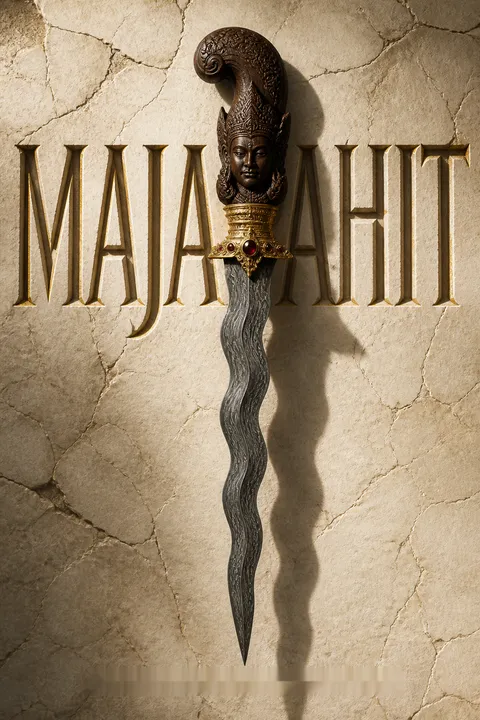
The cursed keris. The cycle of violence was famously linked to a magical keris, forged by the smith Mpu Gandring, who cursed it to kill seven kings after Ken Arok murdered him. This prophecy seemed to unfold with chilling accuracy, as Ken Arok himself was assassinated by his stepson, Anusapati, who in turn was murdered by his stepbrother. This relentless "Game of Thrones" continued for decades, destabilizing the kingdom and eroding public trust in the royal family.
From ashes, a new power. The chaos culminated in 1292 when Jayakatwang, a disgruntled Kediri nobleman, attacked Singasari, killing King Kertanegara and razing the city. From this destruction, Prince Widjaya, Kertanegara's son-in-law, fled and, with the help of the cunning Wiraraja, founded a new settlement. This new city, named Majapahit after the bitter local fruit, would rise from Singasari's ashes to become the heart of a vast empire, but its foundation was steeped in the blood and treachery of its predecessors.
2. Kertanegara's Bold Vision and Defiance of a Global Empire
The king flew into a rage. He wasn’t about to be lectured to by some lowly messenger and he had no intention of taking orders from Kublai Khan.
Unifying the archipelago. King Kertanegara, who ruled Singasari from 1254 to 1292, was a visionary leader determined to unify the sprawling Indonesian archipelago for the first time in history. He expanded Singasari's influence through military campaigns, conquering Bali and parts of Sumatra in his "Pamalayu" expedition, and forging alliances with states like Champa. This ambition laid the groundwork for the future Majapahit empire's vast territorial claims.
Spiritual and political might. Kertanegara was not only a military strategist but also deeply immersed in tantric rituals, believing they enhanced his spiritual powers and protected his realm. He reshuffled his court, promoting loyal, younger advisors who shared his progressive views and participated in his esoteric ceremonies, often held in cemeteries. This blend of spiritual authority and political acumen was central to his rule, culminating in a grand unification ceremony in 1289.
Defiance of the Great Khan. Kertanegara's most audacious act was his defiance of Kublai Khan, the powerful Mongol emperor who demanded tribute and submission. In 1290, when a Chinese envoy delivered this blunt message, Kertanegara famously ordered the diplomat's nose to be cut off, sending a clear message of refusal. This act of defiance, though ultimately leading to a Mongol invasion, cemented his legacy as a fearless ruler who dared to challenge the world's most formidable empire.
3. Gajah Mada: The Ruthless Architect of Majapahit's Golden Age
‘I will not enjoy palapa until all other parts of the archipelago submit to Majapahit.’
From obscurity to power. Gajah Mada, whose name means "rutting elephant," emerged from humble origins to become Majapahit's most formidable patih (vizier) and the true architect of its golden age. First appearing in historical records during the Kuti rebellion in 1319, he saved the young King Jayanegara, quickly rising through the ranks due to his intelligence, ruthlessness, and unwavering loyalty to the Rajasa dynasty. His ambition was matched only by his strategic brilliance.
The Palapa Oath. In 1331, after quelling the Sadeng rebellion, Gajah Mada made his famous "Palapa Oath," vowing to abstain from personal pleasures (possibly even sex) until the entire Nusantara (archipelago) submitted to Majapahit. This audacious declaration outlined his grand vision for a unified proto-Indonesia, encompassing territories from southern Thailand to New Guinea. He systematically pursued this goal through a combination of military conquest and diplomatic alliances.
Master of manipulation. Gajah Mada was a master political operator, adept at navigating court intrigues and eliminating rivals. He was instrumental in the assassination of the weak King Jayanegara, paving the way for Queen Tribhuwanatunggadewi, a strong Buddhist ruler and daughter of the influential dowager queen Gayatri, to ascend the throne. With Gayatri's patronage, Gajah Mada consolidated his power, becoming the undisputed force behind the throne and driving Majapahit's expansion for decades.
4. The Battle of Bubat: A Wedding Turned Diplomatic Catastrophe
Instead of celebrating a royal wedding, the city prepared for battle on its own doorstep.
A strategic marriage. In 1357, King Hayam Wuruk, a charismatic and popular young ruler, sought to marry Princess Citra Rashmi of the Sunda kingdom in western Java. This union was intended to be a diplomatic coup, bringing Sunda under Majapahit's influence and fulfilling Gajah Mada's vision of a unified archipelago. The Sundanese king, Wangi, eager for an alliance of equals, arrived with a grand fleet and his daughter at Bubat, just outside Majapahit.
Gajah Mada's treachery. However, Gajah Mada harbored a different agenda. He saw the marriage as an opportunity to force Sunda's complete submission, demanding that Princess Citra Rashmi be presented as a concubine rather than an equal queen. This insult, delivered with characteristic arrogance by Gajah Mada, shattered any pretense of diplomacy. The Sundanese, proud and unwilling to surrender their sovereignty, prepared for battle.
A tragic massacre. The ensuing Battle of Bubat was a devastating massacre. Despite initial resistance, the Sundanese forces were heavily outnumbered and overwhelmed by Majapahit's military might, reinforced by King Hayam Wuruk's uncle, Wengker. King Wangi and his entire entourage, including Princess Citra Rashmi, perished in the fighting, with chroniclers speaking of "a sea of blood and mountains of corpses." This diplomatic disaster left a lasting schism between Majapahit and Sunda, a wound that never truly healed.
5. Hayam Wuruk's Royal Progress: Pomp, Prosperity, and Prapanca's Pen
The royal procession was an incredible sight and sent ripples of excitement though the countryside as scouts arrived in towns and villages to announce that the king was approaching.
A king among his people. King Hayam Wuruk, a charismatic and gregarious ruler, regularly embarked on "Royal Progress" tours across eastern Java, the heartland of his empire. These elaborate, months-long journeys, meticulously planned by Gajah Mada, allowed the king to connect with his subjects, inspect his lands, and reinforce Majapahit's authority. They were grand spectacles, with elephants, carriages, guards, and a retinue of officials, bringing excitement and a sense of royal presence to remote villages.
Prapanca's invaluable record. The court poet Prapanca, a childhood friend of Hayam Wuruk, accompanied these tours, diligently documenting every detail in his epic poem, the Desawarnana (later known as Nagarakertagama). His observations provide a unique eyewitness account of 14th-century Majapahit life, from the bustling markets and salt-making industries to the diverse religious practices and the king's interactions with commoners. Prapanca's work, initially dismissed by court critics, became an invaluable primary source for understanding the empire's golden age.
A thriving, diverse society. These tours revealed a prosperous and sophisticated society built on abundant rice harvests, a powerful navy, and extensive trade networks. Majapahit was a melting pot of cultures and religions, with Hindu and Buddhist divinities worshipped side-by-side, and women holding esteemed positions at court. The annual Caitra festival, a month-long celebration of music, dance, gambling, and feasting, further showcased the empire's vibrancy and the king's popularity, even as it masked underlying political tensions.
6. Ma Huan's Eyewitness: A Vibrant, Cosmopolitan Majapahit
The people of the country, both men and women, are all particular about their heads. If a man touches their head with his hand, they at once pull out these knives and stab each other.
A Chinese perspective. In 1413, Ma Huan, a Muslim translator accompanying Admiral Zheng He's treasure fleet, provided the only known foreign eyewitness account of Majapahit. His detailed observations, recorded in "The Overall Survey of the Ocean's Shores," paint a vivid picture of a bustling, cosmopolitan city. He noted the diverse population of Chinese, Indian, Arab, and Javanese traders in ports like Tuban and Canggu, and was impressed by the local customs, diet, and craftsmanship.
Daily life and unique customs. Ma Huan described Majapahit as a lively city without walls, filled with terracotta workshops producing intricate piggy banks and cremation urns. He observed the Javanese men's distinctive keris daggers and the women's hairstyles, and was struck by their sensitivity regarding personal space, particularly the head. His account highlights the blend of everyday commerce with spiritual practices, such as the Ganesha statues at crossroads and the ritualistic decapitation of terracotta figures for childbirth.
Religious tolerance and social vibrancy. The Chinese visitor noted the prevalence of both Buddhist and Hindu faiths, as well as a growing Muslim presence, reflecting Majapahit's religious diversity. He was enchanted by the city's social life, from cockfights and wrestling matches to elaborate wedding parties and "musical moonlight walks" by young women. Despite some cultural differences, Ma Huan found Majapahit a welcoming place, a testament to its open and tolerant society, even as he witnessed the gruesome sati ritual of widow burning.
7. Queen Suhita's Progressive Reign Amidst Decline and Famine
What the queen lacked in height she made up for in spirit. She was progressive in mind and assertive in style.
A queen of substance. Queen Suhita, who ascended the throne in 1429, was a diminutive yet formidable ruler, known for her progressive ideas and assertive style. Having witnessed the trauma of her grandfather's cremation and the brutality of civil war, she developed a deep empathy for her people and a pragmatic approach to governance. She was childless, a fact that some traditionalists used to criticize her unconventional methods, but she remained undeterred.
Addressing the famine. Facing a devastating famine and crumbling infrastructure inherited from her father's reign, Suhita embarked on extensive royal tours, conversing directly with commoners to understand their plight. She prioritized practical solutions, ordering the repair of irrigation systems, roads, and bridges, and commissioning the construction of the large Kolam Segaran reservoir to secure water supply. Her focus on infrastructure and agricultural recovery brought the kingdom back from the brink of collapse.
A radical architectural legacy. Defying conservative Hindu priests, Suhita commissioned the construction of two unique temples, Candi Sukuh and Candi Ceto, on Mount Lawu. These temples, unlike any other Javanese Hindu-Buddhist structures, featured erotic bas-reliefs and phallic symbols, reflecting a resurgence of pre-Hindu animist practices and a radical reinterpretation of spirituality. This bold architectural statement underscored her non-conformist vision and her willingness to challenge established norms, leaving a distinct mark on Majapahit's cultural landscape.
8. Internal Strife and External Pressures: The Empire's Slow Decay
It is often said that when it comes to how people go bankrupt there are two ways: gradually, then suddenly. And so it was with the fall of Majapahit.
The Paregreg Civil War. After the death of the revered King Hayam Wuruk in 1389, Majapahit entered a period of irreversible decline marked by internal strife. The succession dispute between his daughter, Kusumawardhana, and his son by a concubine, Wirabumi, escalated into the Paregreg Civil War (1401-1406). This brutal conflict, which saw both sides engage in tit-for-tat skirmishes and massacres, severely weakened the empire's prestige and drained its resources.
Chinese intervention and waning influence. The civil war inadvertently drew in the Ming dynasty, whose Admiral Zheng He's fleet arrived in Java in 1406. A tragic incident saw 170 Chinese soldiers massacred by Majapahit forces, leading to a hefty demand for compensation from Emperor Yongle. While the debt was eventually settled, the incident highlighted Majapahit's diminished authority and China's growing influence in the region, as vassal states like Brunei and Palembang began to shift their allegiance to Peking.
Environmental and economic woes. Beyond political turmoil, Majapahit faced severe environmental and economic challenges. A series of earthquakes and landslides damaged vital infrastructure, while the silting of the Brantas River threatened the capital's access to the sea. These issues, coupled with the "Ming Gap" in trade (China's temporary closure of its ports), contributed to widespread famine in 1426. The empire, once a beacon of prosperity, was slowly crumbling under the weight of internal divisions and external pressures.
9. The Final Blow: Majapahit's Destruction and Enduring Legacy
By noon, all that was left of Majapahit was a heap of rubble and a pile of dead bodies.
The rise of Demak. The final chapter of Majapahit's decline was written by the ascendant Muslim sultanate of Demak on Java's northern coast. Tensions between the Hindu-Buddhist Majapahit and the rapidly growing Islamic power simmered for years, exacerbated by Majapahit's attempts to seek support from the Portuguese in Malacca. In 1524, Demak's ruler, Prince Tranggana, converted to Islam and renounced his loyalty to Majapahit, setting the stage for a decisive confrontation.
The city's demise. In 1527, Demak launched a two-pronged assault on Majapahit. The city, already weakened and largely deserted by its fleeing inhabitants, offered little resistance. Demak soldiers stormed the palace, massacring the remaining royals and priests, and burning everything to the ground. The once-glorious capital was reduced to "a heap of rubble and a pile of dead bodies," marking the definitive end of the Majapahit empire and the symbolic close of Java's Hindu-Buddhist era.
A living legacy. Despite its physical destruction, Majapahit's legacy profoundly shaped Indonesian identity. Its elite fled to Bali, preserving Hindu-Buddhist culture and traditions, effectively making Bali a "reincarnation of Majapahit." The empire's concept of "Nusantara" (unified archipelago) and its motto "Bhinneka Tunggal Ika" (Unity in Diversity) were adopted by modern Indonesia. Figures like Gajah Mada and the Panji tales continue to inspire national narratives, demonstrating that while the city may have fallen, the spirit of Majapahit endures in the cultural, political, and historical fabric of Indonesia.
Review Summary
Readers widely praise Majapahit as an engaging, narrative-driven history that reads like a novel rather than a dry academic text. Many Indonesians express pride and newfound appreciation for their heritage, while international readers applaud its accessibility. Highlights include vivid storytelling, rich detail on royal intrigue, betrayal, and war, and meaningful connections to modern Indonesia. Some note minor redundancies and wish for better footnote placement or deeper coverage of art, architecture, and the empire's decline. Overall, the book is celebrated as an essential, long-overdue work on Southeast Asian history.
People Also Read


Download PDF
Download EPUB
.epub digital book format is ideal for reading ebooks on phones, tablets, and e-readers.








































