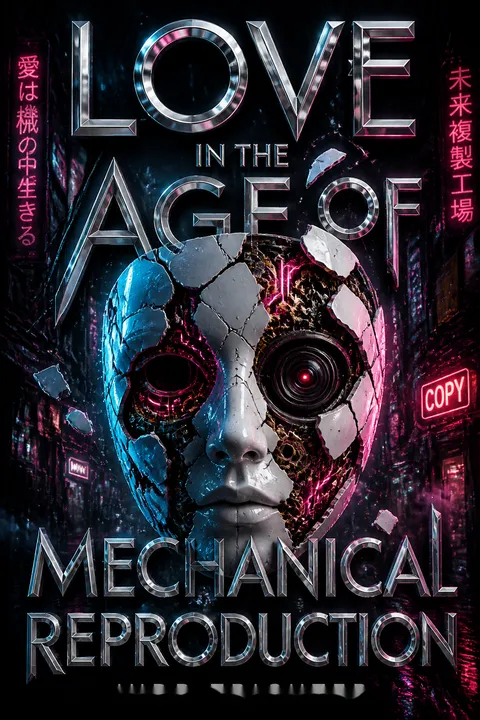

Plot Summary
Lovers Beneath the Hollywood Sign
Eliot Lazar, a human with a mechanical arm and a haunted past, lies with Iris Matsuo, a late-model android, beneath the charred Hollywood sign. Their love is illegal in a Los Angeles where androids ("bots") and humans ("heartbeats") are segregated and violence against interspecies couples is common. They dream of escaping to Avernus, a mythic island commune where they can live freely. Eliot promises Iris a future together, but their happiness is shadowed by fear—someone may be following Iris, and the city's hostility is ever-present. Their tender moments are laced with anxiety, longing, and the desperate hope that one last big deal will buy their freedom. The emotional core is Eliot's realization that love, once found, is worth any risk, even as the world conspires to tear them apart.
Dangerous Deals and Drip
Eliot, a salesman at Global Assistance Corporation (GAC), navigates the cutthroat world of android labor contracts. He meets with Dale Hampton, a ruthless Texan mining executive, to negotiate a massive bot lease for a dangerous job on Jupiter's moon. The deal is fraught with ethical dilemmas: sending thousands of bots to likely destruction for profit. Eliot's addiction to "drip," a narcotic inhaled through a cloth, clouds his judgment but also numbs his pain—physical and emotional. The commission from this deal could buy the boat he and Iris need to escape, but the cost is his conscience. The chapter pulses with tension between survival, love, and the compromises demanded by a corrupt, dehumanizing system.
Brothers, Boats, and Betrayal
Eliot turns to his brother Shelley, hoping to borrow his beloved boat for the escape to Avernus. Their relationship is a mix of affection, rivalry, and mutual dependence. Shelley is skeptical of Eliot's plans and his love for Iris, especially given Eliot's ongoing struggle with addiction. The brothers' banter is laced with dark humor and underlying pain—both lost their father and sister in a bot-related explosion years ago. Shelley's cynicism about Avernus and Eliot's motives exposes the difficulty of trusting, even within family. Yet, despite doubts and debts, Shelley ultimately agrees to help, setting the stage for Eliot's desperate bid for freedom.
Pit Fights and Botwhores
Eliot and Shelley descend into the city's underbelly: illegal pit fights where bots battle animals and each other for entertainment, and brothels where androids swap heads and bodies to satisfy human clients' fantasies. The spectacle is brutal and dehumanizing, reflecting a society that commodifies both flesh and metal. Eliot's discomfort grows as he witnesses the violence and exploitation, while Shelley revels in the chaos. The chapter exposes the blurred lines between pleasure and pain, love and transaction, and the ways both humans and bots are trapped by their roles. Eliot's resolve to escape with Iris hardens, even as the world's ugliness threatens to overwhelm him.
Iris Disappears
Eliot's world collapses when he arrives at Iris's apartment to find her missing and her home ransacked. The police, led by the weary Detective Flaubert, are indifferent—androids, especially "free roamers" like Iris, have no legal protection. Eliot is consumed by guilt, blaming himself for not acting sooner to protect her. He spirals into grief and self-recrimination, haunted by memories of his family's death and his own failures. The city's violence escalates, and Eliot's addiction worsens. The emotional arc is one of despair and paralysis, as Eliot confronts the possibility that love, once lost, cannot be reclaimed.
Detective Flaubert's Investigation
Detective Jean-Michel Flaubert, a veteran cop with a failing body and a battered soul, investigates the break-in at Iris's apartment. His partner, Ochoa, is a bigoted brute, highlighting the generational and moral divides within the police force. Flaubert is both compassionate and resigned, recognizing the futility of seeking justice for bots in a system designed to ignore their suffering. His interactions with Eliot reveal a deep understanding of loss and the limits of the law. The chapter explores the detective's internal struggle: upholding a flawed process versus acknowledging the humanity (or personhood) of those the law excludes.
Drip, Guilt, and Grief
Alone in his apartment, Eliot succumbs to his addiction, using drip to numb the pain of Iris's disappearance and his own failures. He lays out her clothes on the floor, creating a shrine to her absence, and is tormented by memories and regrets. The city's chaos mirrors his internal turmoil—riots, fires, and violence rage outside as Eliot contemplates suicide. The chapter is a raw exploration of grief, addiction, and the desperate need for meaning in a world that offers none. Eliot's only solace is the faint hope that Iris left a clue—a "bread crumb"—that she can still be found.
The Search for Iris
Eliot embarks on a relentless search for Iris, following leads through factories, chop shops, and the criminal underworld. He uncovers the brutal realities of bot life: exploitation, trafficking, and the constant threat of being "chopped" for parts. Each clue brings him closer to the truth but also deeper into danger. The city's history of bot labor and rebellion is revealed, including the rise of Lorca, the one-armed nannybot turned revolutionary. Eliot's journey is both physical and existential—a test of his resolve, his morality, and his willingness to sacrifice for love.
Underground Clues
Eliot's search leads him to the underground party scene, where he encounters DJ Pink, a sadistic trapper who collects bot parts as trophies. Disguised and desperate, Eliot infiltrates Pink's lair, discovering a hidden room filled with severed pinky fingers and a laptop containing a ledger of bot parts and their buyers. In a harrowing confrontation, Eliot kills Pink to save a bot from torture, crossing a line from victim to perpetrator. The emotional climax is one of horror, guilt, and grim determination—Eliot now has the information he needs, but at the cost of his innocence.
The Monster Named Pink
After killing Pink, Eliot is wracked with guilt and fear. He meticulously cleans the crime scene, aware that the law will not see his actions as heroic. Detective Flaubert closes in, piecing together the evidence. Eliot's quest becomes a race against time—not only to recover Iris's parts before they are lost forever, but to evade capture and the consequences of his violence. The chapter explores the moral ambiguity of Eliot's actions: is he a savior, a murderer, or both? The emotional toll is immense, as Eliot realizes that saving Iris may require sacrificing everything else.
The Hunt for Iris's Parts
Armed with Pink's ledger, Eliot tracks down the buyers of Iris's parts: a modeling agency, a recycling plant, a casino pimp, a revolutionary leader, and a loan shark. Each encounter is fraught with danger, negotiation, and moral compromise. Bots who possess Iris's parts are often unwilling or unable to give them up, forcing Eliot to bargain, steal, or even commit violence. The process is dehumanizing for all involved, reducing love to a scavenger hunt for body parts. Yet, Eliot persists, driven by the belief that reassembling Iris will restore what was lost.
The Model Called Yoshiko
Iris's head has been reconfigured onto a modelbot named Yoshiko, who has no memory of her past life. Eliot tries to awaken Iris within her, but Yoshiko is resistant, cynical, and ultimately self-destructive. Their interactions expose the Fragmented Identity and Reassembly of identity and the impossibility of returning to what once was. Even with the right parts, the essence of Iris may be irretrievable. The emotional arc is one of frustration, loss, and the painful recognition that love cannot simply be reconstructed from pieces.
The Price of Reassembly
To recover Iris's torso, Eliot must confront Chief Shunu, a hapless casino pimp, and his monstrous botwhore, Martha, who is assembled from mismatched parts. The encounter is grotesque and farcical, culminating in a chaotic escape. Each part of Iris is obtained at a price—money, violence, or the suffering of others. The process of reassembly becomes a metaphor for the impossibility of restoring what has been broken. Eliot's determination is both heroic and tragic, as he sacrifices his own safety, morality, and even his humanity for the chance to bring Iris back.
Lorca's Bargain
The final missing piece, Iris's right arm, is in the possession of Lorca, the legendary bot revolutionary. Eliot is kidnapped by Lorca's disciples and brought before her. In a tense negotiation, Lorca recognizes the power of Iris's creative spirit and agrees to return the arm—not for Eliot's sake, but for Iris's. The encounter is a meditation on power, compassion, and the possibility of change. Lorca's own transformation, influenced by Iris's arm, suggests that identity is fluid and that even revolutionaries are shaped by the parts they acquire.
The Final Pieces
With all of Iris's parts except her eyes, Eliot faces one last obstacle: Slugger Davydenko, a pit fighter who has been given Iris's eyes by his owner, the loan shark Blumenthal. In a brutal confrontation, Eliot is forced to choose between saving Iris and sparing a child who now possesses her eyes. The cost of wholeness is the suffering of another, and Eliot's actions are marked by guilt and regret. The city erupts in violence as the bot-human conflict reaches its breaking point, mirroring Eliot's own internal apocalypse.
The Cost of Love
Eliot, wounded and pursued, finally reassembles Iris on his brother's boat. Detective Flaubert catches up with him, demanding a confession in exchange for allowing Iris to be restored. The two men, both broken by loss and the failures of their respective systems, reach a fragile understanding. Eliot's confession is both an act of love and a surrender to fate—he will have one last moment with Iris before facing the consequences of his actions. The emotional climax is bittersweet: love is reclaimed, but at a terrible cost.
The Last Escape
Eliot and Iris, now whole but forever changed, escape the burning city by boat, heading for the uncertain promise of Avernus. The world they leave behind is in flames, torn apart by the war between bots and heartbeats. Eliot is haunted by guilt, loss, and the knowledge that the Iris he saved is not the same as the one he lost. Yet, in their shared exile, there is a glimmer of hope—a chance to build something new from the wreckage of the old. The chapter is suffused with longing, regret, and the fragile possibility of redemption.
A New World, Uncertain Love
As they approach Avernus, Eliot and Iris face an uncertain future. The island, once a dream of freedom and belonging, is now a reality fraught with new dangers and unknowns. Iris, reassembled and infected, may never be the same, and Eliot's own wounds—physical and emotional—may never heal. Yet, together, they choose to move forward, embracing the ambiguity of their love and the world they must now inhabit. The story ends not with closure, but with the open question of what it means to love, to change, and to begin again.
Analysis
A modern myth of love, loss, and the limits of restorationLove in the Age of Mechanical Reproduction is a searing exploration of what it means to love—and to lose—in a world where identity, memory, and even the body are fragmented and commodified. Through Eliot's obsessive quest to reassemble Iris, the novel interrogates the boundaries between human and machine, self and other, love and possession. The story's structure, echoing the myth of Orpheus, underscores the futility of trying to reclaim the past: even if the parts are recovered, something essential is always lost. The novel's dystopian setting amplifies contemporary anxieties about technology, labor, and the erosion of empathy, while its characters—broken, yearning, and deeply human (or bot)—invite us to question what makes us whole. Ultimately, the book suggests that love is both transformative and tragic: it compels us to acts of courage and sacrifice, but it cannot undo the wounds of time or restore what has been destroyed. In the end, the only way forward is to accept change, embrace uncertainty, and begin again, even as we carry the scars of what we have lost.
Review Summary
Love in the Age of Mechanical Reproduction receives mixed reviews, averaging 3.51/5. Praised elements include rich world-building in a dystopian near-future Los Angeles, thought-provoking social commentary on race, labor, and inequality, and the compelling Orpheus-and-Eurydice mythological framework. The protagonist Eliot Lazar divides readers—some appreciate his moral complexity, while others find him deeply unlikable. Critics cite weak internal logic, unsatisfying pacing, and problematic racial and gender portrayals. Most agree the novel is fast-paced and ambitious, though execution is inconsistent for a debut work.
People Also Read
Characters
Eliot Lazar
Eliot is a human ("heartbeat") whose life is defined by loss, addiction, and a desperate longing for connection. Scarred by the childhood trauma of losing his father and sister in a bot-related explosion, he carries both physical (a mechanical arm) and psychological wounds. His love for Iris, a late-model android, is both redemptive and destructive—he is willing to sacrifice everything, including his morality and safety, to save her. Eliot's addiction to "drip" is both a symptom and a cause of his emotional paralysis, serving as a means to escape pain but also as a barrier to healing. His journey is one of relentless pursuit, moral compromise, and the recognition that love cannot be restored by force or will alone. Eliot's relationships—with his brother Shelley, with Detective Flaubert, and with the various bots and humans he encounters—reveal a man torn between hope and despair, agency and helplessness.
Iris Matsuo / Yoshiko
Iris is a Hasegawa C-900 android, designed for creativity and marked by a distinctive red fleck in her eye—a flaw that becomes her signature. As a "free roamer," she navigates a precarious existence, valued for her art but vulnerable to exploitation and violence. Her relationship with Eliot is genuine, but her identity is fragile—when she is chopped and her parts scattered, she is reconfigured into other bots (notably Yoshiko, a model with no memory of her past). The process of reassembly raises profound questions about memory, identity, and the soul: is Iris still Iris if her parts are returned but her experiences are lost? Her journey is one of victimization, erasure, and the struggle to reclaim agency in a world that treats her as both object and subject.
Shelley Lazar
Shelley is Eliot's younger brother, a journalist and opportunist who oscillates between supporting and undermining Eliot's quest. Scarred by the same family tragedy, Shelley copes through humor, detachment, and self-indulgence. He is skeptical of Eliot's love for Iris and the dream of Avernus, viewing both as escapist fantasies. Yet, beneath his cynicism lies genuine affection and a willingness to help, even at personal cost. Shelley's psychoanalysis reveals a man afraid of vulnerability, using sarcasm and bravado to mask his own pain and longing for connection.
Detective Jean-Michel Flaubert
Flaubert is a veteran LAPD detective, physically and emotionally worn down by decades of service in a city riven by bot-human conflict. He is both compassionate and resigned, upholding the law even as he recognizes its limitations and injustices. Flaubert's relationship with Eliot is complex—part adversarial, part paternal. He sees in Eliot a reflection of his own struggles with loss, duty, and the search for meaning. Flaubert's arc is one of gradual disillusionment, culminating in a final act of empathy that blurs the line between justice and mercy.
Lorca
Lorca is a legendary one-armed nannybot turned revolutionary leader of the Android Disciples. She embodies both the nurturing and violent aspects of bot resistance, inspiring loyalty and fear in equal measure. Lorca's psychoanalysis reveals a being shaped by trauma, injustice, and the longing for dignity. Her interactions with Eliot and her decision to return Iris's arm are motivated not by sentimentality, but by a recognition of shared suffering and the transformative power of compassion. Lorca's development reflects the fluidity of identity and the possibility of change, even for those hardened by conflict.
Pink (Edmund Spenser)
Pink is a human trapper and DJ who tortures and dismembers bots for profit and pleasure, collecting their pinky fingers as trophies. He represents the darkest aspects of a society that commodifies and brutalizes the vulnerable. Pink's lair is a house of horrors, and his death at Eliot's hands marks a turning point in the narrative—a moment when the victim becomes the perpetrator. Pink's role is to embody the consequences of unchecked power and the moral cost of survival.
Slugger Davydenko
Slugger is a Russian android pit fighter, feared for his strength and capacity for violence. Given Iris's eyes by his owner, he becomes the final obstacle in Eliot's quest. Slugger's relationship with his adopted daughter humanizes him, complicating the morality of Eliot's actions. His development exposes the ways in which even the most monstrous can be capable of love, and the cost of treating beings as mere assemblages of parts.
Martha
Martha is a botwhore assembled from mismatched parts, including Iris's torso. Her existence is both farcical and tragic, highlighting the absurdity and cruelty of a world where identity is fragmented and commodified. Martha's interactions with Eliot are a darkly comic inversion of intimacy, exposing the limits of empathy and the impossibility of restoring wholeness through violence.
Tim (Satine 5000)
Tim is a prototype securitybot, designed for speed and efficiency. He serves as both protector and potential threat, embodying the ambiguity of machine agency. Tim's loyalty to Eliot is both a product of programming and a reflection of genuine connection. His presence in key moments—especially the final confrontation with Slugger—underscores the blurred boundaries between tool and companion, machine and friend.
Chief Shunu
Chief Shunu is a hapless casino pimp on the Chumash reservation, in possession of Iris's torso. His incompetence and self-pity are both comic and pathetic, representing the failures of leadership and the ways in which power is often wielded by the unworthy. Shunu's interactions with Eliot are marked by negotiation, bluff, and ultimately, loss.
Plot Devices
Fragmented Identity and Reassembly
The central plot device is the literal and metaphorical fragmentation of Iris—her body chopped and sold, her identity erased and reconfigured. Eliot's quest to recover her parts is both a detective story and a meditation on the nature of self: can a person (or bot) be restored by reassembling their components, or is something essential lost in the process? This device allows the narrative to explore themes of memory, trauma, and the limits of restoration, while also structuring the plot as a scavenger hunt through the city's underworld.
Noir Detective Structure
The story employs classic noir elements: a missing woman, a haunted protagonist, a jaded detective, and a city rife with corruption and violence. Detective Flaubert's investigation provides a parallel narrative to Eliot's quest, offering both external and internal perspectives on the central mystery. The structure allows for Foreshadowing and Symbolism, red herrings, and the gradual revelation of character motivations, while also highlighting the moral ambiguity of justice in a broken world.
Foreshadowing and Symbolism
Recurring symbols—such as the red fleck in Iris's eye, the locket, and the scattered "bread crumbs" of her parts—foreshadow the impossibility of true restoration. The myth of Orpheus, explicitly referenced and retold, serves as a narrative and thematic touchstone: the quest to reclaim a lost love from the underworld, the inevitability of loss, and the dangers of looking back. These devices deepen the emotional resonance and invite reflection on the nature of love, memory, and change.
Social Satire and World-Building
The novel's setting—a near-future Los Angeles divided by species, class, and technology—serves as both backdrop and commentary. The world-building is rich with detail: bot labor, addiction, pit fights, brothels, and revolutionary movements. Satirical elements (such as the brothel's head-swapping androids and the absurdity of office politics) underscore the dehumanizing effects of capitalism, prejudice, and technological progress. The plot is driven by the interplay between personal desire and systemic forces, highlighting the ways in which individuals are shaped and constrained by their environment.
Download PDF
Download EPUB
.epub digital book format is ideal for reading ebooks on phones, tablets, and e-readers.








































