
Key Takeaways
1. Conservatism Upholds Ordered Liberty Against Statist Tyranny
To put it succinctly: Conservatism is a way of understanding life, society, and governance.
Defining principles. Conservatism, deeply influenced by philosophers like Locke and Burke, champions the dignity of the individual and God-given natural rights to life, liberty, and the pursuit of happiness. It advocates for an "ordered liberty" within a civil society, characterized by a moral order, respect for private property, and a just rule of law that restrains government power. This framework promotes individual potential and societal betterment through cooperation and tradition.
Statist counterrevolution. In stark contrast, Modern Liberalism, or Statism, believes in the supremacy of the state, rejecting the Declaration's principles and the civil society's order. The Statist views individual imperfection as an impediment to a utopian state, promoting a "soft tyranny" that gradually becomes more oppressive. The New Deal era marked a radical shift, breaching constitutional firewalls and expanding federal power through programs, taxes, and regulations, creating a massive, unaccountable government.
Insatiable control. The Statist's appetite for control is insatiable, constantly agitating for government action by concocting grievances and demonizing the industrious as perpetrators against the public good. This manipulation subordinates both "perpetrators" and "victims" to governmental authority, fostering a culture of conformity and dependency. Neo-Statists, while claiming conservatism, inadvertently advance this agenda by abandoning founding principles for perceived efficiency, marching slowly but surely alongside the Statist.
2. Prudence Guides Conservative Change, Rejecting Statist Innovation
Prudence, indeed, will dictate that Governments long established should not be changed for light and transient causes; and accordingly all experience hath shewn, that mankind are more disposed to suffer, while evils are sufferable, than to right themselves by abolishing the forms to which they are accustomed.
Change vs. reformation. The Conservative, like the Founders and Edmund Burke, distinguishes between prudent "reformation" that preserves and improves basic institutions, and destructive "innovation" that radically departs from the past. Change must be informed by societal experience, knowledge, and traditions, ensuring thoughtful deliberation rather than unpredictable consequences that threaten ordered liberty with chaos and despotism. The Statist, however, often justifies change by conferring new, abstract rights, which merely serves to empower the state.
Statist's motivations. The Statist rejects liberty, viewing it as an enemy to his utopian vision where individuals are dehumanized and subordinated to the state. He is often driven by dissatisfaction with his own existence, projecting anger, resentment, and jealousy onto society, believing that only he can provide justice and righteous resolution to perceived injustices. This leads to a continuous "revolution" against religious dogma, antiquated traditions, and ambitious individuals who obstruct his plans, all under the guise of "progress."
Tools of manipulation. To achieve his ends, the Statist relies on a powerful network:
- International community: Used to foster disaffection with civil society and promote "global citizenship."
- Academics: Serve as missionaries, turning classrooms into propaganda mills to shape beliefs and identify "enemies of the state."
- Hollywood: Uses entertainment to besmirch civil society, with actors finding "anonymity in the larger fraternity" and "relevance in its causes."
- Media: Acts as a parasite, regurgitating statist information and amplifying calls for greater authority, often censoring dissenting voices.
3. Natural Law and Faith Are the Foundation of Unalienable Rights
Man is more than a physical creature.
Divine origin of rights. Reason and science, while critical, cannot explain their own existence or the spiritual nature of man, ultimately directing him to a supernatural force—the Creator. The Founders, men of varying faiths, were united in the belief that God was the origin of existence and the source of Natural Law, which prescribes "unalienable rights" like "Life, Liberty, and the pursuit of Happiness." These rights are not conferred by man, and thus cannot be legitimately denied by man, making their divine nature essential for their inviolability.
Secularist assault. The Statist rejects Natural Law, believing rights are state-ratified and rationed, not inherent. This leads to arbitrary morality and the adoption of tyranny, as seen in bloody revolutions under various statist ideologies. The rise of New Deal statism coincided with secularism's ascent, particularly in the judiciary. Justice Hugo Black's 1947 Everson v. Board of Education ruling, asserting a "high and impregnable wall between church and state," was a "wretched betrayal" of America's founding, effectively rewriting the First Amendment to establish a secular polity.
Faith's vital role. For the Conservative, faith is not a threat but vital to civil society's survival, encouraging restraint, duty, and moral behavior. Attempts to stigmatize religious individuals as "zealots" or "extremists" for resisting secular impositions are attacks on conservatism itself. George Washington warned that "morality can [not] be maintained without religion," underscoring that moral order and liberty are inseparable; without them, relativism leads to anarchy and tyranny.
4. The Constitution's Original Meaning Is Under Attack by Judicial Activism
To say that the Constitution is a “living and breathing document” is to give license to arbitrary and lawless activism.
Originalist interpretation. The Conservative is an originalist, believing the Constitution, like a contract, holds the same meaning today as it did when ratified, connecting generations by restraining government excess. James Madison emphasized that only by adhering to the original sense can there be "security for a consistent and stable" exercise of powers, warning against the "metamorphosis" produced by changing word meanings. To abandon originalism is to abandon the Constitution's underlying principles.
Judicial manipulation. The Statist, however, is uninterested in the Framers' intent, seeking only to impose his own. The judiciary has become the primary path to amassing authority, with judges like Thurgood Marshall and Arthur Goldberg openly admitting to deciding cases based on what they "think is right" or "just," rather than the law. This transforms the judiciary into an "ongoing constitutional convention," unilaterally amending the Constitution and even justifying the use of foreign law, thereby rejecting America's governmental system.
"Second Bill of Rights." Franklin Roosevelt, despite earlier warnings against "master minds," became the very figure he denounced, proposing a "Second Bill of Rights" in 1944. These "rights" — to jobs, adequate food, housing, medical care, and education — are not rights but "tyranny's disguise," false promises of utopianism used to justify seizing private property and enslaving individuals to the state. Legal "realists" like Cass Sunstein further argue that property is a government construct, not a natural right, advocating for its redistribution and the transformation of civil society through judicial fiat.
5. Federalism's Erosion Empowers an Unaccountable Administrative State
The powers not delegated to the United States by the Constitution, nor prohibited by it to the States, are reserved to the States respectively, or to the people.
Purpose of federalism. The Framers designed federalism to limit federal power, separate it among three branches, and safeguard the Declaration's principles by preserving state authority. States, reflecting diverse local interests, serve as "laboratories" for policy experimentation and offer citizens mobility to choose preferred economic, cultural, or social conditions. This decentralized system defuses conflict and promotes harmony, allowing divergent beliefs to coexist within the same country.
Subversion of state power. However, the Seventeenth Amendment (1913) removed states' direct representation in the Senate, and the Supreme Court's 1942 Wickard v. Filburn ruling radically expanded federal power under the interstate commerce clause, subjecting even local economic activity to federal regulation. This swept away 150 years of constitutional jurisprudence, transforming states into "administrative appendages" blackmailed by federal funds to implement policies beyond constitutional limits.
The Fourth Branch. The Statist has constructed an enormous "Fourth Branch" of government—a massive, amorphous administrative state of nearly 2 million employees and a $3 trillion budget. This bureaucracy churns out a mind-numbing number of dense, confusing regulations (74,937 pages in 2006) that control every aspect of life, from clothing labels to toilet flow rates. The estimated cost of compliance is $1.14 trillion, demonstrating how federal overreach imposes its will directly on citizens, in contravention of the Constitution.
6. The Free Market Is Sabotaged by Statist Intervention and False Narratives
The free market creates more wealth and opportunities for more people than any other economic model.
Private property is key. The free market, a transformative system fostering creativity and wealth, is inextricably linked to private property—the material manifestation of individual labor. Taxation or regulation that diminishes private property can become a form of servitude if it results from illegitimate state action. The Conservative believes federal revenue should only fund constitutionally authorized activities, otherwise, there are no limits to the Statist's power to enslave.
Statist's class warfare. The Statist uses the Marxist "class struggle" to justify assaults on the free market, creating a perception of conflict through inventions like the "progressive" income tax. This tax, which Marx endorsed, aims to redistribute wealth, not merely fund government, and disproportionately burdens high-income earners while leaving many others paying nothing. The Statist manipulates public sentiment by redefining wealth categories and stirring class envy, portraying the free market as unjust and requiring constant government intervention.
Economic destruction. The Statist's central planning creates economic perversions, which he then blames on the free market to seize more power. Examples include:
- Housing bust (2008): Caused by government mandates (Community Reinvestment Act), pressure on Fannie Mae/Freddie Mac, and Federal Reserve interest rate manipulation, leading to trillions in bailouts.
- Oil industry: Sabotaged by drilling bans, refining capacity stagnation, and costly "blend" regulations, driving up prices while the government profits most from taxes.
- Auto industry: Crippled by union monopolies (Wagner Act) and CAFE standards that increase costs and reduce safety, leading to calls for taxpayer bailouts instead of creative destruction.
7. The Welfare State Is an Intergenerational Fraud Leading to Dependency
It is time for all Americans, especially baby boomers to recognize our collective stewardship obligation for the future.
Intergenerational swindle. Entitlement programs like Social Security, Medicare, and Medicaid are "intergenerational swindles" that threaten future generations with massive financial obligations. David Walker, former Comptroller General, estimated the total burden at $53 trillion, or $455,000 per American household, warning that "time is working against us." These programs, rooted in European socialism and advocated by figures like Henry Rogers Seager, represent a radical departure from America's founding principles.
Roosevelt's deception. Franklin Roosevelt designed Social Security to entangle individuals in a "methodological fiction"—the illusion of insurance—to addict them to entitlements. He insisted on payroll taxes to give "contributors a legal, moral, and political right to collect their pensions," ensuring no "damn politician can ever scrap my social security program." This "accounting sleight-of-hand" conceals that payroll taxes are immediately spent, with no funded accounts, leaving future taxpayers to cover trillions in IOUs.
Unsustainable expansion. Truman and Johnson expanded this fraud with Medicare and Medicaid, also packaged as "insurance" despite their true nature as massive welfare programs. These programs now cover 86 million people, consuming an untenable share of the budget and economy. The Congressional Budget Office warns that without changes, tax rates would become "economically unfeasible," leading to "serious problems with tax avoidance and tax evasion." The Statist's ultimate goal is to nationalize healthcare, controlling not only individual wealth but physical well-being, as seen in the disastrous British NHS model.
8. Enviro-Statism Uses Fear and Junk Science to Justify Control
The more dire the threat, the more liberty people are usually willing to surrender.
Pathology of fear. Enviro-statism abandons science for power, using junk science and fear-mongering to promote public health and environmental scares. This pathology involves:
- Event/Study: Food contamination, new disease, or a "frightening" new health risk identified by government agencies or non-profits.
- Alarmism: Cherry-picked "experts" make urgent predictions, amplified by an uncritical media.
- Government action: Public officials clamor to ameliorate dangers, enacting new laws or regulations.
- Liberty surrender: The public, expecting aggressive government action, surrenders liberty, expanding governmental authority.
DDT: A deadly fraud. The modern environmental movement was founded on the "egregious fraud" of banning DDT, a "human-saving wonder chemical" that eradicated malaria and saved millions of lives. Rachel Carson's Silent Spring (1962) spread hysteria about DDT's effects, leading to an EPA ban in 1972 despite scientific findings to the contrary. This decision, driven by political agendas, resulted in millions of deaths in the undeveloped world, a "genocide-like" human cost.
Global warming agenda. The Enviro-Statist's most noxious assault is "man-made global warming," a narrative that shifted from "global cooling" in the 1970s. Despite a lack of scientific consensus and debunked evidence (like Mann's "hockey stick" graph), figures like Al Gore and influential politicians declare the "debate is over." The proposed "cap and trade" scheme, a "most oppressive economic scheme," would create a vast bureaucracy to dictate emissions, leading to trillions in GDP losses, millions of job losses, and increased household energy costs, all justified by a "long and growing roster of preposterous assertions."
9. Immigration Policy Undermines National Sovereignty and Social Cohesion
No society can withstand the unconditional mass migration of aliens from every corner of the earth.
Consent of the governed. The Statist's argument for "comprehensive immigration reform" misrepresents America as merely a "nation of immigrants," implying a moral imperative for extensive legal and illegal migration. However, the Declaration of Independence states that governments derive "just powers from the consent of the governed," meaning the primary responsibility of government is to its citizens. To demean the citizen's paramount role in society by portraying immigrants as universally more virtuous is nonsensical and undermines the nation's legitimacy.
Transforming society. The 1965 Hart-Celler Act, despite assurances it wouldn't, radically altered American society by abolishing national quotas and introducing "chain migration." This led to a substantial increase in immigration from Latin America, Asia, and Africa, with aliens who were generally poorer, less educated, and less skilled. This, coupled with the 1986 amnesty and the misinterpretation of the Fourteenth Amendment for "birthright citizenship," created a "bottomless" pool of future administrative state constituents and sympathetic voters.
Societal costs. The consequences of this "immigration anarchy" are profound:
- Welfare dependency: Immigrant-headed households are 50% more likely to use welfare, costing taxpayers significantly more than they contribute.
- Education strain: Immigrants' lower educational attainment and sheer numbers overwhelm public school systems, with Hispanic students projected to be the majority by 2050.
- Cultural balkanization: Mass migration discourages English use and fosters ethnic enclaves, with groups like La Raza actively working against assimilation and for open borders.
- Economic impact: A surplus of low-skilled labor drives down wages for American workers and retards technological progress.
- Crime and health: Increased criminal alien incarceration and the reemergence of diseases pose significant societal burdens.
10. Self-Preservation Must Guide Foreign Policy, Not Global Utopianism
The Conservative believes that the moral imperative of all public policy must be the preservation and improvement of American society.
Founding principles. The Founders understood that America's survival and prosperity required political, economic, cultural, and military strength. George Washington's Farewell Address, often misunderstood as isolationist, was a call for prudence in foreign dealings and national unity, emphasizing that "to be prepared for war is one of the most effectual means of preserving peace." A defensive foreign policy, including preemptive action when prudent, serves the security of the people in their person and property, not imperialistic hegemony or spreading democracy everywhere simultaneously.
Statist's global vision. The Statist, however, views foreign policy as another opportunity to enhance his authority, promoting a vision of "global citizenship" where America's security is "inextricably linked to the security of all people." President Obama's rhetoric of "investing in our common humanity" and "building the capacity of the world's weakest states" is a messianic, unrealistic global utopianism that ignores complex obstacles and history. This approach subsumes America's interests under an amorphous "global" interest, often leading to treaties that commit the U.S. to courses of conduct easily exploited by adversaries.
Criminalizing war. The Statist also seeks to criminalize war, dragging strategic decisions into the courtroom and empowering terrorists with new rights. The criticism of interrogation techniques like waterboarding, the closure of Guantánamo Bay, and opposition to the Patriot Act and enemy communication interception, all under the guise of "human rights" or "civil liberties," demonstrably make securing the nation against threats more difficult. This zealotry exposes the nation to known external threats, prioritizing ideological purity over the preservation of American society.
11. Conservatives Must Act Decisively to Reclaim America's Founding Principles
We Conservatives need to get busy.
America's transformation. America is no longer strictly a constitutional, representative, or federal republic; it is "a society steadily transitioning toward statism." Republican administrations, with the exception of Reagan, have largely remained on the statist glide path, exemplified by President Bush's "abandoned free-market principles to save the free-market system" and his unconstitutional auto industry bailout, which paved the way for President Obama's "ideologically pure Statist" agenda. Republicans' timidity in returning to first principles is a "hollow victory."
Call to action. Conservatives must become more engaged, forming a new generation of activists who are "larger in number, shrewder, and more articulate." This requires seeking elective and appointed office, infiltrating the administrative state, teaching in schools, and influencing media and Hollywood. Parents and grandparents must actively counteract statist indoctrination by teaching American civil society principles at home. Conservatives must also acquire knowledge outside the statist's universe, utilizing independent resources and publications.
Reclaiming the narrative. The Statist controls public vocabulary, framing draconian measures as benign "reforms" or "going green." Conservatives must dissect this language, as Ronald Reagan did, to highlight the Statist's duplicity and the bankruptcy of his ideas, recasting the morality of the message. The battle over language and ideas is crucial. While the road is long, conservatives must be resolute, flexible, and willing to compromise only if it advances founding principles, rejecting self-defeating ideological boundaries imposed by Statists and neo-Statists.
Review Summary
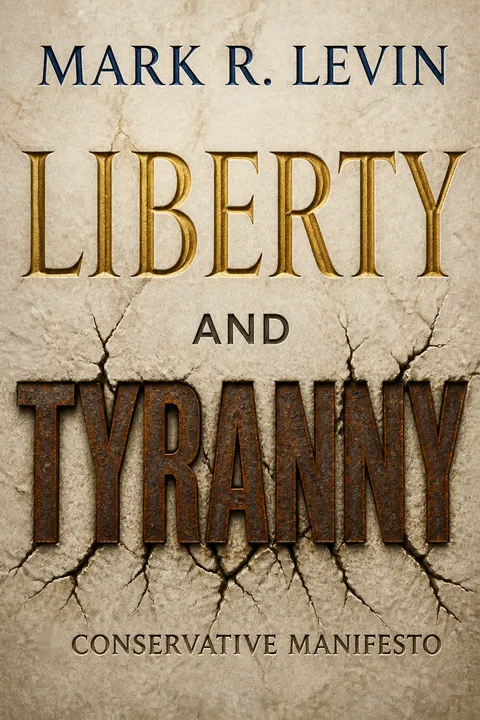
Liberty and Tyranny receives mostly positive reviews for its clear articulation of conservative principles and critique of statism. Readers appreciate Levin's logical arguments, historical context, and call to action. Critics argue the book relies on straw man arguments and lacks nuance. Some find it an essential primer on conservatism, while others see it as partisan rhetoric. The book's popularity and bestseller status indicate its resonance with conservative readers seeking to understand and defend their ideology in the current political climate.
People Also Read






Download PDF
Download EPUB
.epub digital book format is ideal for reading ebooks on phones, tablets, and e-readers.








































