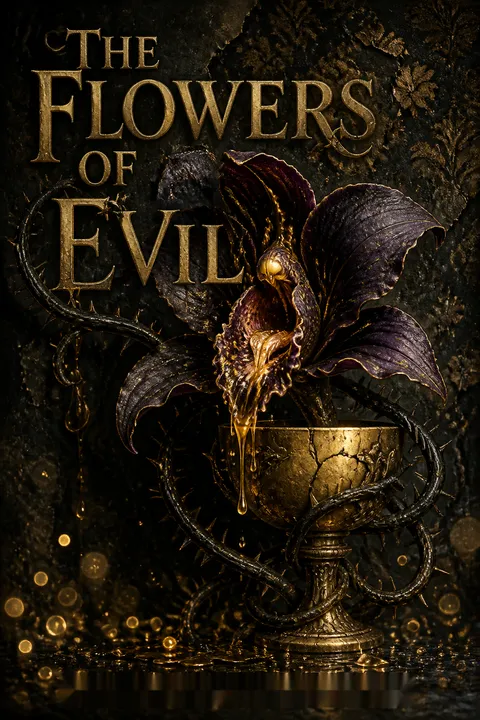

Summary Unavailable
This book is not suitable for a summary (it may be a textbook, workbook, cookbook, reference book, or collection). However, you can still explore the FAQs, about author, and other metadata below!
Plot Summary
Prologue: Humanity's Secret Rot
Baudelaire opens with a direct address to the reader, exposing the universal rot at the heart of humanity. He accuses us all—himself included—of being complicit in stupidity, error, sin, and greed, feeding our own remorse like beggars tending their vermin. The Devil, he claims, pulls our strings, and we are drawn to the repugnant, descending daily toward Hell without horror. Yet, the greatest monster is Ennui, a silent, yawning force that would swallow the world whole. This prologue sets the tone: the poems to follow are not merely personal confessions, but a mirror held up to the reader, implicating all in the shared malaise of modern existence.
The Poet's Divine Curse
The poet, marked by a divine curse, is both blessed and damned. Born to suffering, misunderstood by his mother and society, he is protected by an invisible angel but subjected to scorn and cruelty. The poet's sensitivity isolates him, making him a target for the world's malice. Yet, in his pain, he finds a strange nobility, believing that suffering is a divine remedy that purifies and elevates the soul. The poet's role is to transform agony into beauty, to endure the world's contempt while glimpsing a higher, mystical reality.
Fallen Angels, Broken Wings
Through the image of the albatross—majestic in flight, clumsy on land—Baudelaire likens the poet to a fallen angel, exiled and ridiculed. The poet soars above the world in spirit, but is mocked and misunderstood when forced to walk among men. This chapter explores the pain of alienation, the longing for transcendence, and the inevitable humiliation that comes with being different. The poet's "giant wings" are both his gift and his burden, preventing him from fitting into the mundane world.
Beauty's Double-Edged Sword
Beauty, in Baudelaire's universe, is both divine and infernal. It inspires love and awe, but also cruelty, obsession, and despair. The poet is enthralled by beauty's cold perfection, yet tormented by its unattainability and indifference. Women are depicted as muses, temptresses, and even destroyers—objects of worship and sources of suffering. Beauty is a mask, hiding pain and decay beneath its surface. The poet's pursuit of the ideal leads to both ecstasy and ruin, as he is drawn to the sublime and the monstrous alike.
The Alchemy of Suffering
Suffering is not merely endured but transmuted. Baudelaire sees himself as an alchemist, turning the lead of pain into the gold of poetry. The world is full of decay, but the poet's task is to extract meaning and beauty from it. Through vivid imagery—flowers blooming from rot, perfumes rising from decay—he shows how art can redeem even the most sordid experiences. Yet, this process is fraught with danger: the line between creation and destruction is thin, and the poet risks being consumed by the very darkness he seeks to illuminate.
The Masks We Wear
Society is a masquerade, and individuals hide behind masks—of beauty, virtue, or indifference. Baudelaire exposes the duplicity of social roles, the lies we tell ourselves and others. The mask is both protection and prison, concealing true feelings and desires. The poet is fascinated by the interplay between surface and depth, appearance and reality. He recognizes that behind every mask lies pain, longing, and the fear of being truly seen. The mask becomes a symbol of the human condition: we are all actors, hiding our wounds.
The Seduction of Decay
Baudelaire is drawn to the morbid and the forbidden. He finds beauty in decay, sensuality in death, and fascination in the grotesque. The infamous poem "A Carcass" juxtaposes the memory of a lover with the image of a rotting corpse, suggesting that all beauty is doomed to corruption. Yet, there is a strange seduction in this decay—a reminder of mortality that intensifies desire. The poet's love is tinged with necrophilia, as he seeks to possess what is already lost. Decay becomes a metaphor for the fleeting nature of pleasure and the inevitability of loss.
Spleen: The Weight of Ennui
Spleen, for Baudelaire, is a state of soul-crushing ennui—a sense of futility, heaviness, and despair. The poet is haunted by memories, overwhelmed by the passage of time, and paralyzed by the monotony of existence. The city becomes a prison, the mind a cluttered attic of regrets. Hope is a bat flapping against the walls of a damp cell. The poet's only relief is in fleeting moments of beauty or intoxication, but these are quickly swallowed by the black tide of spleen. This chapter captures the modern malaise: the sense that life is both too much and not enough.
Paris: City of Shadows
Baudelaire's Paris is a city of contrasts: dazzling and sordid, vibrant and decaying. He wanders its streets as a flâneur, observing beggars, prostitutes, old women, and outcasts. The city is a theater of misery and desire, where every face tells a story of loss. The poet is both participant and observer, moved by compassion and horror. The city's beauty is inseparable from its ugliness; its vitality is haunted by death. In the urban crowd, the poet finds both anonymity and connection—a sense of belonging among the damned.
The Consolation of Wine
Wine, for Baudelaire, is both poison and sacrament. It offers temporary relief from pain, a sense of brotherhood, and glimpses of transcendence. The drunkard, the poet, the lover—all seek in wine a way to forget, to dream, to rebel against the tyranny of time and suffering. Yet, intoxication is always fleeting, and the hangover brings new despair. Wine is a metaphor for all forms of escape—art, love, religion—that promise salvation but deliver only momentary respite. Still, the poet clings to these consolations, knowing their futility.
The Dance of Destruction
The poet is pursued by demons—of lust, addiction, and self-destruction. He is drawn to forbidden pleasures, knowing they will destroy him. The figures of the femme fatale, the vampire, and the damned sisters embody the fatal attraction of sin. The poet's love is always tinged with violence and regret; his ecstasies end in ruin. Yet, he cannot resist the pull of the abyss. Destruction becomes a form of creation, as the poet turns his wounds into art. The dance of death is both terrifying and exhilarating—a way to affirm life in the face of annihilation.
The Allure of the Abyss
Baudelaire flirts with the diabolical, invoking Satan as a symbol of revolt and forbidden knowledge. He is fascinated by the idea of falling, of embracing the darkness within. The poet's prayers are addressed not to God, but to the Prince of Exile, the healer of human anguish. This rebellion is both spiritual and aesthetic—a refusal to accept the world's hypocrisy and mediocrity. The abyss is terrifying, but it also promises freedom and authenticity. The poet is willing to risk damnation for the sake of truth.
Satanic Prayers and Revolt
In the section "Révolte," Baudelaire turns religious language upside down, offering litanies to Satan and questioning the justice of God. He identifies with Cain, the outcast, and celebrates the beauty of the fallen angel. This is not mere shock value, but a profound expression of spiritual crisis. The poet seeks meaning in a world that seems abandoned by God, and finds solace in rebellion. Yet, even in revolt, there is a longing for grace—a hope that suffering and sin might lead to redemption.
The Seduction of Death
Death is ever-present in Baudelaire's world, not as an end but as a seduction. The poet imagines death as a bed, a voyage, a reunion with lost loves. For the poor, death is consolation; for the artist, it is the final inspiration. The poet dreams of the afterlife as a place of strange beauty and eternal rest. Yet, death is also terrifying—a leap into the unknown, a surrender to oblivion. The poet's relationship with death is ambivalent: he fears it, desires it, and seeks to make it beautiful.
The Voyage Beyond Hope
The book ends with the metaphor of the voyage—a restless search for meaning, pleasure, and escape. The poet and his companions set out in hope, only to find that every paradise is an illusion, every journey ends in disappointment. The world is a desert of ennui, and the only true voyage is toward death. Yet, even in despair, there is a strange joy—a willingness to embrace the unknown, to keep searching, to find beauty in the ruins. The final prayer is for death to take the poet beyond the limits of experience, into the heart of the mystery.
Analysis
Baudelaire's Les Fleurs du Mal is a radical exploration of the modern soul, torn between the longing for transcendence and the inescapable reality of suffering, decay, and ennui. The poet's journey is not linear but cyclical, marked by repeated attempts to escape—through beauty, love, intoxication, rebellion—only to be dragged back into despair. The book's enduring power lies in its honesty: it refuses easy consolation, insisting that beauty and horror, ecstasy and ruin, are inseparable. Baudelaire's vision is both deeply personal and universal, implicating the reader in the shared malaise of modernity. His use of symbolism, irony, and direct address creates a work that is at once intimate and confrontational, lyrical and brutal. The lesson is not one of redemption, but of lucidity: to see the world in all its contradictions, to find meaning in suffering, and to transform pain into art. In a world where hope is fragile and death ever-present, Baudelaire offers the consolation of beauty—fleeting, ambiguous, and profound.
Last updated:
Report IssueReview Summary
Les Fleurs du Mal is widely regarded as a masterpiece of French literature, praised for its innovative style, dark themes, and exploration of beauty in the unconventional. Reviewers commend Baudelaire's poetic genius, noting his ability to transform the mundane into the sublime. While some find the content challenging or disturbing, many appreciate its profound impact on symbolist and modernist poetry. The collection's controversial nature upon publication is frequently mentioned, along with its enduring influence on literature and culture.
People Also Read

Characters
The Poet (Baudelaire)
The Poet is both the protagonist and the lens through which the world is seen. He is marked by a sense of divine election and exile, feeling both superior to and estranged from humanity. His sensitivity is a curse, exposing him to suffering and ridicule, but also granting him glimpses of the sublime. Psychologically, he is torn between longing for transcendence and being dragged down by despair, addiction, and desire. His relationships—with women, with the city, with God and Satan—are fraught with ambivalence. Over the course of the book, the Poet moves from hope to disillusionment, from rebellion to resignation, but always seeks to transform pain into beauty.
Beauty
Beauty is personified as a cold, indifferent goddess—at once inspiring and destructive. She is the object of the Poet's worship and the source of his torment. Beauty's perfection is unattainable, and her indifference wounds the Poet deeply. She is both salvation and damnation, offering glimpses of the ideal while reminding the Poet of his own inadequacy. Beauty's allure is inseparable from death and decay; she is both mask and abyss. The Poet's pursuit of Beauty is a quest for meaning, but also a path to ruin.
The Muse
The Muse appears in many guises: as a nurturing force, a venal prostitute, a sickly presence, or a vanished ideal. She is the source of the Poet's creativity, but also the cause of his suffering. The Muse's relationship with the Poet is ambivalent—she gives and withholds, heals and wounds. Psychologically, she represents the Poet's own divided nature: his longing for inspiration and his fear of sterility. The Muse's absence is felt as a profound loss, driving the Poet to despair and self-destruction.
Satan
Satan is invoked as the Prince of Exile, the healer of human anguish, and the object of blasphemous prayers. He represents the Poet's identification with the outcast, the rebel, and the damned. Satan is both a figure of temptation and a source of consolation—a symbol of the Poet's refusal to accept the world's hypocrisy. Psychologically, Satan embodies the Poet's own divided soul: his longing for freedom and his attraction to self-destruction. The relationship is not one of worship, but of kinship in suffering.
The Femme Fatale
Women in Baudelaire's world are often depicted as dangerous, alluring, and fatal. The Femme Fatale is both object of desire and agent of destruction. She seduces the Poet, offering ecstasy and ruin in equal measure. Her love is tinged with violence, addiction, and death. Psychologically, she represents the Poet's own self-destructive impulses—his longing for oblivion and his fear of abandonment. The Femme Fatale is both muse and vampire, giving life and draining it away.
The City (Paris)
Paris is more than a setting; it is a living character, full of contradictions. The city is beautiful and sordid, vibrant and decaying. It is a place of anonymity and spectacle, where the Poet finds both inspiration and despair. The city's crowds offer a sense of belonging among the damned, but also intensify the Poet's isolation. Paris is a mirror of the Poet's own divided soul—a place of endless fascination and profound melancholy.
The Outcasts
The marginalized figures of the city—beggars, prostitutes, the poor, the old—are recurring presences. They are both objects of compassion and symbols of the Poet's own alienation. The Poet identifies with their suffering, seeing in them a reflection of his own fate. Psychologically, the outcasts represent the underside of society, the reality that polite masks conceal. Their presence haunts the Poet, reminding him of mortality, loss, and the fragility of beauty.
Death
Death is personified as a seductress, a voyage, a bed, and a final consolation. The Poet's relationship with Death is ambivalent: he fears her, desires her, and seeks to make her beautiful. Death offers escape from suffering, but also threatens oblivion. Psychologically, Death represents the Poet's longing for rest, his fear of annihilation, and his hope for transcendence. She is both end and beginning, the final mystery that gives meaning to life.
The Reader
The Reader is addressed directly, implicated in the Poet's confessions and accusations. The Poet sees the Reader as his "brother," sharing in the universal rot and ennui of modern life. The Reader is both judge and participant, drawn into the Poet's world of suffering and beauty. Psychologically, the Reader represents the Poet's longing for connection and his fear of misunderstanding. The relationship is intimate and confrontational, blurring the line between author and audience.
God
God is a distant, often silent presence in the book. The Poet alternately seeks God's grace and rails against his indifference. God is invoked as the source of suffering and the hope of redemption, but is often found wanting. Psychologically, God represents the Poet's longing for meaning, order, and forgiveness. The Poet's relationship with God is marked by doubt, anger, and a desperate hope for transcendence.
Plot Devices
Cyclical Structure and Thematic Repetition
The book is structured in cycles, moving from ideal to despair, from intoxication to hangover, from hope to disillusionment. Each section revisits the same themes—suffering, beauty, death, rebellion—offering new variations and perspectives. This cyclical structure mirrors the Poet's own psychological oscillations, as he moves between ecstasy and despair. The repetition of motifs—flowers, masks, wine, the abyss—creates a sense of obsession and inevitability, reinforcing the book's central message: that suffering and beauty are inseparable.
Symbolism and Synesthesia
Baudelaire employs rich symbolism and synesthetic imagery, blending colors, sounds, and scents to evoke complex emotional states. Nature is a temple of symbols, and every object is charged with hidden meaning. This device allows the Poet to suggest connections between disparate experiences—love and death, beauty and decay, pleasure and pain. The use of synesthesia heightens the intensity of the poems, drawing the reader into the Poet's heightened perception.
Irony and Paradox
The book is full of irony and paradox: beauty is found in decay, pleasure leads to pain, rebellion is a form of longing. Baudelaire delights in overturning expectations, exposing the dark side of every ideal. This device serves to unsettle the reader, forcing a confrontation with uncomfortable truths. The Poet's own voice is often self-mocking, aware of the futility of his quest but unable to abandon it.
Direct Address and Confession
Baudelaire frequently addresses the reader directly, drawing them into the Poet's confessions and accusations. This device creates intimacy and complicity, making the reader a participant in the Poet's suffering and rebellion. The confessional mode blurs the line between autobiography and fiction, universalizing the Poet's experience.
Foreshadowing and Circularity
The poems are full of foreshadowing—of death, decay, and disappointment. The cyclical structure ensures that every escape is temporary, every ascent is followed by a fall. The book ends where it began: with the recognition that suffering is inescapable, but that beauty can still be found in the ruins.
About the Author
Charles Pierre Baudelaire was a French poet, critic, and translator whose work profoundly influenced 19th-century literature. His most famous work, Les Fleurs du Mal, was initially condemned for obscenity but later recognized as a groundbreaking masterpiece. Baudelaire's life was marked by financial troubles and controversy, including prosecution for blasphemy. He is known for his translations of Edgar Allan Poe and his innovative prose poems. Despite facing criticism during his lifetime, Baudelaire's reputation grew posthumously, with his work speaking to modern sensibilities and exploring themes of vice, depravity, and beauty in unexpected places. His influence extends well into the 20th century and beyond.
Download PDF
Download EPUB
.epub digital book format is ideal for reading ebooks on phones, tablets, and e-readers.








































