
Key Takeaways
1. Embedded Democracies Face a Chronic Legitimacy Crisis
If these states are in trouble, the liberal international order they help sustain could also be in trouble.
New crisis paradigm. Traditional theories of legitimacy, rooted in the 20th century, often focused on "acute crises" where states faced existential threats like revolution or regime change. However, many long-standing liberal democracies, particularly the US and UK, have become "embedded." This means their citizens, having witnessed the collapse of many rival systems, possess a deep-seated confidence in democracy, making them unable to imagine viable alternatives, even when deeply frustrated.
Beyond acute threats. This embeddedness doesn't eliminate crises; it transforms them. Instead of an acute threat to survival, these democracies experience a "chronic legitimacy crisis." This is a persistent, low-grade fever where the core meaning and procedural form of democracy are constantly contested, leading to gridlock and sclerosis rather than outright collapse. The crisis is not about whether democracy will survive, but how it can function effectively when its foundational principles are in constant dispute.
Diagnostic approach. Understanding this new form of crisis requires a diagnostic approach, where theory and context inform each other. We must move beyond fixed notions of "legitimacy crisis" to recognize how these crises manifest in embedded systems. The goal is to clarify the situation, allowing for informed action or inaction, rather than prescribing what citizens "ought" to do.
2. Deep Pluralism Fuels Hypocrisy and Resentment
All narratives – no matter how descriptively functional – retain the potential to appear as ideology for some subjects at some times.
Conflicting narratives. Embedded democracies are characterized by "deep pluralism," where citizens hold fundamentally divergent values and conceptualizations of core political ideas. To maintain legitimacy amidst this diversity, the state employs a "legitimation strategy" comprising a plurality of often contradictory "legitimation stories." These stories, explaining the state's coercive acts, can appear as genuine justification to some and as mere ideology to others.
Systemic hypocrisy. This deep pluralism necessitates hypocrisy, both personal and impersonal. Individual politicians might shift their narratives or use vague language to appeal to different groups, while the state, personified by multiple actors (parties, branches, levels of government), can simultaneously advocate conflicting actions and values. This allows the state to "talk out of both sides of its mouth," making it hard to pin down or effectively oppose, even when individual actors are sincere.
Resentment as alienation. When state actions inevitably conflict with some of these diverse legitimation stories, they generate "resentment." This isn't necessarily a call for revolution, but a form of alienation where subjects cease to identify with the state's decisions. This resentment, ranging from mild disapproval to total non-identification, is a constant feature of chronic crises, driving accusations of hypocrisy and further fueling the cycle of distrust.
3. The Crisis Politicizes Democratic Procedures
More and more political energy is caught up in the struggle to save democracy from all the other factions that are also trying to save democracy.
Shift to "how." In a chronic legitimacy crisis, the focus of political conflict shifts from substantive policy debates ("what" decisions are made) to procedural questions ("how" decisions are made). Citizens and political actors, frustrated by the state's inability to align with their preferred legitimation stories, increasingly seek to reform the very rules and institutions of democracy.
Saving vs. destroying. Each faction frames its proposed procedural reforms as essential for "saving democracy," while simultaneously portraying opponents' reforms as attempts to "destroy" it. This creates a vicious cycle of mutual accusation and escalating conflict over the definition of democracy itself. Examples include:
- Debates over voter access laws in the US
- Prorogation of Parliament during Brexit in the UK
- Executive aggrandisement vs. checks and balances
Conflicting democratic virtues. This procedural politicization highlights inherent tensions within democratic ideals. Reforms aimed at increasing "dynamism" (the ability to adapt and act) often come at the expense of "credibility" (the ability to make lasting, predictable commitments), and vice versa. Similarly, efforts to combat "tyranny" (concentrated power) can lead to "gridlock," while fighting "totalitarianism" (impersonal structural imperatives) might empower potentially tyrannical actors.
4. Solving and Settling Fail, Leading to Sinking
In a chronic crisis, the state can be ensnared in a situation in which everything it does – including doing nothing – increases resentment.
Hirschman's voice and exit. Drawing on Albert Hirschman, "solving" the crisis means getting the state to align with existing legitimation stories through "voice" (demanding improvement). However, embeddedness removes the credible threat of "exit" (revolution), weakening the power of voice. Other obstacles include:
- Lack of dynamism: Vetocratic procedures or collusive party systems prevent effective action.
- Restricted imaginarium: Loyalty to the system limits the scope of imaginable reforms.
Goodin's striving and settling. Robert Goodin's concept of "settling" offers an alternative: subjects adjust their expectations, accepting less demanding legitimation stories. But settling is difficult because political actors constantly promise solutions, raising expectations and discouraging acceptance of the status quo.
The codependent trap. Solving and settling become codependent and mutually reinforcing in a "sinking" dynamic. Political actors gain power by promising to solve the crisis, but their failures intensify resentment, making future settling harder. This creates a "legitimation tar pit" where:
- Doing nothing increases resentment.
- Attempts to act often backfire, widening the gap between stories and reality.
- Delaying decisions also generates frustration.
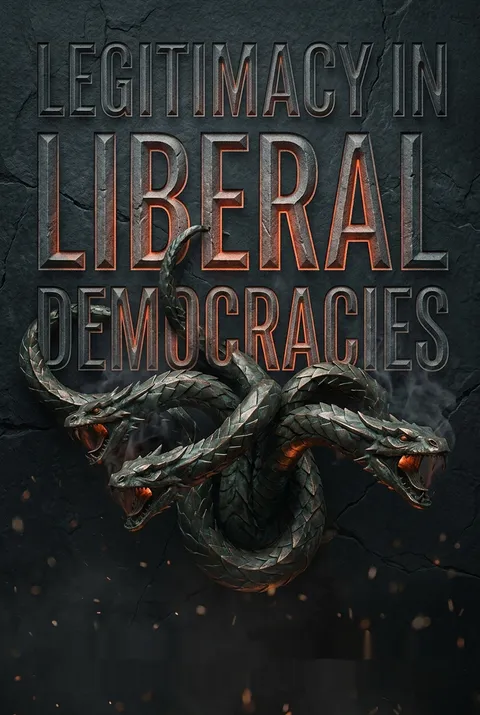
5. The State Becomes a "Legitimation Hydra"
The beast grows new heads faster than you can cut them off.
Vague abstractions. Legitimation stories are built around "legitimating abstractions" like liberty, equality, and representation, which are intentionally vague. This vagueness allows for numerous "conceptualizations," enabling the state to avoid staking too much on any single interpretation and fostering benign disagreement.
Anti-fragile strategy. When one legitimation story is challenged, the state, acting as a "legitimation hydra," effortlessly discards the problematic conceptualization and generates multiple new ones. This anti-fragile strategy means that attacks on the state's legitimacy inadvertently strengthen its overall legitimation ecosystem by increasing its diversity and adaptability. This involves:
- Introducing new conceptualizations: Reinterpreting existing abstractions (e.g., Berlin's positive/negative liberty, Skinner's no-dependence liberty).
- Introducing new abstractions: Less common, but can fundamentally shift the strategy (e.g., "equity" replacing "equality").
Critique appropriated. Even critical theorists, by developing new conceptualizations to expose state hypocrisy, can inadvertently contribute to the hydra's growth. Their critiques, intended to delegitimize, are absorbed and re-purposed, making the state harder to challenge by providing it with new narratives to deploy. This constant generation of new stories, however, comes at a cost to state capacity.
6. Inequality Drives an Unsolvable Crisis
While human societies have been deeply unequal before and persisted in that inequality for long spans of time, never before has this much economic inequality been accompanied by legitimation stories that are comparably demanding.
Undermining core stories. Rising economic inequality, as highlighted by Stiglitz and Piketty, directly undermines numerous legitimation stories. It challenges beliefs in:
- Opportunity and meritocracy: Inequality appears arbitrary, not based on effort.
- Rule of law and justice: The system seems captured by moneyed interests.
- Prosperity and social cohesion: Economic growth benefits only a few, leading to widespread stagnation.
Unsolvable by policy. Walter Scheidel argues that entrenched inequality is rarely disrupted by peaceful policy reform, a view that, if accepted, renders the inequality crisis "unsolvable" through conventional means. This is because the procedural blockages that prevent redistributive policies also hinder reforms aimed at reducing political input inequality.
Settling is difficult. Despite the unsolvability, settling for high inequality is also challenging. Historical memory of lower inequality in the mid-20th century creates demanding expectations. Political actors, seeking electoral gain, constantly promise solutions, preventing subjects from adjusting their attitudes. Moreover, inequality tends to worsen, outpacing any attempts to water down legitimation stories.
7. Despair Becomes a Legitimation Stopgap
Likewise, despair is the final ideology, historically and socially as conditioned as the course of cognition that has been gnawing at the metaphysical ideas and cannot be stopped by a cui bono . . .
The Five A's. When the state cannot solve, settle, or effectively shift its legitimation strategy, subjects experience a cascade of negative feelings, culminating in political despair. This process involves:
- Anomie: A sense of purposelessness from economic precarity.
- Alienation: Inability to realize potential through work.
- Atomisation: Lack of social connection due to work-life imbalance.
- Anxiety: Uncertainty about the future.
- Absurdity: The political system appears ridiculous and unresponsive.
Withdrawal from politics. This feeling of absurdity is a precondition for despair. Subjects, believing political action is pointless, withdraw their energy from politics, leading to:
- Frivolous or non-voting behavior.
- Short-term political considerations.
- A general disengagement from the political sphere.
Despair as ideology. Adorno suggests despair itself can become the "final ideology," where subjects accept the state's existence out of futility, believing it cannot be otherwise. This is a reluctant acceptance, a coping mechanism rather than genuine affirmation, but it still performs a legitimating function by preventing revolutionary action.
8. Enclaves Mediate Despair, Privatizing Legitimation
Instead of realising values itself, the state creates other, further structures that realise values.
The Four F's. Despairing subjects often retreat into ostensibly private "enclaves" to realize their values, mediated by non-state organizations. These "Four F's" include:
- Faith: Churches, spiritual groups.
- Family: Nuclear, extended, or alternative households.
- Fandoms: Entertainment franchises, online communities.
- Futurism: Tech companies promising a better future.
Mediated legitimacy. The state leverages these mediators to secure legitimacy indirectly. It tells stories about preserving the space for these organizations to thrive, allowing subjects to direct their resentment at the mediators (e.g., a church, a film studio) rather than the state itself when values are violated. This "privatizes" legitimation.
Latent political character. These enclaves, though seemingly apolitical, possess a latent political character. They attract actors who seek to influence politics by alternative means, and their internal conflicts often mirror broader political divisions (e.g., descriptive vs. symbolic representation in fandoms). However, their effectiveness as mediators depends on their perceived independence from the state.
9. Post-Doomer Politics is Insincere and Ironic
The pragmatic, ironic post-doomer is above all things insincere.
Instrumental belief. After confronting despair, subjects may return to conservative or liberal moods, but with a changed countenance. Their belief in legitimating abstractions becomes instrumental, a means of coping and survival rather than an authentic commitment. This leads to a pronounced lack of reverence for political values.
Hypocrisy as a feature. This insincerity allows for a greater level of state hypocrisy. If subjects embrace values instrumentally, coherence is less important. The state's polyvalent and contradictory legitimation strategy becomes a "feature rather than a bug," offering diverse "outfits" for subjects to wear on different occasions.
Words as violence. In this environment, where meaningful political action is scarce, rhetoric takes on exaggerated importance. Political discourse becomes melodramatic, with politicians making radical promises they cannot keep and accusing opponents of plotting impossible schemes. The less politicians do, the more meaning and power must be attributed to what they say, leading to a collective exercise in bad faith where "speech acts are acts" and "words are violence."
10. US and UK Exhibit Distinct Crisis Dynamics
The less the politicians do, the more meaning and power must be attributed to whatever remains.
US: Vetocratic gridlock and rhetorical excess. The American political system, with its numerous veto points (50 states, bicameral legislature, judicial review, independent central bank), is exceptionally prone to gridlock. This forces it towards legitimation stories that don't require state action, emphasizing rhetorical "standing for" representation. Politicians engage in extreme overpromising and fearmongering, knowing the system will block substantive change, leading to a pervasive sameness masked by performative radicalism.
UK: Procedural dynamism masking geopolitical decline. In contrast, the UK's unwritten constitution and first-past-the-post system allow for easier procedural reforms (e.g., devolution, electoral reform, Brexit). This enables a more substantive, though still contested, form of descriptive and symbolic representation. However, the UK's diminished geopolitical power means these reforms cannot fundamentally alter its constrained capacity to act on the global stage.
Different paths to sclerosis. While the US suffers from internal procedural blockages, the UK's capacity is eroded by its relative decline in international influence. Both lead to a state unable to deliver on demanding legitimation stories. The US produces a politics of insincere melodrama, while the UK cycles through sincere but ultimately ineffective procedural reforms, constantly rearranging "deckchairs" on a ship that has run aground.
11. The Legitimation Trap: Sclerosis Awaits Catastrophe
Declining state capacity turns the chronic legitimacy crisis into a legitimation trap.
The cost of the hydra. The state's success in managing chronic crisis through legitimation shifts and mediation comes at a steep price: dwindling state capacity and policy dynamism. By devolving responsibility and relying on mediators, the state's ability to address serious problems erodes, even as it avoids acute collapse.
Waiting for catastrophe. This leaves the state caught in a "legitimation trap," unable to act decisively when truly needed. The chronic crisis, therefore, is likely to end not with a return to full legitimacy or a revolution, but with some form of catastrophe—a war, a pandemic, a natural disaster, or rogue AI—that the sclerotic state is ill-equipped to handle.
The revolutionary impasse. Doomers, though despairing, are not becoming revolutionary subjects because they lack compelling alternative visions and organized means to act. Their despair is redirected into enclavism or ironic post-doomer positions, preventing the collective rejection of the imperative to prioritize survival itself. True change requires a sincere commitment to new legitimating abstractions and the willingness to organize and "die for" a genuinely alternative order.
People Also Read


Download PDF
Download EPUB
.epub digital book format is ideal for reading ebooks on phones, tablets, and e-readers.








































