
Key Takeaways
1. Speak Italian from Day One with a "Language Hacking" Mindset
It’s simply about being smart with how you learn: learning what’s indispensable, skipping what’s not, and using what you’ve learned to have real conversations in Italian right away.
Smart learning. The "Language Hacking" philosophy prioritizes immediate communication over perfect grammar or extensive vocabulary. It encourages learners to identify and master the most common and versatile phrases needed for real-life interactions, rather than getting bogged down in years of traditional study. The goal is to jump straight into speaking, even if it feels awkward at first.
Overcome fear. Speaking from day one is crucial for building confidence and fluency. This active engagement helps learners pick up expressions, identify knowledge gaps, improve pronunciation, and conquer the common fear of making mistakes. It transforms language learning from a passive academic exercise into an active, motivating journey.
Focus on utility. Don't aim to learn every word or grammar rule before using the language. Instead, concentrate on what's indispensable for basic conversations and learn how to "speak around" unknown words or concepts. This pragmatic approach ensures that every piece of learned language is immediately applicable, accelerating the path to conversational ability.
2. Build "Me-Specific" Scripts for Predictable Conversations
These scripts make sure you’re learning useful Italian phrases that are truly relevant to you.
Personalized learning. Many initial conversations in a new language follow predictable patterns, making them ideal for pre-scripting. By preparing "me-specific" mini-monologues about your life, you ensure that the language you learn is directly applicable and useful for your personal interactions. This strategy builds confidence by equipping you with ready answers for common questions.
Anticipate questions. Think about the questions you're most likely to be asked in a first conversation, such as your name, nationality, profession, where you live, and why you're learning Italian. Crafting responses in advance allows you to speak confidently and naturally, even as a beginner.
Customization is key. While the core structure of these scripts remains consistent, they should be customized with vocabulary relevant to your unique life. This includes:
- Your name and occupation (
Sono...) - Your origin and current residence (
Sono di...,Vivo a...) - Your reasons for learning Italian (
Voglio imparare... perché...) - Your likes and dislikes (
Mi piace...,Non mi piace...)
3. Master Essential Phrases and Conversation Connectors
Words like e, o, ma, perché (‘and’, ‘or’ ‘but’ and ‘because’) help you connect your thoughts to sound more natural.
Foundational vocabulary. Beyond personal scripts, mastering a core set of essential phrases is vital for navigating any conversation. These include greetings, basic questions, and common responses that form the backbone of daily interactions. Knowing these allows you to initiate and respond effectively.
Smooth transitions. Conversation connectors are powerful tools for making your Italian sound more natural and less choppy. Instead of giving single-word answers, using connectors allows you to link ideas and expand on your thoughts, even with limited vocabulary.
Key connectors include:
e(and)o(or)ma(but)perché(why/because)allora(so/well)dunque(so/well)quindi(therefore/so)a dire la verità(to tell the truth)secondo me(in my opinion)
These phrases provide crucial scaffolding, enabling you to maintain conversational flow and express more complex ideas by combining simpler sentences.
4. Embrace "Tarzan Italian" and Survival Phrases for Communication
Instead of feeling frustrated about it, focus on getting your point across, rather than speaking eloquently.
Communicate imperfectly. As a beginner, you won't always know the perfect way to say something. "Tarzan Italian" encourages you to prioritize getting your message across, even if your grammar or word choice is imperfect. This approach reduces the pressure of perfectionism and fosters active participation.
Essential lifelines. Survival phrases are your secret weapon for navigating misunderstandings and asking for help in Italian. Learning these phrases ensures you can keep a conversation going, even when you're struggling to understand or express yourself. They prevent you from resorting to English.
Key survival phrases:
Mi dispiace, non capisco.(I'm sorry, I don't understand.)Puoi ripetere, per favore?(Can you repeat that, please?)Più piano, per favore.(Slower, please.)Un momento...(One moment...)Non ricordo la parola!(I forget the word!)Come si dice...?(How do you say...?)
These phrases empower you to manage communication breakdowns gracefully, turning potential frustrations into learning opportunities.
5. Leverage Booster Verbs and Simple Tenses for Future and Past
You can start to see that saying things right in Italian means learning how to form verbs differently between tu, io, noi and so on.
Simplify verb forms. Italian verb conjugations can be complex, but "booster verbs" offer a shortcut to express a wide range of ideas without mastering every tense. By combining these versatile verbs with the dictionary form of other verbs, you can significantly expand your conversational abilities.
Key booster verbs:
Mi piace(I like) + dictionary form: Expresses interests (Mi piace viaggiare- I like to travel).Voglio(I want) + dictionary form: Expresses intentions or future plans (Voglio vedere il film- I want to see the film).Devo(I have to/should) + dictionary form: Expresses obligations or recommendations (Devo studiare- I have to study).Posso(I can) + dictionary form: Expresses possibilities or polite requests (Posso venire?- Can I come?).
Time travel with present tense. For talking about the future, simply add a time indicator (e.g., domani - tomorrow, la prossima settimana - next week) to a present tense verb. For the past, the most common method is using avere (to have) or essere (to be) followed by a past participle (e.g., ho parlato - I spoke, sono andato - I went). Even using "Tarzan Italian" for past events will often be understood.
6. Understand Word Genders and Adjective Agreement with Simple Tricks
It’s actually the spelling of the word, in particular the word’s ending, that determines its gender.
Predicting gender. Italian nouns are either masculine or feminine, which affects articles (il/la, un/una) and adjective endings. While it might seem random, word endings provide strong clues for guessing gender. This "word-endings trick" helps you navigate this fundamental aspect of Italian grammar more efficiently.
General rules for gender:
- Words ending in
-oare usually masculine (e.g.,il libro,un gatto). - Words ending in
-aor-àare usually feminine (e.g.,la casa,un'idea). - Words ending in
-ma,-tore/-sore, or most consonants are often masculine (e.g.,il programma,l'autore). - Words ending in
-ioneor-tudineare often feminine (e.g.,l'educazione,l'altitudine).
Adjective agreement. Descriptive words (adjectives) must agree in gender and number with the noun they describe. This means their endings change (e.g., bello (m.s.), bella (f.s.), belli (m.p.), belle (f.p.)). While mastering all variations takes time, understanding the basic principle allows for more accurate and natural descriptions.
7. Use Context, Cognates, and Mnemonics to Rapidly Expand Vocabulary
The key to a good mnemonic is to think about an image or sound that connects the word to its meaning, then try to make it silly, dramatic, or shocking – make it memorable!
Leverage existing knowledge. You already know more Italian than you think, thanks to cognates—words similar in both English and Italian. Recognizing these similarities provides a significant head start in vocabulary acquisition. Look for patterns in words ending in -tion, -tude, -or, -ist, -nce, -ty.
Contextual clues. When encountering unfamiliar words, actively deduce their meaning from the surrounding conversation, visual markers, and intonation. This strategy trains your brain to understand Italian without constant reliance on translations, internalizing language faster. Pay attention to:
- The overall topic of the conversation.
- The speaker's gestures and facial expressions.
- "Signpost words" at the beginning or end of sentences (e.g.,
dove,quando,perché).
Memory hooks. Mnemonics, or memory hooks, are powerful tools for remembering new vocabulary. By creating silly, dramatic, or shocking associations between an Italian word and its meaning (often through sound-alikes), you can "glue" words into your long-term memory. For example, imparo (I learn) can be remembered as "I'm imperfect until I learn."
8. Describe People, Places, and Things with Key Adjectives and Nouns
When you can’t think of a particular word for something, you can just describe it instead!
Enriching descriptions. Expanding your vocabulary to include descriptive adjectives and nouns allows for much richer and more engaging conversations. Instead of simply stating facts, you can paint vivid pictures of the world around you, from cityscapes to personalities. This skill is particularly useful when you don't know the exact word for something.
Power nouns for flexibility. When a specific noun escapes you, "power nouns" like persona (person), luogo (place), and cosa (thing) can act as versatile substitutes. Combine them with a related word using di (of) to convey your meaning (e.g., cosa di scrivere for "pen").
Describing the environment:
- Weather:
Fa caldo(It's hot),Fa freddo(It's cold),Piove(It's raining). - Landscape:
le montagne(mountains),il lago(lake),la foresta(forest),la campagna(countryside). - City features:
piena di negozi(full of shops),all'ombra(in the shade).
Describing personalities:
avventurosa(adventurous),timida(shy),tradizionali(traditional),giovane(young),simpatico(nice).
9. Practice Regularly and Seek Real-Life (Online) Conversations
You need to speak and use a language for it to start to take hold in your long-term memory.
Consistent engagement. Regular practice is the cornerstone of language acquisition. Even short, consistent bursts of Italian practice, known as "hidden moments," accumulate significantly over time. Integrate Italian into your daily routine, whether it's listening to audio, changing app settings, or reviewing vocabulary during downtime.
The power of interaction. The most effective way to learn a language is to use it with actual people. Online language exchange communities and tutors provide accessible platforms for real-life conversations, regardless of your geographical location. These interactions offer invaluable feedback, motivation, and opportunities to apply what you've learned.
Embrace social learning. Engaging with other learners and native speakers in a community fosters a supportive environment. Sharing your "missions" (recorded speaking tasks) and providing feedback to others not only improves your own skills but also exposes you to diverse expressions and conversational styles. This social context is vital for internalizing the language and building confidence.
10. Develop a "Cheat Sheet" for Your First Real Conversation
I can have my cheat sheet right in front of me (on paper, another window, or another device), the whole time.
Strategic preparation. Your first one-on-one conversation with a native Italian speaker can be intimidating. A "cheat sheet" is a powerful tool to alleviate nerves and ensure you can navigate the conversation successfully. This isn't cheating; it's a strategic crutch to transition from studying to speaking.
Components of a cheat sheet:
- Essential phrases: Greetings, common questions you expect, and your prepared answers (e.g.,
Ciao, come ti chiami?,Sono...). - Survival phrases: Lines to use when you don't understand or need help (e.g.,
Non capisco,Puoi ripetere?). - Planned questions: A few questions to ask your partner to keep the conversation flowing and take pressure off yourself (e.g.,
Da quanto tempo insegni italiano?). - "Me-specific" phrases: A small number of personal topics you want to practice discussing (e.g., your hobbies, recent activities, future plans).
Build confidence. Having these phrases readily available allows you to focus on listening and responding, rather than frantically searching for words. It provides momentum, making you more experienced at speaking over less time, and transforms a potentially stressful experience into a productive learning opportunity.
Review Summary
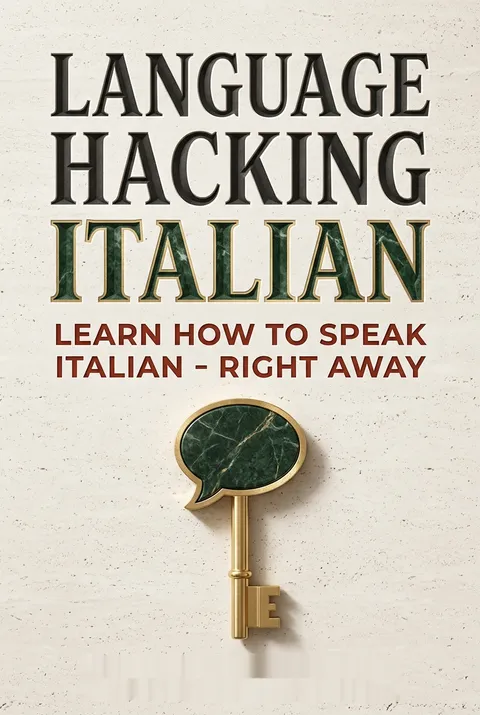
Language Hacking Italian receives mixed reviews with a 4.07 rating. Supporters praise its innovative approach to speaking from day one, with "me-specific" phrases and community accountability through italki videos. The course emphasizes practical conversation over academic perfection, encouraging learners to embrace mistakes. Critics argue it teaches "broken Italian," skipping essential grammar like future tense and subjunctive, over-relying on cognates and simple structures. One reviewer questions whether quick, incorrect learning beats slower, proper instruction, doubting conversational functionality beyond basic phrases.
About the Author

Download PDF
Download EPUB
.epub digital book format is ideal for reading ebooks on phones, tablets, and e-readers.








































