
Key Takeaways
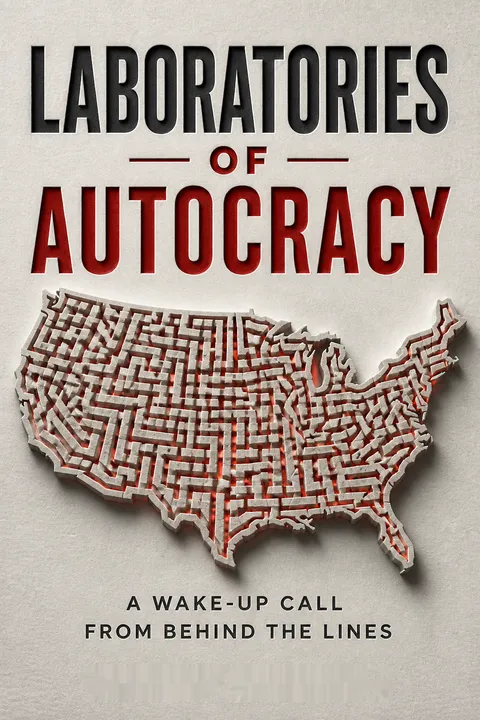
1. Statehouses have become "Laboratories of Autocracy," undermining American democracy.
Far more than the antics of wild-eyed politicians like Marjorie Taylor Greene or Jim Jordan—and yes, even bigger than Donald Trump’s “Big Lie”—these laboratories of autocracy are the most corrosive danger America faces.
A profound danger. The book argues that state legislatures across the country have transformed into "Laboratories of Autocracy," systematically eroding democratic principles. This isn't a sudden shift but a culmination of decades of strategic efforts, now accelerating at a frightening pace. The problem extends beyond national political figures or specific events, representing a deeper, more pervasive threat to the nation's democratic foundations.
Ohio as a bellwether. Ohio, historically a swing state mirroring national demographics, serves as a stark case study of this decline. Despite its natural strengths and a balanced electorate, the state has seen a dramatic downward spiral in public outcomes, including:
- Population growth: Ranked 48th nationally (2.3% between 2011-2020).
- Education: Plummeted from 5th to the 20s in national rankings.
- Health: Ranked 47th in health value, with high rates of drug overdose and infant mortality.
- Poverty: Cleveland and Cincinnati are among the poorest major cities.
This decay is directly linked to a rise in corruption and extremism within its statehouse, which operates with little accountability to the public.
A national phenomenon. The disturbing trends in Ohio are not isolated; they are playing out in state after state across the country. This coordinated, nationwide weaponization of statehouses poses an existential threat to American democracy, creating conditions that have historically led to authoritarian regimes. The urgency of this threat demands immediate and comprehensive action to prevent permanent damage to the nation's democratic underpinnings.
2. Unseen power and anonymity make state legislatures vulnerable to exploitation.
Too few people, including those in politics, understand the immense power—the potential for both good and ill—in our nation’s statehouses.
Vast, unappreciated power. State legislatures wield immense power over citizens' daily lives, controlling state budgets (often billions for Medicaid, education, and criminal justice), establishing laws on almost every major issue, and influencing federal funds. Crucially, they also set the framework for elections, including voter registration, early voting, and the drawing of legislative and congressional districts—a power enshrined in the U.S. Constitution. They can even override local government decisions on issues like minimum wage or gun safety.
A disconnect from public awareness. Despite this robust authority, state legislators and their work remain largely unknown to the public. Most statehouse races are uncontested or low-profile, overshadowed by federal elections, and receive minimal media coverage due to shrinking statehouse press corps. Term limits further exacerbate this anonymity by cycling out experienced legislators before they can build significant public recognition. This creates a dangerous gap:
- Low public awareness: Fewer than 20% of Americans can name their state representative.
- Limited media coverage: Only 164 full-time reporters covered all 50 state capitals in 2014.
- Short tenures: Term limits prevent long-term public recognition.
A critical vulnerability. This dramatic disconnect between the power wielded by state legislatures and the public's awareness of their actions creates a significant vulnerability. While the average voter remains uninformed, insiders and special interests are acutely aware of this power and actively exploit it. This imbalance is a core ingredient in the dysfunction, corruption, and extremism observed in state politics, making these bodies susceptible to anti-democratic influences.
3. Well-funded private interests exploit this anonymity to co-legislate for private gain.
If the average voter doesn’t know or care what state reps do and can do, but insiders and interests know exactly what they do and can do, that’s dangerous.
Exploiting the power vacuum. The anonymity of state legislatures creates a fertile ground for well-funded private interests to exert disproportionate influence. These groups, ranging from corporations to trade associations, understand the immense power of statehouses and actively cultivate relationships with legislators, often through lavish perks and significant campaign contributions. This creates a distorted incentive system where serving private interests often outweighs the public good.
The "Statehouse Grille" menu: Lobbyists and special interests effectively "order" specific legislative outcomes from statehouses, including:
- Paying for "services": Diverting taxpayer funds to private companies for "services," even when performance is poor (e.g., Ohio's ECOT charter school scam).
- Dishing out "goodies": Securing grants, incentives, or tax breaks (e.g., First Energy's $1 billion bailout, special property tax caps for wealthy communities).
- Favorable regulations: Weakening oversight or preventing changes that might hinder business (e.g., shutting down charter school oversight, stalling payday loan reform).
- Kneecapping competitors: Using legislation to stifle competition (e.g., strict setbacks for wind farms, banning municipal broadband).
- Overturning local governance: Preempting local laws that conflict with their interests (e.g., banning plastic bag bans, preventing minimum wage hikes).
Term limits amplify influence. Term limits, intended to curb corruption, paradoxically empower lobbyists. As legislators cycle out every few years, the permanent, experienced lobbyists become the institutional memory and "experts," guiding new, often inexperienced lawmakers. This dynamic ensures that private interests maintain continuous influence, regardless of who occupies the legislative seats, further entrenching a system where public assets are often redirected for private gain.
4. Extreme gerrymandering rigs elections, creating unaccountable and hyper-partisan majorities.
Out of 655 elections over the ensuing decade, their work in that room only failed them eight times. They batted .988!
The "bunker" strategy. In 2010, a coordinated national effort, spearheaded by figures like Karl Rove and the Republican State Leadership Committee, targeted state legislative races. Their goal was to gain control of redistricting after the census, allowing them to draw electoral maps that would guarantee partisan majorities for the next decade. This secretive process, often conducted in "bunkers" away from public scrutiny, effectively rigged thousands of elections nationwide.
Undemocratic outcomes. The impact of this gerrymandering was immediate and profound:
- Predetermined results: In Ohio, a state Obama won in 2012, the gerrymandered map resulted in a 12-4 Republican advantage in Congress and a 60-39 Republican statehouse majority.
- Minority rule: In states like Michigan and Wisconsin, voters chose Democratic statehouse candidates by significant margins in 2018, yet gerrymandered maps ensured Republican majorities.
- Lack of competition: Many districts became so safe that incumbents faced no meaningful opposition, often running unopposed or against token challengers.
Perverse incentives. This lack of electoral accountability creates a deeply dysfunctional incentive structure for legislators:
- No accountability for public outcomes: Politicians can ignore failing public services or economic decline without fear of losing their seats.
- Reward for extremism: The primary threat comes from within their own party, incentivizing legislators to adopt increasingly extreme positions to avoid being outflanked.
- Punishment for bipartisanship: Any perceived cooperation with the opposing party can be weaponized by primary challengers, effectively stifling compromise.
- Immunity from corruption: Even in the face of major scandals, gerrymandered politicians often face no electoral consequences, further entrenching pay-to-play practices. This system fosters a generation of officeholders who have never truly won a competitive election and, consequently, fear genuine democratic processes.
5. A decade of "dry runs" perfected anti-democratic tactics, revealing key lessons.
The past decade has shown that that mission, too, has been accomplished.
Statehouses as laboratories. Over the past decade, state legislatures have served as "laboratories" for anti-democratic measures, experimenting with various tactics, learning from successes and failures, and refining their approach. This continuous process of trial and error has yielded crucial lessons for those seeking to undermine democratic governance. The 2011 Ohio Senate Bill 5 fight, where a deeply unpopular anti-union law was repealed by voters but its legislative supporters were re-elected, demonstrated that even widespread public backlash rarely translates to electoral accountability in gerrymandered districts.
Key lessons learned:
- Popularity is irrelevant: Legislatures can push deeply unpopular policies (e.g., loosening gun laws, restricting abortion access, attacking climate action) without electoral risk, as their seats are safe.
- Protecting donors: Controversies like the "Stand Your Ground" law (spread by ALEC) taught the importance of shielding corporate donors from public backlash, leading to increased secrecy and the disbanding of problematic task forces.
- Legislative supremacy: Statehouses learned they could often override or neutralize the actions of statewide elected officials (like governors or attorneys general) through legislative power, budget control, and agenda setting.
- The 80/20 strategy: By introducing a large volume of bills, some controversial measures can be sacrificed while others, often equally problematic, pass unnoticed amid the legislative churn.
- Continuous adaptation: Lessons from one state's success or failure (e.g., Wisconsin's anti-union law exempted police/fire after Ohio's misstep) are quickly disseminated and adapted across the country by networks like ALEC and the State Policy Network.
Politicians as pawns. A critical, chilling lesson from this decade of dry runs is that individual politicians often don't matter as much as the system itself. The ecosystem of gerrymandered districts, perverse incentives, and external influence ensures that whoever occupies the legislative seats will largely vote in predictable ways. This makes the system resilient to individual scandals or departures, as new "actors" simply step in to read the same "scripts," perpetuating the anti-democratic agenda.
6. The 2021 legislative onslaught is a culmination of these perfected tactics, not an anomaly.
The “Big Lie” might’ve provided a cover for these actions; fealty to Trump an added bonus. But these laws weren’t new at all. They were a natural extension of prior years—a culmination of a decade of dry runs, perfected over time by all that these laboratories of autocracy had learned.
A strategic escalation. The flurry of anti-democratic legislation in 2021, often framed as a reaction to Trump's "Big Lie," is in fact a sophisticated culmination of tactics refined over the past decade. Statehouses, having learned from their "dry runs," are now deploying a comprehensive strategy to solidify power and suppress opposition. This includes:
- Doubling down on voter suppression: Targeting methods popular with Democratic voters in 2020, such as drop boxes, early voting, and mail-in ballots (e.g., Georgia drastically reducing drop boxes and early voting hours).
- Aggressive purging: Expanding "use it or lose it" policies and imposing penalties on election officials for insufficient purges (e.g., Iowa, Arizona, Texas).
- New voter ID requirements: Introducing stricter ID laws and reducing time to cure ballot errors.
Knee-capping emerging threats. Beyond direct voter suppression, legislatures are actively undermining other branches of government and democratic processes:
- Stripping power from election officials: Removing secretaries of state from election boards (Georgia) or shifting their powers (Arizona), and imposing fines or criminal sanctions on local election officials.
- Attacking judicial independence: Passing laws to make judicial elections partisan (Ohio), limit court jurisdiction in election cases, or "gerrymander" judicial districts.
- Illegitimate "audits": Launching partisan, non-standard "audits" of 2020 election results (Arizona, Michigan, Pennsylvania) to sow doubt and justify future interventions.
- Overturning referenda: Defying voter-approved initiatives (e.g., Missouri legislature defunding Medicaid expansion).
Coordinated national effort. This onslaught is not spontaneous but orchestrated by conservative think tanks and advocacy groups like the Heritage Foundation, ALEC, and the State Policy Network. These organizations draft model legislation, provide "expert" testimony, and coordinate lobbying efforts across states, often operating in secrecy. Their goal is to create a "grassroots, from-the-bottom-up type of vibe" for policies that are centrally planned and deeply unpopular, further entrenching minority rule.
7. The ultimate goal: competitive autocracy and permanent minority rule.
The totalitarian mass leaders based their propaganda on the correct psychological assumption that, under such conditions, one could make people believe the most fantastic statements one day, and trust that if the next day they were given irrefutable proof of their falsehood, they would take refuge in cynicism; instead of deserting the leaders who had lied to them, they would protest that they had known all along that the statement was a lie and would admire the leaders for their superior tactical cleverness.
Beyond partisan advantage. The relentless assault on democracy by statehouses aims for more than just short-term political wins; it seeks to establish a system of permanent minority rule, often resembling "competitive autocracy." This model maintains the outward appearance of democratic institutions (elections, courts) but manipulates the rules to ensure predetermined outcomes, effectively locking out opposition without resorting to overt authoritarianism. Hungary under Viktor Orbán is cited as a contemporary example, admired by some American conservatives.
Two core motivations:
- Economic liberty for the few: The agenda, championed by groups like ALEC, prioritizes "economic liberty" for corporations and the wealthy through minimal taxes, weakened labor, and deregulation. This vision is deeply unpopular with the majority, necessitating the suppression of democratic will to implement it.
- Protecting white dominance: Historically, periods of increased diversity and empowerment for marginalized groups have triggered fierce backlashes. Obama's presidency, fueled by a diverse coalition, sparked a wave of attacks on voting rights and a rise in white supremacist rhetoric, mirroring the Jim Crow era. These legislative actions aim to maintain the political power of a shrinking white majority.
The "Big Lie" as a pillar. The embrace and legislation of "The Big Lie"—propagating easily disprovable falsehoods—serves as a critical tool in this authoritarian drift. It fosters a public disconnected from truth, breeds loyalty and subordination among followers, and creates tribal divisions. When state legislatures legislate based on these lies (e.g., "auditing" valid election results, promoting anti-vaccine conspiracy theories), they transform lies into pillars of state policy, further eroding democratic norms and paving the way for more extreme actions.
Future risks. The trajectory points to alarming possibilities:
- 2022 gerrymandering: Solidifying rigged state and federal districts for another decade, potentially handing control of the U.S. House to a minority of voters.
- 2024 presidential election rigging: Changing state laws to allocate electoral votes by congressional district or empowering legislatures to overturn election results.
- Constitutional convention: Using Article V to rewrite the U.S. Constitution without congressional or popular input, controlled by a supermajority of state legislatures.
8. Federal action, grounded in the "Guarantee Clause," is essential to reclaim democracy.
The United States shall guarantee to every State in this Union a Republican Form of government . . . .
A constitutional imperative. The Founders, fearing anti-democratic factions in states, enshrined the "Guarantee Clause" (Article IV, Section 4) in the Constitution, obligating the federal government to ensure states maintain a "Republican Form of government"—one derived from the people, with popular sovereignty and majority rule. This clause, long dormant, must be reactivated as the primary framework for federal intervention against state-level autocracy. It reframes the battle from individual rights to the fundamental structure of governance.
Robust federal legislation. Congress must pass comprehensive legislation to counter state-level attacks on democracy:
- John Lewis Voting Rights Act: Revives and updates the Voting Rights Act, reinstating pre-clearance for states with a history of discrimination and expanding its scope to cover new suppressive tactics.
- For the People Act: Establishes national standards for fair elections, including automatic voter registration, same-day registration, early voting windows, and independent redistricting commissions to end partisan gerrymandering.
These acts would dismantle many tools used by statehouses to insulate themselves from voters and ensure a baseline of democratic practice across the nation.
End the filibuster for democracy. The Senate filibuster, requiring 60 votes, currently obstructs these vital democracy bills. This procedural hurdle is indefensible when one side is actively dismantling democracy at the state level without seeking any minority consent. Creating an exception for voting rights legislation is crucial to prevent asymmetric warfare, where anti-democratic forces act unilaterally in states while pro-democracy efforts are paralyzed federally. The argument for "states' rights" collapses when state governments fail to uphold a republican form of government, as mandated by the Constitution.
Relentless enforcement and broader protections. Beyond voting rights, the federal government must:
- Enforce anti-corruption laws: The FBI and DOJ are often the only entities capable of addressing rampant state-level corruption, which undermines democratic legitimacy.
- Protect other democratic pillars: Pass legislation to safeguard labor unions, ensure accurate historical education, protect the right to peaceful protest, and prevent vigilantism, all of which are under attack in statehouses. This comprehensive approach is necessary to prevent a slide into authoritarianism.
9. State-level resistance must be fierce, unconventional, and year-round to counter the assault.
Concession means to acknowledge an action is right, true or proper. As a woman of conscience and faith, I cannot concede.
Unwavering opposition. In states where anti-democratic forces control the legislature, resistance must be constant, fierce, and unconventional. This means never compromising on democratic principles, even for seemingly beneficial trade-offs, as any bipartisan support legitimizes the erosion of democracy. The example of Texas Democrats walking out of the statehouse to block a voter suppression bill demonstrates the power of unconventional tactics to disrupt the legislative process and draw national attention.
Creating "Laboratories of Democracy." Where pro-democracy forces gain power, they must proactively strengthen democratic institutions and processes, serving as models for the nation. This includes:
- Expanding voting access: Implementing automatic voter registration, same-day registration, extended early voting, and widespread drop boxes (e.g., Virginia's comprehensive pro-voter reforms).
- Disproving myths: Demonstrating that expanded access does not lead to fraud, thereby undermining the justifications for suppression.
- Eliminating counterarguments: By modernizing voting laws, pro-democracy states remove the ability of anti-democratic states to point to their outdated practices as justification for inaction.
Strategic political engagement. Even in gerrymandered landscapes, strategic political efforts can make a difference:
- Targeting key offices: Focusing resources on winnable seats with leverage over power, such as state Supreme Courts or prosecutor offices, which can act as checks on legislative overreach (e.g., Ohio's success in flipping Supreme Court seats).
- Ballot initiatives: Utilizing direct democracy mechanisms (referenda, constitutional amendments) to bypass hostile legislatures and enact popular reforms (e.g., Ohio's successful anti-gerrymandering amendment, Kansas's Medicaid expansion).
- Relentless advocacy: Disrupting the silence around statehouse actions through sustained public pressure, calls, letters, and testimony, even if immediate legislative victories are rare.
10. Individual action and grassroots organizing are critical to empower voters and disrupt silence.
Unless someone like you cares a whole awful lot, Nothing is going to get better. It’s not.
The power of awareness. The core vulnerability of "laboratories of autocracy" is public unawareness. Individuals must actively spread the word about what is happening in statehouses, sharing information and inspiring others to action. This includes:
- Educating networks: Encouraging friends, family, and community groups to read about state-level threats to democracy.
- Local engagement: Becoming informed about local state legislators and their opponents, and actively participating in local political discourse.
Empowering participation. Grassroots organizing and individual actions are vital to counter voter suppression and build a robust democratic base:
- Run for office: Challenging incumbents in every legislative district, even in seemingly unwinnable races, disrupts the silence and forces accountability. These "champions of democracy" provide voters with choices and build long-term political infrastructure.
- Year-round engagement: Rejecting the concept of "off-year" elections and investing time and resources in local races (municipal, school board, judicial) to cultivate future leaders and strengthen community-level democracy.
- Reflecting diversity: Actively supporting and recruiting diverse candidates who represent the changing demographics of America, countering the racist undercurrents of suppression efforts.
Sustained action and investment. Reclaiming democracy requires continuous effort and strategic resource allocation:
- Register voters relentlessly: Every organization and individual should become a "voter registration hub," continuously registering and engaging voters, especially in communities targeted by purges.
- Support independent journalism: Subscribing to and sharing local and statehouse journalism helps expose legislative actions and counter misinformation.
- Strategic giving: Directing financial support to pro-democracy candidates (especially at the state and local level), state parties, and grassroots organizations focused on voter registration and candidate recruitment.
- Voice and time: Actively calling legislative offices, writing letters to the editor, protesting, and engaging on social media to disrupt the silence and hold politicians accountable.
Every ripple of hope, every act of resistance, contributes to a current that can overcome the walls of oppression. The fight for democracy is a continuous act, and every individual has a role to play in ensuring a more fair and just society for future generations.
People Also Read





Download PDF
Download EPUB
.epub digital book format is ideal for reading ebooks on phones, tablets, and e-readers.








































