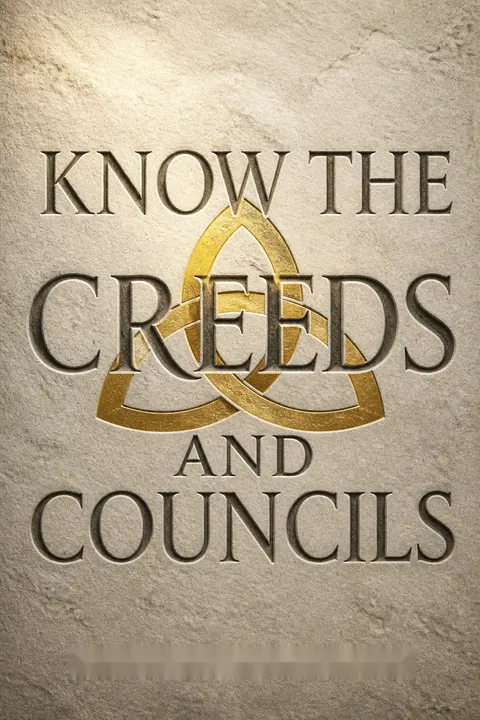

Key Takeaways
1. Creeds and Councils: Ancient Tools for Enduring Faith
To ignore these insights is to attempt to reinvent the wheel, and to risk reinventing it badly.
Preserving Christian thought. Christianity's rich 2000-year history offers invaluable insights, mistakes, and ways of speaking about God. Creeds, confessions, catechisms, and councils are the church's tools to articulate complex theological ideas clearly, guide members, and distinguish authentic faith from heresy. Ignoring this tradition risks repeating past errors and impoverishing our understanding.
Defining key terms. These historical documents serve distinct but related purposes:
- Creeds: Short, fixed formulas summarizing essential Christian beliefs (e.g., "I believe"). They define the boundaries of orthodoxy.
- Confessions: More detailed inquiries into God's nature and specific denominational distinctives, offering "fires and chairs and meals" beyond the "hall" of creeds.
- Catechisms: Q&A formats for basic Christian instruction, translating confessional beliefs into daily life.
- Councils: Large church meetings resolving difficult issues, such as heretical teachings, by comparing Scripture and seeking consensual reception of apostolic teaching.
Guiding faith and worship. Far from being ivory tower constructs, these documents were practical guides for ordinary believers. They were used in baptisms, liturgies, and teaching new converts, uniting congregations in common confession and providing a touchstone to the faith across times and cultures. They are drawn from the Bible and help us "give ear to the gospel."
2. The Trinity: Defining God as One in Three
By insisting that the Son is “of one substance” with the Father, the Arian view was rejected and the council affirmed that the Father is not “more God” than the Son.
Nicaea's crucial declaration. The Council of Nicaea (325 AD) definitively addressed the Arian controversy, which questioned Jesus' full divinity. Arius argued Jesus was a created being, subordinate to God the Father. The Nicene Creed countered this by declaring Jesus "of one substance (homoousios) with the Father," asserting that Father and Son share the same divine essence, ensuring God is God in Trinity.
Holy Spirit's full deity. The First Council of Constantinople (381 AD) expanded the Nicene Creed to affirm the full deity of the Holy Spirit. Against Semi-Arians who viewed the Spirit as merely a force, the council declared the Holy Spirit "the Lord, the Giver of Life, who proceeds from the Father... who with the Father and the Son is worshiped and glorified." This completed the Trinitarian formula, ensuring all three persons are equally God.
Athanasian Creed's precision. The Athanasian Creed (late 400s-early 500s), though not written by Athanasius, offers the most thorough and careful attempt to describe the Trinity. It meticulously defines "one God in Trinity, and Trinity in Unity," guarding against both tritheism (three gods) and modalism (God appearing in different modes). It asserts that each person is uncreated, unlimited, eternal, and almighty, yet there is "not three, but one."
3. Christ's Incarnation: Unpacking the God-Man Mystery
The Definition of Chalcedon described Christ’s descent as a true incarnation of the Logos, the Second Person of the Trinity, while denying that a man was converted into God or that God was converted into a man.
Ephesus: Unity of Christ's person. The First Council of Ephesus (431 AD) addressed the Christological dispute between Nestorius and Cyril. Nestorius emphasized Christ's distinct human and divine natures, leading to accusations of two separate persons. Cyril championed the unity of Christ's person, affirming Mary as Theotokos ("Mother of God"). The council sided with Cyril, affirming Christ as a single person, not two loosely tied together.
Chalcedon: Two natures, one person. The Council of Chalcedon (451 AD) further refined Christology, navigating between Nestorianism (two persons) and Eutychianism (one mixed nature). Its definition declared Christ as "one and the same Son, our Lord Jesus Christ, at once complete in Godhead and complete in manhood... recognized in two natures, without confusion, without change, without division, without separation." This affirmed Christ's full humanity and divinity coexisting in one person.
Constantinople III: Two wills in harmony. The Third Council of Constantinople (681 AD) addressed Monothelitism, which claimed Christ had only one divine will. The council rejected this, affirming Christ had two wills—a divine will and a human will—that worked in perfect concert. This was crucial for salvation, as Christ's human will, obedient to the point of death, redeemed humanity's disobedience, ensuring his full humanity was assumed and sanctified.
4. Humanity's Dilemma: Grace, Free Will, and Original Sin
Without the grace of God, we can do no good thing.
Pelagius's moral challenge. Pelagius, a British monk, observed moral laxity among Christians and argued that humans have full freedom and responsibility for their actions. He believed sin stemmed from bad habits, not a pre-existing condition, and that humans could eradicate evil through sheer willpower. He worried that the doctrine of original sin fostered apathy and excused sin.
Augustine's doctrine of grace. Augustine, a North African bishop, countered Pelagius, arguing that humans are born into the bondage of Adam's sin, "not able not to sin" (non posse non peccare). He believed grace was not a mere nudge but a divine power that frees people to truly love God. This God-empowered love enables them to choose good, destroying sin's stranglehold.
Carthage and Orange's rulings. The Council of Carthage (418 AD) sided with Augustine, decreeing:
- Infant baptism is necessary to wash away original sin.
- A sinless life is impossible, refuting Pelagius's claim of human perfection.
- God's grace is a transformative power, not just a natural ability, essential for doing any good.
Later, the Council of Orange (529 AD) reaffirmed Augustine's core teachings against Semi-Pelagianism, emphasizing that salvation is by grace alone, though it rejected Augustine's doctrine of predestination to hell.
5. Reformation's Divide: Justification, Scripture, and Tradition
The Catholic Church believed that the Reformers had misunderstood both Augustine and the New Testament emphasis on works in advancing a position of justification by faith alone.
Trent's Catholic response. The Council of Trent (1545-63) was the Roman Catholic Church's comprehensive response to the Protestant Reformation. It addressed:
- Institutional reform: Correcting clergy abuses, requiring bishops to reside in their dioceses, establishing seminaries, and reforming indulgences.
- Scripture and Tradition: Affirmed equal weight for Scripture and tradition in determining belief, rejecting sola Scriptura. It also affirmed the Apocrypha and restricted vernacular Bible translations.
Justification: Infused vs. Imputed. The most significant doctrinal issue was justification:
- Protestant (Luther): Sola fide (faith alone) – God imputes Christ's righteousness to sinners by grace, a one-time declaration. Good works are a result of salvation.
- Catholic (Trent): Infused righteousness – God offers grace and strength to be good; believers cooperate, gradually becoming righteous through good works. Justification is a process, and assurance of salvation is not possible.
Sacraments and Church Order. Trent upheld seven sacraments (Baptism, Confirmation, Eucharist, Penance, Extreme Unction, Holy Orders, Matrimony), affirming ex opere operato (grace conveyed by the act itself). It formalized transubstantiation for the Eucharist and auricular confession for penance, solidifying Catholic doctrine against Protestant challenges.
6. Catholicism's Modern Face: Vatican II's Renewal
The church’s teaching remained, but its understanding and formulation had to be changed, as John XXIII would often say.
Aggiornamento and Ressourcement. Called by Pope John XXIII, the Second Vatican Council (Vatican II, 1962-65) aimed for aggiornamento ("bringing up to date") and ressourcement ("return to sources"). It sought to communicate doctrines to the modern world and return to the language and pastoral emphasis of Scripture and the Church Fathers, rather than changing core dogma.
Liturgical and Doctrinal Shifts. Vatican II introduced significant reforms:
- Liturgy: Allowed vernacular languages in Mass, emphasizing Scripture's importance with a new lectionary and homily focus.
- Revelation: Presented Scripture and tradition as two streams flowing from Christ, the ultimate revelation, encouraging laity to read and study the Bible.
- Church Structure: Emphasized the collegiality of bishops (more authority in their regions) and the "people of God" concept, uniting clergy and laity.
Ecumenism and Social Justice. The council fostered open dialogue with non-Christian religions, recognizing elements of truth and goodness in them while affirming Christ as the unique way to salvation. It also affirmed religious liberty and addressed contemporary issues like human rights, dignity, and world peace, rejecting its 19th-century anti-modernist stance and embracing a role as a helper for all people.
7. Contemporary Faith: Inerrancy and Global Evangelism
Doubt regarding the divine origin of the Bible often comes less from careful study than the general mood of the culture.
Chicago Statement on Biblical Inerrancy (1978). This confession addressed the rise of biblical criticism and skepticism. It affirmed:
- Scripture's Authority: Derives from God, not the church, making it authoritative and binding.
- Dual Authorship: God used human language and literary styles, but guaranteed truthfulness.
- Inerrancy of Autographs: Original copies were inerrant; modern translations, while imperfect, accurately represent God's Word.
- Inerrancy's Importance: Not necessary for salvation, but vital to Christian faith, its rejection leading to serious consequences.
Lausanne Covenant (1974). This covenant, signed by 2,300 evangelical leaders, focused on world evangelism in a globalized world. It defined evangelicalism by:
- Authority of Scripture as "infallible Word of God."
- "Lostness of man" outside Christ.
- Salvation by Christ alone.
- Witness through both word and deed.
- Necessity of evangelism.
Evangelism and Social Justice. Lausanne distinguished evangelism (proclaiming Christ and inviting relationship) from social justice, while affirming both as Christian responsibilities. It rejected equating social justice with salvation, which secularizes the gospel. It also encouraged culturally sensitive evangelism, rejecting cultural imperialism and promoting local training programs.
8. Confession: A Worshipful Act, Not Just Doctrine
To confess is to cry out in acknowledgement of the sheer gratuity of what the gospel declares, that in and as the man Jesus, in the power of the Holy Spirit, God’s glory is the glory of his self-giving, his radiant generosity.
Beyond intellectual exercise. The creation of creeds, confessions, catechisms, and councils is not merely an academic pursuit. These documents are specific instances of the church's fundamental act of confession, a "cry of acknowledgement of the unstoppable miracle of God's mercy." They are ultimately about worship, binding the church to the gospel and expressing amazement at God's goodness and truth.
Guarding against "chronological snobbery." Engaging with these historical documents helps us avoid the "characteristic blindness of our own period," as C.S. Lewis noted. Past generations wrestled with tough questions and made different mistakes, offering valuable perspectives that deepen our understanding of faith and correct our contemporary biases. This "clean sea breeze of the centuries" enriches our spiritual lives.
Fueling worship and mission. Learning how Christians throughout history have articulated their faith increases our dependence on God's revelation in Jesus Christ and Holy Scriptures. It fuels our worship, deepens our love for one another, and motivates our mission to the world. These ancient statements are not restrictions but "gateways to contemplation" and "instruments of freedom," preserving the mystery of God for the human mind.
Review Summary
Reviewers widely praise Know the Creeds and Councils as an accessible, well-organized introduction to Christian history's major theological documents. Most appreciate its concise, readable format covering everything from the Apostles' Creed to Vatican II. Common critiques include notable omissions (Nicaea II, Vatican I, Lutheran and Anabaptist writings) and occasional perceived Protestant bias, particularly regarding the Westminster Confession. Despite being considered somewhat dry, readers consistently recommend it for personal study, church groups, and seminary courses, valuing its historical context, content summaries, discussion questions, and further reading suggestions.
People Also Read

Download PDF
Download EPUB
.epub digital book format is ideal for reading ebooks on phones, tablets, and e-readers.








































