
Key Takeaways
1. Islam's Unique Perspective: Faith Beyond Objective Study
Religion is a different matter because here objectivity only skims the surface, missing the essential.
Internal understanding. True understanding of Islam, unlike other subjects, demands personal commitment and an internal key from the observer's own being and experience. Objectivity alone merely skims the surface, missing the essential truth, and Islam treats the distinction between belief and unbelief as fundamental, akin to the difference between the sighted and the blind.
Integrated life. For a Muslim, every aspect of human life—worship, bodily functions, market dealings, work, and play—is shaped and evaluated in the light of the basic article of faith, forming an indivisible whole. This integrated worldview, which recognizes no division between the "sublime" and "mundane," is held together by the affirmation of divine Unity, without which the entire structure of Muslim life falls apart.
Convert's perspective. The author, a European convert, emphasizes that his acceptance of Islam was an act of acceptance, not rejection of a previous faith, but a rejection of the secular, agnostic world of thought. Converts bring a unique viewpoint, sinking roots into the Qur'an and the Prophet's traditions, which can vivify the religion and help establish its essentials in a changing world.
2. Divine Unity (Tawhid) as the Core of Islam
Islam is the religion of all or nothing, faith in a Reality which allows nothing to have independent reality outside its orbit; for if there were such a thing, however distant, however hidden, it would impugn the perfection and the totality of that which alone is.
Absolute Reality. The first Shahada, "La ilaha illa 'Llah" ("There is no divinity but God"), is the fountainhead of all Islamic doctrine and practice, asserting that nothing is absolute beside the sole Absolute. Everything that exists, whether for millennia or a fraction of a second, does so only by participation in the One Reality, which is indivisible, uncaused, and encompasses all.
Omnipotence and omnipresence. This principle implies that all power, love, mercy, and agency originate solely from God, who "says unto a thing 'Be!' and it is." The Muslim acknowledges total dependence on this omnipresent Divine, who is "al-Bayyin" (the Evident), blazing and undeniably present, making man's existence insignificant in comparison to His overwhelming clarity.
Rejection of Shirk. The gravest sin in Islam is shirk, the "association" of other "gods" with God, whether through idolatry, polytheism, or attributing independent power to natural forces or worldly pursuits. This denial of God's sole agency is seen as a corruption of the will, a "covering" of the inherent truth, and ultimately leads to a fragmented understanding of reality, with the human ego being the ultimate "false god."
3. Islam as a Restoration of Primordial Revelation
Had the message of the Qur'an been something entirely 'new' it would have disrupted the pattern, cut the thread of continuity and cast doubt upon the divine Wisdom, which is by its very nature unchanging.
Continuity of divine wisdom. Islam presents itself not as a new religion, but as a restoration of the primordial religion of mankind, the "perennial philosophy," which God enjoined upon Noah, Abraham, Moses, and Jesus. The Qur'an explicitly states, "Nothing is said unto thee [Muhammad] other than what was said to all the messengers who preceded thee," affirming God's unchanging wisdom and guidance throughout history.
Forgiveness and human nature. In the Islamic view, Adam's sin was forgiven, and man's primary challenge is forgetfulness and inclination to idolatry, not inherent corruption of his substance. What was required of later prophets like Jesus and Muhammad was a repetition of the age-old message, appropriate for their times, to restore balance and remind humanity of the God-given wisdom inherent in their fitrah (primordial nature).
Universal truth and tolerance. Islam's comprehensive nature allows it to be generous to other religions, acknowledging the "transcendent unity of all the revealed religions" based on belief in One God. The Prophet Muhammad's saying, "Wisdom is the believer's straying camel; he takes it from wherever he can find it," reflects this openness, asserting that nothing true is alien to Islam, as it is the heir to past spiritual treasures.
4. The Prophet Muhammad: The Perfect Human Exemplar
He represents the human norm and is therefore the model for every Muslim.
Human yet perfect. Muhammad, known as al-Amin (the trustworthy) and abdu 'Llah (slave of God), is the perfect human model for Muslims, demonstrating how to conform to divine truth in every aspect of life. His journey from orphan to statesman, husband, and father, exemplified virtues in diverse human experiences, making him an imitable figure for all believers.
Messenger and unlettered prophet. As rasulu 'Llah (messenger of God), Muhammad conveyed the Qur'an, acting as a pure channel for divine revelation, untainted by human wisdom or profane knowledge. This "unlettered" status (nabi al-ummi) ensured the message's purity, making the Qur'an the Word made book, and Muhammad himself an aspect of this message from God to man.
Love and companionship. Muslims' profound love for Muhammad is central to their spiritual life, seeing him not as a divine incarnation but as a beloved master, guide, and brother-man. His Sunnah (practice) provides a detailed framework for daily life, fostering spontaneity rooted in the deepest self, and his companionship offers comfort and courage, making the world a less cold place.
5. The Shari'ah: God's Law for a Theocentric Society
The belief that God is the sole Legislator flows directly from the Muslim confession of faith, la ilaha illa 'Llah, which, in this context, can be interpreted as meaning that 'there is no legislator but the Legislator'.
Divine, not human, legislation. The Shari'ah, meaning "road" or "highway" to life-giving waters, is Islam's divinely revealed Law, not a human construct. It provides the framework for a self-regulating, theocentric community where sovereignty belongs to God and is delegated to the "rightly-guided" community. The ruler's role is limited to defending the community and maintaining the Law, not legislating.
Sources and development. The Shari'ah is derived from the Qur'an and the Prophet's Sunnah (hadith), with human effort (ijtihad) and consensus (ijma') playing a role in its elaboration. Scholars meticulously assessed hadith authenticity and developed legal provisions to cover all contingencies, ensuring the Law remained comprehensive yet rooted in sacred sources, often at personal risk from temporal powers.
Stability and justice. The Shari'ah fosters social stability, prioritizing community unity over political upheaval, and its laws, though sometimes perceived as harsh by Westerners, are expressions of immutable principles, balanced by mercy and designed to protect the family and society. The emphasis on personal responsibility and mutual aid within the community creates a "monastery-society" where spiritual life permeates all aspects of existence.
6. The Human Paradox: Viceregent, Slave, and Knower
Man, as such, is the 'Viceregent of Allah on earth', but when he forgets that he is only dust he loses this function and becomes the 'lowest of the low'.
Theomorphic being. Adam, archetypal Man, was created "in the image of God," a theomorphic being reflecting divine attributes, and given knowledge of "the names of all things" that angels did not possess. This centrality and capacity for knowledge make man God's Viceregent on Earth, capable of choice and responsibility, distinguishing him from other creatures.
Grandeur and fall. Man's unique privilege of choice also makes him capable of monstrous crimes, as the greatest sins are often the inverse of his supreme potential. When the ego usurps the King's place, man makes himself a "god beside God," leading to self-destruction. The paradox lies in man being both a reflection of divine totality and a creature of dust, prone to forgetfulness and self-deception.
Knowledge and gratitude. Islam emphasizes knowledge (ma'rifah) and intelligence as defining human qualities, but true knowledge comes from God, not human acquisition. Gratitude (shukr) is also paramount, as existence and all its blessings are pure gifts from God. Ingratitude is a form of shirk, attributing to oneself what belongs to God, leading to a "constricted life" and spiritual blindness, as all good deeds without faith are like "ashes which the wind blows away."
7. Islamic Art, Environment, and Mysticism: Reflections of Unity
Islamic art... is the earthly crystallization of the spirit of the Islamic revelation, as well as a reflection of the heavenly realities on earth, a reflection with the help of which the Muslim makes his journey through the terrestrial environment and beyond to the Divine Presence itself, to the Reality which is the origin and the end of his art.
Unity in art. Islamic civilization, guided by tawhid, produces art that is inherently sacred, rejecting the profane. Calligraphy, the art of the revealed Word, and architecture, shaping the human environment, are supreme expressions. Calligraphy's Kufic script conveys divine decisiveness, while arabesques and geometric patterns in mosques express "unity in multiplicity," reflecting God's omnipresence and limitlessness.
Environment as sacred space. The mosque, a "place of prostration," is not consecrated but a designated space for prayer, oriented towards the Ka'ba, symbolizing the inward center. Islamic architecture, with its domes and minarets, transforms stone into light, using colors to reveal divine splendor. The absence of human figures in art prevents idolatry and respects the unrepresentable "secret" within every living creature, ensuring that the human person is not reduced to terrestrial modalities.
Sufism: The inner dimension. Sufism (tasawwuf) is Islam's inner, mystical dimension, deepening religious experience and providing a path to "attaining to God Himself." It emphasizes self-extinction (fana) before finding oneself in God (baqa), achieved through constant invocation (dhikr) of God's Name. Sufism, though sometimes viewed with suspicion by exoteric authorities, is integral to the Ummah's spiritual life, offering a "taste" (dhawq) of ultimate truth and making concrete what is abstract for most.
8. The Hereafter and Divine Presence: Reality Beyond the Mundane
The Muslim, on the whole, remains intensely aware of what is to come.
Akhira: The greater reality. For Muslims, this life is a preparation for the akhira, the hereafter, which is "better and more lasting" and qualitatively more real than earthly experience. Faith in God is inseparable from the conviction of standing before Him on the Day of Judgment, a belief that virtually guarantees salvation for those who truly fear it, as even great fear can testify to great faith.
Degrees of reality. The Qur'an uses vivid imagery of Heaven and Hell, not as mere fantasies, but as symbolic representations of intense states of experience, far more real than our dreams. The Prophet's saying, "Paradise is closer to you than the thong of your sandal, and the same applies to hell," underscores their immediate proximity and the profound difference in perceived reality upon transition from a lower to a higher state of consciousness.
Divine omnipresence and occasionalism. God's presence dominates every dimension, and His beauty and wrath are always at hand. Ash'arite theology, through "occasionalism," asserts that every event is new-minted by God, unconnected to its predecessor, meaning God creates the world anew at every moment. This radical unitarianism emphasizes God's constant activity and omnipresence, reminding us that phenomena are not independent causes but direct manifestations of His will, thereby dismantling the foundations of secular scientific thought.
Review Summary
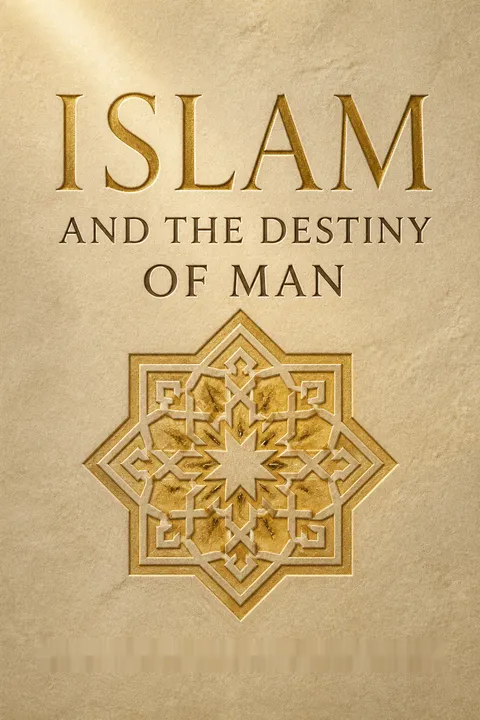
Islam and the Destiny of Man receives overwhelmingly positive reviews (4.4/5) as an exceptional introduction to Islam for Western readers. Reviewers praise Eaton's elegant prose and ability to bridge Islamic and Western worldviews, explaining Islam's perennial philosophy and holistic approach to life. The book covers Islamic history, law, art, and Sufism with poetic insight. Critics note Eaton's perennialist perspective (viewing all religions as valid paths) and some unorthodox Sufi views may concern traditional Muslims. Despite these concerns, readers consistently recommend it for both Muslims and non-Muslims seeking deeper understanding of Islamic thought and practice.
People Also Read


Download PDF
Download EPUB
.epub digital book format is ideal for reading ebooks on phones, tablets, and e-readers.








































