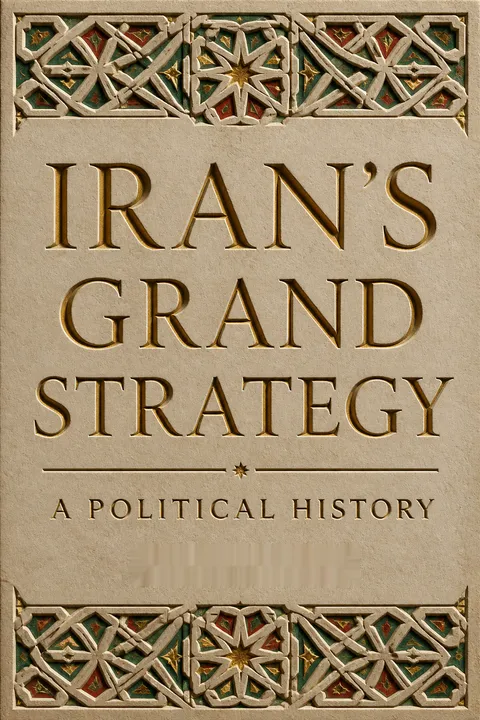

Key Takeaways
1. Iran's Grand Strategy: Beyond Ideology, Towards National Security.
To achieve this aim, Iran is acting on assumptions and calculations that reflect historical experiences, security imperatives, and great power ambitions.
Evolving identity. Iran's grand strategy, often misconstrued as purely ideological, has evolved beyond its revolutionary beginnings into a pragmatic national security framework. While revolutionary ideology defined its formative years and remains embedded in statecraft, Iran now operates as a prototypical nation-state, driven by a distinct vision of national security. This vision, shaped by its two Supreme Leaders, Ruhollah Khomeini and Ali Khamenei, prioritizes Iran's security and greatness by keeping US influence at bay.
Historical anxieties. This strategic outlook is deeply rooted in Iran's historical experiences, particularly legacies of colonialism, national humiliation, territorial losses, and foreign intrigue. Events like the 1953 coup and the Iran-Iraq War instilled a profound fear of external interference and disintegration, alongside aspirations for ancient civilizational power. These anxieties and ambitions form a broad consensus among Iran's leadership, guiding their defiant actions on the world stage.
Secular aims. Today, Islam serves as the language of Iran's politics, used by its political and military leaders to articulate national interests and economic goals. However, these aims are fundamentally secular in nature, focused on geopolitical independence and power projection. The country's actions, such as its role in the Gaza war, demonstrate a calculated and pragmatic approach, aiming to organize the Middle East around a global movement of resistance to the United States, rather than merely exporting a religious revolution.
2. The Revolution's Core: Independence and Anti-Americanism.
Indeed, what is most often missed in understanding Iran’s revolution and its Islamic Republic is this fundamental commitment to protecting national sovereignty and displaying independence on the world stage.
Foundational principle. Geopolitical independence (esteqlal) was a core, non-negotiable principle of the 1979 Islamic Revolution, considered by Ayatollah Khomeini to be as vital as the enshrining of Islamic principles in the state. This commitment stemmed from a widespread belief that Iran's politics and culture had been unduly shaped by foreign influence, particularly from the West. The revolution aimed to liberate Iran from perceived subservience, ensuring that "all decisions are made in Tehran."
Anti-American crucible. Anti-Americanism became integral to the revolution's identity, fueled by the narrative of the 1953 coup as a US-British plot to overthrow Mohammad Mossadegh and impose a "puppet" regime. The subsequent US hostage crisis in 1979 further entrenched this anti-American sentiment, transforming it from a political stance into a national security imperative. Khomeini strategically used the crisis to consolidate power, purge liberal and leftist rivals, and demonstrate Iran's defiance against perceived American conspiracies to undo the revolution.
"Neither East nor West." This deep-seated distrust of the United States, combined with antagonism towards the Soviet Union, led to the adoption of the "Neither East nor West" doctrine, symbolizing Iran's commitment to non-alignment and true independence. This stance, while isolating Iran, was seen by revolutionary leaders as a source of strength, allowing Iran to assert its sovereignty and pursue its national interests without external interference. The early successes against the US, such as the forced withdrawal from Lebanon, reinforced the belief that sustained anti-Americanism was a viable strategy.
3. The Iran-Iraq War: Crucible of Sacred Defense and IRGC's Rise.
The revolution may have birthed the Islamic Republic, but as these next two chapters show, it was the Iran-Iraq War that decisively shaped it.
Existential threat. Iraq's 1980 invasion plunged the nascent Islamic Republic into an eight-year existential struggle, costing hundreds of thousands of lives and devastating the economy. This "imposed war" forced Iran's leaders to prioritize state survival, unifying the country under the banner of "sacred defense" (defa‘e moqaddas). The war, framed as a fight against aggression and a defense of Islamic values, became a defining experience that forged a new strategic outlook centered on self-reliance and ideological commitment.
IRGC's ascendancy. The war proved to be the crucible for the Islamic Revolutionary Guards Corps (IRGC). Initially a loosely organized militia, the IRGC rose to prominence due to its ideological zeal and effective guerrilla tactics, especially after the regular military struggled with purges and supply issues. Khomeini's decision to empower the IRGC, favoring its "human wave attacks" over conventional military strategy, cemented its role as the Praetorian Guard of the revolution and a dominant force in Iran's political and security landscape.
Distrust of international norms. The war also solidified Iran's deep distrust of international institutions and norms. The UN's failure to condemn Iraq's invasion and its use of chemical weapons, coupled with perceived international support for Saddam Hussein, convinced Iran that it was isolated and could only rely on itself. This experience led Iran to increasingly flout international conduct norms in the name of national security, extending its irregular warfare tactics into foreign policy and laying the groundwork for future unconventional strategies.
4. Post-War Era: The Enduring Struggle Between Reform and Resistance.
The years after the war witnessed something of a 'Thermidor,' to borrow historian Crane Brinton’s famous characterization of when a revolutionary state shifts from fervor to normalcy. Yet Iran’s Thermidor remained limited, frozen in a struggle between fervor and normalcy.
Reconstruction vs. ideology. Following the Iran-Iraq War and Khomeini's death in 1989, Iran faced the challenge of reconstruction and economic development. President Ali Akbar Hashemi Rafsanjani championed a pragmatic approach, advocating for "rational government," economic reform, and a foreign policy of "tension reduction" to normalize relations with the world. He believed economic strength was foundational to national security, echoing Pahlavi-era developmentalism.
Deep state resistance. Rafsanjani's reforms, however, met fierce resistance from hard-line clerics, parastatal institutions, and the IRGC, who were deeply invested in the wartime ideology of "sacred defense." They viewed his pragmatism as a threat to revolutionary values and their consolidated power, using accusations of corruption and appeals to the poor to undermine his agenda. This "deep state" actively sabotaged diplomatic overtures and engaged in acts of terror abroad, making it impossible for Rafsanjani to fully normalize relations with the West.
Khatami's challenge. The struggle intensified with Mohammad Khatami's election in 1997, which signaled a popular yearning for political opening, civil society, and engagement with the world. Khatami's "dialogue of civilizations" was met with a brutal crackdown by the IRGC and conservative forces, who saw his reforms as a "national security threat" akin to the collapse of the Soviet Union. This period cemented the deep state's determination to maintain ideological vigilance and control, ultimately marginalizing reformists and paving the way for a hard-line resurgence.
5. Khamenei's Vision: Unwavering Distrust and the Resistance Economy.
He has harbored a deep suspicion of US intentions, believing that America has only one goal in Iran and that is 'regime change': to topple the Islamic Republic.
Guardian of the revolution. As Supreme Leader, Ayatollah Ali Khamenei has consistently prioritized protecting the Islamic Republic from perceived external threats, particularly the United States. His worldview, shaped by his wartime experiences and the collapse of the Soviet Union, is rooted in the belief that American overtures are merely ruses for "regime change." This deep distrust has made him an unwavering advocate for "resistance" and "sacred defense" as the core tenets of Iran's national security.
"Resistance Economy." Khamenei champions a "resistance economy" (eqtesad-e moqavemati) as the means to achieve self-reliance and immunity from US economic pressure. This strategy, emphasizing autarky and investment in domestic industries, aims to decouple Iran from the global economic system, which he views as a tool of Western subjugation. While this approach has fostered some resilience and technological advancement, it has also led to economic inefficiencies, corruption, and significant hardship for the Iranian populace.
Militarized statecraft. Khamenei's leadership has solidified a "battlefield" (meydan) mentality in Iran's foreign policy, where military and security forces, particularly the IRGC, dominate decision-making over professional diplomats. He sees himself as a "turbaned commander in chief," uniquely qualified to lead a state dominated by security forces, and has empowered the IRGC to control vast sectors of the economy and state institutions. This militarization ensures ideological conformity and the seamless implementation of his grand strategy of resistance, even at the cost of popular support.
6. Forward Defense: Projecting Power into the Arab World.
In 2003, Iran formally embraced the strategic doctrine of forward defense (defa‘ pisehrou or defa‘-e roubejelo): the imperative of defending Iran by being present inside the Arab world, providing it with a minimum of 'relative security' (amniyat-e nesbi).
Strategic opportunity. The 2003 US invasion of Iraq, while initially perceived as a direct threat to Iran, ultimately created a strategic vacuum that Iran exploited to launch its "forward defense" doctrine. This strategy aimed to defend Iran by establishing a presence within the Arab world, particularly in Shia-majority Iraq, to counter US influence and prevent future threats from reaching Iranian borders. It drew inspiration from Hezbollah's success in Lebanon and the Sunni insurgency's effectiveness against US forces in Iraq.
Qods Force's role. General Qasem Soleimani and the IRGC's Qods Force were instrumental in implementing forward defense, transforming it into a formidable regional strategy. They organized and trained local Shia militias in Iraq (like Moqtada Sadr's Mahdi Army and later the Popular Mobilization Forces) and deployed Hezbollah fighters, using asymmetrical warfare to make the US presence in Iraq untenable. This strategy proved effective, culminating in the US withdrawal from Iraq in 2011, a significant victory for Iran.
Expanding "strategic depth." Forward defense expanded further into Syria during the 2011 Arab Spring, where Iran viewed the Assad regime as crucial "strategic depth" and a vital link to Hezbollah. Despite international condemnation and the brutal nature of the Syrian civil war, Iran committed significant resources, including deploying the Qods Force and organizing Shia militias (like the Fatemiyoun Brigade), to prevent Assad's fall. This intervention, along with support for Houthis in Yemen, solidified Iran's regional footprint, extending its security perimeter from the Mediterranean to the Red Sea.
7. The Axis of Resistance: A Network of Proxies and Regional Influence.
The concatenation of militias that forward defense had set up now identified itself as the Axis of Resistance.
Unified front. Forward defense led to the consolidation of Iran-backed militias across the Middle East into a cohesive "Axis of Resistance" (Mehvar Moqavemat). This network, spanning Lebanon (Hezbollah), Syria, Palestinian territories (Hamas), Iraq (PMF), and Yemen (Houthis), operates with a shared vision of resisting American and Israeli "colonialism." While guided by Iran, these proxies maintain local adaptability, allowing for effective power projection without requiring extensive Iranian troop deployments.
Gaza War's impact. The October 2023 Hamas attack on Israel and the subsequent Gaza War served as a critical demonstration of the Axis of Resistance's reach and effectiveness. The coordinated actions of Hezbollah, Shia militias in Iraq and Syria, and the Houthis in the Red Sea showcased the axis's ability to escalate regional conflicts and pressure the United States. This event, in Tehran's view, resurrected the Palestinian issue, dented Israel's invincibility, and isolated the US globally, validating Iran's long-term strategy of exhausting its adversaries.
Deterrence and demographics. The Axis of Resistance provides Iran with a flexible and cost-effective deterrence against superior conventional forces. It leverages the youthful demographics of Shia and Palestinian communities in the region, who are often marginalized and receptive to Iran's narrative of resistance. This strategy, however, has come at the cost of deepening sectarian divisions, provoking Sunni Arab resistance, and escalating direct confrontations with Israel, raising the specter of a larger regional war.
8. The Nuclear Gambit: Deterrence, Diplomacy, and Escalation.
The nuclear issue has come to dominate Iran’s relations with the West and shape its domestic politics.
Post-war imperative. Iran's nuclear program, initially a civilian endeavor under the Shah, gained renewed strategic importance after the Iran-Iraq War, particularly following Iraq's use of chemical weapons. Tehran viewed nuclear capability as essential for deterrence against future threats and for gaining international respect. The revelation of the program in 2002, coinciding with the US invasion of Iraq, intensified international pressure and solidified Khamenei's belief that the US sought to use the nuclear issue for "regime change."
JCPOA and its undoing. Despite deep distrust, Iran engaged in nuclear diplomacy, culminating in the 2015 Joint Comprehensive Plan of Action (JCPOA) under President Rouhani. This deal limited Iran's nuclear activities in exchange for sanctions relief, marking a rare diplomatic breakthrough with the US. However, hardliners in Iran viewed it as a compromise of independence, while regional rivals (Israel, Saudi Arabia) saw it as empowering Iran. President Trump's withdrawal from the JCPOA in 2018, followed by "maximum pressure" sanctions, validated Khamenei's long-held suspicions and led Iran to accelerate its nuclear program.
Escalation and deterrence. Post-JCPOA withdrawal, Iran responded to maximum pressure by escalating its enrichment activities and regional aggression, demonstrating its willingness to challenge US containment directly. This strategy, including missile attacks on Saudi oil facilities and the downing of a US drone, aimed to deter further American escalation and showcase Iran's resilience. The killing of General Soleimani in 2020 further hardened Iran's resolve, leading to a ballistic missile attack on a US base in Iraq and reinforcing the belief that a robust nuclear program, coupled with forward defense, is vital for national security against US and Israeli threats.
9. The Cost of Resistance: Economic Strain and Domestic Discontent.
For most Iranians, the lofty idea of a resistance economy fell far short of its goals in practice.
Economic devastation. The grand strategy of resistance, particularly under "maximum pressure" sanctions, has inflicted immense economic hardship on Iranians. Over five years (2018-2022), Iran's economy contracted, per capita income fell, and poverty surged, exacerbated by rampant inflation and corruption. While the "resistance economy" aimed for autarky, it instead fostered a black market controlled by the IRGC, deepening economic inefficiencies and inequality, and eroding the social contract forged during the Iran-Iraq War.
Popular disillusionment. This economic strain has fueled widespread public apathy and anger, leading to growing questioning of the wisdom and cost of forward defense. Protests in 2018 and 2019 saw chants like "No to Gaza, no to Lebanon," reflecting public resentment over regional expenditures amidst domestic economic woes. The 2022 Mahsa Amini protests, driven by demands for individual freedoms and a rejection of ideological strictures, highlighted a profound chasm between the state's vision of "sacred defense" and the aspirations of a younger, secular-leaning populace.
Legitimacy crisis. The declining voter turnout in recent elections (record low 39% in 2024 presidential first round) signals a severe legitimacy crisis for the Islamic Republic. Despite the IRGC's pervasive control and the hardliners' unified grip on power, the population's growing secularism and desire for normalcy challenge the very foundations of the state built on resistance. Critics, including former officials, argue that the current strategy is unsustainable without popular support, pushing for a return to pragmatism, economic development, and improved relations with the West.
10. The Militarization of the State: IRGC's Pervasive Control.
The IRGC is a military force; it controls vast parts of Iran’s economy and is deeply influential in its politics. Yet it cannot prosecute forward defense without the imprimatur of the clergy.
Praetorian Guard to state actor. The Iran-Iraq War transformed the IRGC from a revolutionary militia into the clerical leadership's Praetorian Guard, deeply embedded in the state's security architecture. Over decades, its influence expanded beyond military affairs into the economy, politics, and social institutions. Under Khamenei, the IRGC has become the de facto "state itself," controlling key sectors like construction, telecommunications, and energy through conglomerates like Khatam al-Anbia, fostering a crony capitalist system that aligns economic interests with hardline political control.
"Turbaned commander in chief." Khamenei, seeing himself as a "turbaned commander in chief" rather than solely a religious scholar, has cultivated a unique bond with the IRGC, viewing it as divinely favored and essential for national security. This relationship ensures the IRGC's dominance in foreign policy, particularly in implementing "forward defense" and managing the Axis of Resistance. The Qods Force, under figures like Qasem Soleimani, has become the face of Iran's regional strategy, extending Iran's security parameters deep into the Arab world.
Perpetuating resistance. The IRGC's pervasive control ensures the perpetuation of the "sacred defense" mindset, where ideological vigilance and resistance to the West are paramount. This militarization, however, has come at the cost of stifling domestic dissent, alienating a significant portion of the populace, and condemning the economy to inefficiencies under sanctions. While Khamenei believes this strategy ensures Iran's survival and regional hegemony, the growing chasm between the state and society, coupled with mounting economic and strategic costs, poses a fundamental challenge to the long-term viability of this militarized state of resistance.
Review Summary
Reviews of Iran's Grand Strategy are overwhelmingly positive, averaging 4.19/5. Readers praise Nasr's realist framing of Iran as a rational, strategically coherent state rather than an ideologically irrational one. The historical depth—spanning Safavid Persia to present day—is frequently lauded, as is the accessible prose. Many highlight the "Forward Defense" and "Sacred Defense" doctrines as illuminating frameworks. Common criticisms include Nasr's perceived reluctance to fully criticize U.S. and Israeli policies, repetitiveness, and the book's publication predating major 2025–2026 regional developments.
People Also Read




Download PDF
Download EPUB
.epub digital book format is ideal for reading ebooks on phones, tablets, and e-readers.








































