
Key Takeaways
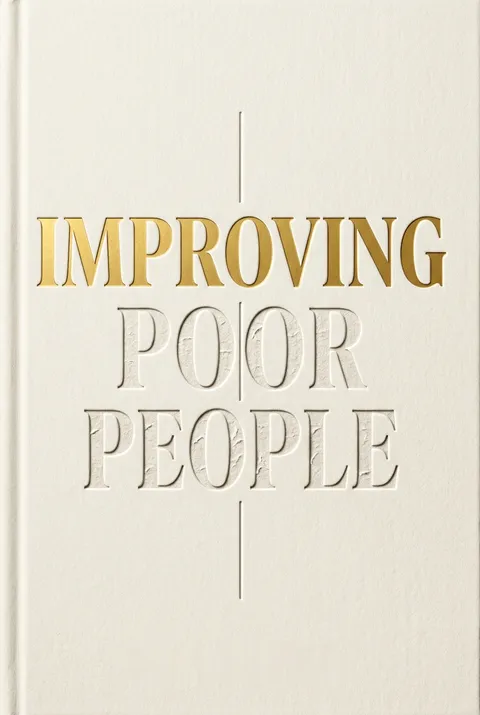
1. "Improving Poor People" is a Persistent, Flawed Strategy
As the history of education shows, improving poor people not only has misdiagnosed the issues; it also time and again has deflected attention from their structural origins and from the difficult and uncomfortable responses they require.
Misdiagnosing poverty. For centuries, reformers have attributed poverty to individual moral failings like laziness, intemperance, or bad behavior, rather than to systemic economic or social structures. This perspective has consistently shaped public policy and philanthropy, emphasizing individual regeneration over material support. For example, 19th-century reformers used evangelical religion, temperance laws, and punitive relief conditions to "improve" the character of the poor.
Deflecting attention. This focus on individual improvement has repeatedly diverted attention from the root causes of poverty, such as inadequate wages, lack of job opportunities, or systemic discrimination. Instead of addressing these structural issues, policies have often sought to control or modify the behavior of poor people, leading to ineffective and often degrading interventions. The author's experience on a welfare reform task force revealed this persistent tendency, where "reducing welfare dependency" often meant cutting benefits rather than fostering genuine independence.
Education's starring role. Education has frequently been cast as the primary solution for social problems, tasked with compensating for inadequate parenting, shaping values, molding character, and imparting skills. However, by placing an "impossible load" on schools to solve societal ills, this strategy has often misdiagnosed the core issues, leading to recurrent allegations of public school failure since the 19th century.
2. America's Welfare State is Historically Incomplete and Contradictory
How remarkable, then, that welfare has remained so impervious to real reform.
Universal hostility. America's welfare system evokes widespread hostility from clients, liberals, and conservatives alike, echoing historical attacks on poor laws. Despite this universal dissatisfaction, fundamental reform has proven elusive, leaving a system that is often punitive, inadequate, and riddled with disincentives. This paradox stems from a mix of conflicting interests, entrenched ideologies, and stale ideas about poverty.
Structural features. The US welfare state is characterized by several enduring structural features:
- Local control: Rooted in Elizabethan Poor Laws, leading to vast differences in benefits and administration across states and counties.
- Public assistance vs. social insurance: A bifurcation where means-tested public assistance (welfare) is stigmatized and underfunded, while non-means-tested social insurance (Social Security) enjoys broad support.
- "Franchise state": Heavy reliance on private agencies and firms to deliver public services, blurring public/private boundaries.
- Supply-side policies: Focus on changing the behavior of the poor rather than addressing the material causes of poverty.
- Incomplete system: Lacking national health insurance or family allowances, leaving significant gaps in social protection compared to other developed nations.
Mixed economy of welfare. The boundaries between public and private welfare have always been ambiguous. Governments have historically delegated responsibility and funds to nominally private agencies, creating a "mixed economy" where resources and administration are tangled. This reliance on corporate models, distrust of patronage politics, and a weak administrative sector have contributed to a distinctive, often incoherent, welfare state.
3. The "Underclass" Concept Echoes Old Blame-the-Victim Narratives
In the 1990s, discussions of inner-city poverty invoke an "underclass," defined primarily by bad behavior, not by poverty, and deemed to be more in need of improvement than cash.
A convenient metaphor. The term "underclass," popularized in the late 1970s, functions more as a metaphor than a sociological term, evoking perceptions of novelty, complexity, and danger in inner cities. It describes a segment of the poor primarily by "bad character"—drugs, crime, teenage pregnancy, joblessness—rather than by economic deprivation, reinforcing a long-standing tradition of moralizing poverty.
Historical continuity. Critics argue that the "underclass" concept is a resurgence of old images of the "undeserving poor," deflecting blame from systemic issues to the victims themselves. Nineteenth-century reformers similarly divided the poor into "worthy" and "unworthy" categories, attributing urban poverty to individual misbehavior and warning of "slums" that threatened to infect respectable society. This ideological persistence highlights how current debates often rehash old themes.
Moynihan's legacy. The "culture of poverty" theory in the 1960s, and Daniel Patrick Moynihan's "tangle of pathology" report on the Negro family, attempted to explain persistent poverty through cultural and family structure arguments. While Moynihan linked family issues to male unemployment, his report was widely criticized for blaming victims and fueled conservative agendas that later blamed welfare for undermining work and family, setting the stage for the "underclass" debate.
4. Postindustrial Cities Face Unprecedented Poverty Dynamics
Failure to appreciate the novelty of the current situation, I argue, has inhibited effective responses.
Transformative changes. The conditions in today's inner cities represent an unprecedented configuration of poverty, distinct from historical patterns. This novelty stems from three interconnected transformations:
- Economic: Shift from manufacturing to services, creating a bifurcated job market with few opportunities for unskilled labor.
- Demographic: Depopulation, replacement of white populations with African Americans and Latinos, and a higher proportion of poor residents.
- Spatial: Suburbanization, heightened segregation, increased concentrations of poverty, and urban decay alongside downtown revitalization.
Poverty of hopelessness. Unlike earlier periods where poverty coexisted with expanding opportunities in industrializing cities, today's inner-city poverty exists within a context of hopelessness. Deindustrialization, shrinking government jobs, and a service sector offering mostly low-wage, non-union work have eroded avenues for social mobility. This contrasts sharply with the past, where even low-wage work could be combined with family efforts to achieve modest gains.
Labor market detachment and segregation. The connection between race, urban poverty, and detachment from the labor force is new. A growing number of inner-city residents are chronically jobless, a sharp rise despite overall declines in black poverty since the 1960s. Furthermore, "American Apartheid"—the unprecedented and unique segregation of black populations—systematically undermines their social and economic well-being, concentrating poverty and creating isolated environments.
5. Urban Schools Were Built on Social Control, Not Pure Intellect
Public school systems existed to shape behavior and attitudes, alleviate social and family problems, and to improve poor people and reinforce a social structure under stress.
Responding to social anxieties. Public education systems in the 19th century emerged not primarily for intellectual cultivation, but as responses to pressing social problems of rapid urbanization, industrialization, and immigration. Reformers believed schools could:
- Reduce crime and poverty by shaping the character of lower-class children.
- Assimilate immigrants, transforming "uncouth" newcomers into "Americans."
- Instill work discipline (punctuality, regularity) for an industrial workforce.
- Address the "crisis of idle youth" by providing a constructive environment.
Displacing social problems. Schools became a "cheap and easy substitute" for direct, uncomfortable confrontations with the structural sources of social problems. This tendency to oversell education's potential has led to recurrent cycles of criticism and justification for perceived failures. The Boston School Committee in 1858, for instance, saw its task as transforming children "from animals into intellectual beings," highlighting the moral and behavioral focus.
Bureaucracy's triumph. The development of public school systems saw the triumph of bureaucracy over alternative models like paternalistic voluntarism or democratic localism. Schoolmen, drawing on manufacturing and military analogies, created age-graded, hierarchically structured systems justified by efficiency and expertise. This bureaucratic framework, established in the 19th century, has proven remarkably resilient, channeling the subsequent history of urban education along rigid grooves.
6. Bureaucracy and Professionalism Shaped, and Often Stifled, Social Institutions
For more than a century, Americans, with good reason, have wondered why social policies and institutions so often have seemed to fail and whether they did more harm than good.
The "inescapable" bureaucracy. Nineteenth-century urban schoolmen pioneered public bureaucracies, believing their rule-driven, centralized structures were essential for managing complex tasks on a large scale. This belief in bureaucracy, though not using the term, became deeply embedded in public education, with superintendents and administrators insulating systems from outside influence and defending their structures as inevitable.
Professionalization's double edge. The rise of educational administration as a profession, abetted by universities and social sciences, aimed to distance policy decisions from parents and politicians, asserting the authority of "experts." While intended to improve quality, this professionalization often led to insular, self-contained systems that resisted external pressure and absorbed innovations without fundamental change. The symbiotic relationship between university-based educational leaders and practicing administrators reinforced this resistance.
Stifling reform. This entrenched bureaucratic and professional structure has historically stifled genuine reform. Innovations were often reshaped to fit existing structures, leading to "mimetic" or "shadow" reforms that lacked substance. Chicago school reform, by radically decentralizing power to local school councils, directly challenges this century-old assumption of bureaucratic inevitability and the authority of professional experts, making it a historically significant, yet difficult, undertaking.
7. Social Movements Drive Real Reform, Challenging Established Power
In America, major social change has not originated with established political parties and institutions.
Outside conventional channels. Significant social change in America, from abolitionism to civil rights, has historically originated outside established political parties and institutions. These social movements, often defying conventional labels, mobilize diverse coalitions and exert pressure until their demands become politically opportune for adoption by government. Chicago school reform exemplifies this pattern, emerging from a broad, multiracial, cross-class coalition outside the traditional political machine.
Grassroots power. Urban social movements, like those described by Manuel Castells, reflect a deep distrust of large corporations and government bureaucracies, expressing frustration over citizens' inability to influence decisions. They democratize information, incubate new leadership, and assert the capacity of ordinary people to make intelligent decisions about public policy. The Chicago school reform, by empowering Local School Councils, embodies this grassroots challenge to expert authority and institutional legitimacy.
Fragile coalitions and sustained zeal. Successful social movements often forge unlikely partnerships, but these coalitions can be fragile and short-lived, splintering along fault lines of divergent interests. Furthermore, movements face the challenge of sustaining initial zeal, often transitioning from passionate "cause" to routine "function." Chicago's reform, while demonstrating the power of such a movement, must navigate these historical challenges to maintain its energy and broad-based support.
8. The Public Sphere's Erosion Undermines Collective Solutions
As the functions of state and local government expanded throughout the first several decades of the twentieth century, public schools managed to stave off further erosion of their legitimacy and support.
Shifting meaning of "public." The definition of "public" has evolved throughout American history, from simply meaning "in a school" or "free" in the 19th century, to encompassing both government financing and control. This shift reflected an early optimism about democracy and civic culture, with monumental public institutions symbolizing civic pride. However, this support began to erode, likely in the 1960s, leading to a decline in public confidence in government and institutions.
Degraded public sphere. Today, many view city government as a "conspicuous failure" and public institutions as "warehouses" incapable of reform. This degradation of the public sphere has led to a growing rejection of collective solutions and a turn towards market models and privatization. In education, this manifests as calls for "choice" and vouchers, driven by the perception that public schools are beyond repair and have reverted to being equated with "pauper" institutions.
Chicago's counter-narrative. Chicago school reform stands as a major alternative to this market-driven approach, rejecting public-private choice as a solution. Its advocates believe that choice will exacerbate inequalities and undermine local efforts. Instead, they seek to revitalize the public sphere by strengthening the interconnections among community, democracy, and education, aiming to restore the preconditions for an effective public life and resist the slide into privatization.
9. Poor People Exhibit Remarkable Agency and Resilience
The children, by and large, were wonderful, as bright, eager, and trusting as any others. Their parents cared deeply about them. Their daily struggle to survive took intelligence, cleverness, and energy.
Challenging stereotypes. The author's personal experience at a settlement house profoundly challenged conventional "liberal" ideas about the "culture of poverty," revealing the intelligence, cleverness, and energy required for daily survival. This ethnographic perspective counters the pervasive stereotypes of poor people as passive, incompetent, or uniformly disorganized, instead highlighting their resourcefulness and resilience.
Survival strategies. Historical case studies of poor families in early 20th-century New York City illustrate diverse survival strategies:
- Reliance on children's wages: Children often left school at 14 to work, contributing significantly to family income, a practice that only began to decline in the 1950s.
- Mutual assistance networks: Friends, relatives, and even landlords (by allowing delayed rent payments) formed crucial "social capital" for navigating daily struggles.
- Strategic use of institutions: Poor people often adapted institutions like courts, orphanages, and hospitals to their own purposes, using them as temporary shelters or sources of care.
Navigating a complex terrain. For poor families, social institutions and agencies were not monolithic entities but a complex, often contradictory, terrain to be navigated. What mattered was the practical help offered and the conditions attached, rather than official goals or public/private distinctions. This client-centric view reveals the active role poor people played in shaping their interactions with the welfare system.
10. Institutional Failure is a Shared American Problem, Intensified for the Poor
The problems of the underclass represent in intensified form transformations that are reshaping the rest of America.
Beyond individual pathology. The challenges faced by the "underclass" are not isolated to a small segment of the population but represent intensified forms of broader transformations affecting all Americans. The decline of public institutions, for instance, is a national crisis that disproportionately impacts the poor because they lack the private alternatives available to the wealthy.
Government's role in decline. Local, state, and federal governments have often contributed to the marginalization and isolation of the poor, rather than alleviating it. Examples include:
- Federal agricultural policies in the 1930s that displaced small, often black, farmers.
- "Redlining" by the Federal Housing Authority that starved city neighborhoods of capital.
- Highway construction and urban renewal programs that destroyed housing and sealed off minority areas.
- The transformation of public housing into stigmatized, segregated ghettos.
Erosion of civil society. The withdrawal and collapse of institutions in inner cities—schools that fail to educate, police unable to prevent crime, inadequate healthcare—destroy the basis of "civil society" and collective life. This leads to a degraded public sphere, pushing towards privatization and anomic individualism, which in turn exacerbates poverty and social problems. The question arises: what happens to citizenship and community when public institutions fail?
11. History Reframes Contemporary Debates, Revealing Continuity and Novelty
One goal of studying the past is not to be trapped by history but to transcend it.
Challenging assumptions. History is crucial for interpreting contemporary social issues, often revealing that current debates are rooted in untested or distorted historical assumptions. By grounding discussions in analytic social history, free of "comforting myths," we can reframe public discourse on welfare, poverty, and education, moving beyond stale, repetitive arguments.
Persistence and discontinuity. Historians must balance the recognition of persistent ideas and patterns (like the "improving poor people" strategy) with an appreciation for radical rupture and discontinuity. While some themes echo across centuries, the specific configuration of poverty in postindustrial cities, for example, is genuinely new. Failing to recognize this novelty can inhibit effective responses.
Beyond progress or decline. Framing social issues in terms of simple "progress or decline" abstracts them from their context, misreads surface similarities as fundamental identities, and distorts historical processes. Instead, history's value lies in sorting out continuities and discontinuities, understanding the origins and dimensions of problems, and showing that current circumstances are products of human agency and choice, not inevitable forces. This perspective empowers us to transcend historical traps and seek new solutions.
Download PDF
Download EPUB
.epub digital book format is ideal for reading ebooks on phones, tablets, and e-readers.








































