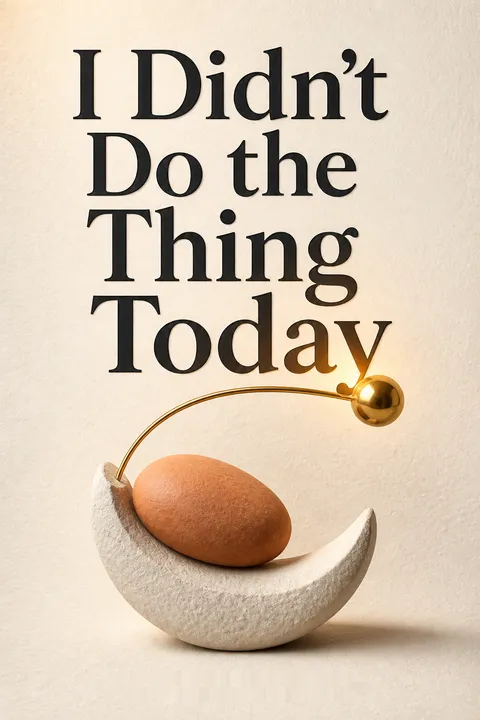

Key Takeaways
1. Redefine Worth Beyond Productivity
When we conflate productivity with worthiness, what we do is never enough.
Challenge the narrative. Modern society often measures our value by how much we accomplish, leading to an internalized sense of capitalism where our worth is tied to our output. This relentless pursuit of "more" creates an "if only" spiral, leaving us feeling inadequate and perpetually behind. We constantly seek the next hack or routine, only to blame ourselves when we inevitably fall short of impossible standards.
Beyond the checklist. The book argues that a checked-off to-do list is merely one byproduct of living well, not the sole measure of a day's value. We are set up to fail by a culture that demands self-optimization while simultaneously telling us we'll never be enough. Instead of overworking and overachieving, we must question why we fasten our self-worth to productivity.
Define your "enough." Rather than chasing an endlessly moving target, we need to define our own version of "enough." This involves untethering our lives from efficiency and order, and instead focusing on being "fecund"—capable of new growth, nourished by sleep, kindness, learning, and resilience. Our days are like fertile gardens, not factories, with seasons for planting, weeding, and resting.
2. Embrace Imperfection and the "Wobble"
What if, instead of striving for balance and stability, we embrace the wobble?
Life's inherent instability. We often strive for perfect balance in our work, health, and relationships, believing it's the key to a good life. However, life is not made of equal counterparts; it's a perpetually shifting seesaw. Resisting this natural "wobble" only intensifies the jolt, as our minds and circumstances are constantly changing.
Congruence over consistency. Instead of rigid rules for balance, we can embrace a process of constant adjustment, a "balancing act." This means acknowledging that perfect consistency is unattainable and that our efforts accumulate over time, not in daily perfection. The goal is congruence—acting in alignment with who we are and what we need, even if it looks inconsistent to others.
Learning from tumbles. Our day-to-day wobbles, inconsistencies, and even ruts are not moral failings but opportunities for growth. Just as a Jenga tower is designed to topple, our lives are designed to shift. By forgiving our daily missteps and seeing them as part of the game, we can learn to adapt, restore, and find new rhythms, rather than letting them derail our entire day.
3. Live Creatively as a "Day Artist"
To make living itself an art, that is the goal.
Expand your perspective. Productivity offers a narrow, sequential lens for our days, leading to guilt when things deviate. Creativity, however, expands our perspective, allowing us to respond to what arises rather than rigidly prescribing it. It embraces the non-linear process of preparation, incubation, illumination, and verification, valuing all stages, even the "not yet done."
Everyone is a creator. You don't need to be a professional artist to live a creative life. Being a "day artist" means shaping your life by turning your attention to what can be done differently, finding poetry in the mundane, and interacting with the world as if your life is a work of art. It's about improvising, being curious, and seeing things anew.
Experiment with your day. A day artist treats each day as an experiment, embracing messiness and imperfection. This mindset shifts judgment to curiosity, allowing us to learn from failures and stumbles. It's about finding what brings us alive and having the courage to explore it, continuously creating our own path rather than following someone else's script.
4. Cultivate Delightful Discipline
Discipline is a way of expression; say we want to express your feelings in stone.
Beyond punishment. Traditional discipline often implies strictness and punishment, leading to dread and eventual abandonment. The book proposes "delightful discipline," driven by curiosity, interest, and the pleasure of learning, rather than rigid obedience. This approach is flexible, acknowledging our human tendency to wobble, and focuses on consistent practice over perfect adherence.
Motivation through fascination. Motivation doesn't precede action; action precedes motivation. The key is to start with fascination or delight, making tasks intrinsically enjoyable. When the reward is in the doing itself, we are more likely to sustain our efforts, inadvertently building a regular practice. This is more sustainable than pushing through dread for an external outcome.
Embrace discomfort for flow. Delightful discipline doesn't mean everything is easy; it means finding delight in the challenge. Engaging with tasks that stretch our minds or bodies can lead to "flow" states—deep concentration, effortlessness, and enjoyment. By choosing inconvenience over convenience, or by embracing repetition, we can discover new insights and build confidence through perseverance.
5. Manage Expectations and Trust Timing
The greatest obstacle to living is expectancy, which hangs upon tomorrow and loses today.
The burden of "shoulds." We often burden our days with excessive expectations—what we "should" achieve, how our lives "should" look. These self-imposed and societal "shoulds" create a gap between reality and ideal, leading to guilt and disappointment. While expectations can offer hope, they can also blind us to present opportunities and solutions.
Hold plans lightly. Instead of rigid plans, cultivate intentions—lighter aims that guide without prescribing outcomes. Intentions are like lighthouses, illuminating a path while allowing for course correction and unexpected discoveries. This shift reduces pressure, encourages adaptability, and allows for the "unexpected wonders" that often bring the most meaning to life.
Patience for the process. Worthwhile things take time, and rushing them can be counterproductive. "Precrastination" (doing things quickly for the sake of completion) can be more costly than procrastination. Trusting the timing of your life means acknowledging that some insights and achievements unfold on their own schedule, and that "when something's not coming, it's coming."
6. Untangle from the Busyness Trap
It is not enough to be busy; so are the ants. The question is: What are we busy about?
The "dis-ease" of busyness. In modern society, "busy" has become synonymous with "good," a status symbol that often masks deeper anxieties or a distraction from what truly matters. This needless busyness, often self-imposed, prevents us from resting, connecting, and engaging with fulfilling activities, leading to overwhelm and burnout.
Rest is not a moral failing. We often ignore our need for rest, viewing it as lazy or unproductive. However, rest is essential for restoration, focus, and creativity. It's not just about sleep; it encompasses physical, mental, sensory, creative, emotional, social, and spiritual replenishment. Embracing rest, even small "horizontal days," helps us avoid burnout and regain impetus.
Reclaim your time. While systemic issues contribute to busyness, we can identify areas where our busyness is a choice. This involves questioning why we constantly strive for more, and consciously creating "stops" or "resets" in our lives. By politely declining unnecessary commitments and valuing downtime, we can signal to ourselves and others that it's okay to be "free" rather than just "busy."
7. Leverage Limitations for Focus
Once we recognise that there is no way to optimise ourselves into being perfect, hyper-productive beings, we can actually get on with spending our limited time and using our limited resources for what matters to us most.
Limits are liberating. We often greet each day with expectations that deny our inherent limitations—of time, energy, and resources. However, acknowledging these limits is not defeatist; it's a powerful way to clarify what truly matters. Life's finiteness makes it precious, and accepting that we can't do everything allows us to focus on what we can do.
Prioritize within constraints. Instead of feeling overwhelmed by endless priorities, identify your daily limitations and then discover your true priorities within them. Tools like the "100 blocks a day" exercise can visualize time constraints, helping us allocate our minutes intentionally. Remember to include "buffer blocks" for human fallibility and unexpected events.
Constraints spark creativity. Limitations, far from being restrictive, can be catalysts for innovation. When faced with a "box," we are forced to think outside it. By making limitations tangible (e.g., Kanban boards, small achievable tasks) and setting clear endpoints, we can transform overwhelming tasks into manageable "puddles," making it easier to start and sustain effort.
8. Transform Comparison with Curiosity
When we get closer to envy, for example—the emotion that often underlies our urge to compare ourselves with others—we begin to notice that it can be as multifaceted as we are.
The human tendency to compare. Comparison is a fundamental human drive for self-evaluation, but in our hyper-connected world, it often becomes a "thief of joy." We compare our "behind-the-scenes" with others' "highlight reels," leading to feelings of inadequacy and a deflating spiral of self-doubt.
Curiosity as an antidote. Instead of hiding from comparison, approach it with curiosity. Envy, when examined, can be benign—a map to what we truly desire. By asking questions and getting "up close" to others' lives, we dismantle pedestals, recognize shared struggles, and uncover what we genuinely want for ourselves, rather than simply emulating others.
Follow your "secret joy." Enriching comparison reveals our "secret joy"—a deeper yearning for a quality or experience, not just a possession or milestone. This redirects energy from external fixation to internal pursuit. By focusing on our own path and celebrating our unique journey, we find that what others are doing matters less, and our own efforts become more meaningful.
9. Practice Generous Attention and Kindness
Attention is the rarest and purest form of generosity.
Connection through attention. When we narrow our days to productivity, we leave little room for generosity and kindness, which are essential for human connection. True attention, derived from the Latin "attendere" (to stretch towards), is a profound act of generosity that deepens our relationships and enriches our days.
Beyond constant connection. Our devices offer an illusion of constant connection, but often lead to isolation and a diminished capacity for quietness and boredom. Instead, we need to practice the art of genuine connection by being fully present, listening deeply, and offering our undivided attention to others. This means choosing to "stretch towards" what truly matters.
Kindness begets kindness. Small acts of kindness—a smile, a compliment, a listening ear—can profoundly shift moods and create ripple effects. Being kind, even when it's difficult or seems unrewarding, fosters connection and reminds us that we are interconnected. It's about making generous assumptions about others and contributing positively to the world around us.
10. Find Extraordinary in the Ordinary
Enjoy the little things in life, for one day you may look back and realise they were the big things.
The "real show" is now. We often lament the ordinariness of our days, waiting for a "better life" to begin. However, the book reminds us that "days like these are the days of our lives." We are in the middle of our lives, and our task as "day artists" is to realize life as we live it, finding meaning in the present moment.
Pluck the day. Instead of "seizing" the day with frantic activity, we are encouraged to "pluck" it, like harvesting from a fecund garden. This means surveying what is blossoming, ripe, and ready for enjoyment, whether it's a quiet moment, a challenging task, or a simple pleasure. These small, ordinary moments are often the most significant.
Cultivate a repository of good things. Overcoming overwhelm and finding contentment often comes from focusing on adding "additional good things, one at a time." These small, controllable moments—reading, walking, a delicious meal, a kind word—pile up to create a bedrock of satisfaction. By being curious about the ordinary, we discover the extraordinary wonders that make life truly alive.
People Also Read





Download PDF
Download EPUB
.epub digital book format is ideal for reading ebooks on phones, tablets, and e-readers.








































