
Key Takeaways
1. Early Life: Music, Illness, and the Seeds of Doubt
By the time we went to Naumburg, my character began to show itself. I had already experienced considerable sadness and grief in my young life, and was therefore not as carefree and wild as children usually are.
Childhood shaped by loss and illness. Friedrich Nietzsche's early life was marked by profound loss and chronic illness. His father, a Lutheran pastor, died from "brain softening" when Nietzsche was four, followed shortly by his baby brother. This morbid atmosphere was only occasionally relieved by his father's piano playing, which instilled in young Friedrich a lifelong passion for music.
Precocious intellect and physical frailty. Nicknamed "the little Minister" at school due to his solemnity and extreme myopia, Nietzsche suffered from debilitating headaches, vomiting, and eye pain. Doctors predicted total blindness, and these early physical torments profoundly influenced his later philosophical inquiries into suffering, health, and the human condition.
Religious fervor and early heresy. Despite intense piety and the expectation to follow his father into the Church, young Nietzsche harbored radical theological thoughts. At twelve, he conceived a "marvellous trinity: God the Father, God the Son, and God the Devil," demonstrating an early challenge to established dogma and a nascent philosophical mind that questioned fundamental religious tenets.
2. The Birth of Tragedy: Apollonian vs. Dionysian Art
The book’s famous opening tells us that, just as procreation depends on the duality of the sexes, so the continuing development of art and culture down the ages depends on the duality of the Apollonian and the Dionysian.
Duality of art. Nietzsche's first major work, The Birth of Tragedy from the Spirit of Music (1872), introduced the concepts of the Apollonian and Dionysian as fundamental, opposing forces in art and life. The Apollonian represents order, clarity, reason, and individual form (like sculpture), while the Dionysian embodies chaos, intoxication, ecstasy, and the dissolution of individuality (like music and tragic drama).
Greek tragedy's essence. He argued that ancient Greek tragedy achieved its greatness by harmonizing these two forces, particularly through the Dionysian chorus providing a primal, ecstatic background for Apollonian dialogue and plot. This synthesis allowed the Greeks to confront the terrifying aspects of existence—the "fearful, the evil, the cruel, the Eater of Flesh"—without succumbing to nihilism.
Socratic decline. Nietzsche lamented that Socratic rationality, with its emphasis on virtue as knowledge, led to the decline of Greek tragedy by suppressing the Dionysian. He saw his own era as suffering from a similar "Socratic delusion," where science and reason had annihilated myth, leading to a "senile, unproductive love of existence" and cultural enfeeblement.
3. The Wagnerian Spell: Idolization and Bitter Disillusionment
Wagner is the person who features more often in Nietzsche’s writing than any other, including Christ, Socrates or Goethe.
Magnetic attraction. Nietzsche's relationship with Richard Wagner was initially one of profound idolization. Wagner's music, especially Tristan und Isolde, deeply moved him, and he saw the composer as a genius capable of revitalizing German culture through a new, Dionysian art form. Their early meetings at Tribschen were idyllic, fostering a deep intellectual and personal bond.
Shared ideals, diverging paths. Nietzsche initially believed Wagner's Ring cycle embodied the Apollonian-Dionysian synthesis, a revolutionary artwork that would restore myth and dissonance to culture. However, he grew disillusioned with Wagner's increasing nationalism, anti-Semitism, and the commercialism of the Bayreuth Festival. He saw Wagner's art becoming a "cowardly continuation of the old order," a compromise with the very "Bildungsphilister" (educated philistines) they once scorned.
The break. The publication of Human, All Too Human, dedicated to Voltaire, marked a decisive intellectual break. Wagner, in turn, publicly attacked Nietzsche's new "scientific" approach. The final, personal breach was exacerbated by Wagner's indiscreet letters to Nietzsche's doctor, speculating on masturbation as the cause of his illness, a betrayal Nietzsche later discovered, leading to profound humiliation and resentment.
4. The Free Spirit: Embracing Reason and Rejecting Metaphysics
Human, All Too Human marks the start of his philosophical journey in search of the free spirit, the man whose existential hunger can be satisfied despite the absence of the ideal, or the divine, and even despite his own susceptibility to sublimity in music.
A new direction. After his disillusionment with Wagner and Schopenhauer, Nietzsche embarked on a new philosophical path, influenced by the rationalist Paul Rée and French moralists like Voltaire. His book Human, All Too Human (1878) marked a shift towards a positivistic, scientific viewpoint, questioning metaphysical assumptions and seeking to explain moral feelings through historical and physiological development.
Psychological exploration. This period saw Nietzsche's focus on "psychological observation" as the basis of free thought, dissecting human motivations and the origins of morality. He argued that religious, moral, and aesthetic sensibilities are "only to the surface of things," and that man often deceives himself with "passionate errors of self-delusion" to cope with existence.
Aphoristic style. Driven by his debilitating health, which made sustained writing difficult, Nietzsche adopted an aphoristic style. This concise, provocative form allowed him to express complex ideas in short bursts, inviting readers to engage actively rather than passively absorb. He saw the "free spirit" as one who embraces uncertainty and transience, finding liberation in questioning all established truths.
5. Zarathustra and Eternal Recurrence: Overcoming Humanity
All gods are dead, Zarathustra preaches. Now we want the superman to live. I teach you the superman. 'Human being is something that must be overcome.'
Prophetic voice. Following the emotional turmoil of the Lou Salomé affair and Wagner's death, Nietzsche found a new voice in Thus Spoke Zarathustra. This ecstatic, poetic work introduced the Persian prophet Zarathustra, who descends from the mountains to proclaim the death of God and the advent of the Übermensch (Superman).
Eternal Recurrence. A central concept revealed in Zarathustra is "eternal recurrence"—the terrifying yet liberating idea that every moment of life will repeat infinitely. Nietzsche proposed that embracing this thought, and willing every past "It was" into an "I wished it so," is the ultimate affirmation of life (amor fati) and the path to becoming the Übermensch.
Man as a bridge. Zarathustra teaches that humanity is a "bridge, not a goal," a transitional stage between animal and Übermensch. The Übermensch is not a racial ideal but a self-overcoming individual who creates his own values, remains faithful to the earth, and finds meaning in a godless world, rejecting nihilism and the "last men" who cling to comfort and outdated certainties.
6. Critique of Morality: Slave, Master, and Ressentiment
Nietzsche specifically chooses the French word ressentiment to describe the foundation of slave morality. Ressentiment is a word with a fuller meaning than mere resentment and jealousy.
Revaluation of values. In Beyond Good and Evil and On the Genealogy of Morality, Nietzsche launched a radical critique of traditional Judeo-Christian morality. He argued that these values, often taken as absolute truths, were in fact historical constructs, born from specific psychological and social conditions.
Slave vs. Master Morality. He distinguished between "master morality," which originates from the strong and noble who define "good" as what they are (powerful, proud), and "slave morality," which arises from the weak and oppressed. The slaves, consumed by ressentiment—a deep-seated, impotent resentment—inverted values, demonizing their masters' strengths as "evil" and elevating their own suffering and weakness as "good."
Bad conscience. This slave morality, perpetuated by priests, led to the internalization of instincts and the development of "bad conscience," where individuals turn their aggression inward, tormenting themselves with guilt and self-loathing. Nietzsche saw this as a "sickness" that weakened humanity, advocating for a return to life-affirming values and the overcoming of pity, which he deemed a decadent negation of life.
7. The Lou Salomé Affair: Erotic and Intellectual Betrayal
I will admit that the greatest objection to ‘eternal return’, my truly abysmal thought, is always my mother and sister … People are least related to their parents: it would be the most extreme sign of vulgarity to be related to your parents.
The "Unholy Trinity." In 1882, Nietzsche met Lou Salomé, a brilliant and unconventional Russian intellectual, and proposed a "Holy Trinity" of philosophizing free spirits with Paul Rée. Nietzsche was deeply captivated, seeing in Lou his first true disciple and intellectual equal, even proposing marriage to protect her reputation.
Betrayal and heartbreak. Lou, however, was more interested in an intellectual ménage à trois without sexual commitment, and she eventually chose Rée, leading to Nietzsche's profound emotional devastation. His sister Elisabeth, fueled by jealousy and anti-Semitism, further poisoned the situation by spreading rumors and accusing Lou of manipulating her brother, contributing to Nietzsche's later misogynistic writings.
Personal cost of philosophy. The affair, and the subsequent betrayal by Rée and Lou, deeply wounded Nietzsche, intensifying his feelings of isolation and contributing to his physical and mental decline. This personal trauma, intertwined with his philosophical development, underscored his belief that "all philosophy... was autobiography," and that the path of the free spirit was fraught with immense personal sacrifice.
8. "I Am Dynamite!": The Final, Explosive Works
I am not a man, I am dynamite.
Unleashing the hammer. In his final sane year (1888), Nietzsche entered a period of furious, prolific writing, producing The Case of Wagner, Twilight of the Idols, The Anti-Christ, Ecce Homo, and Nietzsche contra Wagner. These works were intended to be the "great revaluation of all values," a relentless assault on the foundations of Western thought.
Iconoclasm and self-mythologizing. He wielded his "hammer" against Socrates, Plato, Christianity, German culture, and even Wagner, whom he now saw as a "sickness." In Ecce Homo, his autobiography, he declared himself "dynamite," a force destined to split human history in two, while simultaneously crafting a self-mythology that presented him as Dionysus, the Anti-Christ, and the "philosopher of perhaps."
Prophecy and provocation. These late works are characterized by their aggressive, combative tone, their use of paradox, and their deliberate provocation. Nietzsche aimed not to provide answers but to challenge readers to question everything, to become "free spirits" capable of creating their own values in a post-God world, even if it meant risking madness or misunderstanding.
9. The Descent into Madness: Illness as Catalyst and Destroyer
Can an ass be tragic? – Can someone be destroyed by a weight he cannot carry or throw off? … The case of the philosopher.
Chronic suffering. Throughout his life, Nietzsche battled severe chronic illnesses—migraines, eye pain, digestive issues, insomnia—which he often saw as both a curse and a catalyst for his philosophical insights. He believed his suffering gave him a unique perspective, allowing him to "invert perspectives" and understand the human condition from a place of profound vulnerability.
The Turin collapse. In January 1889, in Turin, Nietzsche suffered a complete mental breakdown, famously embracing a horse being beaten before collapsing. His subsequent behavior—delusional letters, manic outbursts, singing, dancing naked, and claims of divinity—led to his diagnosis of progressive paralysis due to syphilis and his commitment to an asylum.
The "empty occupant." For the next eleven years until his death in 1900, Nietzsche remained in a state of profound insanity and physical decline, cared for by his mother and then his sister. He became an "empty occupant of furnished rooms," a living corpse whose mind had fled, a tragic figure whose life ended in the very madness he had so often contemplated as a path to revelation.
10. Elisabeth's Legacy: Forging the "Nazi Nietzsche"
I am frightened, Nietzsche had written, 'by the thought of what unqualified and unsuitable people may invoke my authority one day. Yet that is the torment of every great teacher of mankind: he knows that, given the circumstances and the accidents, he can become a disaster as well as a blessing to mankind.'
Guardianship and control. After Nietzsche's collapse, his sister Elisabeth Förster-Nietzsche assumed control of his person and his literary estate, the Nachlass. Driven by ambition and a desire to elevate her own status, she meticulously curated his image and writings, suppressing anything that contradicted her narrative or her own political agenda.
The Nietzsche Archive. Elisabeth established the Nietzsche Archive in Weimar, transforming her brother's chaotic notes and drafts into a posthumous "magnum opus," The Will to Power, which she presented as his definitive philosophy. She selectively edited, reordered, and even fabricated passages to align his ideas with her fervent German nationalism and virulent anti-Semitism.
Nazi appropriation. Elisabeth actively courted the National Socialists, welcoming Hitler to the Archive and presenting him with Nietzsche's walking stick. Her distorted "Nazi Nietzsche," with concepts like Übermensch and "will to power" stripped of their original context and reinterpreted as justifications for racial supremacy and violence, became a powerful ideological tool for the Third Reich, a tragic perversion of her brother's complex and often contradictory philosophy.
11. The Philosopher of "Perhaps": An Enduring Challenge
Perhaps part of Nietzsche’s enduring appeal lies in his unwillingness to provide us with an answer. We are meant to find the meaning and the answer, if there is one, for ourselves: this is the true accomplishment of the Übermensch.
Beyond systems. Nietzsche consistently rejected dogmatism and system-building, preferring to be the "philosopher of perhaps." He challenged readers to question all certainties—religious, moral, scientific—and to embrace the inherent uncertainty and chaos of existence as a source of creativity and self-overcoming.
Individual responsibility. His philosophy, particularly the concept of the Übermensch, is a call to individual responsibility and self-creation in a world without God. It urges individuals to forge their own values, to say "yes" to life in all its suffering and joy (amor fati), and to continually strive for self-mastery against internal "slave" instincts like ressentiment.
A timeless provocation. Despite the tragic manipulation of his legacy, Nietzsche's core challenge remains profoundly relevant. He forces us to confront the consequences of a godless world, to examine the origins of our deepest beliefs, and to ask whether we have the courage to live authentically, to become what we are, and to find meaning not in external authority but in the magnificent, terrifying dance of life itself.
Review Summary
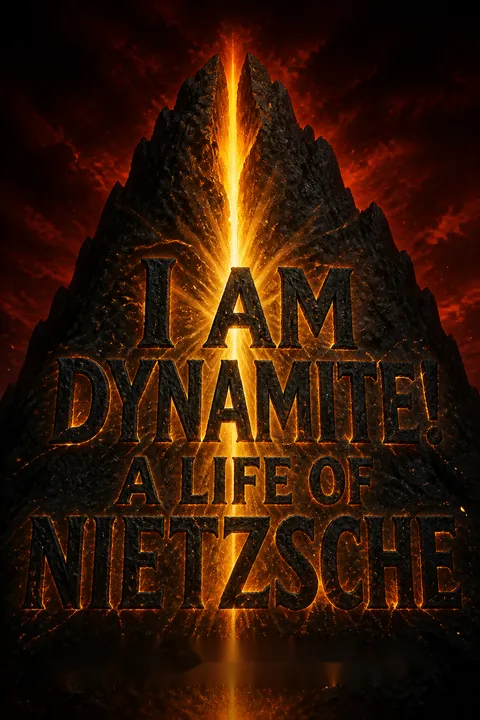
I Am Dynamite! A Life of Nietzsche by Sue Prideaux is a highly praised, accessible biography that humanizes the philosopher Friedrich Nietzsche. Reviewers commend Prideaux's engaging, narrative style that reads like fiction while maintaining scholarly rigor. The book traces Nietzsche's life from his professorship to his mental collapse, emphasizing how his physical suffering and personal relationships shaped his philosophy. A major strength is Prideaux's debunking of Nazi misappropriations of Nietzsche's work, largely orchestrated by his antisemitic sister Elisabeth. While some found philosophical analysis lacking, most appreciated the vivid portrayal of Nietzsche's loneliness, failed romances, and tragic final years, making his radical ideas more understandable.
People Also Read




Download PDF
Download EPUB
.epub digital book format is ideal for reading ebooks on phones, tablets, and e-readers.








































