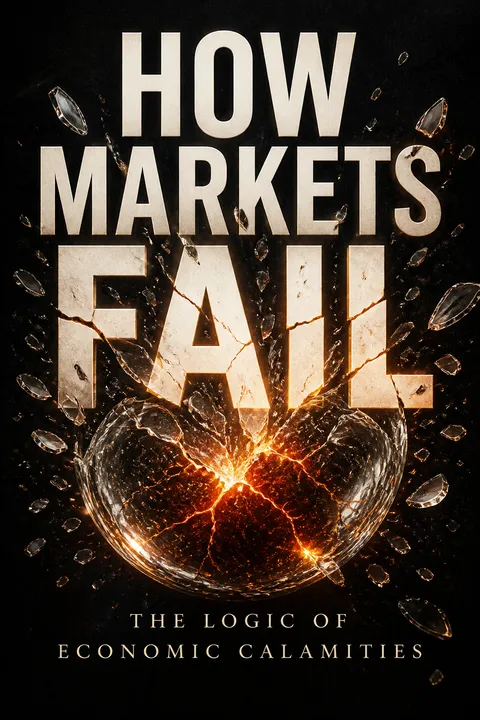

Key Takeaways
1. Utopian Economics: The Flawed Foundation of Free Market Dogma
“I found a flaw in the model that I perceived as the critical functioning structure that defines how the world works, so to speak,” he said.
A Shocking Admission. Alan Greenspan, long the high priest of free markets, admitted a "flaw" in his economic model after the 2008 crisis, a stark acknowledgment that the prevailing "utopian economics" was fundamentally mistaken. This ideology, rooted in Adam Smith's "invisible hand," posits that self-interested actions in competitive markets naturally lead to socially desirable outcomes, ensuring harmony, stability, and predictability. It became the bedrock of conservative counter-revolutions under Thatcher and Reagan, promising prosperity through deregulation and limited government.
The Intellectual Lineage. From Smith's division of labor to Hayek's market-as-telecommunications-system, the idea that prices efficiently convey all necessary information gained traction. Later, the "Lausanne School" (Walras, Pareto, Arrow-Debreu) provided mathematical proofs for market efficiency, suggesting that competitive markets are "Pareto-efficient"—meaning no one can be made better off without making someone else worse off. This theoretical elegance, however, often overshadowed the highly restrictive assumptions underpinning these models.
Ignoring Reality. Despite its intellectual sophistication, utopian economics often ignored real-world complexities. It assumed perfect information, no economies of scale, and stable, unique market equilibria, which later research showed were often not guaranteed. Milton Friedman, a key evangelist, dismissed these theoretical nuances, arguing that the efficacy of free markets was self-evident and that the Great Depression was a failure of government, not the market. This unwavering faith in self-correcting markets set the stage for future crises.
2. The Invisible Hand's Blind Spots: Market Failures Are Endemic
“Climate change presents a unique challenge for economics,” Stern concluded. “It is the greatest and widest-ranging market failure ever seen.”
Beyond Self-Correction. While Adam Smith's invisible hand suggests markets efficiently allocate resources, "reality-based economics" highlights pervasive "market failures" where this mechanism breaks down. Arthur Pigou, an early 20th-century economist, introduced the concept of "spillovers" or "externalities," where private costs and benefits diverge from social ones. For example, a power plant burning coal imposes environmental costs (pollution, global warming) on society that are not reflected in its private production costs, leading to overproduction of pollution.
A Taxonomy of Flaws. Francis Bator later categorized these failures, including:
- Monopoly Power: When a few large firms dominate an industry, they can set prices above costs, leading to inefficient outcomes.
- Public Goods: Services like national defense or streetlights are "nonrival" (one person's use doesn't diminish another's) and "nonexcludable" (difficult to prevent free riders), so markets under-provide them.
- Information Problems: When one party in a transaction has more or better information than the other, leading to adverse selection or moral hazard.
The Coase Theorem's Limits. While Ronald Coase argued that private bargaining could resolve externalities if property rights were clear and transaction costs low, this often fails in large-scale problems like pollution or climate change, where countless affected parties make negotiation impractical. These market failures are not mere anomalies but fundamental features of modern capitalism, necessitating government intervention to align private incentives with social welfare.
3. Rational Irrationality: When Self-Interest Undermines Collective Good
“Worldly wisdom teaches that it is better for reputation to fail conventionally than to succeed unconventionally.”
The Prisoner's Dilemma. Game theory reveals how individually rational actions can lead to collectively irrational and suboptimal outcomes. The "prisoner's dilemma" illustrates this: two firms might prefer to cooperate (e.g., install pollution filters, restrict output to raise prices), but each has an incentive to defect, fearing the other will exploit their cooperation. This leads to a "dominant strategy" of non-cooperation, resulting in a worse outcome for both.
Tragedy of the Commons. This dilemma extends to the "tragedy of the commons," where individuals over-exploit shared resources (e.g., overfishing, deforestation) because the private benefit of taking more outweighs their small share of the collective cost. This self-defeating behavior, termed "rational irrationality," is pervasive in economic interactions, from tacit collusion in industries to the over-exploitation of natural resources.
Keynes's Beauty Contest. John Maynard Keynes applied this logic to financial markets, describing investing as a "beauty contest" where participants try to guess "what average opinion expects the average opinion to be," rather than focusing on fundamental value. This "rational herding" means investors often follow the crowd, even when they suspect assets are overvalued, to protect their reputations or avoid being "early" (and thus "wrong"). This behavior amplifies market swings and contributes to bubbles, as seen in the dot-com era where hedge funds "rode the bubble, not fighting it."
4. The Peril of Hidden Information: Lemons, Moral Hazard, and Financial Fragility
“The least sophisticated borrowers are probably duped into taking these products.”
The Market for Lemons. George Akerlof's seminal work on "the market for lemons" demonstrated how "hidden information" can cause markets to fail. In the used car market, sellers know more about a car's quality than buyers, leading buyers to assume the worst. This "adverse selection" can drive out sellers of good cars, leaving only "lemons." This problem is widespread:
- Labor Market: Employers are wary of unemployed applicants, fearing they might be "lemons."
- Health Insurance: Insurers are reluctant to cover the sick, as they know more about their health than the insurer, leading to high premiums or denial of coverage.
Moral Hazard and Banking. Kenneth Arrow highlighted "moral hazard," where insurance changes behavior. Deposit insurance, while preventing bank runs, can incentivize banks to take on excessive risks, knowing the government will cover losses. This was evident in the Savings and Loan crisis of the 1980s, where deregulation combined with deposit insurance led to reckless lending and massive taxpayer bailouts.
Information Asymmetries are Pervasive. Joseph Stiglitz further argued that imperfect information is endemic to all markets, meaning they are generally not Pareto-efficient. Banks, as financial intermediaries, exist to mitigate these information problems by screening borrowers and monitoring loans. However, the rise of securitization allowed banks to offload loans, reducing their incentive to vet borrowers and creating a "loan pusher" mentality, exacerbating hidden information problems throughout the financial system.
5. The Illusion of Predictability: Why Financial Models Fail
“I believe that the VAR is the alibi bankers will give shareholders (and the bailing-out taxpayer) to show documented due diligence and will express that their blow-up came from truly unforeseeable circumstances and events with low probability—not from taking large risks they did not understand.”
The Efficient Market Myth. The "efficient market hypothesis" (Eugene Fama) claimed financial markets always price assets correctly, reflecting all available information. This "coin-tossing view" suggested market movements were random and unpredictable, making speculation futile. However, critics like Benoit Mandelbrot showed "fat tails"—extreme market moves are far more frequent than predicted by standard models—and "volatility clustering," where large changes follow large changes, indicating some predictability.
The Flaws of VAR. Despite these critiques, Wall Street embraced quantitative risk management, particularly "Value-at-Risk" (VAR) models. VAR promised to quantify worst-case losses with precision, but it relied on historical data and the flawed assumption that future market behavior would resemble the past. This led to:
- Understated Risk: VAR models understated "tail risk" during tranquil periods, as they lacked data on extreme events.
- Exaggerated Diversification: They assumed low correlation between assets, but during crises, "all correlations go to one," making diversification ineffective.
- Increased Leverage: Falling VAR estimates encouraged banks to reduce capital and take on more debt, increasing fragility.
Financial Weapons of Mass Destruction. Warren Buffett famously called derivatives "financial weapons of mass destruction," warning that they concentrated risk and were poorly understood. The unregulated Credit Default Swap (CDS) market, in particular, allowed firms to take on massive credit risk without setting aside capital, creating an illusion of safety. These models and instruments, rather than managing risk, enabled reckless leverage and provided a false sense of security, setting the stage for systemic failure.
6. Greenspan's Legacy: Cheap Money, Deregulation, and the Birth of Bubbles
“The traditional fixed-rate mortgage may be an expensive way of owning a home,” the Fed chairman said in 2004.
The Maestro's Missteps. Alan Greenspan's tenure at the Federal Reserve, particularly from the late 1990s, was marked by a disastrous combination of overly loose monetary policy and fervent deregulation. After the dot-com bubble burst, the Fed slashed interest rates to historic lows (1% in 2003), making borrowing incredibly cheap. This fueled an unprecedented credit boom, with total U.S. debt soaring by $13.5 trillion between 2002 and 2006, much of it in the financial sector.
Dismantling Safeguards. Greenspan, influenced by Ayn Rand's libertarianism, actively championed deregulation. He played a key role in repealing the Glass-Steagall Act, which had separated commercial and investment banking, and vehemently opposed regulating derivatives like Credit Default Swaps. His belief in "private regulation" and the market's self-correcting nature led him to dismiss warnings about rising leverage and complex financial instruments.
Bubbles and Blindness. Greenspan consistently downplayed the risk of a housing bubble, arguing that real estate markets were local and illiquid, and that the Fed should only "mitigate the fallout" after a bubble burst, not try to prevent it. This "disaster myopia" and "illusion of stability" meant the Fed ignored the growing risks. His policies effectively substituted one bubble (tech) for another (housing and credit), creating a dangerously overextended financial system.
7. The Subprime Chain: A System of Distorted Incentives and Opacity
“There is therefore an incentive for bank loan officers to become ‘loan pushers’ and loan traders rather than investigators of the soundness of the borrower’s use of loan money.”
From Hard Money to Mainstream. Subprime lending, once a fringe "hard money" business, exploded into the mainstream due to deregulation and the housing boom. Policymakers initially welcomed it as a way to expand homeownership, particularly for minorities, believing that new financial techniques could efficiently price risk. However, the securitization of subprime mortgages created a long, opaque "mortgage chain" with perverse incentives.
The Race to the Bottom. In this chain, mortgage brokers and lenders, paid on commission, had little incentive to vet borrowers, as they quickly sold loans to Wall Street firms. These firms, in turn, packaged thousands of risky loans into Residential Mortgage-Backed Securities (RMBSs) and Collateralized Debt Obligations (CDOs). The rating agencies, paid by the issuers, often gave these complex, thinly protected securities inflated "AAA" ratings, creating a "race to the bottom" in lending standards.
Rational Irrationality in Action. Banks and investment banks, eager for profits and market share, embraced these products, even "eating their own cooking" by holding large amounts of subprime securities in off-balance-sheet entities (SIVs) or on their own books. CEOs, driven by enormous incentive packages tied to short-term growth, engaged in "rational irrationality," knowing the risks but compelled to "dance" as long as the music played. This system, far from efficiently allocating capital, disguised and concentrated risk, creating a massive negative spillover that would eventually engulf the entire financial system.
8. The Great Crunch: From Liquidity Freeze to Systemic Collapse
“The problem was—people use the phrase ‘too interconnected to fail.’ That’s not totally accurate, but it’s close enough.”
The Wobble Begins. The financial crisis began in August 2007 when BNP Paribas froze redemptions from funds holding U.S. mortgage securities, citing "evaporation of liquidity." This exposed the hidden information problem: no one knew the true value of these assets or who held them. The interbank lending market seized up, forcing central banks to inject emergency liquidity, akin to the "synchronous lateral excitation" that caused London's Millennium Bridge to wobble.
The Loss Spiral. The crisis escalated due to "mark-to-market" accounting rules and high leverage. As asset prices fell, banks were forced to recognize losses, eroding their equity. To restore target leverage ratios, they had to sell more assets, driving prices down further in a "loss spiral." This self-reinforcing cycle, where falling prices generate more selling and losses, mirrored the housing market's own spiral of foreclosures and declining values.
Systemic Failure. The implosion of the shadow banking system, with SIVs collapsing back onto parent banks' balance sheets, concentrated risk at the heart of the financial system. The run on Bear Stearns in March 2008, driven by fears of its interconnectedness and illiquid assets, demonstrated that "too interconnected to fail" was a stark reality. The subsequent failure of Lehman Brothers and the near-collapse of AIG, due to its massive CDS exposure, confirmed that the financial system was not self-stabilizing but prone to catastrophic, Minsky-esque meltdowns.
9. The Government's Reluctant Rescue: Socialism for the Rich
“When I picked up my newspaper yesterday, I thought I woke up in France,” Senator Jim Bunning, a Republican from Kentucky, said at a hearing. “But no, it turns out socialism is alive and well in America.”
Crossing the Rubicon. The collapse of Lehman Brothers and the AIG bailout in September 2008 forced the U.S. government to abandon its laissez-faire stance. Despite initial reluctance and political backlash against "moral hazard," policymakers realized that the systemic interconnectedness of major financial institutions meant their failure would trigger a global catastrophe. This led to a series of unprecedented interventions:
- Fannie and Freddie Nationalization: The government took control of the two mortgage giants, injecting $100 billion each.
- TARP: A $700 billion program to buy toxic bank assets, later used for direct capital injections.
- FDIC Guarantees: Insuring bank debt, transferring credit risk to taxpayers.
- Fed's Expanded Role: Providing massive emergency loans and purchasing various assets to unfreeze credit markets.
The Cost of Inaction. These actions, though criticized as "socialism for the rich," were deemed necessary to prevent a second Great Depression. The global recession that followed still saw industrial production, trade, and stock markets diving faster than in 1929-30, underscoring the severity of the crisis. The interventions, however, did succeed in preventing a wholesale financial collapse, demonstrating that in times of market failure, only coordinated government action can overcome rational irrationality and stabilize the system.
10. Reality-Based Economics: A Call for Comprehensive Reform
“Our system failed in basic fundamental ways,” Treasury Secretary Timothy Geithner said in March 2009. “To address this will require comprehensive reform. Not modest repairs at the margin, but new rules of the game.”
Beyond Utopian Ideals. The Great Crunch exposed the fatal flaws of utopian economics, necessitating a shift to "reality-based economics" that acknowledges market usefulness but also its inherent limitations and tendencies to break down. Comprehensive reform is needed to prevent future calamities, moving beyond the false dichotomy of "liberty or socialism."
Key Reform Proposals:
- Securitization Accountability: Force banks to retain a significant portion (e.g., 20%) of securitized loans to ensure proper underwriting.
- Federal Mortgage Regulation: Standardize oversight of mortgage brokers and lenders, imposing strict predatory lending laws and establishing a Consumer Financial Protection Agency.
- Taming Wall Street: Impose maximum leverage ratios, higher capital and liquidity requirements, and transparency rules on all systemically important financial institutions, including large hedge funds and industrial finance arms.
- Derivatives Oversight: Mandate central clearing and public disclosure for all derivatives, closing loopholes for "customized" products.
- Executive Pay Reform: Implement government-mandated rules for Wall Street compensation, such as deferred bonuses and claw-back provisions, to curb excessive risk-taking and short-termism.
- Fed Mandate Expansion: Add financial stability to the Federal Reserve's dual mandate of maximum employment and price stability, forcing it to proactively address speculative bubbles.
A Hybrid System. The idealized free market is a fiction; reality demands a hybrid system of private enterprise and public supervision. The goal is not the "most advanced" financial system, but a "reasonably advanced but robust" one. This requires a fundamental mental shift among policymakers and economists, moving away from blind faith in self-correction towards a pragmatic understanding of market failures and the necessity of intelligent, coordinated intervention.
Review Summary
How Markets Fail receives generally positive reviews (4.06/5), with readers praising Cassidy's clear explanation of economic theory from Adam Smith through the 2008 crisis. The book's tripartite structure examines "Utopian Economics" (free-market ideology), "Reality-Based Economics" (Keynesian approaches), and the financial crisis itself. Reviewers appreciate the accessible writing and historical depth, though some criticize perceived bias toward Keynesian economics and insufficient discussion of government failures. Critics note the book is occasionally dense and dated, while supporters value its synthesis of complex concepts and critique of efficient market hypothesis.
People Also Read





About the Author
Other books by John Cassidy
Download PDF
Download EPUB
.epub digital book format is ideal for reading ebooks on phones, tablets, and e-readers.








































