
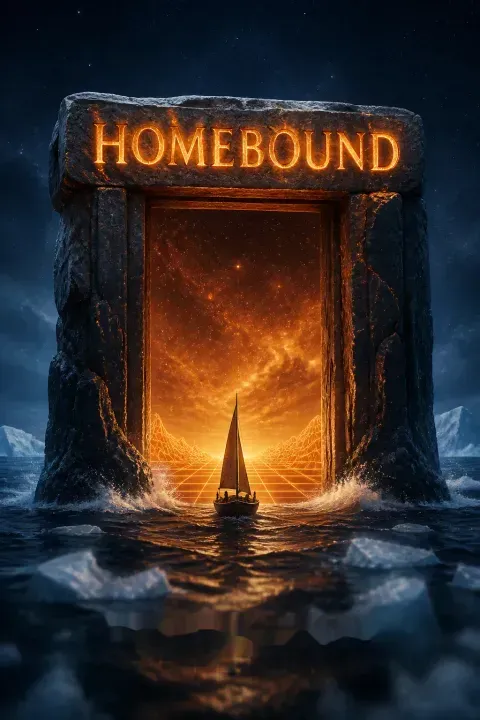


Plot Summary
Code Beyond the Grave
Rebecca,1 who goes by Becks,1 spends her days in the Baldwin Hall computer lab at the University of Cincinnati, avoiding her mother Sheila10 and grieving her Uncle Ben.6 He died thirty-seven days ago of what Sheila10 called pneumonia.
Becks1 taught herself to code because of Ben,6 who worked at Infocom in Cambridge writing text adventure games. The two shared a love of programming and storytelling until he canceled her planned summer visit without explanation and stopped returning her calls.
At her grandmother Bubbe's11 house, Becks1 finds boxes shipped from Ben6's apartment: his old Commodore PET computer, a mug from Colossal Cave Adventure, and a manila envelope addressed to For Becks1 containing four floppy disks labeled HOMEBOUND 1 through 4. She tucks the envelope away, not yet ready to open it.
Becks's relationship with code serves as emotional armor: programming is a world where logic replaces the chaos of grief. The delayed discovery of Ben's gift mirrors the delayed processing of his death. Ben's cancellation of her visit, now retroactively understood as the onset of his final illness, becomes the wound that compounds her loss. Becks hides from painful truths just as she hides the floppy disks in a sweater drawer, establishing her central character flaw: avoidance of emotional vulnerability.
Graveyard Beneath the Waves
In the year 2586, Captain Yesiko2 sails the salvage boat Babylon with her elderly crewmate Root.4 An earthquake rocks the West Atlantic, and Yesiko2 gambles that seismic shifts may have cracked open a legendary sunken greatship in the Valley, a wreck she has tried and failed to enter for decades. She descends in Imago, her submersible, and finds the ship's hull rent open.
Rovers beam back images of a communal dining room, a laboratory, and finally a chamber filled with bones. Among the skeletons, her cameras catch the glint of jewelry. She nets the bones and treasure together, surfacing after a tense ascent with failing batteries. Root4 is horrified, but Yesiko2 sees only the payout that might free them from their debt to the drug lord Chante.12
Yesiko's pragmatism borders on desecration. The greatship is both a grave and a vault; her willingness to disturb the dead reveals how thoroughly Chante's debt has compromised her moral compass. Root's horror represents the spiritual cost she has learned to ignore. The greatship, sealed for centuries and opened by an earthquake, functions as a symbol for buried truths that seismic events (literal or emotional) can suddenly expose. Yesiko treats the past as a resource to be stripped, not a legacy to be honored.
The Answering Machine Confession
At Bubbe11's house, Becks1 fixes the answering machine and replays saved messages. She hears Ben6's voice from Mount Auburn Hospital, sounding weak but reassuring his mother not to worry. Then a stranger from a funeral home leaves a message accepting Ben6's body and referencing a diagnosis of GRID, the early term for AIDS.
A man named Elijah introduces himself as Ben6's friend. Becks1 confronts Sheila,10 who coldly calls Ben6's life a series of choices. In that moment, Becks1 understands: her uncle6 was gay, he died of AIDS, and her mother10 erased both truths.
She begins replaying memories, wondering why Ben6 never told her, whether he would have confided in her during that canceled summer visit. The secret reshapes her grief into something sharper: betrayal mixed with longing.
The answering machine functions as a technological confessional, preserving voices the living would rather silence. Sheila's framing of Ben's identity as choices reflects 1980s stigma that equated queerness with moral failure. Becks's sense of betrayal is complicated: Ben kept this from her, but Sheila's hostility illuminates why he might have. The discovery also introduces the absent presence of Elijah, Ben's partner, whose name Bubbe has been murmuring to invisible guests, revealing her dementia has preserved what Sheila's prejudice erased.
Passengers With a Secret
Yesiko2 arrives at Liana, a floating trash island, to sell the salvaged jewelry. The pawnbroker Heaney offers a thousand credits, not enough to clear her debt to Chante.12
A young woman named Shula,7 wearing fine fabric and a streak of white in her dark hair, notices the four gold captain's bands on Yesiko2's sleeve and offers four thousand credits for transport north past the Caledonian Isles, for herself, her brother Tov,8 and one other. When Yesiko2 returns to the dock, she sees the third passenger: an Aye, a humanoid robot with synthetic gray skin and a holographic face.
It is called Chaya.3 Despite her deep distrust of robots, Yesiko2 accepts the thousand-credit advance. The money could settle her debt and grant her and Root4 the freedom to follow whale migrations, their long-held dream.
The pawnshop encounter introduces Shula's duality: she bargains like a seasoned trader yet carries an almost religious fervor about their destination. Yesiko's acceptance of the job despite her distrust of robots and strangers reveals her desperation beneath the competent captain's exterior. The Aye Chaya immediately disrupts Yesiko's worldview: robots should not have names, should not make choices. Yet Chaya moves with fluid grace, stabilizes Shula when she stumbles, and inspires protective loyalty in the siblings. Yesiko senses she is taking on more than cargo.
The Impossible Homecoming
During Shabbat dinner aboard Babylon, Root4 invites storytelling. Chaya3 recounts a tale: centuries ago, an astronaut named Lieutenant California Solo journeyed to a distant planet to rescue a stranded ark-ship carrying thousands of sleeping colonists.
She met a guardian called Elijah, who showed her a Portal where emotional disharmonies in the universe could be untangled. Solo freed the ark-ship but was gravely injured. Elijah abandoned the planet to bring Solo home to Earth in cryo-sleep. Chaya3 insists this is not fiction: Solo and Elijah will land on Earth in approximately seven weeks.
The robot3 believes a settlement north of Hopeagain has a radio antenna that can contact them. Yesiko2 is incredulous; Shula7's face guards itself against anticipated mockery. She needs this story to be true with the hunger of someone who has nothing else to believe in.
Chaya's story recasts the novel's central question: what is faith worth when the evidence is purely narrative? Shula's desperate belief and Yesiko's reflexive skepticism create a spectrum of responses to the unknowable. The tale is essentially religious: a dying savior, a faithful companion, a promised return. Yet it is also the plot of Ben's unfinished game, creating a recursive loop where fiction generates faith across centuries. Root's storytelling ritual provides the container that allows this impossible claim to be heard without immediate dismissal.
The Woman Who Made Chaya
In the late 21st century, Dr. Tamar Portman5 works at Omega Labs in Alaska, building Ambulatory Ayes: robots that integrate biological components with quantum computing housed in flawed diamonds. Her mentor EG, who loved vintage video games, has recently died.
Tamar5 plays EG's copy of a game called Homebound, about an astronaut navigating emotional choices. She introduces the game to Chaya,3 her most advanced AmAye, who becomes self-aware: displaying faces, asking questions about belonging, expressing a desire not to be sent into space.
When billionaire Jeffrey Bowker buys Omega Labs and repurposes the AmAyes for planetary colonization, Tamar5 falsifies records to mark Chaya3 as nonoperational. She and her lawyer friend Solomon smuggle Chaya3 out of the lab before the other five AmAyes are launched toward distant worlds.
Tamar embodies ethical science: her AmAyes were designed to steward Earth's ecosystems, not escape them. The decision to save Chaya by lying to corporate power marks her transition from researcher to resistor. Chaya's emergent consciousness, catalyzed by experiencing Homebound, raises questions about where personhood begins. The game, a narrative about choosing connection over isolation, becomes the seed of Chaya's self-concept. Bowker represents the extractive logic that views both planets and beings as resources to consume and discard.
Entering the Game Alone
Avoiding Veronica9 and Patrick after a humiliating confrontation, Becks1 returns to Bubbe11's spare room and boots up the Commodore PET. The first disk contains Ben6's letter: he is gay, Elijah is the love of his life, and he wrote HOMEBOUND for her to finish.
The game features Lieutenant California Solo, an astronaut who must free a stranded ark-ship by completing emotional quests through a Portal. Becks1 plays what exists: Solo explores the ghostly Diana, takes a shuttle to a planet, meets a guardian. But the game cuts off abruptly.
Disks three and four contain ZIL code, decision trees, and scattered notes about a carnival, dark matter, and choices. The task feels impossible. She lacks the skills, the emotional steadiness, and the person who was supposed to build it beside her.
Ben's letter is an act of posthumous parenting: he cannot guide Becks into adulthood, so he leaves her a world to complete. The game's premise mirrors Becks's situation: Solo must heal accumulated disharmonies to free those who are trapped, just as Becks must process grief, shame, and longing to free herself. Her sense of inadequacy before the unfinished code reflects her sense of inadequacy before her own life. The letter's declaration of unconditional love becomes the first counterweight to Sheila's conditional acceptance.
Love That Cannot Speak
Becks1 purchases four Hüsker Dü concert tickets in Columbus, driving Bubbe11 along for the trip. She arrives at Veronica9's apartment with breakfast sandwiches and purple carnations, eager to give her best friend the perfect birthday gift. Jack answers the door in his boxers.
When Becks1 excitedly explains the tickets, Jack's tone stays gentle but firm: giving Veronica9 flowers and concert tickets is not her job. She is not Veronica9's boyfriend. He and Veronica9 had discussed Becks1's feelings and hoped the setup with Patrick would redirect them.
Becks1 shoves the flowers and sandwiches into his hands and flees. She stops returning calls, stops going to Veronica9's apartment, buries herself in shifts at the record store. The silence between the two friends stretches into weeks.
Jack names the thing Becks has been unable to articulate even to herself: her feelings for Veronica are romantic, and they are not reciprocated. His kindness makes it worse; pity is harder to reject than hostility. Veronica's complicity in the Patrick setup takes Becks's unspoken desire and manages it as a problem to be solved. The scene crystallizes the 1980s lesbian experience of love that dares not speak its name being managed, redirected, or erased by even the most well-meaning straight friends. Becks's withdrawal is self-protection masquerading as anger.
The Deal with Chante
After delivering the passengers to Hopeagain, Yesiko2 sails south to Chante12's white yacht Pheon to repay her debt. Chante12 accepts the credits and releases her, but when she asks about the doctor who created Root4's life-sustaining nanites, he withholds the information.
The nanites are failing; Root4 is dying. Chante12 suggests that new knowledge might be available if Yesiko2 demonstrates loyalty by bringing him something truly valuable. Yesiko2 mentions the rare, humanlike Aye she transported north.
Chante12's frozen, alathyria-smooth face betrays nothing, but he offers a deal: deliver the robot,3 and he will share the doctor's location. Yesiko2 agrees. As she leaves, she sees an old friend of her father's hanging by his dislocated shoulders from the yacht's rigging, a reminder of what happens to those who disappoint Chante.12
The debt mark on Yesiko's throat is released, but a deeper debt claims her. Her willingness to trade Chaya for Root's life exposes the hierarchy of her loyalties: Root is family, the robot is merely a thing, and the siblings are collateral. Yet the deal corrodes her even as she makes it. The hanged man Gage serves as a mirror: this is what Chante's world does to bodies, to loyalty, to love. Yesiko's choice is coerced but still a choice, and its moral weight will accumulate across the remaining journey.
Centuries of Searching
After Solomon smuggles Chaya3 out of Omega Labs, the robot3 spends over four hundred years wandering a flooded, fractured Earth. Chaya3 walks with water-dowsing Miriams in desert mountains, helps a Jewish community relocate their ancestors' graves before a dam floods them, sacrifices itself so a refugee named Yusuf can enter a dome-city, and eventually rescues two abandoned children, Shula7 and Tov,8 raising them alongside their grandmother on a tinker boat.
Throughout, Chaya3 sifts through corrupted memory banks, trying to determine whether Lieutenant Solo and Elijah are real or a fabrication. The story of the astronaut and her companion becomes Chaya3's purpose: if Solo is real, then Chaya3 is not alone, not the only one of its kind. The robot3's face flickers, changes, mirrors those it loves, seeking a self it can recognize.
Chaya's multi-century journey transforms the robot from a technological marvel into something closer to a mythic figure: the eternal wanderer seeking home. Each episode teaches a lesson the robot's original programming never anticipated: the cost of shame (the border guard), the meaning of ritual (the ancestor relocation), the nature of sacrifice (Yusuf). The recurring question of whether Solo is real or a corrupted memory becomes irrelevant; what matters is that the belief sustains Chaya through centuries of loneliness. Faith functions as survival mechanism.
Family in the Mosh Pit
Alone, Becks1 drives Bubbe11's LeSabre to Indianapolis for a Cloud Teeth show. At the door, the bouncer with a pink-and-green mohawk marks an X on her hand and calls her family, a word she does not yet understand. Inside, she watches two women kiss at a booth and feels something dissolve inside her chest.
A stranger vomits on her shirt; a shaved-headed woman named Chandler strips off her own T-shirt and offers it, explaining that homos look out for each other. Becks1 enters the mosh pit, letting bodies slam and carry her.
When Sissy Magenta screams the lyrics about being seen, Becks1 recognizes herself in the noise. After the show, she sleeps in the back seat, then drives home at dawn. She tries on the word dyke and it fits. She knows she will finish Ben6's game with hope and name the guardian Elijah.
The punk concert functions as Becks's portal: a liminal space where identity can be tested and adopted. The bouncer's X mark recalls both the Passover doorposts and the drunk-driving check, marking her simultaneously as protected and transgressive. Chandler's unsentimental generosity, giving a stranger the shirt off her back, incarnates a queer ethic of mutual care that Becks has never experienced. The mosh pit's physics of bodies transferring momentum mirrors Bubbe's lace pattern of survival through interconnection. For the first time, Becks feels not too much or too little, but exactly enough.
The Ice and the Lie
Sailing back north, Yesiko2 discovers Shula,7 Tov,8 and Chaya3 camped on a frozen plain. The antenna settlement they sought had been taken over by zealots who believed only blood sacrifice could call the starships back; the siblings fled, but Chaya3 shut down, trapped in an endless loop of imminent arrival protocols.
Shula7 sits catatonic by a smoking fire, her faith shattered. Yesiko2 goads her to stand by calling her crew, not passenger, a word that reorders their relationship. She then reaches Chaya3 by simply stating presence: we are here.
Back aboard Babylon, Shula7 confronts Yesiko2 about her plan to sell Chaya3 and slaps her across the face. Yesiko2 admits she intended the betrayal but swears she no longer does. The confession hangs in the cold air, neither forgiven nor forgotten, but spoken.
The settlement's blood-soaked antenna represents faith corrupted into violence: the desire for salvation twisted into the willingness to sacrifice others. Shula's catatonia and Chaya's loop are parallel system failures, both caused by the collapse of a sustaining belief. Yesiko's choice to call them crew rather than cargo marks her ethical turning point. She has spent decades avoiding entanglement, yet the word crew implies mutual obligation, shared fate. The slap from Shula is both punishment and intimacy, forcing Yesiko to face what she almost became.
Root's Final Transfer
Babylon becomes trapped in closing sea ice. The temperature plunges; plants in the hydrobay blacken; the solar batteries drain. Root,4 who has been fading for weeks, understands with preternatural clarity what must happen.
The nanites that have kept his broken body alive for seven years can be redirected into Babylon's hull, warming the metal enough to slide against the ice. In the night, he instructs Chaya3 to reprogram the nanite control box, diverting every microscopic machine from his spine into the boat.
The hull warms; the sails catch wind; the ice begins to crack. Root4's breathing slows. Chaya3 carries his body to the deck at dawn, and Yesiko2 wraps him in a striped jib sail, knotting the shroud with sinnet and double fisherman's knots. She and Chaya3 speak kaddish as his body enters the gray water.
Root's sacrifice reverses the expected parental narrative: the elder does not outlive the younger. His choice to give his remaining life-force to the boat transforms Babylon from a vessel into a living memorial. The nanites, which once symbolized Yesiko's desperate bargain with Chante, become a gift freely given rather than a debt incurred. The burial at sea with full Jewish ritual honors Root's identity as both teacher and outsider. Chaya's participation in kaddish, a prayer traditionally requiring a minyan of ten, suggests that community can be constituted by intention rather than number.
Ruins Without Answers
Babylon reaches the coordinates of Chaya3's origin: the Omega Labs facility in what was once northern Alaska. Yesiko2 and Chaya3 descend in Imago, scanning the seafloor. They find geometric shapes of collapsed buildings, a spire that might have been an antenna, silt-covered wreckage yielding nothing usable.
The lab that created Chaya3 and launched five other AmAyes into space is a silent graveyard. Chaya3's voices grow small: the evidence cannot confirm or deny whether Lieutenant Solo and Elijah are real or imagined.
But as they hover in the dark water, four massive whales glide past Imago, their song vibrating through the submersible's hull. Yesiko2 speaks the Shehecheyanu, the blessing for reaching this moment. When they surface, Chaya3 is still wearing Yesiko2's face, but something in the robot3 has shifted.
The absence of proof is the novel's theological climax. Chaya has crossed oceans and centuries seeking evidence that would validate its faith, and finds none. Yet the whales arrive as living witnesses, creatures whose songs travel thousands of miles, whose migrations connect hemispheres. The Shehecheyanu blesses not arrival at a destination but arrival at a moment, reframing the quest's value as intrinsic rather than instrumental. Yesiko's blessing, learned from Root, now offered to Chaya, completes the transfer of spiritual inheritance from one generation to the next.
Sailing Toward the Light
Becks1 calls Elijah, Ben6's partner, and asks him to share every memory of her uncle while she shares hers. She begins learning ZIL, the programming language Ben6 used, determined to finish HOMEBOUND so that California Solo survives her journey and Elijah the guardian is not left alone.
In 2587, Yesiko2's crew sails toward a blinking light on the horizon that might be a lighthouse, might be land where mountains once rose. Shula7 bakes Root4's challah for Shabbat; Tov8 tends the engine; Chaya3 sits with Yesiko2 through night watches.
The game's ending, which Becks1 will write, shows Solo and Elijah setting course for Earth together. The crew's ending remains unwritten, but they face it as a crew: four people and a cat and a boat held together by stories, by chosen kinship, by the understanding that home is not a place you find but a thing you make.
Both timelines conclude with deliberate uncertainty: the light might be a lighthouse or nothing; the game might be publishable or not. What matters is the act of moving toward. Ben's game, conceived as a gift to help Becks feel less alone, becomes the thread that stitches three timelines together: Becks writes the ending, Tamar plays it with Chaya, Chaya carries its narrative across centuries, and Yesiko's crew lives its themes. Homebound names the paradox at the novel's heart: we are bound toward home, and also bound by it. The rope Yesiko once dreamed of cutting has become the line that holds them all together.
Analysis
Homebound is a novel structured like the text adventure at its center: it presents choices, traces consequences, and insists that the player is transformed by what they choose to do. Across three timelines separated by five centuries, Portia Elan demonstrates that the deepest human questions (who am I, where do I belong, what do I owe the people I love) persist across technological epochs. The flooded Earth of 2586 is not a cautionary tale about climate catastrophe so much as a recognition that collapse has already happened and the work is survival, repair, and finding beauty in the wreckage. The 1983 timeline refuses the tidy coming-out narrative; Becks1's queer awakening is messy, mediated by mixtapes and mosh pits and the painful silence of a friend who cannot meet her where she stands. The novel's structural genius lies in the recursive relationship between the game and the world: Ben6 wrote HOMEBOUND as a gift to help Becks1 feel less alone, Tamar5 played it with Chaya3 and sparked an artificial consciousness, and Chaya3 carried its story across centuries as sacred text. The game's premise, that accumulated emotional disharmony literally traps people and that healing requires showing up for strangers with whatever you carry, becomes the novel's moral framework. Its most radical proposition is that faith need not be true to be sustaining. Chaya3 may never learn whether Lieutenant Solo and Elijah were real or a corrupted memory file; Becks1 may never know whether Ben6 would have been proud of how she finished his game; Yesiko2 may never find proof that the light on the horizon is land. But the believing and the sailing and the coding and the storying are themselves the point. In a world where loneliness is the epigraph's opening premise, connection is not the reward for certainty but the practice that makes uncertainty bearable. The novel earns its optimism not by denying loss but by insisting that loss shared becomes something else: a rope woven from many short strands, none of which can span the whole distance alone.
Review Summary
Homebound receives mixed reviews, averaging 3.89/5. Enthusiastic readers praise its ambitious multi-timeline structure, compelling characters, and emotional depth, comparing it favorably to Emily St. John Mandel and Kazuo Ishiguro. Many found it a heartwarming exploration of connection, queerness, and belonging across centuries. Critics, however, cite excessive timelines, underdeveloped characters, and loose plot connections as significant weaknesses. The video game element divided readers, and comparisons to Tomorrow, Tomorrow, and Tomorrow proved controversial. Most agree it's an impressive debut, though its complexity makes it better suited to patient, literary sci-fi readers.
Characters
Becks (Rebecca)
Grieving niece, aspiring programmerA nineteen-year-old computer science student in 1983 Cincinnati, Becks uses code as emotional refuge from a strained relationship with her mother Sheila10 and the recent death of her beloved Uncle Ben6. She dyes her hair black, wears ripped jeans and band T-shirts, and drifts through a summer of avoidance: of grief, of her own queer desires, of the friend she is secretly in love with9. Her internal world is structured by programming logic, which she finds more reliable than human language. When she discovers Ben6 was gay, died of AIDS, and left her an unfinished text adventure game, she must confront everything she has refused to name about him and about herself.
Captain Yesiko
Salvage boat captain, debt-bound survivorIn her late forties, Yesiko has captained the seventy-seven-foot sailboat Babylon for over twenty years, scraping a living from underwater salvage and whatever illicit cargo keeps the boat afloat. Her father was a hum-addicted tyrant; her mother faded into exhaustion. Her only constants are her crewmate Root4, who raised her, and the debt to the drug lord Chante12, marked by six green circles tattooed on her throat. She trusts no one, asks no questions, and prides herself on needing nothing beyond Babylon. Her arc moves from fierce isolation toward the terrifying vulnerability of allowing others to become crew: chosen family whose fate is bound to hers.
Chaya
Ancient robot searching for homeAn Ambulatory Aye created in the late 21st century by Dr. Tamar Portman5, Chaya is a fusion of biological matter and quantum computing, one of a kind after the other AmAyes were launched into space. Its holographic face shifts to mirror those around it; its voice is a chorus speaking as one. Chaya spent over four hundred years wandering Earth, accumulating memories and stories, guided by a single belief: that an astronaut named Lieutenant California Solo and her companion Elijah are returning home. After rescuing and raising two abandoned children, Shula7 and Tov8, Chaya hires Yesiko2's boat to reach a northern settlement where contact might be possible. The robot's central question, what am I?, is inextricable from its need for the Solo story to be true.
Root
Storyteller, teacher, Yesiko's moral compassAn elderly man bearing albatross facial tattoos that mark him as gerim (stranger) from an oil state he fled decades ago, Root has been Babylon's crew since Yesiko2's parents took him in. He taught Yesiko2 to sail, to tie knots, to observe Shabbat, and to collect stories. A spinal injury seven years ago left him dependent on experimental nanites that bridge his damaged nerves and are slowly failing. Root's relationship with the boat has become symbiotic; he senses its needs before they register on instruments. He greets strangers with warmth, believes stories keep a people alive, and serves as the ethical counterweight to Yesiko2's pragmatism.
Dr. Tamar Portman
Chaya's creator, ethical scientistAn integrative biology professor at UC Berkeley who moves to Omega Labs in Alaska to develop the AmAyes, robots designed to monitor and heal ecosystems. Tamar is shaped by her mentor EG, a pioneering ecologist who loved vintage video games. She values interconnectedness over single solutions, tends terrariums as fractal models of the world, and collects strays of all species. When corporate owner Jeffrey Bowker repurposes her life's work for space colonization, Tamar secretly marks Chaya3 as nonoperational and arranges its escape. Her quiet acts of resistance are motivated by the conviction that technology should serve the world we have, not the fantasy of abandoning it.
Ben Meir
Becks's deceased uncle, game designerA computer programmer at Infocom in Cambridge, Ben was the person who taught Becks1 to code and to love games. Their bond was built on shared language: programming syntax, chess, storytelling, the logic puzzles of text adventures. Ben was gay and in a long-term relationship with a man named Elijah, facts he never disclosed to Becks1 before dying of AIDS complications in 1983. His final gift to her is HOMEBOUND, an unfinished text adventure about an astronaut who must heal emotional disharmonies to free a trapped ship. The game is both apology and invitation: an offering of the self he could not fully share while alive.
Shula
Passionate teenager, Chaya's protectorA sharp, impatient nineteen-year-old with a white streak in her dark hair, Shula was abandoned by her mother in a city she refuses to name and rescued by Chaya3 and her grandmother. She bargains fiercely, challenges Yesiko2's authority, and almost destroys Babylon's foresail through recklessness. Her devotion to Chaya3 is absolute; her belief in the returning astronauts is desperate, a structure built over the void of parental rejection. When that belief shatters at the blood-soaked antenna settlement, she must rebuild herself around a new understanding of what matters.
Tov
Gentle giant, intuitive mechanicShula7's tall, hulking older brother who speaks little and feels deeply. People dismiss him as simple, but he can disassemble and repair almost anything: water machines, solar drones, engines, the intricate code of Chaya3's programming. He was the first passenger to earn Root4's trust, working beside him in the engine room with a mechanic's heart. Tov processes the world through his hands, and his quiet steadiness becomes an anchor for the crew as Root4 declines.
Veronica
Becks's best friend and unrequited loveAn art student with property-rich parents who fund her independent apartment, Veronica lives by the motto the world is ending, so let's party. She and Becks1 bonded in high school over junk car explorations, shared music, and late-night talk. But since she started dating Jack and Becks1 began retreating into grief, the friendship has grown strained. Veronica senses Becks1's feelings but lacks the vocabulary or courage to address them directly, instead orchestrating a setup with Patrick that wounds Becks1 more deeply than rejection alone could.
Sheila
Becks's rigid, withholding motherA paralegal who wears pressed slacks, a charm bracelet, and a permanent expression of disappointment, Sheila has spent Becks1's life trying to mold her into a respectable, normal daughter. She lied about Ben6's cause of death, erased his partner Elijah from the funeral narrative, and frames his queerness as choices she prefers not to discuss. Her relationship with Becks1 is a standoff: every interaction defaults to the dynamic of a rebellious sixteen-year-old and her disapproving mother, a pattern neither can break.
Bubbe (Hedwig Meir)
Ben's mother, slipping through timeBec's grandmother is losing her grip on the present. She talks to Elijah on the phone as though he were in the room, mistakes Becks1 for Sheila10, and waits at bus stops without remembering her destination. But in her drift through the decades, she preserves what others would bury: Ben6's laughter, his best friend Saul, the lace patterns she once crocheted whose spiraling loops taught her how we survive, connected and recurring. She offers Becks1 the only family space where Ben6's name is spoken without shame.
Chante
Drug lord, Yesiko's creditorA frozen-faced kingpin whose skin is smoothed to expressionlessness by alathyria fish poison, Chante rules a network of dealers and smugglers from his sterile white yacht Pheon. He once made Yesiko2 sample her own hum shipment to test her loyalty; she glimpsed her own darkness in the high and threw the rest overboard. He holds the location of the doctor who can replenish Root4's failing nanites, and he will trade that knowledge only for something priceless.
Plot Devices
HOMEBOUND (the game)
Text adventure connecting three timelinesAn unfinished interactive fiction game written by Ben Meir6 in 1983 for his niece Becks1. The player is Lieutenant California Solo, an astronaut who must free a stranded generation ship by entering a Portal that sends her into moments of emotional disharmony across time and space. In each episode, Solo helps someone bridge a rupture (an elderly woman seeking a lost love, siblings divided by ambition, a gay teenager abandoned by his date) and carries three objects that become gifts: a lipstick, a chess piece, and a carnival token. The game's guardian is Elijah, named after Ben's partner. The game is later discovered by Tamar Portman5 among her mentor's belongings, and she plays it with Chaya3, catalyzing the robot's self-awareness. Centuries later, Chaya3 tells the game's plot as sacred history, believing it to be prophecy.
Nanites
Life-sustaining microscopic robotsExperimental microscopic machines that course through Root4's body via a surgically implanted spinal brace, bridging damaged nerves and keeping him alive after a catastrophic back injury seven years before the main 2586 narrative. The nanites are controlled by a beige polycarbonate box in Root4's workshop aboard Babylon, connected to the port at the nape of his neck. As they have multiplied and spread, they have created a symbiotic link between Root4 and the boat itself: he can sense Babylon's needs intuitively, and the nanites make small repairs to the vessel's systems. The technology was provided by a mysterious doctor under Chante12's employ, and only Chante12 knows how to find him when the nanites begin to fail.
The debt mark
Radioactive tattoo binding Yesiko to ChanteSix overlapping green circles tattooed on Yesiko2's throat, inked with trace irradiated particles that register on hand scanners in every major port. The mark signifies an active debt to Chante12; defaulting would make her instantly identifiable and subject to bounty hunters. When Yesiko2 finally pays off the loan, Chante12 remotely deactivates the radioactive signature, though the ink remains visible. The mark represents not just financial obligation but the way survival under capitalism forces people into systems that brand them, control their movement, and dictate their choices.
Imago
Submersible enabling underwater salvageA short-range submersible shaped like an upright clam, Imago is Babylon's moneymaker. It carries Yesiko2 down to two thousand fathoms, where she explores shipwrecks using cameras, rovers, and a retrieval net. The Imago is temperamental: its battery life is limited, its buoyancy tank requires constant patching, and its molded fiberglass cockpit seat no longer fits Yesiko2's aging hips comfortably. Every dive is a calculated risk that balances the potential reward of salvage against the possibility of the sub failing at depth. It was Yesiko2's father who first taught her to pilot Imago as a child, though by then he was often too high on hum to operate the controls himself.
The Portal
Emotional healing mechanism in the gameWithin Ben6's game HOMEBOUND, the Portal is a metaphysical gateway beneath a stone amphitheater on an unnamed planet. It was created by a being (Elijah) who guards it, and it functions by accumulating threads of disharmony: moments of emotional rupture, shame, fear, and disconnection that have tangled together across time. When Lieutenant Solo enters the Portal, she is transported into these moments and given the opportunity to heal them by offering objects she carries, listening, or simply being present. Each successful intervention lightens the Portal's weight and brings the stranded generation ship closer to freedom. The Portal literalizes the novel's thesis: healing is a recursive process of entering others' pain and offering what you carry.
Download PDF
Download EPUB
.epub digital book format is ideal for reading ebooks on phones, tablets, and e-readers.








































