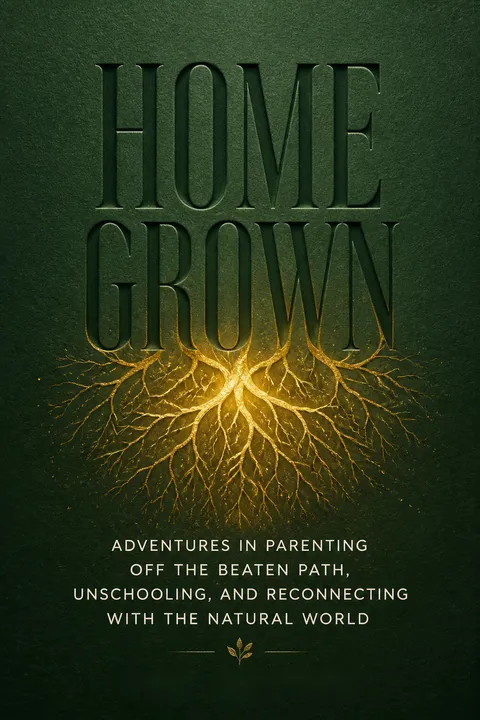

Key Takeaways
1. Unschooling: Learning is Innate, Not Taught
But of course children needn’t be taught how to learn; they just do.
Innate curiosity. The core principle of unschooling is that children are naturally curious and driven to learn, much like they are driven to breathe or walk. Formal instruction is often unnecessary and can even stifle this innate drive. The author's sons, Fin and Rye, demonstrate this by mastering skills like bow crafting or basic literacy not because they were told to, but because their internal desire to learn compelled them.
Beyond the classroom. Unschooling means learning through living, without a structured curriculum, grades, or tests. It's an active, inclusive approach that encourages engagement and leverages a child's natural curiosity. The author argues that formal instruction in subjects like reading, writing, spelling, and basic math is often unnecessary, as children assimilate these skills organically when they are relevant to their passions.
Questioning assumptions. The author challenges the societal assumption that children must be taught to learn, or that learning happens primarily in isolation from other aspects of life. He highlights the irony that while children are often forced into standardized learning, many adults struggle to recall what they learned in school because it felt irrelevant. Unschooling, in contrast, allows learning to be deeply personal and meaningful.
2. Nature and Place: The True Classroom
No matter where we live, Home Grown reminds us that learning at any age is a lifelong process, and that the best education is never confined to a classroom.
Deep connection. The Hewitt family's decision to unschool their children is deeply rooted in their belief that connection to nature and place is essential for human intellect and spirit. Every hour a child spends in a classroom is an hour not spent developing these vital connections outside. Their Vermont farm, with its fields, forests, and animals, becomes the primary learning environment for Fin and Rye.
Experiential learning. The boys' education unfolds through direct interaction with their surroundings. They learn about trees, plants, animals, and the cycles of seasons by exploring, observing, and participating in farm life. This hands-on, immersive experience fosters a tangible understanding of the world that cannot be replicated by textbooks or screens.
Richness of the "world at hand." The author advocates for showing children the richness of experience available directly outside their front doors, in their neighborhoods and communities. This contrasts with the constant expansion into new horizons and opportunities often pushed by modern society. The boys find fulfillment in the immediate, tangible world, whether it's crafting a bow from black locust or tapping sugar maples.
3. Reclaiming Time: Freedom Over Busyness
Is there really anything my sons might learn in school—to say nothing of what is learned in front of the television or peering into a smartphone—that is worth giving up so much of their lives for?
Prioritizing autonomy. The Hewitts consciously choose to prioritize freedom and autonomy over the accumulation of money and status, allowing them to allocate their time as they see fit. This decision directly enables their unschooling lifestyle and their deep engagement with their land. They measure wealth in terms of trees planted, time in the woods, and family meals, rather than financial metrics.
Resisting the "busy" culture. The family actively resists the pervasive culture of busyness, which often sees children's lives filled with endless extracurricular activities, homework, and screen time. They observe how this constant rushing fragments families and pulls them away from their homes and appreciation of their surroundings. Their sons' schedules are uniquely relaxed, allowing for self-directed play and exploration.
The cost of convenience. The author reflects on the "downside of convenience," noting how organized activities, while well-intentioned, can disrupt family life and diminish opportunities for self-directed play. He argues that the freedom to self-determine how to pass time cultivates discernment, teaching children that time is a finite resource and encouraging them to be particular about how they spend it.
4. Trusting Children: Fostering Responsibility and Resourcefulness
The more freedom and autonomy I allow my children to follow their passions and to learn on their own terms, the more passionate and eager to learn they become.
Empowering self-direction. The Hewitts grant their children enormous freedom to pursue their passions, believing that this fosters genuine engagement and a love for learning. This approach means allowing Fin and Rye to choose their own projects, from building shelters and crafting tools to hunting and trapping, even if these interests initially challenge parental comfort zones.
Responsibility through risk. The author challenges conventional parenting fears by allowing his young sons to handle knives and operate tractors, under supervision. He argues that taking responsibility away from children makes them less responsible. By exposing them to calculated risks and teaching them safe practices, the boys develop a profound sense of self-reliance, caution, and competence.
Learning from mistakes. The Hewitts embrace the inevitable mistakes and messes that come with children's hands-on learning. They understand that learning how not to bend nails requires bending some, and learning how not to pull up beets requires pulling some. This acceptance of imperfection is crucial for fostering confidence, skills, and resourcefulness, even if it means sacrificing immediate "productivity."
5. The Power of Mentors: Beyond Parental Guidance
The reality is that all of our children are in need of meaningful, mutually respectful relationships with adults and elders to facilitate learning and help children understand their role in their communities and, by extension, the world.
Community support. The Hewitts actively seek out mentors for Fin and Rye, recognizing that while they provide love and support, they cannot teach their sons everything. Mentors like Erik (wilderness skills instructor) and Nate (wilderness skills expert) offer specialized knowledge and experience that the parents themselves lack, enriching the boys' learning journey.
Filling the gaps. Mentors play a critical role in validating children's interests and instincts, especially when those interests fall outside the parents' expertise or comfort zone. Nate, for example, taught the boys about trapping ethics and techniques, providing a perspective that challenged the parents' initial reservations. His words carried the authority of experience and respect, which children often value from non-parental figures.
Disappearing role. The author laments the diminishing role of mentors in contemporary childhood, attributing it to the busyness of adult lives and children's packed schedules. He highlights the generosity required of mentors—time, knowledge, and an ethos of sharing—and how such relationships are vital for children to understand their place in their communities and the broader world.
6. Challenging Convention: Defining Your Own Success
I am often struck by the truth that the more thoroughly I liberate myself from prevailing cultural assumptions—around education, wealth, ambition, and success, to name but a few—the more choice I actually have.
Redefining wealth. The Hewitts consciously reject mainstream metrics of success, such as money, power, and recognition. Instead, they define their wealth in terms of freedom, autonomy, and meaningful connections to place and people. This "out-of-step" lifestyle, while sometimes isolating, allows them to live in alignment with their values.
Freedom from expectations. The author's own experience of dropping out of high school and discovering writing as a self-directed passion informs his belief that a meaningful life can be crafted outside conventional paths. He sees how not adhering to rigid planning freed him to live authentically, rather than serving assumed future interests.
Questioning the "greater good." The book challenges the notion that standardized education serves a "greater good," arguing that this "good" is often rooted in flawed ideologies that prioritize economic and social structures over individual well-being. The Hewitts believe that true success lies in the ability to determine one's own path and contribute to a world built on beauty, kindness, and connection.
7. Dignity of Labor: Learning Through Tangible Work
Growing food is one of those rare undertakings with the capacity to alter your perceptions so completely that something that might once have seemed objectionable and even disgusting becomes beautiful as the elegance of its true purpose is revealed.
Hands-on contribution. The Hewitts deeply integrate their children into the daily and seasonal work of their small farm, from moving cows and tapping maples to gardening and processing animals. This participation instills a sense of responsibility, usefulness, and an understanding of how their contributions directly benefit the family and farm.
Essential life skills. The boys learn practical, hands-on skills that are rapidly disappearing in modern society: identifying trees, butchering hogs, wielding tools, making fire, and understanding agricultural cycles. These skills are not abstract; they are directly tied to providing food, shelter, and warmth, fostering a profound sense of resourcefulness.
Quiet appreciation. The author emphasizes the quiet dignity of honest labor, much of which unfolds in anonymity, without external acknowledgment or acclaim. He observes this in his neighbor Melvin, a dairy farmer who finds deep satisfaction in his demanding work. This perspective teaches the boys to appreciate essential work and the people who dedicate their lives to it, fostering gratitude and humility.
8. Embracing Imperfection: Growth in Uncertainty
Our life is imperfect in no small part because we are imperfect people inhabiting an imperfect world.
Accepting the unknown. The Hewitts acknowledge the inherent uncertainty of parenting and life. They cannot guarantee their children's future outcomes or protect them from all challenges. Instead, they focus on the present, trusting that by allowing their sons freedom and fostering their innate learning, they will develop the adaptability and resilience needed to navigate an unpredictable world.
Flaws as character. The author views the unfinished aspects of their self-built home—a missing baseboard, an unpainted surface—not as failures, but as expressions of their personalities and imperfections. This acceptance extends to their parenting and educational choices, recognizing that striving for perfection is often counterproductive to genuine growth and happiness.
Coexisting with uncertainty. A crucial job for the author as a parent is to learn how to peacefully coexist with uncertainty. This means letting go of specific desires for his children's future and instead trusting in their capacity to find their own way. This mindset allows for greater freedom and less disappointment when life inevitably deviates from expectations.
9. Interconnectedness: We Are All Part of the Whole
We are all interconnected and interdependent, and because of this, we are all only as rich as we enrich those around us.
Beyond the individual. The author's experiences on the farm, from the smells of manure enriching the soil to the mutual aid in haying, reinforce a profound sense of interconnectedness. He sees himself not as the "master of his domain," but as a thread woven into the fabric of the land and community, dependent on millions of other visible and invisible threads.
Community bonds. Living between two dairy farms has been an "unanticipated and unplanned blessing," fostering relationships built on mutual need and shared labor. These ties, like haying with Martha and Lynn, go beyond mere convenience, creating a rare and valuable dependence that strengthens community bonds.
Nature's lessons. The natural world constantly demonstrates interdependence. The cows' quiet contentment, their generosity of milk and manure, and their acceptance of the elements offer a model for human behavior. The author learns that his perceived separation from nature is an illusion; by recognizing this, he can awaken dormant "sensory receptors" and hear the "whispered stories" of the world.
10. Parental Unlearning: The Journey of Letting Go
In a very real sense, it is not our sons who needed unschooling: it is us.
Challenging ingrained beliefs. The Hewitts' journey into unschooling required them to actively "unlearn" many of the expectations and assumptions they had been socialized to regarding education, wealth, and ambition. This process was often challenging, forcing them to step outside their comfort zones and question deeply held cultural norms.
Growth through observation. Abandoning preconceived notions about how their son Fin should learn allowed them to truly observe him. They discovered his capacity for tremendous focus when pursuing his passions, a stark contrast to his resistance to structured artistic activities. This observation became a crucial turning point, liberating them from rigid concepts and opening their eyes to a different path.
The gift of freedom. By granting their children the freedom to learn and grow at their own pace, the Hewitts inadvertently granted themselves the same freedom. This includes the freedom to be present, to develop patience, and to trust their instincts as parents. Their sons' unschooling became their own unschooling, a continuous process of self-discovery and liberation from societal pressures.
Review Summary
Home Grown receives mixed reviews, with an overall rating of 3.95 out of 5. Many readers appreciate Hewitt's thoughtful exploration of unschooling, alternative education, and simple living, praising the book's lyrical prose and thought-provoking reflections on childhood and freedom. However, critics note the memoir focuses heavily on the author himself rather than practical unschooling advice, with extensive descriptions of homesteading that some found self-righteous or unhelpful. Several readers felt the book was unrelatable, particularly those without access to rural farm settings.
People Also Read



Download PDF
Download EPUB
.epub digital book format is ideal for reading ebooks on phones, tablets, and e-readers.








































