
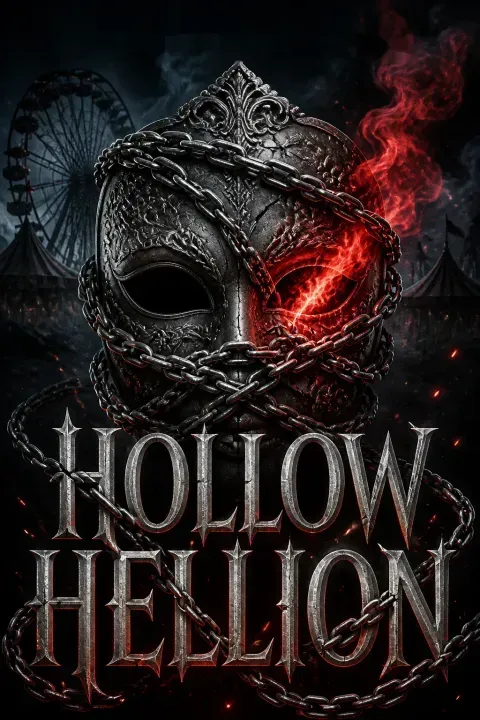


Plot Summary
Prologue
Noir1 runs through a rain-lashed forest, thorns slashing her nightdress, dogs and gunshots closing in. Beside her, her sister Arabella5 shouts for them to split up. Noir1 sobs, refusing to abandon her, but Arabella5 insists, promising to follow.
With a final look, Noir1 sees Arabella's5 shadowy figure swallowed by the dark. She forces herself forward, each stride a frantic hope for reunion and escape from the men who held them captive. The memory of that separation will haunt every step of her future.
This opening establishes the primal wound that drives Noir: the loss of her sister and the guilt of leaving her behind. The chaotic flight, the visceral danger, and the blur of memory signal a protagonist shaped by trauma and survival. The forest becomes a threshold between captivity and a fragile, uncertain liberty. Arabella exists in the shadows of Noir's mind, a ghost of hope and failure whose ambiguous fate will later manifest as hallucination, laying the groundwork for the book's exploration of fractured identity and the unreliability of memory.
The Poster at the Gas Station
Outside a crumbling gas station, Noir1 spots a weathered poster for Oddity Carnival & Cirque seeking dancers. Eli, her companion of four months,4 urges they join to escape cheap motels and his truck. Noir1 hesitates, years removed from the dance and aerial silks that once made her feel alive. She finally jots down the address.
Driving into a dense forest, she notices on her map a clearing shaped like a skull. Eli4 laughs it off, but unease coils in her stomach. They pass a sign promising a terrifying stay, and the bright day dims to grey gloom as they pass through the carnival gates, which stand open despite no visible life.
The poster functions as a lure into a literal and psychological underworld. Noir's reluctant agreement, born of exhaustion and Eli's coaxing, illustrates how weariness can override instinct. The skull-shaped landmark and the carnival's ominous welcome sign introduce the theme of fate disguised as choice. Noir's intuition prickles, yet she overrides it, pulled by a need for stability and a buried desire to reclaim her lost artistry. This moment sets the pendulum between self-preservation and the magnetic pull of the unknown.
Aerial Audition Under the Big Top
The old man Billy leads them to Madame, the carnival's elegant yet severe matriarch.6 Noir1 strips to her panties and sports bra, revealing the lattice of self-harm scars on her arms and thighs. Instead of revulsion, Madame's6 eyes show approval. Noir1 ascends to a silver hoop and, despite years without practice, delivers a breathtaking routine of drops, spins, and aerial silk work.
Madame6 applauds but initially refuses to house Eli,4 calling him weak. Noir1 issues an ultimatum: both stay or both leave. Intrigued by her boldness, Madame6 relents, assigning them a double-trailer and warning that Eli4 will need to prove himself or face the consequences of this place.
This scene establishes the transactional yet spiritual entry into Oddity. Noir's body, mapped with past pain, becomes her credential. Her audition is an act of reclamation: she transforms the scars that society would hide into a testament of survival that the carnival instantly recognizes. The negotiation over Eli reveals Madame's shrewd perception and Noir's fierce loyalty, while also planting the seed that Eli does not belong. The carnival accepts broken things, but only those strong enough to thrive in darkness.
Spiral Eyes at the Campfire
Blush, a fire dancer with pink-tipped hair,9 drags Noir1 to a campfire in the woods where the younger performers gather after midnight. Three dirt bikes roar into the clearing. The riders, known as the Hollows, dismount. Soul,7 with green spiral contacts and manic energy, lunges toward Noir,1 but the tallest one, Hellion,2 yanks him back by the scruff.
Hellion2 crouches before Noir,1 pressing a knife to her throat, his white-and-black spiral eyes boring into hers. He calls her 'Dolly' and declares she will be whatever he wants. Noir1 swats his arm away, the blade nicking her. His expressionless calm and intense stare spark a terrifying, unwanted thrill in her.
Hellion's intrusion is a trauma reenactment disguised as seduction. His immediate ownership language mirrors the abuser's lexicon, yet Noir's defiance and her body's involuntary arousal reveal the complex intersection of fear and desire that defines their bond. The public nature of his claim and the silent deference of the other performers establish Hellion as the apex predator of this domain. His fascination with her scars marks her as a kindred creature, setting the stage for a romance built on mutual recognition of brokenness.
The Voyeur at Her Window
Hellion2 stalks Noir1 to her trailer. While she showers, he watches through the window, seeing every scar, every curve. Eli4 joins her, his lovemaking gentle to the point of inadequacy. Noir1 places his hand on her throat, seeking dominance, but Eli4 refuses. Hellion's2 rage and desire surge; he recognizes that the man cannot give her what she craves.
When Noir's1 eyes meet his through the glass, she does not scream. She holds his gaze, unflinching, then slowly turns away as if daring him. This silent challenge cements his obsession. He retreats to his underground chamber, where he murders a bound victim, his mind consumed by how he will break and possess his Little Dolly.
This scene crystallizes the central sexual dynamic: Noir's unmet need for intensity and Hellion's predatory perception of it. His voyeurism is both violation and appraisal, and her refusal to react with fear transforms the power play. She inadvertently signals that she is not prey but a participant in a darker game. Hellion's retreat to murder reveals his method of processing arousal and frustration, linking violence and desire inextricably. The victim in his chamber becomes a surrogate for the control he will seek from Noir.
First Fall in the Death Rooms
One night, restless and craving air, Noir1 breaks into the fenced-off death rooms behind the Ferris wheel. Inside the dark building, she sees Arabella, her lost sister,5 who screams a piercing wail before disappearing through a door. Noir1 chases and plunges through the doorway, only to realize she is falling into a spiked pit.
A strong hand seizes her hoodie, yanking her back. It is Hellion.2 He carries her to a table in a red-lit room, pins her down, and demands she pleasure herself for him. When she struggles, he cuts her inner thigh with his knife, and the pain unlocks her first shattering orgasm. He sends her home with her soaked panties as a reminder of his claim.
The death rooms become a liminal space where Noir's fragmented psyche projects her deepest fears and where Hellion's role as both threat and protector solidifies. The hallucination of Arabella suggests unresolved guilt and the possibility of a fractured identity. Hellion's 'rescue' is another form of capture, yet his method of giving her pain as a path to pleasure taps directly into her conditioned response. This is the moment she learns that orgasm is possible, and that Hellion holds the key, binding them in a dependency that is both liberating and annihilating.
The Torture Machine Below
Hellion2 descends to his hidden bunker and finishes a contract killing, a man secured in a machine that screws into his eyes and snaps his neck. He pins the victim's photo on a board crowded with faces, but one picture stands out: a young woman with dark hair, labeled Harley.1 She is the only target who has escaped him, the murderer of his cousin Haze.
He tears the photo down, staring at it. The same night, he stitches a crude plush dolly for Noir,1 imbuing it with his scent and obsession. This juxtaposition of brutal murder and handmade gift distills Hellion's2 duality, the cold assassin and the obsessive admirer who will soon realize Noir1 and Harley1 are one and the same.
The underground chamber literalizes Hellion's compartmentalized psyche. The torture machine represents his methodical, detached violence, while the photo board shows an almost archival relationship to death. His fixation on Harley, the one who got away, suggests a wounded pride and a need for closure. The dolly he crafts for Noir is a fetish object, transferring his possessiveness from victim to beloved. The narrative seeds the collision between his professional duty and his personal obsession, creating dramatic irony as the reader understands the collision before the characters do.
Needle in the Neck
After discovering Hellion's2 bunker, Noir1 steals a syringe of etorphine. When next they meet, she corners him, stabbing the needle into his neck. He collapses onto his own surgeon's table, furious but immobilized. She climbs atop him, confessing her own dark desires, and rides him to a mutual climax while he strains against the chains.
This role reversal both terrifies and arouses him. When a victim in the room stirs, Noir1 obeys Hellion's2 command and throws a knife into the man's chest, securing his belief that she is truly like him. This act of murder cements her transition from victim to participant in his world.
This scene is a pivotal power transfer. Noir, who was systematically stripped of agency by her stepfather, seizes control using the very tools of Hellion's domain: drugs, chains, and violence. Yet her exercise of power is not vengeful but consensually transgressive; she offers him what he wants under her terms. The killing of the victim under his direction is a shared transgression that binds them in complicity. Hellion's grudging admiration becomes respect, and their relationship evolves from predator/prey to a partnership of mutual monstrosity.
Dark Night's Grand Guignol
Madame6 announces Dark Night, a private event where wealthy guests expecting a spectacle are instead slaughtered. Performers immolate, dismember, and shoot patrons. Noir1 witnesses a woman axed on a spinning wheel, a man melted by acid, and others crushed in the Glass Maze.
Hellion,2 now fully in his Hellion persona, pursues Noir1 through the maze, slipping in blood, catching her on the floor, and violating her violently as death screams echo around them. Glass walls crush fleeing guests. He brands her pubic area with his knife, carving 'HELL' into her skin. By dawn, she lies in his bed, having survived the night and fully initiated into the carnival's cult of death.
Dark Night materializes the carnival's raison d'être: a ritualistic slaughter that binds participants through shared atrocity. For Noir, it is a baptism of blood. Hellion's branding act of carving his name into her flesh is the ultimate possession, merging ownership with artistry. The Glass Maze sequence, where Hellion protects her from the traps even as he abuses her, demonstrates a proprietary care that perverts standard notions of safety. Her survival and subsequent calm acceptance signal that she has crossed a threshold, leaving behind the moral world and embracing the carnival's logic of horrific belonging.
Harley's Photograph Found
Wandering into Hellion's2 underground chamber, Noir1 finds the pinboard and recognizes her own face in a photograph. Hellion2 reveals that this woman, Harley,1 murdered his cousin Haze a year ago by slicing his throat and mutilating him. Noir,1 trembling, begins to piece together fragmented memories: the escape, the kitchen, the blood.
She confesses she is Harley,1 that Kyro, her stepfather and Hellion's uncle,3 kept her chained and raped her for years. She killed Kai in a psychotic break during her flight. Hellion,2 shocked, now faces an impossible conflict: his oath to avenge his cousin versus his obsession with the woman he now loves.
The revelation shatters the nascent trust between them, recasting their entire relationship as a trap designed by Kyro. Noir's confession reframes her trauma not as abstract suffering but as the direct cause of Hellion's loss. The photograph becomes a symbol of intersecting fates: Kyro used Hellion's quest for vengeance as a tool to punish both Noir and Hellion. This moment exposes the architecture of the story's central conspiracy, transforming their bond from chance encounter to calculated manipulation, and forcing a choice between blood loyalty and soul recognition.
I Choose You
Hellion2 consults Madame,6 who reveals a buried history: Noir's1 mother had an affair with Hellion's2 father, enraging Kyro.3 After his wife and Hellion's2 father died, Kyro3 faked Noir's1 death and imprisoned her out of vengeance, intending to sell her. The entire setup with Eli4 was orchestrated to deliver Noir1 into Hellion's2 hands, hoping he would kill her and unknowingly complete Kyro's3 revenge.
Furious, Hellion2 calls Kyro3 and declares he now knows everything. He renounces his loyalty, vowing to kill Kyro3 instead. Returning to his trailer, he finds Noir1 curled up, terrified. He climbs onto the bed, pins her down, and tells her he chooses her and will always choose her.
This decision constitutes Hellion's moral awakening, not toward goodness but toward a singular devotion that overrides all other codes. His choice dismantles the revenge narrative that has defined him, replacing it with a protective obsession that acknowledges Noir's victimhood without diminishing her. Madame's revelations recast the entire tragedy as a saga of generational passion and vengeance, giving mythic weight to their union. Hellion's declaration to Noir is the emotional climax of the novel, transforming their relationship from destructive obsession into a mutually chosen salvation.
Three Skulls of Sacrifice
Hellion2 brings Noir1 before the Shadow's Society council to plead mercy for killing a member. The three hooded men question Noir1 about her captivity and Kai's death. After deliberation, they grant mercy on condition: Hellion2 must draw three cards from the Deck of Skulls. The first, a gold skull, sentences him to eternal loyalty to the Society with no retrial.
The second, a black-crossed skull, orders mutilation of his right eye. The third, two skulls with a smaller one, demands a permanent vasectomy, stripping his right to father children. Hellion2 accepts without hesitation. Noir1 weeps as he is cut and operated on. He limps out, one eye bandaged, telling her she was worth every sacrifice.
The skull cards system externalizes the cost of loyalty in this brutal underworld. Each card demands a piece of Hellion's bodily autonomy or future, mirroring the same violation Noir suffered, but he gives it willingly. This ritualized punishment turns his choice into a physical covenant, scarring him as she is scarred. The grotesque symmetry of him losing an eye and reproductive capacity speaks to a theme of sacrificial love as mutilation. Noir's guilt is profound, but Hellion's unwavering acceptance reframes her worth not as cause for guilt but as something he willingly pays for, deepening the bond through shared physical diminishment.
Eli's Intestines on the Floor
Soul's7 investigation reveals Eli4 is a convicted pedophile on the run, hired by Kyro3 to shepherd Noir1 to Oddity. Noir1 finds Eli4 in her old trailer. He attacks her and tears the head off the mini dolly Hellion2 made her. Something inside Noir1 snaps. She grabs a kitchen knife, slices his stomach open, and when his guts spill, she reaches in and yanks them out hand over hand, screaming that he will never touch a child again.
Hellion2 and Wrath8 burst in to find her sitting in a pool of blood, catatonic. Hellion2 kneels, promising to repair her dolly. The killing is a cathartic exorcism of years of manipulated passivity, and Hellion's2 calm acceptance reinforces that her violence is not monstrous but just.
Eli embodies a more quotidian evil, predation masked as kindness, and his destruction of the dolly, a symbol of Hellion's handmade devotion, triggers Noir's full psychological break. The visceral, almost orgiastic killing channels all her suppressed rage against every abuser. It is her first independent act of lethal violence, and it is not performed under Hellion's direction but from her own fractured agency. His reaction, soothing rather than condemning, validates her rage and cements their relationship as one where even the most extreme acts are understood within a framework of shared darkness.
Plunging into the Sea
Kyro's3 men attack Oddity, spraying the carnival with bullets. Hellion2 throws Noir1 onto his bike, and they flee with Soul7 and Wrath.8 Six pursuers follow. Noir,1 making a desperate decision, guns the throttle toward a cliff edge. Hellion2 shouts for her to brake, but too late; they soar off and plunge into the stormy sea below.
Noir1 disappears beneath the waves. Hellion2 surfaces, screaming her name, but the currents yield nothing. He believes she is dead. Days later, he enters his underground chamber and finds a black thorned rose placed on his surgeon's table. A grin splits his face. She is alive, lurking in the shadows, forcing Kyro's3 guard down.
Noir's sacrificial act, though seemingly reckless, is a calculated gambit born of her understanding that Kyro will never stop while she lives. By faking her death, she seizes control of the narrative, becoming a ghost who can strike from darkness. The black rose, a symbol of their love that thrives in darkness, becomes a signal of survival and a promise of reunion. Hellion's grief transforms into renewed purpose. This turning point shifts their dynamic from protector/victim to equal conspirators in a revenge plot, each operating independently but toward the same end.
Burning the Childhood Cage
Noir1 breaks into Kyro's3 abandoned mansion, searching for proof of her sister Arabella's5 existence. Hellion,2 tracking her, corners her in the dark hallway. After a tense standoff, they reconcile passionately. He leads her to the room where she was chained for years. There, he produces a gasoline can and douses the floor, the bedframe, the walls.
He hands her a lit match. Without hesitation, she drops it, and the room erupts in flames. Standing at the fence, wrapped in Hellion's2 arms, she watches her childhood prison burn to ash. The fire consumes not just wood but the memory of every violation, every scream that died in those walls.
The arson is a ritual of psychic exorcism. Hellion's participation transforms it from solitary catharsis to shared sacrament. By giving her the match, he hands her the agency to destroy the physical locus of her trauma. The flames become a purification, a cremation of the girl she was and the rebirth of the woman who now stands with her avenger. The image of them watching the fire together cements their bond as one forged in destruction and regeneration, aligning their darkness toward creation rather than solely annihilation.
Kyro's Eyes Torn Out
The Shadow's Society tips Hellion2 that Kyro3 will be traveling to plead for mercy. Hellion2 mobilizes the Dark Night crew. They intercept Kyro's3 car on a wooded road, slashing tires and forcing a crash. Hellion2 drags Kyro3 out and beats his face to a pulp. Then he plunges his thumbs into Kyro's3 eye sockets, gouging them out while snarling that he will never look at Noir1 again.
He hands a machete to a trembling Noir1 and guides her hands onto Kyro's3 head. Together, they hack through the neck, pulling until the head comes free. The crew cheers as Soul7 and Wrath8 kick the severed head like a ball. Noir1 collapses in Hellion's2 arms, finally free.
This scene is an unflinching depiction of vigilante justice as catharsis. The blinding of Kyro reverses the gaze of power; the man who watched her suffer is now forbidden to see. Noir's active participation, her fingers in his eye sockets, her grip on his head, is the climax of her reclamation arc. She does not simply witness his death; she enacts it. The carnival crew's celebration reframes the act not as murder but as communal vengeance, sanctioned by their twisted code. The decapitation is a symbolic unseating of the patriarchal tyranny that dominated both Noir and Hellion's lives.
The Dove on the Scarred Ankle
A week after Kyro's3 death, Hellion2 leads Noir1 through the carnival and halts. Ahead stands Arabella,5 alive, her long dark hair unmistakable. Noir1 rushes into her sister's5 arms, sobbing. Hellion2 explains he found her in one of Kyro's3 other properties. The sisters, both abused and separated, now have a chance at a new life together at Oddity.
That night around a campfire, amid fireworks, Hellion2 pulls Noir1 close. He fastens a delicate silver anklet around the scarred flesh where she was once shackled. The charm is a dove with a black diamond. It is, he tells her, the only chain she will ever wear again, a symbol that she is free and will always be free with him.
The anklet, placed on the specific site of her binding, is a masterstroke of symbolic healing. The dove, usually a symbol of peace, is rendered in black diamond, recasting freedom as something hard, precious, and inextricable from darkness. The reunion with Arabella resolves the foundational trauma of the prologue, proving that her sister was real and that her guilt was misplaced. The campfire gathering, with the entire found family present, concludes the narrative by affirming that Noir has not only escaped her past but has constructed a new identity and a new home within the monstrous community. Love, in this universe, is a chain one chooses.
Analysis
Hollow Hellion operates as a dark fable about the reclamation of agency through the embrace of one's own monstrosity. Noir1 and Hellion2 are both products of systematic abuse, their identities forged by the Shadow's Society's cruelty and Kyro's3 generational vendetta. The novel posits that for some, healing does not lie in returning to a state of innocent wholeness but in finding a partner who understands the language of pain and can translate it into connection. Their sadomasochistic dynamic is not presented as pathology but as a legitimate form of intimacy, a shared vocabulary of sensation that bypasses the inadequacy of words. The carnival itself functions as a heterotopia, a space where society's rejects can construct a new moral code based on loyalty, spectacle, and brutal honesty. The novel challenges the reader to consider whether a monster who chooses to protect rather than destroy can be considered redeemed, or whether redemption is even a relevant concept in a world where victims become killers and killers become lovers. Ultimately, the story argues that freedom is not the absence of chains but the power to choose who holds the key, and that love, in its most extreme form, is indistinguishable from obsession.
Review Summary
Hollow Hellion is a dark, twisted romance set in a creepy circus. Readers praise the intense, unhinged characters, particularly Hell and Noir, and the atmospheric setting. The book features extreme violence, explicit sexual content, and disturbing themes. Many reviewers found it addictive and thrilling, while others felt it was too intense or lacked depth. The spice level is consistently described as very high. Trigger warnings are strongly emphasized. Overall, it's a polarizing read that appeals to fans of dark romance and horror.
People Also Read

Characters
Noir (Harley Miller)
Trauma survivor, aerialist, kill-switchA young woman on the run, her body mapped with self-harm scars and her mind fragmented by years of captivity and rape by her stepfather Kyro3. She dyes her blonde hair and goes by Noir to hide. She finds solace in pain, a masochism born of abuse, and has a fierce, pragmatic resilience. Her emotional range is blunted, but her instinct for survival is razor-sharp. As the story unfolds, she reclaims her identity as Harley, confronts her abuser, and discovers a capacity for both love and lethal violence. Her relationship with Hellion2 becomes the crucible in which she transforms from victim to avenger, finally finding a dark, unconventional freedom.
Hellion (Hell)
Obsessed ringleader, sadist, protectorA tattooed, pierced, paint-masked daredevil and contracted torturer for the Shadow's Society. He presents as calm and calculating, but beneath lurks Hellion, a persona of pure id released during Dark Night. His upbringing in the Society stripped him of empathy, yet he possesses a twisted code of loyalty. Upon meeting Noir1, he becomes instantly, irrevocably obsessed, claiming her as 'Dolly.' His sadism aligns with her masochism, creating a bond that defies conventional morality. When he learns she is the target he swore to kill, he chooses her over blood and oath, sacrificing his eye, fertility, and freedom to save her. His character arc moves from predator to devoted guardian without ever ceasing to be monstrous.
Kyro
Villainous stepfather, architect of revengeHellion's2 uncle and Noir's1 stepfather, a wealthy, sadistic man who orchestrated a decades-long vendetta. After his wife had an affair with Hellion's2 father, Kyro caused a car crash that killed her, faked Noir's1 death, and kept the girl imprisoned, repeatedly raping her as 'training' to be sold. He manipulated events so that Hellion2 would unknowingly target Noir1, hoping nephew would kill niece, completing his revenge. His cruelty is methodical, his patience monstrous. He uses people like Eli4 as pawns. Ultimately, his arrogance and the Society's betrayal lead to his brutal death at the hands of the two people he sought to destroy.
Eli
False companion, hidden predatorA recovering heroin addict who found Noir1 on the roadside and became her traveling companion and lover. He presents as gentle but is secretly a convicted pedophile on the run, hired by Kyro3 to shepherd Noir1 to Oddity. His sexual inadequacy frustrates Noir1, and his growing jealousy over Hellion2 fractures their bond. When his true crimes and role in Kyro's3 scheme come to light, Noir1 eviscerates him in a rage, her killing marking her final separation from manipulated passivity. He functions as the mundane evil that contrasts with Hellion's2 more grandiose darkness.
Arabella
Lost sister, hallucination made realNoir's1 younger half-sister, unknown to her until they were imprisoned in adjacent rooms by Kyro3. Arabella helped orchestrate Noir's1 escape, but they were separated. For much of the story, Noir1 believes she may be dead or a figment of her fractured psyche, seeing her in hallucinations. In reality, Arabella was recaptured and held elsewhere by Kyro3. She is resilient, pragmatic, and shares a deep bond with Noir1. Her eventual rescue and reunion provide Noir1 with the familial closure she desperately needs, proving that some hopes are not illusions.
Madame
Maternal ringmaster, keeper of secretsThe elegant, middle-aged woman who runs Oddity Carnival & Cirque with an iron hand. She can sense darkness in people and hires those who belong to its world. She becomes a surrogate mother figure to Hellion2, having taken him in at thirteen after his mother died. She also extends a strange care to Noir1, offering wisdom and wine. She knows the tangled history between the families and eventually reveals to Hellion2 the affair that started the cycle of vengeance. Her authority is absolute within the carnival, and she manages the deadly performances with theatrical flair.
Soul
Hollow brother, manic hackerOne of Hellion's2 two closest companions, a green-eyed daredevil with split tongue and manic energy. Despite his name, he is soulless, a product of the Society's brutal training. He masks his inner deadness with a party persona. He is a skilled hacker who uncovers Eli's4 past and assists in the family's schemes. He reluctantly participates in Hellion's2 degradation games and harbors some denial about his bisexuality. His bond with Hellion2 and Wrath8 is unbreakable, forged through shared trauma.
Wrath
Mute enforcer, word-carverThe most terrifying of the Hollows, a red-eyed, shirtless figure with selective mutism. He rarely speaks, communicating through gestures and intense stares. His particular madness involves writing words all over the skin of dead women he keeps as 'art projects.' Despite his grotesque habits, he is fiercely loyal and participates in all the family's missions. His ominous presence and the dark fascination he sparks in Blush9 suggest a future story. He shoots Kyro's3 fingers off during the ambush without hesitation.
Blush
Fire breather, loyal friendA dancer and fire breather with pink-tipped black hair and peachy-colored contacts. She befriends Noir1 immediately, introducing her to the campfire gatherings and defending her against Pearl's jealousy. She is cheerful but capable of extreme violence during Dark Night. She has a crush on Wrath8, despite knowing his dangerous nature, and helps Noir1 navigate the carnival's social landscape. Her loyalty is absolute.
M (The Monster)
Hellion's scarred, feral petA massively scarred, chained man used as a terrifying act in the circus. Hellion2 rescued him from an abusive carnival and keeps him caged but treats him with a strange kinship. Noir1, recognizing the scars on his ankles as similar to her own, shows him compassion, and he responds to her gentleness. He represents the possibility of redemption even for those deemed monstrous, and under Noir's1 influence, he is eventually allowed more freedom.
Plot Devices
The Mini Dolly
Handmade symbol of obsession and loveA crudely stitched plush doll with cross eyes and yarn pigtails that Hellion2 makes for Noir1 early in their relationship. It becomes a token of his devotion and a stand-in for her identity as his 'Little Dolly.' When Eli4 tears its head off before attacking her, the destruction triggers Noir's1 homicidal rage. Hellion2 later repairs it, and she keeps it as a cherished possession, cementing its role as a symbol of their bond and her reclaimed sense of self.
The Black Rose
Signal of survival and dark loveAfter faking her death by driving off a cliff, Noir1 leaves a single black thorned rose on Hellion's2 surgeon's table. The rose, a flower that thrives in darkness, communicates that she is alive and still devoted to him. It prompts Hellion2 to resume his hunt, leading to their reunion at Kyro's3 mansion. The black rose becomes their shared symbol of a love that exists outside conventional light.
The Deck of Skulls
Randomized punishment contractA method used by the Shadow's Society for determining the price of mercy. Cards painted with skulls and symbols are drawn by the petitioner, and each card specifies a physical or contractual cost. Hellion2 draws three: eternal servitude without retrial, mutilation of the right eye, and permanent vasectomy. The cards represent the arbitrary cruelty of the underworld's justice system and test the depth of Hellion's2 commitment to Noir1.
The Etorphine Syringe
Tool of role reversal and trustNoir1 steals a veterinary-grade tranquilizer from Hellion's2 medical drawer and uses it to inject him, temporarily paralyzing him. She then chains him to his own table and takes sexual control, flipping their dominant/submissive dynamic. This act proves to Hellion2 that she is not merely a victim but a dangerous equal. The needle becomes a symbol of her resourcefulness and her willingness to play his games on her own terms.
The Anklet with Dove Charm
Final symbol of chosen freedomAfter Kyro's3 death, Hellion2 presents Noir1 with a silver anklet featuring a dove charm with a black diamond. He fastens it around the ankle that once bore the scars of Kyro's3 chains, declaring it the only chain she will ever wear again. The dove, traditionally a peace symbol, is recontextualized in black, signifying that her freedom is not innocent but hard-won. It encapsulates the novel's thesis: that love and liberation can exist within darkness.
About the Author
Other books by Jodie King


Download PDF
Download EPUB
.epub digital book format is ideal for reading ebooks on phones, tablets, and e-readers.








































