
Key Takeaways
1. American Individualism: A Double-Edged Sword
Individualism, the first language in which Americans tend to think about their lives, values independence and self-reliance above all else.
Core American value. Individualism is deeply ingrained in American culture, prioritizing independence and self-reliance. This foundational belief shapes aspirations for self-confidence, energy, and integrity, driving personal achievement since the nation's inception.
Hidden anxieties. Despite its celebrated virtues, individualism fosters a "haunting fear that things have somehow gone wrong." This leads to distrust in institutions and neighbors, and the unique American belief that economic success is solely individual responsibility, often obscuring systemic issues.
A cancerous growth. The authors warn that individualism may have become "cancerous," destroying social bonds and threatening freedom. While valuing individual dignity, radical individualism can lead to isolation, undermining both public and private life, necessitating critical re-evaluation.
2. Two Faces of Individualism: Utilitarian and Expressive
We found that it took both a "hard" utilitarian shape and a "soft" expressive form.
Dual manifestations. American individualism appears in two primary forms: utilitarian and expressive. Utilitarian individualism focuses on practical success, competition, and extrinsic rewards, valuing toughness and often dismissing "losers."
Focus on feelings. Expressive individualism, conversely, centers on feelings, self-realization, and personal gratification, often therapeutically. It prioritizes individual choice and inner experience, detached from external moral frameworks.
Societal impact. Both forms contribute to a culture where personal preferences are ultimate arbiters of value. The authors question if either form adequately serves society, suggesting they can lead to isolation and a "qualified no" regarding their long-term benefit.
3. The Erosion of Civic Membership and Social Capital
What we mean by the crisis of civic membership is that there are, at every level of American life and in every significant group, temptations and pressures to disengage from the larger society.
Disengagement from public life. A profound crisis of civic membership plagues America, marked by widespread disengagement from public life. This includes declining participation in civic organizations, reduced public trust, and a weakening sense of obligation to the broader community.
Declining social capital. This disengagement depletes "social capital"—networks, norms, and trust for mutual benefit. Evidence includes drops in:
- League bowling
- Union membership
- Public meeting attendance
Even growing "support groups" often involve individuals "focus[ing] on themselves in the presence of others."
Class disparities. Widening class disparities exacerbate the crisis. A "deracinated elite" secedes into enclaves, losing civic consciousness. An "impoverished underclass" is pushed out, deemed redundant. The "anxious class" (middle class) faces economic uncertainty, prioritizing individual survival over social solidarity.
4. Neocapitalism's Reinforcement of Individualism
The neocapitalist vision is viable only to the degree to which it can be seen as an expression—even a moral expression—of our dominant ideological individualism, with its compulsive stress on independence, its contempt for weakness, and its adulation of success.
Ideological fervor. Neocapitalism thrives by aligning with American individualism, framing economic success as solely individual responsibility. It reinforces independence and adulation of winners, often dismissing losers, and interprets structural problems as personal failings.
Blaming the victim. This ideology often blames individuals for systemic issues like poverty, portraying welfare as creating dependency despite evidence. This narrative comforts the affluent and diverts attention from collective responsibility for economic and political failures.
Privatization and profit. Neocapitalism champions privatization, even for public services like healthcare, leading to elite profits and reduced services for the less fortunate. It implies those without care are to blame, while the wealthy are entitled to siphon resources.
5. The "Unencumbered Self" and its Emptiness
The ideal self in its absolute freedom is completely "unencumbered," to borrow a term from Michael Sandel.
Radical autonomy. Modern individualism fosters an "unencumbered self," detached from social and cultural contexts, free from tradition and obligation. This self is the sole source of its judgments, making its fulfillment the ultimate meaning of life, rooted in modern philosophy.
Arbitrary values. When the self defines its own values, but these choices are arbitrary, each self becomes its own moral universe. There are no objective criteria for right or wrong; what is good is simply what one finds rewarding or "feels good."
Illusory freedom. This radical autonomy, while promising liberation, often leads to emptiness and isolation. The self, perpetually in progress but without fixed moral ends, struggles for meaning beyond momentary desires. It's a "self that hangs in the void, slowly twisting in the wind."
6. Work: From Calling to Career/Job
But the calling not only links a person to his or her fellow workers. A calling links a person to the larger community, a whole in which the calling of each is a contribution to the good of all.
Lost moral meaning. Historically, work was a "calling," a moral activity contributing to the common good, connecting individuals to a community of practice and wider society. Today, work is largely a "job" (making money) or "career" (personal advancement), losing its intrinsic moral purpose.
Self-definition through achievement. Identity is often defined by career progress, measured by promotions and financial success. This utilitarian pursuit of success can overshadow deeper purpose, leading to a "suffocating" identification with work that lacks social responsibility.
Midlife disillusionment. Career trajectories often flatten in midlife, causing disillusionment when the "Number One" dream fades. Without a calling, work loses meaning, pushing individuals to seek fulfillment in private life or "lifestyle enclaves," highlighting the split between work and collective well-being.
7. Love and Marriage: Fragile Bonds of Self-Interest
The love that must hold us together is rooted in the vicissitudes of our subjectivity.
Subjective foundations. Americans idealize love as the basis for enduring relationships, yet marriage is increasingly precarious. Love defined by spontaneous feelings makes commitment fragile when emotions fluctuate, creating a dilemma where love is desired but inherently unstable.
Self-preservation in intimacy. The therapeutic attitude encourages self-knowledge and self-realization even in intimacy. This can lead to a "selfishness" essential to love, where partners assert needs and may leave if a relationship no longer serves self-interest. Communication replaces substantive duties.
Erosion of commitment. Many desire lasting love but resist obligations beyond personal wishes, fearing loss of individuality. "Sacrifice" is reframed as something one wants to do. This contractual view of intimacy struggles to justify enduring commitment beyond immediate satisfaction.
8. The Therapeutic Ethos: A Model for All Relationships?
The therapeutic attitude liberates individuals by helping them get in touch with their own wants and interests, freed from the artificial constraints of social roles, the guilt-inducing demands of parents and other authorities, and the false promises of illusory ideals such as love.
Pervasive influence. The therapeutic attitude has permeated American middle-class culture, shaping views on relationships, family, work, and society. It emphasizes self-knowledge, self-realization, and open communication, often seeing external obligations as hindrances to authentic selfhood.
Intimate yet instrumental. Therapy itself is an intimate yet distanced, fee-based relationship, modeling personal growth as a paid service. This encourages viewing relationships as means to personal ends, training individuals to be "better communicators" for effective coordination in a complex society.
Limits in public life. While useful for managing feelings and navigating bureaucracy, the therapeutic ethos struggles with public life. It dismisses moral arguments as futile and politics as too complex due to conflicting subjective "values," lacking a framework for common moral discourse beyond individual preferences.
9. Politics: From Community Consensus to Conflicting Interests
What is paradoxical in this picture of the three types of American politics is that in an individualistic culture that highly values diversity and 'pluralism,' it is consensus that is appreciated and the conflict of interests that is suspect.
Three political conceptions. American politics is understood through three lenses: "politics of community" (consensual, local), "politics of interest" (pursuit of differing interests, often negative), and "politics of the nation" (statesmanship, national purpose). These often conflict.
Distrust of interest politics. Despite valuing pluralism, Americans distrust "politics of interest," seeing it as power-driven rather than fair. This stems from individualism's subjective moral views, making genuine adjudication of conflicting interests seem impossible without coercion.
Invisible complexity. The individualistic framework struggles to explain conflicting interests or large-scale societal structures. This "invisible complexity" reduces group claims to competing "wants," satisfied by power, not justice. This hinders articulating a common good beyond self-interest.
10. The Illusion of Small-Scale Solutions
To imagine that problems arising from failures rooted in the structure of our economy and polity can primarily be traced to the failings of individuals with inadequate family values seems to us sadly mistaken.
Misplaced blame. Attributing societal problems to "family values" or limited "community" is a "sadly mistaken" diagnosis. It blames individuals for structural economic and political failures, increasing personal guilt and diverting attention from collective responsibility.
Limitations of localism. While local communities are valuable, they are insufficient for deep structural problems. An exclusive focus on small-scale community can reinforce social divisions, as residential segregation means local solidarity might not bridge class or racial divides.
Hostility to government. These narrow solutions often involve hostility towards government, seen as an interfering entity. This individualistic mindset overlooks market biases and the necessity of effective government and a strong independent sector for a complex modern society.
11. Reclaiming Our Traditions: Biblical and Civic Republicanism
At such times in the past Americans have turned to other cultural traditions, particularly those we termed the biblical and civic republican understandings of life.
Alternative moral languages. When individualism falls short, Americans have historically drawn on "second languages" from biblical and civic republican traditions. The biblical tradition emphasizes the intrinsic value of all individuals, asserting an obligation for mutual respect and concern for the common good.
Common moral purpose. Civic republicanism, guiding the founders, views the American experiment as a project of common moral purpose, placing responsibility on citizens for collective welfare. Both traditions highlight the social dimensions of the person, showing true freedom lies in fulfilling our social nature, not rejecting it.
Beyond radical individualism. These traditions counter radical individualism's focus on adolescent independence. They remind us that being "one's own person" means acknowledging interdependence. Reappropriating these traditions is crucial for replenishing cultural resources and moving society towards coherence.
12. Transforming American Culture: A Call for Social Ecology
We need to learn again from the cultural riches of the human species and to reappropriate and revitalize those riches so that they can speak to our condition today.
A new integration. The authors propose a "social ecology" or "moral ecology" for a new level of social integration, where human beings and their societies are deeply interrelated. This requires reversing modernity's cultural fragmentation by revitalizing humanity's "cultural riches" to address contemporary challenges.
Reconstituting the social world. Transformation must be multi-layered: personal commitment, nurturing moral traditions within groups, and institutional changes through social movements. This means restoring democratic politics and encouraging economic democracy and social responsibility, moving beyond narrow political economy.
Beyond the "private dream." The "American dream" of private success often conflicts with a livable society. Overcoming this requires reducing "punishments of failure and rewards of success," reappropriating work as a "calling" for the common good, and fostering intrinsic satisfactions. This would mend the public/private split, leading to genuine human flourishing.
Review Summary
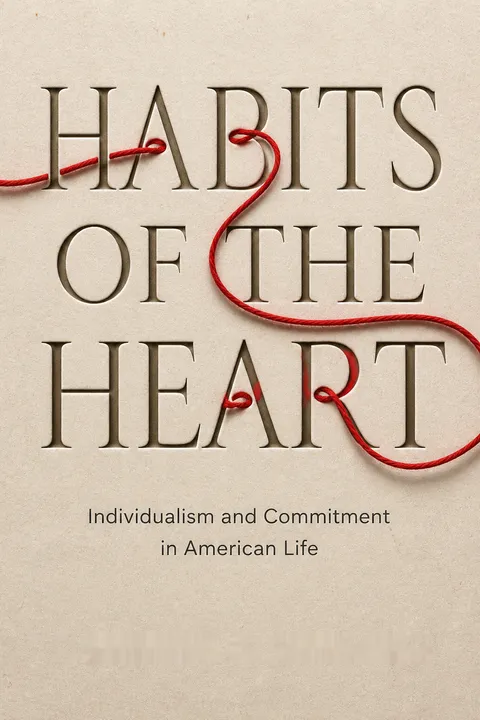
Habits of the Heart examines American individualism and community through interviews with middle-class white Americans. Reviewers note the book's critique of therapeutic culture and materialism, advocating for communal integration through religion and civic engagement. Many praise its sociological insights and relevance to contemporary issues, though some criticize its repetitive, dry writing and limited sample excluding minorities and non-middle-class perspectives. Critics found it boring and overly focused on white suburban America. Supporters value its analysis of individualism's costs and call for renewed civic participation, drawing on Tocqueville's observations to diagnose modern American society's tensions between autonomy and meaningful connection.
People Also Read



About the Author



Download PDF
Download EPUB
.epub digital book format is ideal for reading ebooks on phones, tablets, and e-readers.








































