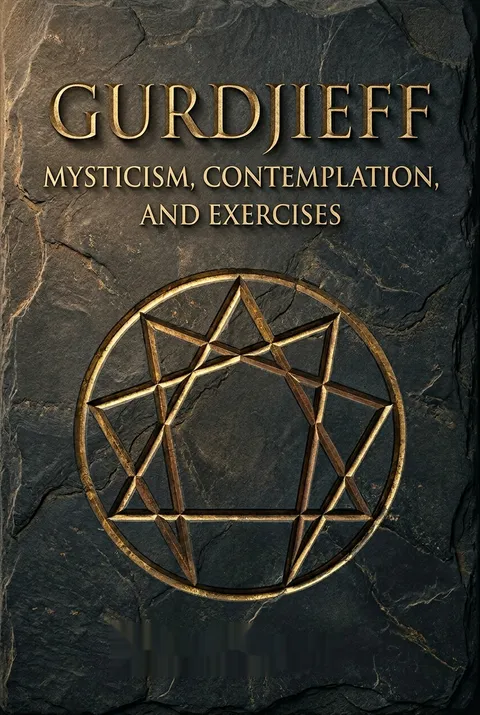

Key Takeaways
1. Gurdjieff's Enigmatic Teaching: A Deliberate Challenge
He by no means wanted to make it easy for people to become acquainted with his ideas. On the contrary he considered that only by overcoming difficulties, however irrelevant and accidental, could people value his ideas.
Purposeful obscurity. Gurdjieff intentionally shrouded his life and teachings in mystery, mixing fact with myth and employing complex, sometimes contradictory, language. This was not to confuse, but to filter out the merely curious and engage only those "serious" students willing to exert genuine effort to penetrate his meaning. He believed knowledge gained without struggle held little value.
Beyond conventional labels. Gurdjieff resisted easy categorization, often being labeled a "charlatan" or "magician" rather than a religious teacher. His system, the "Fourth Way," claimed to integrate practical elements from the Fakir (body), Monk (feeling), and Yogi (mind) paths, offering a unique approach to spiritual advancement compatible with various traditions but beholden to none. He saw himself as presenting "esoteric Christianity," "esoteric Islam," or "esoteric Buddhism" depending on the context.
A mosaic of influences. Gurdjieff's background was a rich tapestry of Greek, Armenian, Russian, and Turkish cultures, with extensive travels across Asia. He drew from diverse sources like Sufism, Tibetan monasteries, and Mount Athos, adapting elements into his distinctive system of ideas, music, and movements. His personal charisma and demonstrated abilities in healing, trance, and telepathy further contributed to his enigmatic persona.
2. The Human Condition: Sleep and the Disconnected Self
Man has no permanent and unchangeable I. Every thought, every mood, every desire, every sensation, says “I.”
A state of "waking-sleep." Gurdjieff taught that ordinary humans live in a state of "sleep," believing themselves to be conscious and unified, but in reality, they are mechanical, fragmented beings. This "sleep" prevents objective perception of self or reality, leading to a life driven by automatic reactions rather than conscious choice.
The fragmented "I." Instead of a single, coherent "I," individuals are a "plurality" of contradictory "I"s, each fleetingly claiming identity. This internal disunity means humans cannot truly "do" anything consciously, as their actions are merely mechanical responses. The goal of Gurdjieff's work is to develop a "real I" and a unified will.
Features of "sleep." This unconscious state is characterized by several phenomena that waste energy and hinder development:
- Identification (attention riveted, no self-awareness)
- Internal considering (obsession with others' opinions)
- Imagination and daydreaming (uncontrolled fantasy)
- Negative emotions (anger, hatred, depression, seen as diseases)
- Lying, unnecessary talking, excessive formatory thinking
3. Cosmic Purpose: Man as a Transformative "Food Factory"
The human organism represents a chemical factory planned for the possibility of a very large output.
Universe as a living organism. Gurdjieff's cosmology posits a "Great Universe" that is a vast, interconnected system of living cosmoses, from the "Most Holy Sun Absolute" (God's abode) down to Earth and the Moon. This entire system, called "Trogoautoegocrat," sustains itself through a process of reciprocal feeding and transformation of substances.
God's existential need. The universe was created not out of desire, but out of necessity: the Sun Absolute was diminishing, and creation was a means to nourish and maintain it. This process involves a dynamic movement from cosmic unity to plurality, governed by the "Law of Three" (active, passive, neutralizing forces) and the "Law of Seven" (octave of development with critical intervals).
Man's unique role. Humans are "different formulas" from animals, possessing the potential to "coat and crystallize" higher-being-bodies (soul and spirit) within their physical form. The human organism acts as a "chemical factory" that processes three types of "food"—solid nourishment, air, and impressions—transforming coarser substances into finer "hydrogens" essential for spiritual evolution and contributing to the cosmic maintenance.
4. The Fourth Way: A Path of Conscious Evolution "In Life"
The evolution of man is the evolution of his power of doing.
Beyond traditional paths. Gurdjieff presented the "Fourth Way" as a unique path of conscious evolution, distinct from the ways of the Fakir (body), Yogi (mind), or Monk (feeling). Unlike these, which often require withdrawal from the world, the Fourth Way is meant to be practiced "in life," within the conditions of one's ordinary existence, integrating work on all three centers simultaneously.
The aim of "doing." True "doing" for Gurdjieff means consciously achieving a "projected aim," rather than merely reacting mechanically. In their ordinary state, humans "can do nothing," but through self-work, they can develop a permanent, individual will. This evolution involves transforming one's being to perceive objective reality and serve higher purposes.
Five being-obligolnian-strivings. Gurdjieff outlined five duties for humanity, emphasizing conscious development and service:
- Physical health
- Constant self-perfection of being
- Knowledge of World-creation and World-maintenance laws
- Paying for one's existence and individuality
- Assisting the perfecting of other beings, "helping God"
5. "Self-Remembering": The Core Practice for Inner Unity
If a man . . . tries to remember himself, every impression he receives while remembering himself will, so to speak, be doubled.
Integrating the fragmented self. "Self-remembering" is the foundational practice in Gurdjieff's system, aiming to unify the disparate "I"s within an individual. It involves simultaneously being aware of what one is doing and the fact that one is conscious of oneself, creating a "doubled" impression of experience.
Separation of individuality. This practice facilitates a crucial separation between one's true individuality and the mechanical workings of the human organism. By consciously observing oneself—not just mentally, but with integrated awareness of mind, feeling, and sensation—one begins to overcome identification and internal conflicts.
Gateway to higher consciousness. Self-remembering is the "first conscious shock" in the human "food factory," enabling the organism to refine the "food of impressions" and absorb higher "hydrogens." This process connects the lower centers with the higher emotional and intellectual centers, leading to "self-consciousness" (the third state) and eventually "objective consciousness" (the fourth state, akin to mystical experience).
6. The Evolution of Gurdjieff's Exercises: From Tasks to Contemplation
I was then already convinced of the impossibility of exactly explaining and fully formulating in words the various fine points of the procedures of any intentional experiencings and exercises for the purpose of self-perfection.
Early methods: tasks and disciplines. Gurdjieff's initial teaching in Russia (1915-1917) focused on "tasks" like mental arithmetic with names, relaxation, sensing exercises, and the "Stop Exercise." These were primarily aimed at occupying the mind, controlling attention, and breaking automatism, often performed in daily life rather than secluded contemplation. Orage later formalized these into "Psychological Exercises" and "On Dying Daily."
Shift to "Transformed-contemplation." After his near-fatal car accident in 1924 and disappointment with Ouspensky's failure to publish his ideas, Gurdjieff began to formalize "contemplation-like exercises." He introduced terms like "Transformed-contemplation" and "Aiëssirittoorassnian-contemplation" in his writings (1930s), explicitly stating their necessity for assimilating higher substances and coating the soul.
Necessity of seclusion. While the Fourth Way emphasized "in-life" work, Gurdjieff increasingly recognized the need for periods of quiet withdrawal. He found that people struggled to awaken in the social domain alone, leading him to introduce exercises to be done in a "special state" of calm, allowing for deeper inner work and the experience of states that could then be recalled in daily life.
7. Hesychasm: The Hidden Source of Gurdjieff's Contemplative Methods
A monk kneels or stands in a certain position and, lifting his arms, which are bent at the elbows, he says—Ego aloud and drawn out while listening at the same time where the word “Ego” sounds.
Athonite influence. Gurdjieff's contemplative exercises show striking parallels with the Hesychast tradition of Mount Athos, particularly the "Prayer of the Heart" and the "Jesus Prayer" as described by Nicephorus the Solitary in the Philokalia. Gurdjieff, who identified as Greek and likely studied in Athens, was familiar with Orthodox monasticism.
Direct adaptations. The similarities are too precise to be coincidental:
- "Ego" Exercise: Gurdjieff explicitly attributed an "Ego" (I am) exercise, involving sensing where the word sounds in the body, to Mount Athos monks.
- Assisting Exercises: His First and Second Assisting Exercises (from Life Is Real) mirror Nicephorus's instructions for the Jesus Prayer and Prayer of the Heart, involving conscious breathing, mental focus on the breast/solar plexus, and internal repetition.
- Counting and Beads: The use of rosary beads for counting prayers in The Way of a Pilgrim (popular in Gurdjieff's Russia) aligns with Gurdjieff's "Soil Preparing Exercise" and his use of chaplets for sensing.
Bridging the sacred and secular. Gurdjieff adapted these monastic techniques, often replacing overtly religious phrases with his own terminology ("I am" for "Lord have mercy") and integrating them into his secular-facing system. This suggests a deliberate effort to make profound spiritual practices accessible to a modern, non-monastic audience, while retaining their core efficacy.
8. "Transformed-Contemplation": Cultivating Higher Substances for the Soul
The substances needed both for coating and for perfecting the higher-being-body Kesdjan enter into their [i.e., humanity’s] common presences through their, as they say, “breathing,” and through certain what are called “pores” of their skin.
Beyond ordinary impressions. "Transformed-contemplation" is Gurdjieff's unique term for internal practices designed to assimilate, transform, and "coat" sacred cosmic substances within the body. These substances, finer than ordinary food or air, are crucial for developing the "higher-being-body Kesdjan" (soul) and ultimately achieving immortality.
Conscious intention and three-centered work. The process requires "cognized intention on the part of all their spiritualized independent parts"—meaning the simultaneous, conscious engagement of intellect, feeling, and sensation. This three-centered attention allows for the reception of higher impressions and the efficient metabolism of subtle "hydrogens" from the air.
Examples of cultivation:
- Air ingestion: Exercises like "Make Strong! Not Easy Thing" focus on consciously inhaling "I" and exhaling "am," imagining a part of the air remaining and flowing to specific body parts.
- Atmosphere control: The "Atmosphere Exercise" involves representing a personal atmosphere, preventing thoughts from escaping, and consciously drawing this collected energy inward.
- Emanation absorption: The "Four Ideals Exercise" involves drawing in "higher substances" formed from the emanations of believers praying to sacred figures (Christ, Buddha, Muhammad, Lama).
9. The "Preparation": A Daily Ritual for Conscious Living
In the morning when you wake up, do the same thing: immediately make a program, think, suggest to yourself how you will spend your day; do the same work as when you relax yourself. Your activity will double.
Foundation of daily work. The "Preparation" is a comprehensive morning ritual, developed by Gurdjieff in his later years, designed to establish a conscious state before engaging with the day's activities. It serves as a "DO" note in the "Law of Seven" octave, setting a trajectory for conscious living.
Structured inner work. The Preparation typically involves:
- Posture and Relaxation: Adopting a stable, comfortable posture, consciously relaxing all muscles (large, medium, small), and quieting thoughts and feelings.
- Sensation and Feeling: Systematically sensing the entire body, part by part, to achieve a "total sensation," then connecting this with a conscious awareness of one's feeling.
- Conscious Breathing: Observing the breath without interference, becoming aware of "special elements" from the air, and sensing their mingling and flow within the body.
- "I Am" Affirmation: Concluding with the affirmation "I am," often repeated silently, murmured, and voiced, connecting it to feeling in the solar plexus and sensation in the spine.
- Planning for the Day: Making a conscious program for the day, including specific "appointments" to remember oneself, to carry the collected state into ordinary life.
Bridging inner and outer. The Preparation aims to create a "special state" of collectedness and self-awareness that can then be maintained and tested in the social domain. It is a deliberate effort to counter the automaticity of daily life, allowing for conscious choice and action rather than mechanical reaction.
10. The "I Am" Affirmation: Unifying Being and Will
I am—when you say “I” you feel the three centers. When you say “am,” you feel also the three centers but differently. “I,” it is as if something stood up. “Am,” it is as if, in the three centers something sat down.
Central to self-realization. The affirmation "I am" is a cornerstone of Gurdjieff's contemplative exercises, serving as a direct means to access and unify one's fragmented "I." It is not a mere intellectual statement but an invocation meant to engage all three centers—intellect, feeling, and sensation—simultaneously.
Variations and applications. Gurdjieff taught numerous "I am" exercises, often linking the affirmation to conscious breathing ("I" on inhale, "am" on exhale) and directing the resulting "reverberation" or "echo" to specific body parts like the solar plexus or spine. This practice aims to:
- Ground presence: Establish a tangible sense of one's own existence.
- Heal disharmonies: Direct conscious energy to alleviate physical or emotional imbalances.
- Influence others: Project conscious wishes and emanations towards others, fostering love and respect.
Beyond self-suggestion. While involving an element of "self-deception" (constructive imagination), the "I am" affirmation is intended to bypass ordinary consciousness and implant a "reasonable indication" in the subconscious, leading to genuine inner change. It is a "conscious labor" that, when practiced consistently, gradually crystallizes a "real I" and a unified will.
11. The Four Ideals: Accessing Universal Spiritual Energies
We choose four ideals: Muhammad, Christ, Buddha, Lama. We represent that their essence exists somewhere in space, in a place situated above the country where they lived.
Objective spiritual reservoirs. This advanced exercise, taught by Gurdjieff to George Adie, posits the existence of "reservoirs of substances" in space, formed by the collective emanations and prayers of believers directed towards their respective "Ideals." These Ideals (Christ, Buddha, Muhammad, Lama) are understood to be real, existing entities, though too distant for direct contact by unprepared individuals.
Ingesting higher substances. The exercise involves establishing a conscious connection, like a "thread," between specific limbs of the exercitant's body and these spiritual reservoirs. Each limb is assigned to an Ideal:
- Right arm: Muhammad
- Right leg: Buddha
- Left arm: Christ
- Left leg: Lama
The exercitant then "sucks" or "attracts" the concentrated substances from these foyers into the corresponding limbs, which become "accumulators fully charged."
Assimilation and transformation. The second part of the exercise involves consciously breathing in air and drawing the accumulated substances from the limbs into the breast, mixing them with the incoming air, and then "pouring" them into the sex organs. This process is followed by the "I am" affirmation, with "I" centered in the solar plexus and "am" in the vertebral column, and a period of quiet assimilation to prevent the results from being lost. This exercise is a powerful example of Gurdjieff's esoteric anthropology and cosmology in practice.
12. Gurdjieff's Legacy: A Mystical System in a Secular World
Behind real I lies God.
A mystic in secular guise. Gurdjieff, fundamentally a mystic, navigated the tension between his spiritual aspirations and the secularizing world of the 20th century. His system, while often presented in scientific or psychological terms, ultimately aimed at a direct experience of "God" or "Ultimate Reality" through the development of a "real I" and objective consciousness.
Paradoxical development. His initial reluctance to use contemplative methods, viewing them as monastic and potentially weakening, evolved into a full embrace of "Transformed-contemplation." This shift, partly driven by the perceived ineffectiveness of "in-life" methods alone and the influence of pupils like Orage, led him to adapt esoteric Christian (Hesychast) techniques, making his later teaching more overtly religious.
An unfinished, living tradition. Gurdjieff deliberately left his Third Series unfinished and his teachings fragmented, compelling his pupils to "struggle" and "exchange" to complete their understanding. His exercises, passed down through a few trusted students like Jeanne de Salzmann and George and Helen Adie, represent a unique synthesis of Eastern and Western spiritual practices, designed to awaken humanity to its true potential and cosmic purpose.
Download PDF
Download EPUB
.epub digital book format is ideal for reading ebooks on phones, tablets, and e-readers.








































