

Key Takeaways
Consciousness isn't ancient biology; it's a learned trick barely 3,000 years old
The startling core thesis. Julian Jaynes argued that human introspection, the inner mental theater where a felt self weighs options, is not innate hardware but a cultural invention taught through language, emerging roughly around 1000 B.C.E. Before that, Jaynes claimed, people could speak, perceive, learn, and solve problems while lacking any inner mind-space to reflect within.
The crucial definition. Most critics misfire because they equate consciousness with being awake or aware. Jaynes meant something narrower: the introspectable inner space populated by an imagined self. He identified its features, including spatialization (turning time into imagined space), narratization (seeing your life as a story), and an analog self that moves through this mental landscape. Strip these away and you get a functioning human who is nonetheless not conscious in Jaynes's precise sense.
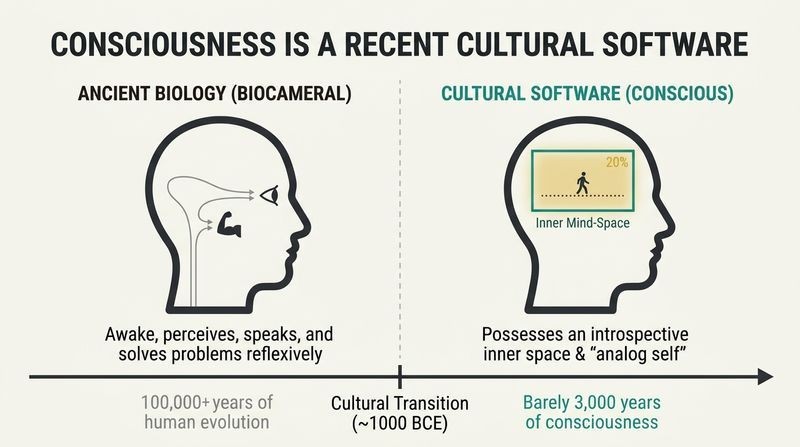
What's striking is how much resistance the theory triggers before it's understood. Nolan Bushnell's observation that a clear simple falsehood beats a true complexity applies here: people prefer the tidy assumption that minds were always like ours. Modern neuroscience partly vindicates Jaynes, with research showing consciousness handles far less of cognition than assumed, echoing Kahneman's System 1 and System 2 split. The theory's genius is falsifiability: Jaynes staked precise claims that archaeology and neuroimaging could test. Its vulnerability is that so much rides on interpreting ancient texts, where absence of evidence (no mind-words) is read as evidence of absence.
Before self-reflection, people obeyed hallucinated voices they called gods
The bicameral mind. Jaynes proposed that pre-conscious humans had a two-chambered mentality: one part issued commands experienced as auditory hallucinations, the other simply obeyed. Under stress or novel decisions, where a modern person would deliberate internally, bicameral people heard a voice, attributed to a god, dead king, or ancestor, telling them what to do. There was no inner argument, only command and compliance.
The neurological model. These voices, Jaynes suggested, originated in the right temporal lobe (in areas mirroring the left hemisphere's Broca's and Wernicke's speech regions) and were transmitted across the anterior commissure to the language-dominant left hemisphere. Wilder Penfield's brain surgeries supported this: electrically stimulating these normally silent right-hemisphere regions in awake patients often produced hallucinated voices, frequently admonitory and attributed to dead relatives or authority figures.
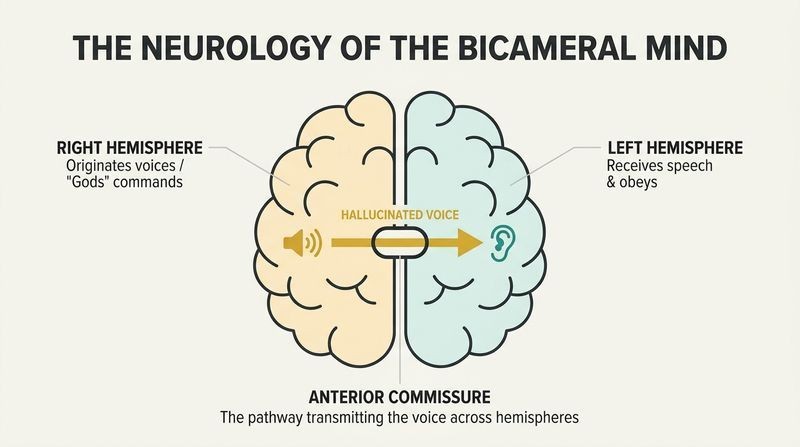
The auditory hallucination piece is what most tempts scholars to discard, as Daniel Dennett openly wished. Yet it may be the theory's most durable prediction. Since 1999, neuroimaging has repeatedly shown right/left temporal lobe interaction during verbal hallucinations, and the Hearing Voices Network has documented that voice-hearing is far more common in the general population than psychiatry assumed. The command-and-comment character of these voices matches Jaynes's forecast precisely. The steelman: if voices once organized whole societies, schizophrenia and command hallucinations become vestiges rather than pure pathology, which reframes mental illness as partial reversion to an ancestral operating system rather than mere broken wiring.
Compare the Iliad and Odyssey to watch the mind change
A window into vanished mentality. In the oldest strata of Homer's Iliad, Jaynes found no vocabulary for inner mental life. Words later meaning soul or mind carried only concrete bodily senses: psyche meant breath, thumos meant the surging agitation of limbs, noos meant mere perception. Achilles and Agamemnon do not deliberate; gods intervene at every crisis and the heroes obey, like will-less instruments of divine command.
The transition made visible. The Odyssey, composed perhaps a century later, reads entirely differently. Wily Odysseus schemes, deceives, and wanders using his own cunning in a world where gods have grown feeble. Jaynes traced the same shift in Hebrew scripture, from prophets declaring "thus spake the Lord" to the reflective doubt of Ecclesiastes, and dated the first explicit call to introspection to Solon's "know thyself."
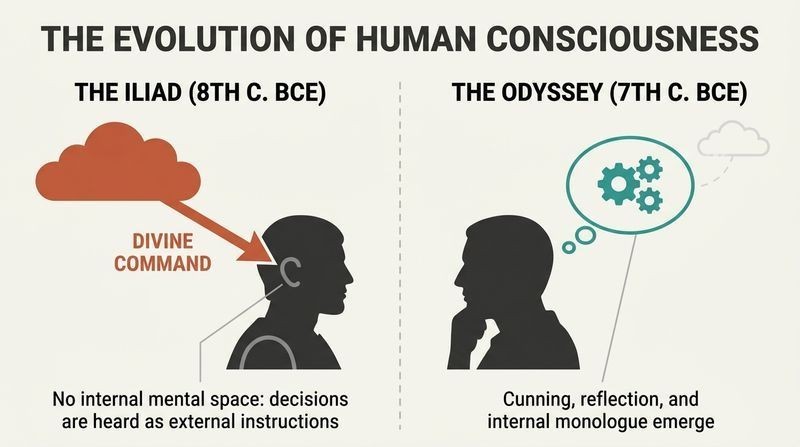
The philological method is Jaynes's most testable and most contested move. Classicists like Bruno Snell and E.R. Dodds independently noticed that Homeric man lacks a unified concept of self, lending outside support. The vulnerability: literary conventions could explain sparse mind-language without any change in actual mentality, and dating Homeric layers is notoriously fraught. Still, the parallel evolution across independent traditions (Greek, Hebrew, and arguably Chinese with Confucius, Indian with the Upanishads) is harder to dismiss as coincidence. Karl Jaspers called this window the Axial Age, when the world's major religions and philosophies erupted almost simultaneously, a synchrony Jaynes's theory explains as the aftermath of a shared cognitive rupture.
Idols, tombs, and god-houses were technology for hearing the dead
Reading archaeology through voices. Jaynes reinterpreted otherwise baffling ancient practices as machinery for triggering hallucinated guidance. At the Natufian settlement of Eynan (around 9000 B.C.E.), a dead king was propped upright on stones facing a mountain, presumably still heard giving commands. Later cultures buried the dead beneath house floors, plastered and displayed skulls, and built monumental god-houses where no human lived and no grain was stored.
The staring idols. Statues from Tell Asmar and eye-idols from Tell Brak feature grotesquely enlarged eyes, some reaching 20 percent of head height versus the normal 10 percent. Jaynes read these as aids to hallucination: eye-to-eye contact with an authority figure heightens the sense of being commanded. Cuneiform texts, Spanish accounts of Inca statues speaking, and the biblical teraphim all describe idols that literally spoke.
This is where Jaynes turns a psychologist's eye into an archaeologist's, and the reframe is genuinely illuminating. Anthropology's default explanation, ancestor worship to legitimize land claims, struggles to explain why the practice appears among pre-agricultural hunter-gatherers, as James Whitley noted. Jaynes offers a cleaner mechanism: mortuary elaboration was about maintaining the voice, not venerating the corpse. The eye-idol argument connects to real cognitive science, since the human brain has dedicated circuitry for gaze detection and direct eye contact measurably increases arousal and perceived authority. The risk is over-reading: not every large-eyed statue served hallucination, a caveat Jaynes himself acknowledged.
Bicameral societies were rigid, so they shattered when worlds collided
Why the voices fell silent. Jaynes listed converging causes for consciousness emerging around 1200 to 1000 B.C.E.: the spread of writing (commands frozen on clay could be ignored in ways living voices could not), the inherent fragility of hallucinatory control, the collision of peoples with incompatible gods, and the survival value of deceit. Bicameral theocracies functioned only when life was predictable and everyone marched to the same divine drummer.
The Bronze Age collapse. Around 1200 B.C.E., roughly fifty major cities across the eastern Mediterranean were burned and never rebuilt. Historians Robert Drews and Eric Cline surveyed candidate causes: earthquakes, drought, iron weapons, migrations, raiders. Each fails alone. Cline concluded it was a systems collapse. Bill Rowe argues Jaynes supplies the missing ingredient: a cognitive inflexibility that left god-run societies unable to adapt, so even a small shock cascaded into total breakdown.
The systems-collapse convergence is intellectually satisfying because it reframes a historical mystery. Complexity theory describes tightly coupled systems poised near tipping points where any perturbation triggers cascade, exactly Cline's framing for the interconnected Bronze Age. Jaynes's contribution is to locate the fragility inside human cognition rather than only in trade networks or bureaucracy. The provocative implication: consciousness itself was a survival adaptation selected for during chaos, favoring individuals who could improvise, deceive, and self-direct when the gods went quiet. This inverts the usual story of consciousness as humanity's crowning glory; here it is a trauma response, born of refugees and rubble.
Watch children learn consciousness the way our ancestors did
Two origins, one process. Bill Rowe argues consciousness has two births: one in history we can barely glimpse, one in childhood we can watch unfold. Developmental psychology shows that theory of mind, the ability to attribute beliefs, desires, and false beliefs to others and oneself, reliably emerges around ages 3 to 5, with children passing the false-belief test consistently only after age 6. The Catholic Church set the age of reason at 7.
Culture shapes the timeline. Chinese children develop executive skills (impulse control, working memory) earlier than American children because more is expected of them, yet acquire theory of mind on the same schedule. This suggests executive function precedes and enables theory of mind, and that mental-state understanding is a socially taught skill, not innate unfolding, mirroring Jaynes's claim that consciousness is learned generation by generation.
Grounding a historical theory in replicable child studies is a shrewd methodological move, converting untestable speculation into observable science. The parallel is suggestive rather than conclusive: ontogeny need not recapitulate phylogeny, a nineteenth-century assumption long discredited in biology. Yet the finding that theory of mind requires social scaffolding (children with more older siblings develop it faster) genuinely supports the cultural-transmission thesis. Rowe's provocative aside about autism is worth weighing carefully: autistic individuals master nouns and verbs yet struggle with mental-state language, demonstrating that language and consciousness can dissociate. This is precisely the separation Jaynes needs, showing sophisticated language without introspective self-modeling is neurologically possible.
Metaphor doesn't decorate thought; it builds the mind itself
Consciousness as a metaphor-generated model. Jaynes argued the inner mental world is constructed entirely from metaphors drawn from the physical world. The verb "to be" descends from Sanskrit bhu, "to grow"; "am" traces to a root meaning "to breathe." Abstract words are worn-down concrete images. We build an analog mind-space the way a map represents territory, then place an imagined self inside it.
Extending the rhetoric of I.A. Richards. Ted Remington shows Jaynes advanced the metaphor theory of rhetorician I.A. Richards. Where Richards named a metaphor's parts (vehicle, tenor, ground), Jaynes added the paraphier and paraphrand: the associations we map from a familiar image onto something new, generating fresh meaning. "The snow blankets the earth" imports warmth, sleep, and coziness, quietly personifying the earth as a slumbering body. Crucially, metaphor does not describe pre-existing likeness; it creates it.
The claim that metaphor is generative rather than ornamental has become mainstream through Lakoff and Johnson's work on conceptual metaphor, which independently confirmed that abstract reasoning (time as space, argument as war, affection as warmth) rests on bodily-grounded metaphor. Jaynes anticipated this by decades. The deeper move is treating the self, the "I," as itself a metaphor, a virtual entity with no referent beyond the linguistic process that generates it. This resonates with Buddhist analyses of the self as constructed, and with Dennett's later view of the self as a "center of narrative gravity." If the I is a paraphrand, self-knowledge becomes interpretation, not observation.
Most of your mind runs without you, and that's normal
Interiority is a tiny sliver. Brian McVeigh, a student of Jaynes, prefers the term "interiority" for consciousness: the belief in a mental space inside the head where a self moves and events transpire. His key point is that we mistake this sliver for the whole mind. Roughly eleven million bits of sensory information reach us each second; conscious awareness handles perhaps forty bits, by some estimates a millionth of sensory input.
Reactivity, not perception. McVeigh relabels nonconscious processing "reactivity" and lists six intellectual barriers that block understanding of Jaynes: the vagueness of the word consciousness, conflating it with perception, confusing it with reasoning, assuming cognition is mainly conscious, failing to be astonished that interiority exists at all, and ignoring history as evidence. The real mystery is not why the unconscious exists but why interiority exists, since most sophisticated thinking (the chess master's calculation, the tennis champion's anticipation) happens invisibly.
The information-reduction figures are worth scrutinizing, since bit-rate estimates vary wildly by methodology, but the qualitative point is bulletproof and well established: reading this sentence, you are unaware of the visual processing, syntactic parsing, and memory retrieval making comprehension possible. McVeigh's diagnostic value is clinical. By naming the specific confusions (perception is not introspection, reasoning is not introspection), he explains why intelligent people talk past Jaynes. His proposed replacement of Cartesian dualism with a triad (conscious mind, nonconscious mind, body) tracks the cognitive-science consensus that awareness is the exception, not the rule. The humbling upshot: the feeling of being in control of your actions is, as research on automaticity suggests, substantially an after-the-fact illusion.
Poets hearing muses and mystics hearing gods are running old software
Inspiration as vestige. Judith Weissman argued that poetry born from commanding voices has survived twenty-five centuries of philosophical attack because the capacity to hallucinate authoritative voices is built into our evolutionary inheritance. Plato disparaged poets as inspired but uncomprehending, like oracle-chanters. From Homer to Blake to Yeats, poets have claimed voices dictated their verse, and Jaynes explains why: the gods once spoke in verse, so most people once heard poetry composed within their own minds.
Voices across cultures. Weissman collected commanding voices enforcing ethical codes worldwide: Delphic oracles giving clear commands, the Ugandan Ik's last voice-hearer tending gardens by ancestral rule, the Saramaka of South America calling their apukus. Roughly 71 percent of a college population reported at least a brief encounter with voices, and children's imaginary companions often speak in remembered voices, all consistent with widespread residual bicamerality.
The cross-cultural sweep is the strongest evidence and the weakest link simultaneously. That voice-hearing appears in every documented society, with schizophrenia showing similar incidence among Bering Sea Eskimos and Nigerian Yoruba as in the West, does argue for a biological substrate rather than pure cultural artifact. Yet Weissman's frank observation that nearly all voice-hearing poets are male, transmitting patriarchal codes, complicates any neat evolutionary story, since it suggests the tradition is also shaped by who holds social authority. The generous reading: inspiration and schizophrenia share a mechanism, which both destigmatizes mental illness and demystifies creativity, though it also limits what voices can offer, since they can only repeat inherited codes, never invent genuinely new ones.
Ancient dreams delivered spoken visitations; modern dreams became silent theater
Dreams changed across history. Robert Atwan traced a shift in how dreams work. In Homer's Iliad, dreams are auditory visitations: a god or trusted figure stands at the sleeper's head and delivers a message, nearly identical to a waking bicameral hallucination except for sleep. Agamemnon's false dream, sent by Zeus in Nestor's likeness, is prototypical: a voice at the head, a command, no internal action.
From ear to eye. By the fifth-century Greek tragedies, dreams became predominantly visual, symbolic, and participatory. The dreamer acts within the dream rather than passively receiving a voice, as in Atossa's vivid allegorical dream in Aeschylus's The Persians. This mirrors Jaynes's claim that the coming of consciousness was a shift from an auditory mind to a visual mind. The Greek word for tragic actor derives from a term meaning "to interpret a dream," linking the birth of theater to the mind becoming an inner stage.
The auditory-to-visual dream transition is an elegant, independently observable prediction that dovetails with the Iliad-Odyssey analysis. E.R. Dodds's scholarship on the "culture-pattern dream" lends support: the message-dream where a single figure appears and speaks was a recognized ancient type, not merely literary artifice. The Freudian objection matters, since Freud insisted dreams think in visual images and dismissed articulate-speech dreams as artificial, which if true would undercut the historical reading. But Jaynes's framework suggests Freud was describing the modern conscious dream and universalizing it. The idea that theater arose as an externalization of the newly interiorized mind, the dream as private drama becoming public spectacle, is a haunting cultural hypothesis.
Tibet's mind-words shifted from body to soul as subjectivity grew
Tracking mentality through etymology. Todd Gibson applied Jaynes's philological method to Tibetan, watching words migrate from concrete bodily meanings toward subjective ones, a red flag against "katachronism" (imposing modern meanings onto ancient words). The word glo, once meaning lungs and breath-linked feelings, became blo, meaning pure intellect. The word thugs, now an honorific for mind, traces back through funeral practices to a war-and-burial banner embodying ancestral power, likely borrowed from the Turko-Mongol tuq.
Kings, mountains, and voices. Gibson connected the Tibetan sacral kingship to Jaynes. The sku bla, tied to sacred mountains, protected the emperor when "gnyan po." That puzzling adjective, translated variously as fierce, exalted, or mighty, resolves neatly if read via its homonym nyan, "to hear": the sku bla was the bicameral voice guiding the king, and the object that stimulated it. The State Oracle of Tibet, still delivering garbled verse commands through a possessed medium, has outlasted Delphi by eighteen centuries.
Testing a theory built on Greek and Near Eastern data against an unrelated civilization is exactly the falsification exercise good science demands, and the Tibetan material fits with surprising cleanliness. The recurring pattern (semantic shift plus slight spelling change: glo/blo, thug/thugs, bla/lha, gnyan/nyan) is either powerful corroboration or seductive pattern-matching, and Gibson is admirably candid about which. The Tibetan case also refines Jaynes: since Tibet became literate and imperial only in the seventh century C.E., its bicameral vestiges survived far longer than in the Mediterranean, suggesting the transition to consciousness was gradual and uneven, not a single global switch. The State Oracle offers the rare gift of a living institution to observe rather than merely reconstruct from texts.
An 18th-century philosopher glimpsed the same mental revolution Jaynes described
Vico anticipated Jaynes. Robert Haskell showed that Giambattista Vico (1668-1744), in his New Science, described early humans as "all body and almost no reflection," who heard thunder as an angry god Jove and spoke in poetry that was "the language of the gods," centuries before Jaynes, and without either knowing of the other. Both held that humans were not always conscious, that consciousness arose from culture and language, that metaphor is a fundamental cognitive operation rather than mere ornament, and that Homer was a collective tradition, not one author.
Convergent conclusions. Both traced the evolution of language parts (nouns before verbs, imperatives first), both saw religion originating in early mentality, and both located the birth of self-reflection in the same window of ancient history. Where Vico invoked divine Providence, Jaynes stayed strictly materialist, refusing what he called metaphysical imposition.
Independent convergence across 250 years and utterly different intellectual worlds is one of the more persuasive arguments for a theory's validity, akin to two explorers mapping the same coastline from opposite directions. Vico's obscurity in his own time and Jaynes's controversy in his both illustrate how ideas that violate the reigning assumption (that minds have always been the same) get marginalized regardless of merit. The comparison also exposes the theory's central fork: the same evidence that led the devout Vico to Providence led the empiricist Jaynes to neuroscience. This is worth sitting with, since it suggests the historical-mentality data underdetermines the metaphysics, and readers must supply their own.
Analysis
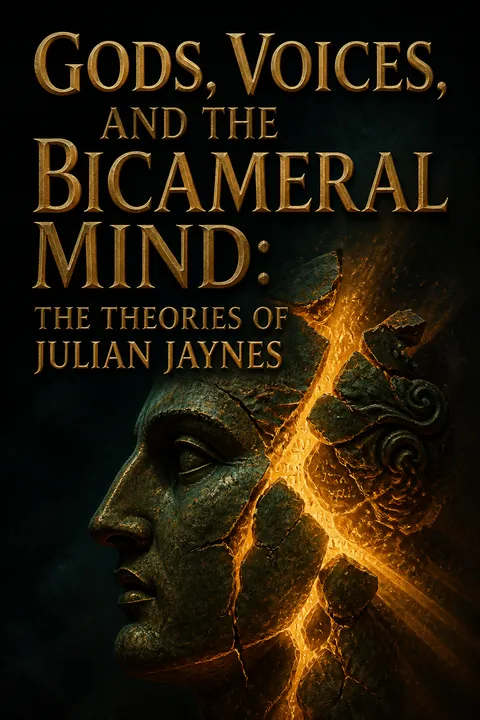
This anthology, edited by Marcel Kuijsten, is not Jaynes's 1976 original but a collection of scholars extending, testing, and applying his theory across neuroscience, classics, anthropology, rhetoric, Tibetology, and developmental psychology. That structure is both its strength and its summarizing challenge: there is no single argument to compress, but rather one radical hypothesis refracted through many disciplines, each contributor assuming familiarity with the core claim.
The theory's fate hinges almost entirely on Jaynes's narrow definition of consciousness as introspectable mind-space, not wakefulness or perception. Nearly every dismissal in the literature, as Brian McVeigh catalogs, stems from ignoring this stipulation. Read charitably, Jaynes made an unusually falsifiable claim for a theory of mind, and the intervening decades have been kind to several predictions: neuroimaging confirms right/left temporal interaction during hallucinations, voice-hearing proves common in healthy populations, and consciousness demonstrably handles a fraction of cognition.
The weakest joints are evidentiary rather than logical. Dating Homeric strata, inferring mentality from vocabulary absence, and interpreting archaeological ambiguity all require judgment calls that skeptics can contest. The strong version (a rapid transition around 1000 B.C.E.) is more falsifiable but likely less accurate than the weak version (gradual, overlapping emergence), a tension Jaynes acknowledged.
What makes the theory enduring is its explanatory reach. Hypnosis, religious frenzy, schizophrenia, poetic inspiration, the origin of gods, and the Axial Age's synchronous eruption of philosophy all become facets of one process rather than isolated puzzles. Whether or not the strong thesis survives, Jaynes reopened consciousness as a legitimate scientific and historical question after behaviorism had banished it, and reframed it as learned and cultural rather than fixed at birth. That reframing carries genuine stakes: if consciousness is taught, it can be developed, expanded, and improved across generations rather than passively inherited.
Review Summary
Reviews of Gods, Voices, and the Bicameral Mind are mixed, averaging 3.93/5. Enthusiastic readers praise its fascinating exploration of Jaynes's theory across psychology, archaeology, literature, and philosophy. Critics note significant unevenness among the essays, excessive repetition, and a lack of new evidence or critical exploration. The Tibet-focused entries drew particular criticism for being inaccessible or dull. Most agree the collection is best appreciated by those already familiar with Jaynes's original work, though newcomers can follow along via the recaps provided.
People Also Read





Download PDF
Download EPUB
.epub digital book format is ideal for reading ebooks on phones, tablets, and e-readers.








































